Ankylosing spondylitis (AS) treatment is entering a new phase as biologics, targeted immune therapies, advanced imaging, artificial intelligence, and digital health technologies reshape the way this chronic inflammatory condition is diagnosed and managed.
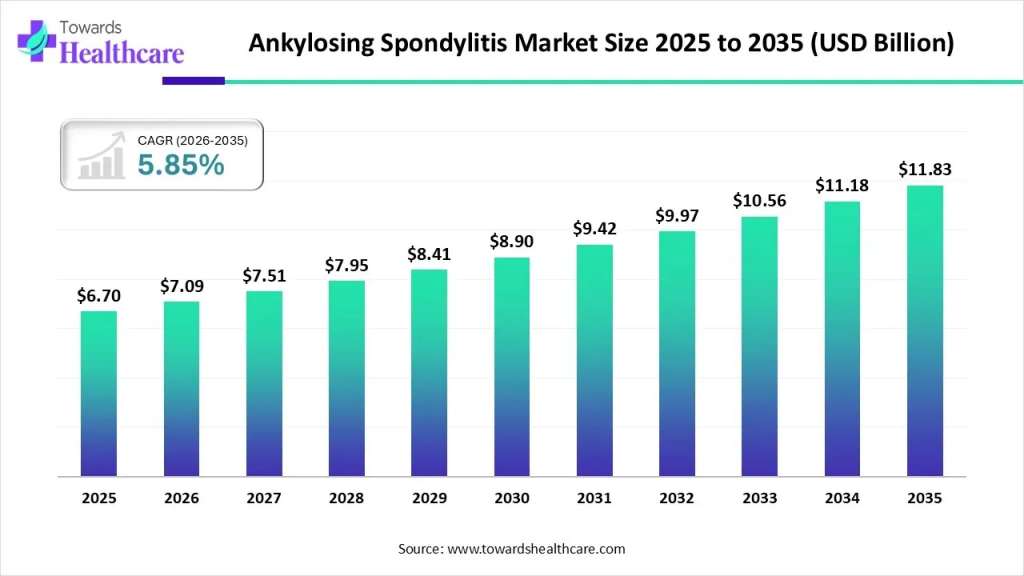
The global ankylosing spondylitis sector was valued at approximately USD 6.7 billion in 2025 and is expected to rise from USD 7.09 billion in 2026 to around USD 11.83 billion by 2035, expanding at a 5.85% CAGR from 2026 to 2035.
The transformation is being supported by growing disease awareness, earlier diagnosis, increasing adoption of biologic therapies, advances in personalized medicine, and continued research into innovative treatment approaches.
Ankylosing Spondylitis Enters a New Treatment Era
Ankylosing spondylitis is a chronic inflammatory disorder that primarily affects the spine and sacroiliac joints. Persistent inflammation can lead to back pain, stiffness, reduced mobility, and, in advanced cases, spinal fusion.
For years, treatment largely focused on managing inflammation and symptoms. Today, physicians have access to a broader range of targeted therapies designed to address specific inflammatory pathways.
TNF inhibitors remain an important treatment option, while IL-17 inhibitors and newer immune-modulating therapies are creating additional choices for patients who require more targeted approaches.
At the same time, improvements in diagnostic imaging and digital monitoring are helping healthcare professionals identify disease activity and follow treatment responses more closely.
Key Highlights
- The global sector was valued at USD 6.7 billion in 2025.
- It is projected to reach approximately USD 11.83 billion by 2035.
- Growth is expected at a 5.85% CAGR between 2026 and 2035.
- North America accounted for approximately 40% of revenue in 2024.
- Asia-Pacific is expected to record the fastest growth, with a CAGR of around 12%.
- TNF inhibitors held the leading position among drug classes, with approximately 45% share in 2024.
- IL-17 inhibitors are expected to experience strong expansion during the coming years.
- Subcutaneous administration represented approximately 50% of revenue in 2024.
- MRI accounted for around 40% of diagnostic revenue.
- Hospitals represented approximately 45% of end-user revenue in 2024.
Biologics Are Changing the Treatment Landscape
Biologic medicines have transformed the management of ankylosing spondylitis by targeting specific inflammatory pathways.
TNF inhibitors such as adalimumab, infliximab, and etanercept work by blocking tumor necrosis factor, an inflammatory protein associated with disease activity.
Another important development is the growing use of IL-17 inhibitors, including secukinumab and ixekizumab. These therapies target the IL-17A pathway and can help reduce inflammation and improve symptoms.
As research progresses, newer immune-modulating therapies could provide additional options for patients who experience inadequate responses or intolerance to existing treatments.
AI Is Making Diagnosis and Monitoring Smarter
Artificial intelligence is beginning to play a greater role in ankylosing spondylitis care.
AI and machine learning can assist in analyzing X-rays and MRI scans, helping physicians identify subtle inflammatory changes and structural abnormalities. These technologies may also support disease monitoring by identifying patterns that are difficult to detect through conventional analysis alone.
Digital health platforms, wearable sensors, and smartphone applications are creating another layer of patient monitoring. These tools can capture information about mobility, stiffness, pain, and daily activity, allowing healthcare professionals to better understand how patients respond to treatment outside clinical settings.
In the long term, combining imaging, patient data, and AI-based analytics could support more individualized treatment decisions.
MRI Remains a Key Diagnostic Tool
MRI continues to play a central role in early ankylosing spondylitis diagnosis because it can identify inflammatory changes that may not yet be visible through conventional X-rays.
Its ability to visualize soft tissues and inflammatory activity makes MRI particularly valuable when physicians suspect early-stage disease.
Meanwhile, digital spine monitoring tools are emerging as an important complementary technology. Wearable devices and mobile applications could make continuous monitoring more practical while reducing the need for frequent in-person visits.
Blood biomarkers and HLA-B27 genetic testing are also contributing to the broader diagnostic approach.
Targeted Therapies Gain Momentum
The treatment landscape is moving toward greater precision.
Instead of relying on a single treatment pathway, physicians can increasingly consider disease severity, inflammatory activity, treatment response, patient characteristics, and other clinical factors when selecting therapy.
This shift toward personalized treatment is encouraging greater research into:
- IL-17 inhibitors
- JAK inhibitors
- Novel biologic therapies
- Biosimilars
- Biomarker-based treatment selection
- Digital disease monitoring
- Emerging cell and gene therapy approaches
Although several of these technologies remain at different stages of development, they demonstrate the direction in which AS treatment is evolving.
Hospitals Lead, but Specialty Clinics Are Expanding
Hospitals currently represent the largest end-user group, supported by advanced infrastructure, multidisciplinary teams, diagnostic capabilities, and access to specialized therapies.
Hospitals also play an important role in clinical research and trials, giving patients opportunities to access innovative therapies under controlled conditions.
Specialty rheumatology clinics, however, are expected to expand rapidly. These centers offer focused expertise in inflammatory diseases and can provide personalized treatment, medication management, rehabilitation, and ongoing monitoring.
The growth of outpatient care could make long-term AS management more convenient for patients.
North America Remains at the Forefront
North America holds a leading position, supported by advanced healthcare infrastructure, pharmaceutical innovation, strong research capabilities, and access to biologic therapies.
The United States remains a major center for AS clinical research. A well-developed clinical trial ecosystem, extensive pharmaceutical R&D capabilities, and strong healthcare spending continue to support innovation.
Canada is also advancing its capabilities through greater awareness of autoimmune diseases, improved diagnostic services, and increasing adoption of targeted treatments.
Asia-Pacific Could Deliver the Fastest Growth
Asia-Pacific is emerging as one of the most promising regions for future expansion.
Several factors are contributing to this momentum, including increasing healthcare expenditure, greater disease awareness, expanding specialty care, improving diagnostic infrastructure, and rising biotechnology activity.
China is strengthening its rheumatology ecosystem while working to improve access to specialized professionals and advanced treatment options.
India is also seeing growing interest in autoimmune disease diagnosis and management. Improvements in healthcare infrastructure, increasing awareness, expansion of specialty centers, and greater access to biologic therapies are creating new opportunities for patients and healthcare providers.
Europe Strengthens Personalized Care
Europe continues to benefit from established healthcare systems, advanced pharmaceutical research, and strong regulatory frameworks.
The region is seeing increased interest in early diagnosis, targeted therapies, biologic medicines, and personalized treatment strategies.
The UK continues to support research through organizations such as UK Research and Innovation and the National Institute for Health and Care Research.
Germany also remains an important pharmaceutical and healthcare hub, supported by strong R&D capabilities and increasing adoption of innovative approaches to inflammatory disease management.
Emerging Opportunities in Latin America and the Middle East
Latin American countries are gradually expanding access to advanced ankylosing spondylitis therapies as diagnostic capabilities and healthcare infrastructure improve.
Argentina, for example, is seeing increasing attention toward biologic treatment and specialty rheumatology services.
The Middle East and Africa also offer opportunities as governments and healthcare organizations invest in modern medical infrastructure. The high cost of biologic therapies remains a challenge, but partnerships and improved healthcare access could help expand treatment availability.
The UAE is particularly active in adopting advanced therapies and strengthening specialized healthcare services.
Competitive Landscape
The competitive environment includes established pharmaceutical companies, biotechnology firms, biosimilar manufacturers, and emerging diagnostic technology developers.
Novartis remains an important player through Cosentyx (secukinumab), an IL-17A inhibitor used for ankylosing spondylitis.
AbbVie has a strong history in immunology, with Humira (adalimumab) serving as an established TNF inhibitor for AS.
Other notable companies include Pfizer, Eli Lilly, Johnson & Johnson, Gilead Sciences, Amgen, Sandoz, Samsung Biologics, and Fresenius Kabi.
Competition is increasingly moving beyond traditional TNF inhibitors toward newer mechanisms of action, oral therapies, biosimilars, precision diagnostics, and digital monitoring technologies.
Recent Industry Developments
In June 2026, Lynk Pharmaceuticals announced the completion of patient enrollment in a Phase III study of zemprocitinib for ankylosing spondylitis. The development represents an important step toward expanding oral treatment options for patients.
In July 2025, Biocon Biologics launched Nepexto, a biosimilar of etanercept, in Australia through a collaboration with Generic Health, supporting broader access to biologic treatment.
In April 2025, Biocad, the Russian National Research Medical University of Pirogov, and the Institute of Bioorganic Chemistry collaborated on the development of Seniprutug, a domestic treatment for ankylosing spondylitis.
What the Next Decade Could Bring
The future of ankylosing spondylitis care will increasingly revolve around early detection, targeted treatment, personalized medicine, and continuous monitoring.
Biologics and small-molecule therapies are expanding treatment choices, while AI-assisted imaging and digital health tools are creating new ways to understand disease progression.
Research into biomarkers could further improve patient selection and treatment decisions. Meanwhile, advances in biotechnology may open the door to new therapeutic approaches that go beyond conventional immune suppression.
With the global sector projected to reach USD 11.83 billion by 2035, the coming decade could bring significant advances in how ankylosing spondylitis is detected, treated, and monitored.
The ultimate goal is becoming clearer: move from managing symptoms to delivering earlier, smarter, and more personalized care that helps patients maintain mobility and quality of life.
About Us
Healthcare WebWire is a part of Towards Healthcare Research & Consulting is a global healthcare market research and consulting firm dedicated to helping businesses make informed decisions through reliable market intelligence and strategic insights. We serve pharmaceutical, biotechnology, medical device, AI in healthcare, cell and gene therapy, digital health, and life sciences organizations with in-depth market research, custom consulting, competitive analysis, and growth forecasts. Our team combines industry expertise with rigorous research to deliver clear, actionable insights that support market expansion, product strategy, investment decisions, and long-term business growth. From emerging innovations to established healthcare markets, we help organizations understand where the industry is today and where it’s headed tomorrow.
Download Customized Sample: https://www.towardshealthcare.com/download-sample/6456
You can place an order or ask any questions, please feel free to contact us at [email protected]
Europe Region – +44 778 256 0738
North America Region – +1 8044 4193 44
APAC Region: +91 9356 9282 04
Visit Our Website: Towards Healthcare Research & Consulting – Expert Consulting Solutions & Research Reports
Find us on social platforms: LinkedIn | Twitter | Instagram | Medium