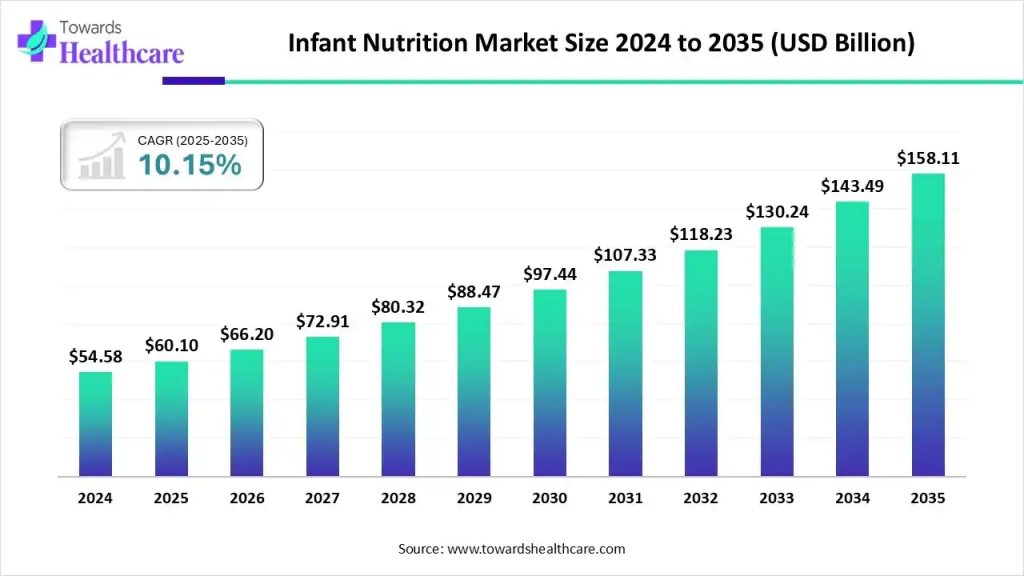
The global infant nutrition market is entering a strong growth phase as parents become more focused on early-life nutrition, product safety, and healthier feeding choices. Valued at around USD 60.1 billion in 2025, the market is projected to reach approximately USD 158.11 billion by 2035, expanding at a 10.15% CAGR from 2026 to 2035.
Growing awareness of infant health, rising female workforce participation, urbanization, higher disposable incomes, and demand for premium nutrition products are reshaping the industry. At the same time, organic ingredients, plant-based formulations, probiotics, human milk oligosaccharides (HMOs), and personalized nutrition are creating new opportunities for manufacturers.
What’s Driving the Infant Nutrition Boom?
Parents today are paying closer attention to what goes into infant food and formula. This has increased demand for products that offer balanced nutrition, clean-label ingredients, and scientifically supported health benefits.
The industry is also moving beyond traditional infant formula. Manufacturers are expanding into fortified cereals, fruit and vegetable purees, growing-up milk, probiotics, omega-3 supplements, and specialized formulas.
Digital commerce is another major growth engine. E-commerce platforms allow parents to compare products, access detailed nutritional information, and order infant nutrition products from home.
Key Market Highlights
- The global infant nutrition market was valued at USD 60.1 billion in 2025.
- It is projected to reach USD 158.11 billion by 2035.
- The market is expected to grow at a 10.15% CAGR between 2026 and 2035.
- Asia-Pacific held the leading regional share at approximately 45% in 2025.
- North America is expected to record strong growth during the forecast period.
- Infant formula accounted for the largest product share, at approximately 63%.
- Cow milk-based products represented the leading ingredient/source segment.
- Powder formulations dominated with around 70% share.
- Supermarkets and hypermarkets remained the leading distribution channel.
- The e-commerce segment is expected to grow rapidly.
- The 0–6 months age group represented the largest share.
From Basic Feeding to Smarter Nutrition
Infant nutrition is evolving into a more specialized and science-driven industry. Products are increasingly being developed around specific nutritional requirements, digestive health, immune support, and developmental needs.
Organic and natural ingredients are gaining popularity, while plant-based formulations are attracting parents looking for alternatives to conventional dairy-based products. Probiotics, DHA, ARA, iron, calcium, vitamins, and HMOs are also becoming important components of premium formulations.
The next phase of growth could come from personalized nutrition, microbiome research, and precision formulation technologies.
AI Is Bringing Personalization to Infant Nutrition
Artificial intelligence is beginning to influence how infant nutritional needs are assessed and managed.
AI and machine learning can analyze nutritional data, identify infants who may require additional support, and help healthcare professionals monitor nutritional responses. These technologies can also assist researchers in developing formulations tailored to specific nutritional requirements.
In March 2025, researchers at Stanford Medicine developed an AI algorithm designed to improve intravenous nutrition for premature babies. The technology was aimed at reducing medical errors and improving the identification of nutritional requirements for vulnerable infants.
Product Trends to Watch
Infant Formula Remains the Core Segment
Infant formula accounted for approximately 63% of the market in 2025. Its widespread availability, convenience, and nutritional composition continue to support demand.
However, the competitive landscape is changing as companies introduce specialized, organic, probiotic-enriched, and premium formulas.
Baby Cereals and Purees Gain Momentum
Baby cereals and purees are expected to experience strong growth as parents increasingly look for minimally processed and nutritious complementary foods.
Fortified cereals, fruit purees, vegetable purees, and convenient snacks are becoming important products during the transition to complementary feeding.
Plant-Based Nutrition Gains Attention
Soy-based and plant-based products are gaining traction as consumers seek alternative ingredients and more diverse nutritional choices.
This segment is also benefiting from growing interest in vegan and plant-forward diets, although infant nutrition remains an area where product formulation, safety, and nutritional adequacy are particularly important.
Powder Still Leads, but Liquid Is Catching Up
Powder formulations accounted for roughly 70% of revenue in 2025, supported by their longer shelf life, easier transportation, and flexible preparation.
Ready-to-feed and liquid products, however, are gaining popularity because they offer convenience for busy parents and eliminate the need for preparation.
E-Commerce Is Changing How Parents Buy Infant Nutrition
Supermarkets and hypermarkets remained the largest distribution channel in 2025, benefiting from strong brand visibility, product variety, and promotional pricing.
But e-commerce is rapidly changing purchasing behavior. Parents can compare brands, read product information, access reviews, and arrange home delivery without visiting a physical store.
This shift is encouraging manufacturers to strengthen their digital presence and develop direct-to-consumer strategies.
Asia-Pacific Leads the Global Landscape
Asia-Pacific accounted for approximately 45% of the global market in 2025, making it the leading regional market.
Rapid urbanization, increasing disposable incomes, a growing middle class, and rising awareness of early-life nutrition are supporting demand across China, India, Japan, and Southeast Asia.
China
China remains an important market because of its large consumer base and growing demand for premium infant nutrition. Rising participation of women in the workforce and changing household lifestyles are also influencing demand for convenient feeding products.
India
India is emerging as a high-potential market, supported by increasing awareness of infant nutrition, urbanization, rising incomes, and expanding access to premium formulas and complementary foods.
The rapid growth of e-commerce and improvements in healthcare access are further creating opportunities for infant nutrition brands.
North America: A Fast-Growing Opportunity
North America is expected to witness strong growth as manufacturers focus on product safety, nutritional quality, specialized formulas, and innovative product development.
The U.S. remains a major consumer market, with infant formula playing an important role in feeding for many families. Regulatory initiatives are also placing greater emphasis on the safety, resilience, and nutritional adequacy of infant formula supplies.
Canada is experiencing growing interest in organic, premium, clean-label, and specialized infant nutrition products.
Europe Focuses on Premium and Organic Nutrition
Europe represents a mature but highly attractive market. Consumers show strong interest in organic ingredients, sustainability, clean labels, and scientifically supported nutritional products.
Strict regulatory standards and strong consumer awareness are encouraging manufacturers to focus on quality, transparency, and product innovation.
Germany, the UK, France, and other European markets remain important hubs for premium infant nutrition.
South America Opens New Growth Opportunities
South America is witnessing growing demand for fortified and premium infant foods as parents become increasingly aware of the importance of early-life nutrition.
Brazil remains a major regional market, with opportunities emerging around premium formulas, probiotic products, natural ingredients, and locally sourced nutrition.
Middle East & Africa: An Emerging Growth Story
The Middle East and Africa represent emerging opportunities for infant nutrition companies. Urbanization, expanding healthcare infrastructure, rising consumer awareness, and changing lifestyles are encouraging demand for convenient and fortified infant nutrition products.
The UAE is particularly attractive for premium infant wellness products, supported by higher consumer purchasing power and strong interest in scientifically formulated nutrition.
Leading Companies Shaping the Industry
The competitive landscape includes major global nutrition and food companies such as:
- Nestlé S.A.
- Danone S.A.
- Abbott Laboratories
- Reckitt Benckiser Group plc
- The Kraft Heinz Company
- FrieslandCampina
- Arla Foods
- Hero Group
- Perrigo Company
- Ausnutria Dairy Corporation
- Meiji Holdings
- Bellamy’s Organic
- Yili Group
- Feihe International
- HiPP GmbH & Co. Vertrieb KG
These companies are competing through product innovation, premium formulations, organic ingredients, specialized nutrition, geographic expansion, and stronger digital distribution.
Recent Industry Developments
In September 2025, Panacea Biotec Pharma launched new infant milk substitute products in India under its Staart Prime range, targeting different stages of infant development.
In April 2025, Else Nutrition announced its Formula for Change campaign to support regulatory progress and clinical development for a dairy-free and soy-free infant formula.
These developments highlight the industry’s growing focus on alternative ingredients, specialized nutrition, and new product formats.
What Comes Next for Infant Nutrition?
The future of infant nutrition will be shaped by a combination of science, convenience, personalization, and sustainability.
Companies are increasingly exploring microbiome-based formulations, HMOs, probiotics, plant-based ingredients, personalized nutrition, and environmentally responsible packaging.
At the same time, consumers are demanding greater transparency around ingredients, sourcing, nutritional claims, and manufacturing processes.
With the global market projected to reach USD 158.11 billion by 2035, infant nutrition is moving from a conventional food category toward a more sophisticated, science-led ecosystem focused on supporting healthy beginnings.
The next generation of infant nutrition will not simply be about feeding babies—it will be about delivering smarter, safer, and more personalized nutrition from the earliest stages of life.
Download Customized Sample: https://www.towardshealthcare.com/download-sample/6437
About Us
Healthcare WebWire is a part of Towards Healthcare Research & Consulting is a global healthcare market research and consulting firm dedicated to helping businesses make informed decisions through reliable market intelligence and strategic insights. We serve pharmaceutical, biotechnology, medical device, AI in healthcare, cell and gene therapy, digital health, and life sciences organizations with in-depth market research, custom consulting, competitive analysis, and growth forecasts. Our team combines industry expertise with rigorous research to deliver clear, actionable insights that support market expansion, product strategy, investment decisions, and long-term business growth. From emerging innovations to established healthcare markets, we help organizations understand where the industry is today and where it’s headed tomorrow.
You can place an order or ask any questions, please feel free to contact us at [email protected]
Europe Region – +44 778 256 0738
North America Region – +1 8044 4193 44
APAC Region: +91 9356 9282 04
Visit Our Website: Towards Healthcare Research & Consulting – Expert Consulting Solutions & Research Reports
Find us on social platforms: LinkedIn | Twitter | Instagram | Medium