CRISPR-based stem cell differentiation is emerging as a powerful technology for advancing disease research, drug discovery, regenerative medicine, and cell therapy development. By combining precise gene editing with the flexibility of stem cells, researchers can create specialized cell types that closely replicate human biological conditions and support the development of more targeted treatments.
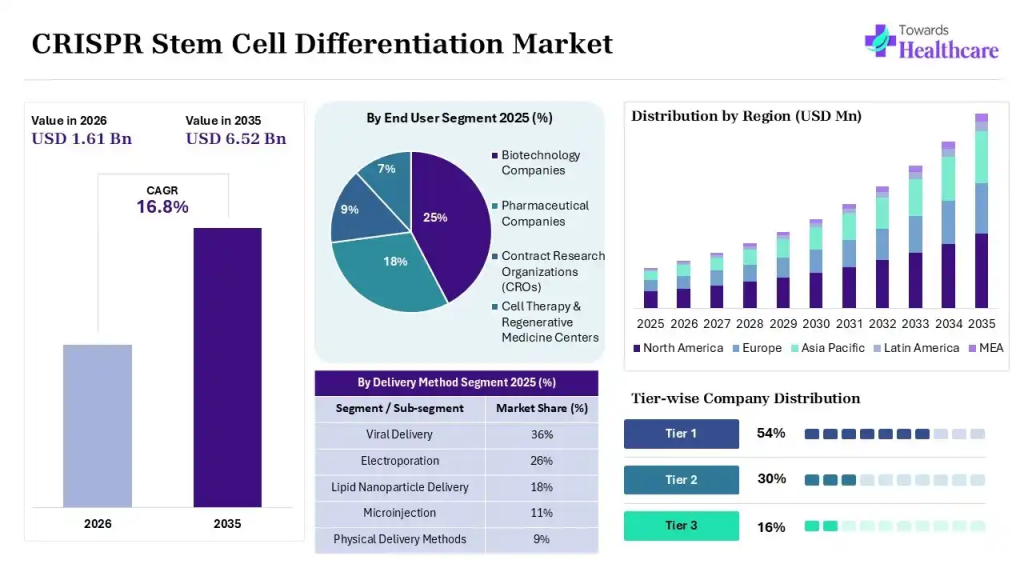
The global CRISPR stem cell differentiation sector was valued at approximately USD 1.38 billion in 2025 and is projected to reach USD 6.52 billion by 2035, expanding at a 16.8% CAGR from 2026 to 2035. The strong growth reflects increasing investment in gene editing, personalized medicine, regenerative therapies, and advanced drug discovery.
Why CRISPR Stem Cell Differentiation Is Gaining Momentum
The growing burden of chronic and genetic diseases is encouraging researchers to explore more precise approaches to understanding disease mechanisms and developing therapies. CRISPR technology enables researchers to modify specific genes in stem cells and study how those changes influence cell development and disease progression.
At the same time, induced pluripotent stem cells (iPSCs) are becoming increasingly valuable because they can be generated from adult cells and differentiated into specialized cell types. When combined with CRISPR, iPSCs can support patient-specific disease models and potentially enable personalized therapeutic development.
Growing investments in cell and gene therapy, advances in genome engineering, and increasing demand for alternatives to conventional animal testing are further supporting adoption.
Key Trends Shaping the Industry
Precision Genome Editing
The development of more precise CRISPR systems is helping researchers improve editing accuracy while reducing unintended genetic changes. Technologies such as base editing and prime editing are attracting attention because they can enable targeted genetic modifications without relying on conventional double-strand DNA breaks.
Expansion of iPSC Research
iPSCs are becoming an important foundation for disease modeling, drug screening, toxicity testing, and regenerative medicine. CRISPR-edited iPSCs can help researchers reproduce disease-associated genetic conditions and evaluate potential therapies in controlled laboratory environments.
Artificial Intelligence Meets Gene Editing
Artificial intelligence is increasingly being integrated into CRISPR research. AI-based tools can assist with guide RNA design, target identification, prediction of off-target activity, and optimization of experimental workflows.
The combination of AI, genomic data, and automated laboratory systems could significantly accelerate research and reduce the time required to develop new cell and gene therapy candidates.
Automation of Stem Cell Manufacturing
As research moves toward clinical and commercial applications, reproducibility and scalability are becoming increasingly important. Automated cell culture, cell sorting, imaging, and bioprocessing technologies can help improve consistency while reducing manual intervention.
Rise of Personalized Regenerative Medicine
Personalized medicine is creating new opportunities for CRISPR-edited stem cells. Patient-derived cells can potentially be genetically modified and differentiated into specific cell types for disease research and therapeutic development.
Leading Applications
CRISPR stem cell differentiation is being explored across several important applications.
Disease modeling currently represents one of the leading applications. Gene-edited stem cells can reproduce disease-related genetic characteristics, allowing researchers to investigate disease mechanisms and identify potential therapeutic targets.
Drug discovery and toxicity testing are also gaining importance. Human-relevant cell models can provide valuable information about how potential drugs interact with specific cell types.
Regenerative medicine and cell therapy development represent another major opportunity. Researchers are exploring ways to produce functional cells for conditions involving damaged or dysfunctional tissues.
Other applications include functional genomics and developmental biology research.
Technology Landscape
CRISPR-Cas9 remains the most widely established genome-editing technology, supported by extensive research, established protocols, and broad laboratory adoption.
However, newer technologies are gaining momentum. Prime editing offers greater flexibility for certain genetic modifications, while base editing can enable specific nucleotide changes with potentially lower levels of DNA damage.
CRISPR-Cas12 and CRISPR-Cas13 are also expanding the range of possible applications, particularly in areas involving DNA and RNA manipulation.
Why iPSCs Are at the Center of Innovation
Induced pluripotent stem cells accounted for approximately 39% of activity in 2025, making them a leading stem cell type within this field.
Their ability to differentiate into multiple specialized cell types makes iPSCs highly valuable for laboratory research. Combined with CRISPR, they can be engineered to reproduce specific genetic mutations or correct disease-associated changes.
This combination could support the development of more realistic disease models and accelerate research into neurological disorders, metabolic diseases, cardiovascular conditions, cancer, and rare genetic diseases.
North America Leads the Innovation Race
North America accounted for approximately 42% of global revenue in 2025, supported by strong biotechnology ecosystems, high research funding, advanced laboratory infrastructure, and the presence of leading life sciences companies.
The United States remains a major contributor due to its extensive clinical research capabilities, venture capital activity, and strong focus on cell and gene therapies.
Europe is also making significant progress through academic collaborations, public research funding, and advanced biotechnology infrastructure.
Meanwhile, Asia Pacific is expected to experience the fastest growth, supported by expanding biotechnology investment, government genomics programs, pharmaceutical manufacturing capabilities, and growing research activity in countries such as China, Japan, India, and South Korea.
Competitive Landscape
Several major companies are contributing to the development of CRISPR and stem cell technologies.
STEMCELL Technologies provides tools and products supporting stem cell research and genome engineering.
CRISPR Therapeutics is advancing gene-editing technologies and cell-based therapeutic programs.
Thermo Fisher Scientific offers CRISPR reagents, genome-editing solutions, stem cell media, and laboratory technologies.
Merck KGaA provides genome-editing reagents and technologies supporting research and cell engineering.
Vertex Pharmaceuticals is advancing cell and gene therapy programs, including approaches involving stem-cell-derived therapies.
Other organizations, including Synthego, Sana Biotechnology, and Fate Therapeutics, are also contributing to the broader development of engineered cell therapies.
Challenges That Could Slow Progress
Despite strong scientific potential, several challenges remain.
High research and development costs can make advanced CRISPR technologies difficult to scale. Regulatory requirements are also becoming increasingly important as gene-edited cells move from laboratory research toward clinical applications.
Researchers must carefully address off-target effects, genetic stability, manufacturing consistency, and long-term safety. Ethical considerations surrounding genome editing and the handling of patient genetic information also require strong oversight.
Another challenge is achieving reliable and scalable differentiation of stem cells into functional, mature cell populations suitable for therapeutic applications.
What Lies Ahead?
The next decade could bring significant changes to stem cell engineering and precision medicine. Greater integration of CRISPR, artificial intelligence, single-cell genomics, organoid engineering, and automated manufacturing is expected to create more sophisticated research platforms.
The development of high-fidelity genome-editing technologies could improve safety and precision, while advances in non-viral delivery methods may support broader clinical translation.
The combination of CRISPR-edited iPSCs and organoid technologies could also provide researchers with increasingly realistic models of human tissues and diseases.
From drug discovery to regenerative medicine, these innovations could help move healthcare toward more targeted and personalized treatment strategies.
Future Outlook: 2026–2035
Between 2026 and 2035, growth is expected to be supported by expanding clinical research, increasing investment in cell and gene therapies, growing demand for personalized medicine, and continued advances in genome editing.
In the short term, CRISPR adoption is likely to remain focused on research, disease modeling, and drug discovery. Over the medium term, regenerative medicine and cell therapy applications could become increasingly important. By the longer term, commercially scalable gene-edited cell products, advanced organoid models, and AI-assisted genome engineering could reshape how researchers develop and evaluate therapies.
With an estimated valuation of USD 6.52 billion by 2035, CRISPR stem cell differentiation is positioned to become an increasingly important part of the life sciences ecosystem. Its future will depend on scientific breakthroughs, regulatory progress, manufacturing innovation, and the ability to translate promising laboratory discoveries into safe and effective therapies.
Download Customized Sample: https://www.towardshealthcare.com/download-sample/7029
About Us
Healthcare WebWire is a part of Towards Healthcare Research & Consulting is a global healthcare market research and consulting firm dedicated to helping businesses make informed decisions through reliable market intelligence and strategic insights. We serve pharmaceutical, biotechnology, medical device, AI in healthcare, cell and gene therapy, digital health, and life sciences organizations with in-depth market research, custom consulting, competitive analysis, and growth forecasts. Our team combines industry expertise with rigorous research to deliver clear, actionable insights that support market expansion, product strategy, investment decisions, and long-term business growth. From emerging innovations to established healthcare markets, we help organizations understand where the industry is today and where it’s headed tomorrow.
You can place an order or ask any questions, please feel free to contact us at [email protected]
Europe Region – +44 778 256 0738
North America Region – +1 8044 4193 44
APAC Region: +91 9356 9282 04
Visit Our Website: Towards Healthcare Research & Consulting – Expert Consulting Solutions & Research Reports
Find us on social platforms: LinkedIn | Twitter | Instagram | Medium