Healthcare apparel is becoming much more than a basic uniform or protective layer. Hospitals, clinics, and outpatient facilities are increasingly looking for clothing that combines infection prevention, comfort, durability, sustainability, and advanced textile technology.
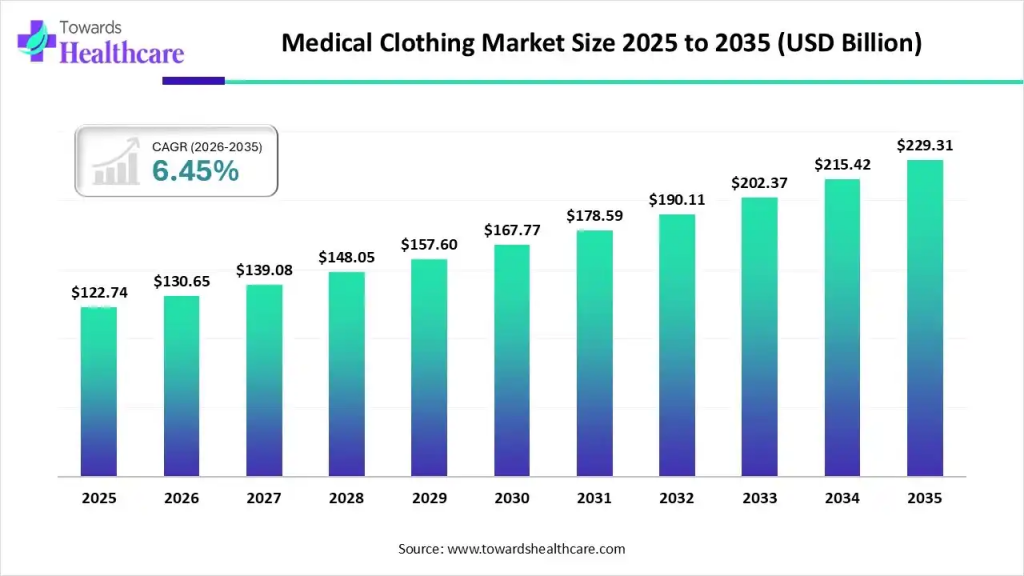
According to the latest analysis, the global medical clothing industry was valued at USD 122.74 billion in 2025 and is projected to reach USD 229.31 billion by 2035, expanding at a 6.45% CAGR from 2026 to 2035. The industry is expected to reach approximately USD 130.65 billion in 2026.
What Is Medical Clothing?
Medical clothing includes specialized garments and protective products used across hospitals, clinics, laboratories, outpatient facilities, and other healthcare environments.
These products include:
- Surgical drapes, scrubs, and gowns
- Gloves
- Facial protection
- Sterilization wraps
- Protective apparel
- Patient clothing
- Laboratory coats
- Healthcare uniforms
These garments are designed to support hygiene, infection prevention, occupational safety, comfort, and protection from fluids and contaminants.
What Is Driving Growth?
Greater Focus on Infection Prevention
Infection prevention continues to be a major priority for healthcare providers. Hospitals require gowns, gloves, masks, scrubs, and other protective products to reduce exposure to contaminants and support safer clinical environments.
Expansion of Healthcare Infrastructure
New hospitals, outpatient centers, diagnostic facilities, and specialty healthcare centers are being developed across emerging economies. This expansion is creating consistent demand for healthcare apparel.
Rising Surgical and Outpatient Procedures
Increasing surgical volumes and the expansion of outpatient care are contributing to recurring consumption of gowns, scrubs, drapes, gloves, and protective apparel.
Advances in Medical Textiles
Textile manufacturers are developing fabrics with improved fluid resistance, breathability, antimicrobial properties, durability, and comfort.
These innovations are helping healthcare providers balance protection with the practical needs of medical professionals.
How AI Is Transforming Medical Clothing
Artificial intelligence is beginning to influence the design and manufacturing of healthcare apparel.
AI-powered systems can assist manufacturers with:
- Fabric selection
- Product design
- Quality inspection
- Demand forecasting
- Inventory planning
- Predictive maintenance
- Production optimization
- Supply-chain management
AI can also analyze customer and healthcare-worker feedback to improve garment fit, comfort, durability, and functionality.
Key Trends Shaping the Future
Antimicrobial Fabrics
Antimicrobial and antibacterial textiles are gaining attention because they can help support hygiene in healthcare environments. Manufacturers are focusing on developing fabrics that maintain performance through repeated use and laundering.
Sustainable and Reusable Apparel
Healthcare organizations are increasingly exploring reusable gowns, scrubs, and protective apparel to reduce waste and improve resource efficiency.
Recycled materials, biodegradable fibers, and environmentally responsible manufacturing processes are also gaining importance.
Ergonomic Healthcare Uniforms
Healthcare professionals often work long shifts and require clothing that allows easy movement.
Modern scrubs and uniforms are therefore being designed with lightweight materials, improved flexibility, breathable fabrics, functional pockets, and better-fitting designs.
Smart Medical Textiles
Smart fabrics represent an emerging opportunity. Sensor-enabled clothing could potentially monitor movement, temperature, or other physiological indicators.
The combination of textiles, sensors, and healthcare technology could create entirely new applications in patient monitoring and professional healthcare environments.
Digital Purchasing
Online platforms are making it easier for healthcare professionals and institutions to purchase medical clothing.
Customization, digital ordering, direct delivery, and personalized product options are becoming increasingly important for individual buyers and healthcare organizations.
Product Trends
Surgical Drapes, Scrubs and Gowns
Surgical drapes, scrubs, and gowns represented approximately 30% of the industry in 2025, according to the supplied analysis.
Their widespread use across operating rooms, hospitals, clinics, and outpatient facilities makes them one of the most consistently demanded product categories.
Facial Protection
Facial protection is expected to experience strong growth as healthcare providers continue emphasizing respiratory safety and infection prevention.
Advances in comfort, breathability, filtration, and protective performance are supporting product innovation.
Healthcare Professionals Remain the Largest User Group
Clothing designed for healthcare professionals accounted for approximately 60% of demand in 2025.
Doctors, nurses, surgeons, laboratory professionals, technicians, and other healthcare workers require regular access to uniforms and protective apparel.
Patient clothing is also gaining importance as hospital admissions, outpatient procedures, and long-term care requirements increase.
Disposable vs. Reusable Clothing
Disposable products accounted for approximately 70% of demand in 2025.
Single-use apparel remains widely preferred because it offers convenience and supports infection-control procedures.
However, reusable products are expected to gain momentum as healthcare organizations focus on sustainability, waste reduction, and long-term cost efficiency.
Advancements in antimicrobial fabrics, industrial laundering, and sterilization processes are making reusable products increasingly attractive.
Hospitals Remain the Largest End User
Hospitals accounted for approximately 50% of demand in 2025.
High patient volumes, surgical procedures, emergency care, infection-prevention requirements, and continuous replacement needs contribute to strong consumption.
Meanwhile, outpatient facilities are expected to grow rapidly as healthcare delivery increasingly shifts toward ambulatory and same-day care.
Regional Outlook
North America
North America accounted for approximately 40% of global demand in 2025.
The region benefits from:
- Advanced healthcare infrastructure
- High healthcare expenditure
- Strong infection-control standards
- Large hospital networks
- Established procurement systems
- Presence of leading manufacturers
The United States remains the largest contributor in the region.
Asia Pacific
Asia Pacific is expected to experience the fastest growth through 2035.
Healthcare infrastructure expansion, increasing hospital capacity, medical tourism, rising healthcare expenditure, and improving hygiene standards are creating significant opportunities.
India and China are particularly important because of their large healthcare systems and strong textile manufacturing capabilities.
Europe
Europe continues to benefit from stringent healthcare standards, an aging population, healthcare infrastructure investment, and growing interest in sustainable textiles.
Reusable garments and environmentally responsible materials are becoming increasingly relevant to healthcare procurement decisions.
Middle East and Africa
The Middle East and Africa are emerging as important growth areas, supported by healthcare infrastructure investments in countries such as Saudi Arabia and the UAE.
Medical tourism, hospital construction, surgical capacity expansion, and stronger infection-prevention policies are contributing to demand.
Competitive Landscape
The industry includes major healthcare suppliers, medical apparel manufacturers, textile companies, and specialized uniform brands.
Key companies include:
- Medline Industries
- Cardinal Health
- 3M
- Mölnlycke Health Care
- Ansell
- Owens & Minor
- Barco Uniforms
- Superior Group of Companies
- FIGS
- Jaanuu
Competition is increasingly focused on product performance, regulatory compliance, sustainability, customization, supply-chain reliability, and innovation.
Challenges
The industry continues to face challenges related to raw material costs, regulatory compliance, supply-chain disruptions, and environmental concerns.
Disposable apparel also creates waste-management challenges. As healthcare organizations adopt sustainability targets, manufacturers will need to develop products that balance protection, affordability, durability, and environmental responsibility.
Counterfeit and low-quality products are another concern because they can compromise safety and product reliability.
Future Outlook
The future of medical clothing will be shaped by the convergence of healthcare, textiles, technology, and sustainability.
Antimicrobial fabrics, reusable garments, smart textiles, ergonomic designs, sustainable materials, AI-powered manufacturing, and digital procurement are likely to influence product development over the coming years.
With global demand projected to reach USD 229.31 billion by 2035, medical clothing is becoming an increasingly important part of the healthcare supply chain.
The companies that successfully combine protection, comfort, sustainability, innovation, and cost efficiency will be well positioned to capture emerging opportunities through 2035.
Download Customized Sample: https://www.towardshealthcare.com/download-sample/6564
About Us
Healthcare WebWire is a part of Towards Healthcare Research & Consulting is a global healthcare market research and consulting firm dedicated to helping businesses make informed decisions through reliable market intelligence and strategic insights. We serve pharmaceutical, biotechnology, medical device, AI in healthcare, cell and gene therapy, digital health, and life sciences organizations with in-depth market research, custom consulting, competitive analysis, and growth forecasts. Our team combines industry expertise with rigorous research to deliver clear, actionable insights that support market expansion, product strategy, investment decisions, and long-term business growth. From emerging innovations to established healthcare markets, we help organizations understand where the industry is today and where it’s headed tomorrow.
You can place an order or ask any questions, please feel free to contact us at [email protected]
Europe Region – +44 778 256 0738
North America Region – +1 8044 4193 44
APAC Region: +91 9356 9282 04
Visit Our Website: Towards Healthcare Research & Consulting – Expert Consulting Solutions & Research Reports
Find us on social platforms: LinkedIn | Twitter | Instagram | Medium