The global knee replacement prosthesis market, valued at US$ 12.1 billion in 2023, is expected to reach US$ 22.73 billion by 2034, growing at a CAGR of 5.9% (2024–2034), driven by the increasing prevalence of osteoarthritis, sports-related knee injuries, technological breakthroughs in robotics, AI, and 3D printing, alongside the rising geriatric population worldwide.
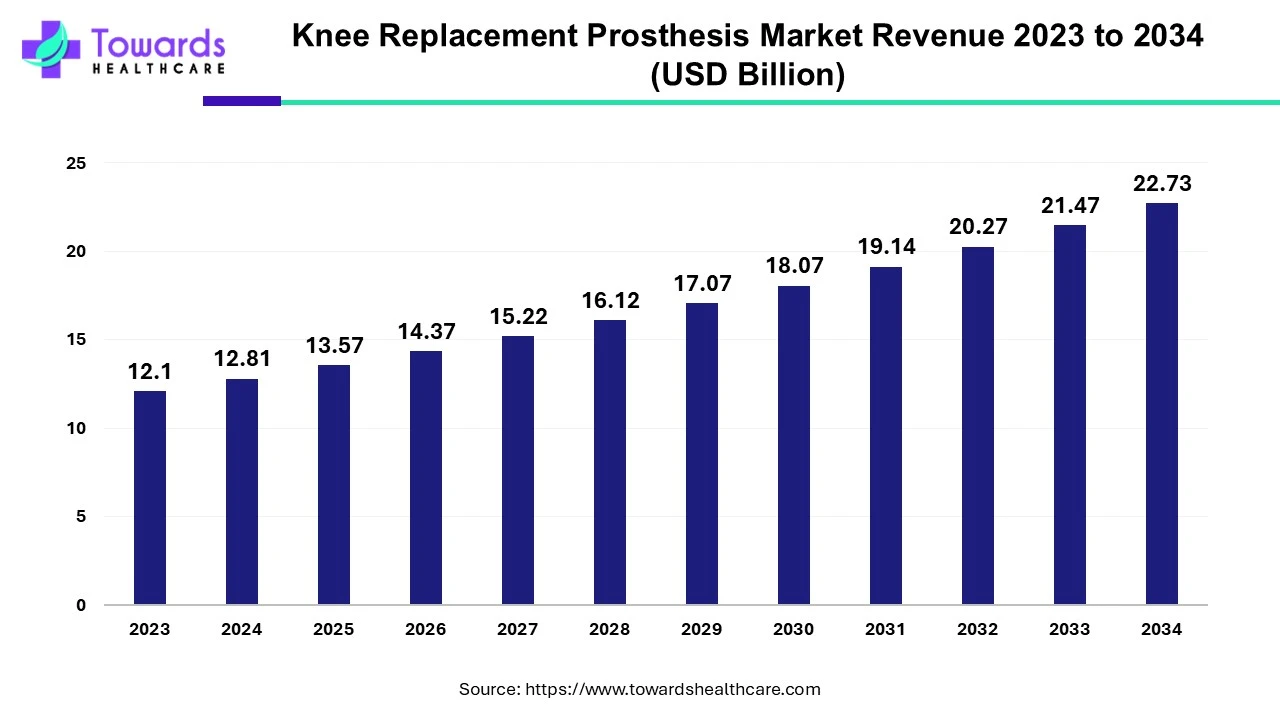
Download the free sample and get the complete insights and forecasts report on this market @ https://www.towardshealthcare.com/download-sample/5280
Market Size
Base Year 2023
➣Market valued at USD 12.1 billion.
➣Strong demand from North America and Europe due to early adoption of advanced surgical technologies.
➣High penetration in tertiary care hospitals and specialty orthopedic centers.
Early Growth Phase (2024–2026)
➣CAGR stabilizes around 5.5–6%, reflecting steady adoption of robotic-assisted surgeries.
➣Funding inflows (e.g., restor3D, Nanochon, Osteal Therapeutics) accelerate innovation pipelines.
Middle Phase (2027–2030)
➣Wider adoption of 3D-printed implants reduces implant cost and customization time.
➣Asia-Pacific surges as population aging accelerates (China, India, Japan, South Korea).
➣Outpatient knee replacement procedures expand significantly in North America.
Forecast Period 2031–2034
➣Market peaks at USD 22.73 billion.
➣Share of minimally invasive and robotic-assisted knee replacement surgeries could account for 40–50% of procedures.
➣Affordable implant manufacturing in APAC and LATAM increases accessibility.
Investment Influence
➣Over USD 180+ million in funding (2024) directed towards knee prosthesis start-ups.
➣Venture capitalists favor companies using AI + 3D printing synergy.
Geographic Split by 2034
➣North America: Largest market (driven by insurance coverage & advanced R&D).
➣Asia-Pacific: Fastest CAGR, expanding geriatric base, domestic innovations.
➣Europe: Consistent growth due to orthopedic disease prevalence and public healthcare coverage.
➣LATAM & MEA: Growing steadily, supported by medical tourism and gradual healthcare infrastructure improvements.
Market Trends
Rise of 3D Printing in Knee Implants
➣Enables patient-specific prosthesis design.
➣Reduces surgical time by providing pre-modeled implants.
➣Minimizes raw material wastage, lowering manufacturing costs.
➣Example: Naton Biotechnology’s 3D-printed total knee implant approved by China’s NMPA (2025).
Collaborations for Market Entry
➣Alkem MedTech’s tie-up with Exactech (2024) – gaining global expertise for India’s local production.
➣Partnerships accelerate market entry in emerging economies.
Start-up Ecosystem Growth
➣Funding rounds (e.g., restor3D: $70M, Nanochon: $40M) show market confidence.
➣Start-ups focus on next-gen prostheses, regenerative medicine, and AI integration.
Robotic-Assisted Surgery Adoption
➣Corin’s ApolloKnee™ platform launched globally in 2024.
➣Robotics increase precision, reduce revision surgeries, and cut recovery time.
AI in Preoperative and Postoperative Care
➣AI-based apps like mymobility track recovery progress.
➣Algorithms predict prosthesis longevity and optimize surgery planning.
Shift to Outpatient Arthroplasty Centers (ASCs)
➣U.S. witnessed 84% increase in ASC surgeries in 2022.
➣Lower cost vs. hospital stays, with faster patient turnover.
High Cost Barrier
➣Knee replacement cost in U.S. ranges USD 15,000–75,000.
➣Limits access in uninsured and middle-income populations.
Focus on Sports Injuries Segment
➣Sports like football, basketball, athletics fuel knee injuries.
➣Example: ATRO Medical’s 3PPP prosthesis (2024) blends AI and 3D printing for sports injury repair.
Advancements in Biocompatible Materials
➣PEEK Optima material by Maxx Orthopedics (2025) reduces wear and tear.
➣Higher durability → longer implant lifespan.
Global Expansion of Mid-Tier Players
➣Firms like Medacta, Corin, and Exactech rapidly expanding in APAC & LATAM.
AI Impacts in the Market
Precision Preoperative Imaging
AI-enabled imaging (MRI, CT, and X-ray scans) can create highly accurate 3D models of the patient’s knee.
Subpoints:
➣Helps surgeons plan incisions and prosthesis positioning before surgery.
➣Improves accuracy in identifying cartilage loss, bone density variations, and alignment issues.
➣Reduces “trial and error” during surgery → shorter procedure times.
➣Enhances patient outcomes by lowering the probability of revision surgeries.
2. Surgical Robotics Control
AI-powered robotics improve precision and reproducibility during knee replacement procedures.
Subpoints:
➣AI algorithms guide robotic arms for bone cutting with millimeter-level accuracy.
➣Minimizes surgical trauma → less blood loss and faster healing.
➣Standardizes procedures across surgeons, reducing variability in outcomes.
➣Corin’s ApolloKnee™ is a clear example of AI-powered robotic-assisted knee replacement.
3. Predictive Patient Outcomes
Machine learning (ML) uses patient data to forecast risks and success rates.
Subpoints:
➣Predicts infection risk, implant rejection, or revision needs.
➣Identifies patients at risk of poor post-op mobility or complications.
➣Provides surgeons with a “probability score” to guide surgical choices.
➣Helps insurance companies evaluate coverage and costs based on predictive analytics.
4. Prosthesis Customization
AI integrates CT/MRI scans with 3D printing to design implants tailored to individual anatomy.
Subpoints:
➣Eliminates “one-size-fits-all” prostheses.
➣Reduces implant misfit, discomfort, and long-term wear.
➣Shortens operating room time since implants arrive pre-customized.
➣Increases implant lifespan and patient satisfaction.
5. Smart Wearable Integration
AI-powered wearables (smart bands, knee sensors) track recovery progress.
Subpoints:
➣Monitors gait, walking distance, and joint movement.
➣Sends real-time alerts to surgeons if abnormal patterns (like limping) occur.
➣Collects continuous patient data → large datasets for AI learning.
➣Patients gain personalized rehab feedback through mobile apps.
6. AI-driven Rehabilitation
Rehabilitation is often long and resource-intensive; AI personalizes and automates it.
Subpoints:
➣Adaptive AI platforms recommend exercise routines based on progress.
➣Virtual physiotherapists via apps guide patients remotely.
➣Reduces hospital visits and associated costs.
➣Keeps patients motivated with gamified rehab programs.
7. Data Mining for Clinical Trials
AI accelerates prosthesis development by analyzing vast medical datasets.
Subpoints:
➣Identifies suitable patient groups for clinical trials faster.
➣Reduces time taken to analyze outcomes across hundreds of patients.
➣Enhances regulatory submissions by generating AI-backed statistical insights.
➣Helps companies like Zimmer, Medacta, and Exactech shorten R&D-to-market timelines.
8. Remote Recovery Monitoring
AI-powered virtual assistants track recovery outside the hospital.
Subpoints:
➣Patients log pain levels, swelling, and stiffness through AI apps.
➣AI flags complications early → reduces emergency re-admissions.
➣Doctors get real-time dashboards of patient progress.
➣Encourages outpatient procedures → supporting the shift to ambulatory surgical centers (ASCs).
Regional Segments
North America
Strengths
High Procedure Volume
➣Over 3.1 million hip and knee arthroplasty surgeries (2012–2022).
➣Primary knee arthroplasty alone accounted for 51% of all procedures.
➣Reflects strong surgeon expertise and patient acceptance.
Advanced Outpatient Adoption (ASCs)
➣U.S. shift toward Ambulatory Surgical Centers (ASCs) for knee replacements.
➣ASCs offer cost savings vs. inpatient hospital stays.
➣Growing demand due to insurance coverage + convenience.
Drivers
R&D in Robotics and AI
➣U.S. firms (Zimmer Biomet, Stryker, Corin) leading innovations in robotics-assisted knee replacement.
➣Heavy integration of AI-based surgical planning & recovery apps.
Insurance Penetration
➣Widespread insurance coverage makes costly surgeries (USD 15,000–75,000) more accessible.
➣Medicare and private insurance support high adoption among elderly patients.
Trends
84% Growth in ASC Surgeries (2022)
➣Indicates rising preference for day-care surgeries with faster discharge.
➣Supports cost efficiency for healthcare providers.
Higher Demand for Revision Surgeries
➣Large number of implants placed in the past decade are reaching their wear-out period.
➣Aging prostheses → demand for revision arthroplasty grows steadily.
Asia-Pacific (APAC)
Strengths
Largest Geriatric Population Globally
➣China: 216.76M aged 65+ in 2023, 15.4% of its population.
➣India & Japan also major contributors to aging demographics.
Fastest CAGR Growth Forecast
➣Rising demand for affordable prostheses.
➣Healthcare systems expanding rapidly to handle orthopedic cases.
Drivers
Government-Supported Low-Cost Implants
➣Example: IIT Madras’ “Kadam” prosthetic knee (2022) → affordable domestic alternative.
➣Reduces dependency on costly imports.
Ceramic Knee Replacement Tech
➣SIMS Hospital AOI (India, 2024) pioneered ceramic implants.
➣Offers durability + affordability.
Trends
India’s 80+ Population Growth
➣Expected rise of 279% between 2022–2050.
➣Indicates exponential demand for orthopedic care.
Japan’s Elderly Population (29.3% in 2023)
➣One of the oldest populations globally.
➣Strong market for knee prosthesis adoption.
Europe
Strengths
Robust Orthopedic Infrastructure
➣Well-established healthcare systems with public funding.
➣Access to advanced orthopedic centers across Germany, UK, France, Italy.
Public Healthcare Access
➣High reimbursement rates under EU healthcare frameworks.
➣Ensures accessibility for elderly patients.
Data Highlights
UK: 74,082 knee replacements annually.
➣97.8% patients were above 50 years old.
➣Female patients: 54.9%, male patients: 45.1%.
Drivers
EU Health Initiatives
➣Programs like European Action Towards Better Musculoskeletal Health.
➣Aim: Reduce long-term orthopedic disease burden.
Trends
Women >50 yrs as Majority Patients
➣Osteoarthritis disproportionately impacts women after menopause.
➣Reflects higher prosthesis demand among female demographics.
Latin America
Strengths
Growing Medical Tourism
➣Brazil, Mexico, Argentina attract patients from U.S. and Europe.
➣Knee replacement procedures cost significantly less compared to developed nations.
Drivers
Rising Osteoarthritis Prevalence
➣Rapidly growing elderly population contributes to higher joint disease rates.
➣Increasing incidence of obesity → higher joint stress.
Government Investments
➣Expanding orthopedic facilities and training programs.
➣Encouraging domestic production of prostheses.
Trends
Inbound Medical Tourism
➣Patients from high-cost regions (U.S./Europe) travel for affordable, quality surgeries.
➣Example: Knee replacement costs in Mexico can be 40–60% cheaper than in the U.S.
Market Dynamics
Drivers
Rising Prevalence of Osteoarthritis
➣Global burden: Osteoarthritis is the leading cause of knee replacements worldwide.
➣Demographic link: Incidence rises steeply after age 40, with women >50 yrs most affected (seen in Europe data: 54.9% female cases in UK).
➣Medical impact: Persistent pain, stiffness, and reduced mobility push patients towards surgical intervention.
➣Market implication: Osteoarthritis segment dominates application share in 2024 and will remain the primary driver.
Increasing Sports Injuries
➣High-risk sports: Football, basketball, athletics, and skiing cause repetitive knee strain.
➣Injury data trend: ACL and meniscus tears often require partial/total knee replacements when conservative treatments fail.
➣Example: ATRO Medical’s 3D-Printed PCU Meniscus Prosthesis (3PPP) (2024) integrates AI for treating sports-related knee damage.
➣Market implication: Sports injuries segment expected to expand at one of the fastest CAGRs.
Technological Advancements (AI, Robotics, 3D Printing)
➣AI: Enables personalized prosthesis design, outcome prediction, and recovery tracking.
➣Robotics: Platforms like Corin’s ApolloKnee™ and Zimmer’s ROSA® enhance surgical precision.
➣3D Printing: Naton Biotechnology’s laser 3D-printed implant (2025), approved in China, shows potential for cost reduction and customization.
➣Market implication: Advanced tech improves success rates, shortens recovery, and increases surgeon and patient adoption.
Aging Global Population (especially APAC)
Asia-Pacific epicenter:
➣China: 216M+ elderly (65+) in 2023.
➣Japan: 29.3% elderly population (2023).
➣India: 80+ age group to rise 279% by 2050.
➣Implication: Elderly population directly correlates with higher incidence of joint degradation and prosthesis demand.
➣Market implication: APAC expected to post the fastest CAGR globally.
Growing Venture Capital Investments in Start-ups
➣Funding 2024:
➣restor3D: $70M.
➣Nanochon: $40M.
➣Osteal Therapeutics: $50M.
➣Innovation focus: Funding supports development of next-gen prostheses, robotics, regenerative implants.
Market implication: Increases competition, speeds up innovation cycle, and accelerates adoption.
Challenges
1. High Procedure Costs ($15k–$75k in U.S.)
➣Factors influencing cost: Implant material, robotic vs. manual procedure, hospital stay, post-op rehab.
➣Barrier: Even insured patients face significant out-of-pocket expenses.
➣Market implication: Limits adoption, especially in mid-income populations.
2. Lack of Affordability in Developing Countries
➣Implant pricing: Imported implants make surgeries unaffordable in India, LATAM, and Africa.
➣Domestic response: Initiatives like IIT Madras “Kadam” (2022) aim to reduce costs.
➣Market implication: Local manufacturing crucial for growth in emerging economies.
3. Limited Insurance Penetration (LATAM/MEA)
➣Problem: Public insurance often excludes elective knee replacements.
➣Consequence: Patients pay full cost → surgeries delayed or avoided.
➣Market implication: Restrains adoption despite growing osteoarthritis prevalence.
Opportunities
1. 3D Printing + AI Integration
➣Benefit: Delivers custom-fit, cost-efficient prostheses.
➣Example: Naton Biotechnology’s 3D-printed implant (2025) proves regulatory acceptance.
➣Market implication: Potential to disrupt traditional bulk manufacturing, lowering costs worldwide.
2. Expansion of Outpatient Knee Replacements
➣Growth trend: U.S. ASCs reported 84% growth in procedures in 2022.
➣Advantages: Lower cost, reduced infection risk, shorter patient stay.
➣Market implication: Shifts more surgeries into cost-friendly outpatient settings → wider patient adoption.
3. APAC Demand Surge from Geriatric Base
➣Population growth: Elderly population in APAC rising faster than global average.
➣Policy support: Governments pushing for domestic low-cost prostheses (India’s Kadam, China’s implant approvals).
➣Market implication: APAC set to narrow gap with North America by 2034.
4. Growing Scope in Regenerative Materials (PEEK, Ceramics)
➣PEEK implants: Maxx Orthopedics’ Freedom Total Knee System (2025) using PEEK Optima femoral component.
➣Ceramic implants: SIMS AOI’s ceramic knee technology (India, 2024).
➣Advantages: Higher durability, lower wear, improved biocompatibility.
➣Market implication: Extends implant lifespan → reduces revision surgeries → higher adoption.
Top 10 Companies
1. Zimmer Biomet Holdings, Inc.
Product Portfolio:
➣Wide range of knee prosthesis systems (total knee, partial knee, revision implants).
➣Robotics integration through ROSA® Knee System.
➣Digital health tools for patient recovery.
Strengths:
Market leader with global brand presence.
➣2024 Q4 revenue: $2.23 billion, showing +4.3% growth.
➣Strong R&D investments (focus on AI, robotics, materials).
➣Positioned strongly in North America and Europe.
Strategic Advantage:
➣Strong orthopedic ecosystem — hip, spine, sports medicine — cross-selling opportunities.
➣Patient-centric innovations improving satisfaction and long-term implant success.
2. Stryker Corporation
Product Portfolio:
➣Knee systems with Mako® Robotic-Arm Assisted Surgery.
➣Advanced implant materials reducing wear and extending prosthesis life.
Strengths:
➣Global leader with strong hospital and surgeon partnerships.
➣Focus on minimally invasive procedures with robotic precision.
➣Trusted by surgeons worldwide due to training and education programs.
Strategic Advantage:
➣Dominates in robotic-assisted orthopedic surgery.
➣Strong global footprint, especially in U.S., Europe, and Asia-Pacific.
3. Johnson & Johnson (DePuy Synthes)
Product Portfolio:
VELYS™ Robotic-Assisted Solution (FDA-approved).
➣Advanced implants tailored for partial and total knee replacements.
Strengths:
➣Backed by J&J’s vast medical device network.
➣FDA approvals strengthen credibility and adoption.
➣Strong pipeline of innovative technologies for personalized care.
Strategic Advantage:
➣Leveraging AI, robotics, and digital surgery platforms.
➣Global distribution and economies of scale.
4. Medacta International SA
Product Portfolio:
➣Focus on personalized implants and patient-specific instrumentation.
➣Knee systems engineered for anatomical fit.
Strengths:
➣2024 Revenue: €590.6 million (+16.2%).
➣Adjusted EBITDA margin 28%, showing operational efficiency.
➣Expanding with Parcus acquisition to strengthen portfolio.
Strategic Advantage:
➣Specializes in minimally invasive orthopedic procedures.
➣Positioned as a premium innovative brand in Europe and beyond.
5. Smith & Nephew plc
Product Portfolio:
➣Wide range of joint reconstruction implants.
➣Offers both partial and total knee prosthesis solutions.
Strengths:
➣Global orthopedic presence with strong hospital networks.
➣Known for durable implant solutions.
➣Focus on sports medicine + joint reconstruction synergy.
Strategic Advantage:
➣Trusted heritage brand with a strong surgeon training network.
➣Expanding market share in Europe and Asia-Pacific.
6. Exactech Inc.
Product Portfolio:
➣Joint replacement systems for knee, hip, and shoulder.
➣Digital surgery platforms for better implant alignment.
Strengths:
➣Collaboration with Alkem MedTech (India, 2024) for joint replacement manufacturing and distribution.
➣Strong innovation pipeline for emerging markets.
Strategic Advantage:
➣Growth through regional partnerships.
➣Positioned as a mid-tier company expanding rapidly in Asia-Pacific.
7. Corin Group PLC
Product Portfolio:
➣ApolloKnee™ robotic surgical platform.
➣Wide orthopedic implant offerings.
Strengths:
➣Expertise in AI integration and robotics.
➣Global reputation as an innovative challenger brand.
Strategic Advantage:
➣Focused on robotic-assisted precision surgery.
➣Differentiates by offering next-gen AI-driven solutions.
8. MicroPort Scientific Corporation
Product Portfolio:
➣Knee implants, prosthetics, trauma, and spine solutions.
➣Strong orthopedic pipeline tailored for APAC.
Strengths:
➣Asia-Pacific leader with focus on China, Japan, India.
➣Affordable prosthesis systems for emerging markets.
Strategic Advantage:
➣Leverages low-cost manufacturing base.
➣Strong domestic networks with rapid expansion into global markets.
9. B. Braun Melsungen AG
Product Portfolio:
➣Advanced surgical solutions and orthopedic implants.
➣Comprehensive hospital-based solutions for surgeries.
Strengths:
➣Presence in 120+ countries.
➣Integrated offering (surgical tools + implants).
Strategic Advantage:
➣Trusted by hospitals for end-to-end surgical care solutions.
➣Leverages brand recognition and global hospital penetration.
10. LimaCorporate S.p.A.
Product Portfolio:
3D-printed implants (pioneers in additive manufacturing).
➣Total joint replacement systems.
Strengths:
➣Recognized innovator in personalized, custom implants.
➣Strong adoption in Europe & North America.
Strategic Advantage:
➣First-mover advantage in 3D printing technology.
➣Positioned as a premium innovator with future-ready solutions.
Latest Announcements
Maxx Orthopedics (2025): IDE approval for Freedom Total Knee System (PEEK femoral).
Hospital for Special Surgery (2025): Announced implants bridging biologics and prosthesis gap.
Recent Developments
Meril (2024): MISSO robotic knee system launched in India.
DePuy Synthes (2024): FDA approval for VELYS™ Unicompartmental knee robotic system.
Corin (2024): ApolloKnee™ robotic app launched globally.
Naton Biotechnology (2025): World’s first laser 3D-printed knee implant (China).
Top 5 FAQs
Q1. What is the global market forecast for knee prostheses?
👉 USD 22.73 billion by 2034 from USD 12.1B (2023).
Q2. Which region leads today?
👉 North America, due to advanced healthcare and ASCs.
Q3. Which region will grow fastest?
👉 Asia-Pacific, driven by aging population.
Q4. What is the major barrier to adoption?
👉 High surgery cost ($15k–$75k U.S.).
Q5. What future tech will transform the market?
👉 AI + 3D Printing synergy enabling custom, affordable prostheses.
Access our exclusive, data-rich dashboard dedicated to the therapeutic area sector – built specifically for decision-makers, strategists, and industry leaders. The dashboard features comprehensive statistical data, segment-wise market breakdowns, regional performance shares, detailed company profiles, annual updates, and much more. From market sizing to competitive intelligence, this powerful tool is one-stop solution to your gateway.
Access the Dashboard: https://www.towardshealthcare.com/access-dashboard
Immediate Delivery Available | Buy This Premium Research @ https://www.towardshealthcare.com/price/5280
Become a valued research partner with us – https://www.towardshealthcare.com/schedule-meeting
You can place an order or ask any questions, please feel free to contact us at [email protected]
Powering Healthcare Leaders with Real-Time Insights: https://www.towardshealthcare.com/healthcare-intelligence-platform
Europe Region – +44 778 256 0738
North America Region – +1 8044 4193 44
APAC Region: +91 9356 9282 04
Web: https://www.towardshealthcare.com
Find us on social platforms: LinkedIn | Twitter | Instagram | Medium | Pinterest