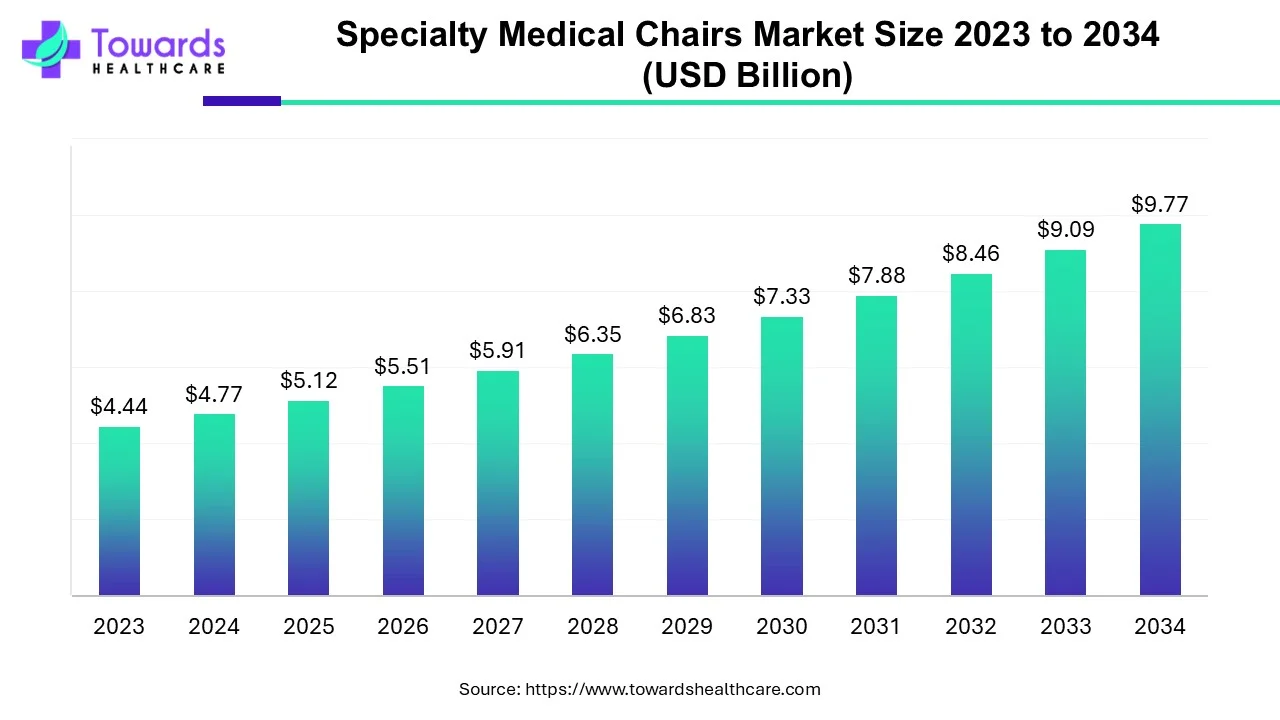
The global specialty medical chairs market was valued at USD 5.12 billion in 2025 (USD 4.77B in 2024) and is projected to reach USD 9.77 billion by 2034 at a CAGR of 7.43% (2025–2034), driven by an aging population, rising chronic disease burden, adoption of advanced/automated chair solutions, and expanding use across hospitals, clinics and rehabilitation facilities.
Download this Free Sample Now and Get the Complete Report and Insights of this Market Easily @ https://www.towardshealthcare.com/download-sample/5480
Market size
Historical base and near-term level (2024–2025):
●2024 market size: USD 4.77 billion (reported).
●2025 market size: USD 5.12 billion — ~7.3% year-over-year increase implied by those two data points.
Forecast horizon and terminal value:
●Projected 2034 market size: USD 9.77 billion.
Compound growth:
●CAGR 2025–2034 = 7.43% — implies the market roughly doubles over the decade (5.12 → 9.77).
Value growth drivers (monetary lens):
●Increased per-unit ASPs (average selling prices) for advanced/automated chairs (high-end models priced in the EUR 4,000–8,000 band).
●Expansion of addressable volume due to aging population and greater adoption in clinics and home care.
Addressable market dynamics:
●Large hospitals and clinic procurements dominate current spend (hospitals largest share in 2024), but faster growth in clinics and outpatient/ambulatory settings increases future addressable spend.
Price vs. volume tradeoff:
●High-end automated chairs drive revenue per unit; affordability/awareness remain constraints in many emerging markets, moderating unit growth but supporting value growth via premium products.
Capital expenditure / funding impact:
●Government health capital increases (e.g., India’s Union Budget allocation, UK capital spending, Newfoundland investments) expand procurement budgets and positively affect market value.
Replacement and aftermarket revenue:
●Maintenance, service contracts and retrofits for high-technology chairs contribute recurring revenue streams (serviceable market beyond new unit sales).
Market concentration (by revenue):
●North America accounted for ~43% share in 2024 — large single-region concentration that influences global revenue distribution.
Long-term upside / downside sensitivity:
●Upside: faster adoption of AI/automation, home care adoption, and medical tourism growth.
●Downside: price resistance, reimbursement limits, and substitution by lower-cost alternatives (stretchers, standard exam chairs).
Market Trends
Aging population as a structural tailwind
●Global seniors are expanding (WHO projections cited): rising need for geriatric, bariatric and rehabilitation chairs; drives both volume and specialized product launches.
Rising chronic disease burden
●Higher prevalence of chronic conditions (cardiovascular, diabetes, cancer) increases long-term demand for dialysis chairs, cardiac chairs, blood-drawing chairs and rehab seating.
Shift toward outpatient & clinic care
●Growth of clinics and ambulatory care centers is shifting procurement away from hospitals only; clinics projected to be fastest-growing end-use segment.
Technological sophistication and digitization
●Integration of digital delivery systems (e.g., A-dec 500 Pro / 300 Pro dental systems) and development of digitally integrated chairs increases product differentiation.
AI/automation & smart chair features
●Movement toward automated positioning, sensors for pressure-care, and predictive maintenance (detailed AI impacts later).
Product specialization and niche chairs
●Expansion of chairs designed for specific specialties: ophthalmic, ENT, mammography, birthing — creating narrower product lines with higher ASPs.
Government funding and healthcare capital programs
●Increased capital expenditure (India Rupees 99,858 crore; UK health capital £13.6B; Newfoundland $40M) frees hospital/clinic budgets to buy advanced chairs.
Consolidation and strategic partnerships
●M&A and distribution deals (e.g., Nakanishi acquiring DCI International; Infinium Medical teaming with Lemi MD) strengthen company footprints and product availability.
Focus on patient comfort and recovery metrics
●New products (Vivid. Care HiBack bedside chair) designed to improve pressure care and reduce recovery/discharge times — procurement tied to clinical outcomes.
Regional growth divergence
●North America leads (43% share), Asia-Pacific shows fastest regional expansion prospects due to rising healthcare spend and large populations.
Investment into distribution & education
●Investments by private equity/strategic investors (Foresight → DP Medical Systems) to expand product lines and market reach.
Price pressure vs. premiumization
●Tension between cost-sensitive procurement (esp. in emerging markets) and demand for premium, feature-rich chairs in developed markets.
AI impact
Automated posture & positioning control
●AI uses sensor inputs (load, body contours) to auto-adjust chair geometry for optimal procedural access and patient comfort.
●Benefits: reduces manual handling tasks, shortens setup time, improves procedure ergonomics.
Personalized patient profiles & presets
●ML models learn patient preferences/clinical needs and recall saved presets (e.g., recline angles, footrest position) per patient or procedure type.
●Benefits: consistent positioning for repeat treatments, faster turnarounds, improved patient experience.
Real-time pressure ulcer / tissue-viability prevention
●Integrated pressure sensors + AI infer high-risk zones and implement micro-adjustments or alerts to nursing staff.
●Benefits: reduces pressure injuries, shorter inpatient stays, measurable clinical outcomes for procurement justification.
Predictive maintenance & uptime optimization
●Telemetry data (actuator cycles, motor current draw) fed to ML models predicts part failures before they occur.
●Benefits: schedule preventive maintenance, reduce downtime, lower lifecycle cost.
Smart infection-control workflows
●AI monitors usage patterns and suggests optimal cleaning cycles; can notify cleaning staff after high-risk procedures.
●Benefits: improves hygiene compliance, helps infection control teams quantify risk.
Adaptive assistance for transfers and handling
●AI coordinates motorized tilt/slide and integrates with lifting devices to assist safe transfers for bariatric/disabled patients.
●Benefits: reduces caregiver injuries and need for additional staff during transfers.
Clinical decision support & integration
●Chair sensors (position, vitals if present) send context to EHR / perioperative systems — AI recommends positioning based on procedure type or clinician preferences.
●Benefits: tighter EHR integration and audit trails for compliance and billing.
Procedure analytics and workflow optimization
●Aggregated chair usage data analyzed to identify bottlenecks (setup time, idle time) and suggest staffing or layout changes.
●Benefits: increases throughput, supports ROI case for new chairs.
Assistive robotics & haptic feedback
●AI coordinates small robotic actuators for fine micro-positioning during delicate eye/dental procedures; provides haptic cues to operators.
●Benefits: enhances precision for ophthalmic/dental interventions.
Manufacturing optimization & customization at scale
●AI optimizes production lines for configurable chairs, enabling mass customization (color, module, pressure ratings) without prohibitive cost.
●Benefits: faster time-to-market of new models, improved margins on bespoke chairs.
Regional Insights
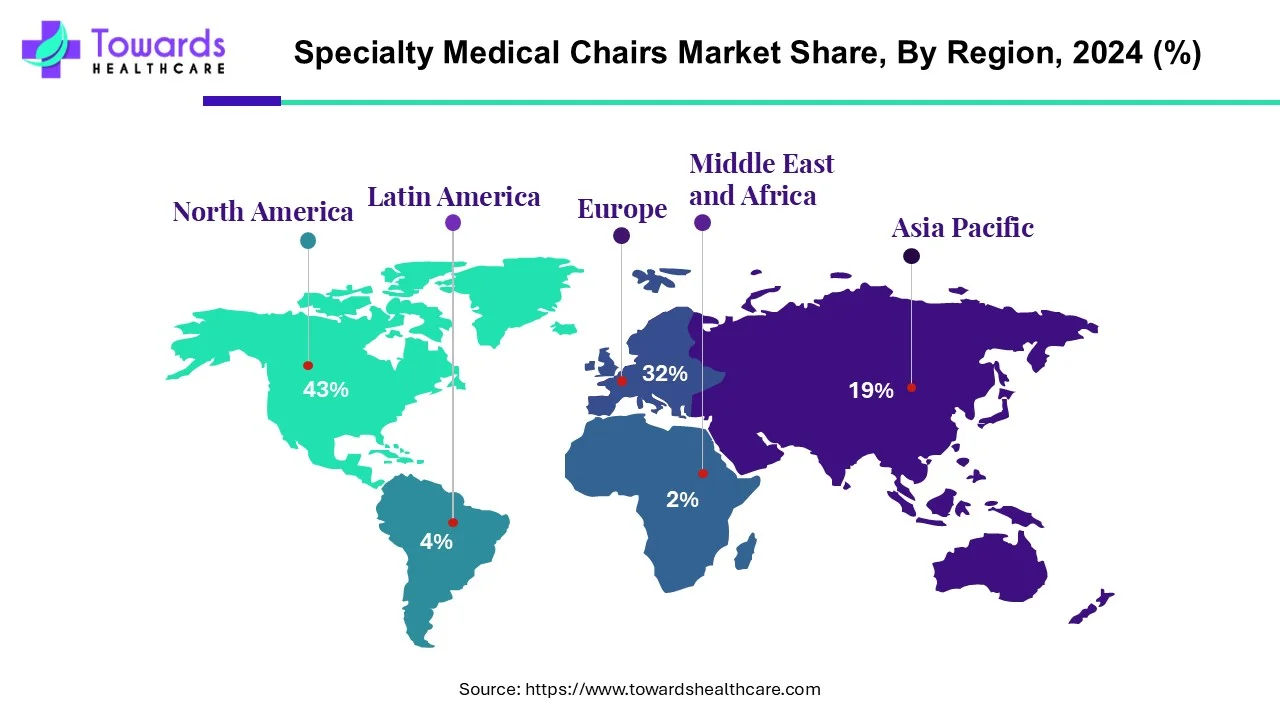
A. North America — (Market leader; 43% share in 2024)
Drivers
●Aging population and favorable reimbursement for durable medical equipment.
●High hospital capital budgets and large network of outpatient centers.
Market characteristics
●Premiumization: high acceptance of advanced automated chairs and digital delivery systems.
●Strong distribution channels and after-sales service networks.
Challenges
●Intense competition on features and quality; regulatory compliance (medical device standards) raises development cost.
Opportunities
●Integration with EHRs, AI feature adoption, and retrofits for existing fleets.
B. Asia-Pacific — (High growth potential)
Drivers
●Large, aging populations coupled with rising healthcare spending.
●Growth of private hospitals, medical tourism, and home health services.
Market characteristics
●Price sensitivity in many markets but increasing appetite for mid- and high-tier solutions in China, India, Korea.
Challenges
●Fragmented distribution, variable reimbursement and limited service infrastructure in rural areas.
Opportunities
●Affordable automation and financing models; localized manufacturing to reduce costs.
C. Europe
Drivers
●Well-established healthcare systems, high outpatient procedure volumes, emphasis on patient safety and ergonomics.
Market characteristics
●Strong regulation and standards; R&D focus on clinical outcomes (pressure care, infection control).
Opportunities
●Government funding for hospital upgrades and strong adoption of advanced chairs in developed markets (Germany, France, UK).
D. Latin America
Drivers
●Growing geriatric cohorts, expanding private healthcare and medical tourism.
Challenges
●Price sensitivity and uneven distribution of advanced facilities.
Opportunities
●Local partnerships and selective deployment in major urban hospitals and private chains.
E. Middle East & Africa (MEA)
Drivers
●Investments in healthcare infrastructure by governments and private investors.
Challenges
●Variability in regulatory environments and service networks.
Opportunities
●High-end installations in GCC nations and targeted rollouts with strong service contracts.
Market dynamics
Driver — Demographic tailwinds
●Aging population and rising chronic disease prevalence increase long-term demand for rehabilitation, geriatric and bariatric chairs.
Driver — Technological advancement
●Development of AI-enabled, ergonomically advanced and digitally integrated chairs supports premiumization and clinical benefits.
Driver — Shift to outpatient care
●Rise in clinics and ambulatory surgery centers expands the addressable market outside hospitals.
Restraint — High product cost
●Advanced chairs often range EUR 4,000–8,000, limiting adoption in cost-sensitive regions and smaller clinics.
Restraint — Awareness & training
●Limited clinician/purchaser awareness of clinical value and the need for staff training impede adoption.
Restraint — Maintenance & service burden
●Ongoing maintenance costs and need for skilled service networks increase total cost of ownership and deter some buyers.
Opportunity — Home healthcare and electric mobility integration
●Growing acceptance of electric wheelchairs and home care devices opens adjacent markets and bundled solutions.
Opportunity — AI & IoT as differentiators
●AI features and predictive maintenance reduce lifecycle cost and create recurring software/service revenue streams.
Opportunity — Government funding
●Increased health capital spending in countries such as India, UK and regional infrastructure investments unlock procurement budgets for advanced chairs.
Competitive dynamic
●Market features both established OEMs (dental and clinical incumbents) and specialist seating companies; partnerships and distribution deals (Infinium/Lemi MD; investment in DP Medical Systems) accelerate market entry for niche players.
Top 10 companies
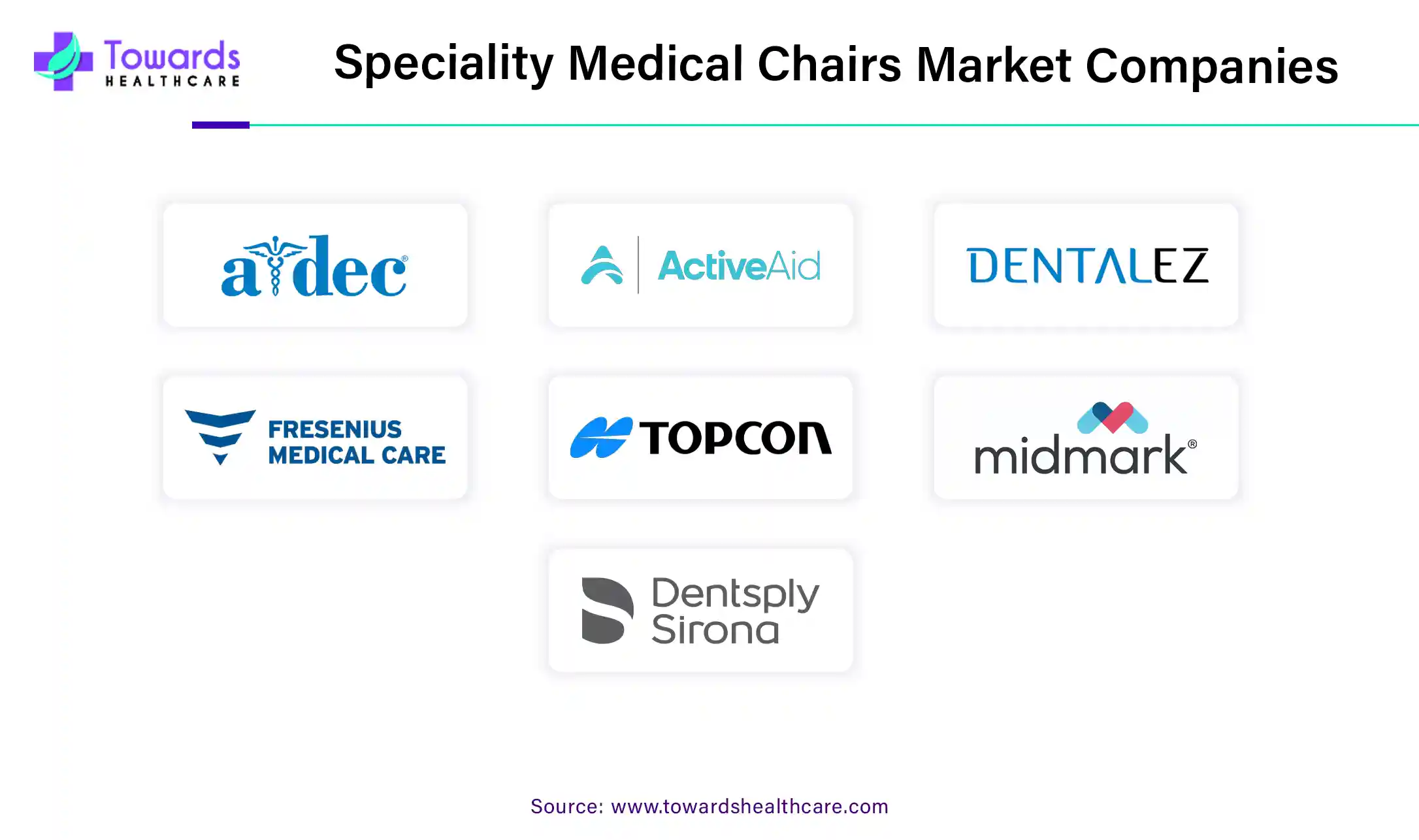
A-dec, Inc.
Product highlights: Dental chairs and digitally integrated delivery systems (A-dec 500 Pro, A-dec 300 Pro).
Overview: Longstanding dental equipment OEM with significant North American presence.
Strengths: Strong dental focus, integrated digital delivery platforms, proven clinical adoption and brand recognition.
ActiveAid, Inc.
Product highlights: (Specialist seating / aids) — products aimed at mobility and patient handling.
Overview: Specialist in assistive devices and seating solutions.
Strengths: Niche expertise in patient aids, targeted product portfolio for mobility & comfort.
DentalEZ, Inc.
Product highlights: Dental chairs, treatment units and dental delivery systems.
Overview: Dental equipment manufacturer serving clinics and dental chains.
Strengths: Focused dental solutions, established service and distribution channels to dental practices.
Fresenius Medical Care AG & Co. KGaA
Product highlights: Dialysis chairs and related renal care seating solutions (company known for dialysis equipment).
Overview: Global leader in renal care with broad healthcare device presence.
Strengths: Strong clinical relationships in dialysis centers, scale in manufacturing and service provision.
Topcon Corp.
Product highlights: Ophthalmic chairs and diagnostic integration (Topcon is a leader in ophthalmic equipment).
Overview: Established ophthalmic and diagnostic instrument maker.
Strengths: Clinical integration in eye care workflows, global distribution to ophthalmic clinics.
Midmark Corp.
Product highlights: Exam chairs, procedure chairs and integrated treatment equipment.
Overview: Healthcare equipment and medical furniture OEM with training/education initiatives (e.g., WCOMP collaboration).
Strengths: Manufacturing expertise, partnerships with education programs, reputation for durable clinic equipment.
Danaher (KaVo Dental GmbH)
Product highlights: Dental chairs and instruments via KaVo dental unit.
Overview: Large diversified medtech conglomerate with dental equipment capabilities.
Strengths: R&D capacity, broad service network and cross-selling opportunities across Danaher portfolio.
Dentsply Sirona
Product highlights: Dental chairs, dental units and integrated treatment systems.
Overview: Major dental OEM with wide product range and global market penetration.
Strengths: Leading brand in dentistry, strong aftermarket services and digital dentistry roadmap.
Planmeca Oy
Product highlights: Dental units and ergonomic treatment chairs (Planmeca is a premium dental OEM).
Overview: Finland-based dental technology leader known for equipment innovation.
Strengths: High-end product design, strong R&D and integration in dental CAD/CAM workflows.
Rahab Seating Systems Inc. / Hill Laboratories Company
Product highlights: Specialty seating solutions (bariatric, geriatric, rehab).
Overview: Specialist seating manufacturers focusing on comfort, pressure care and bespoke solutions.
Strengths: Deep domain expertise in ergonomics, customization capabilities and niche clinical focus.
Latest announcement
Vivid. Care — HiBack Bedside Chair (Feb 2025)
What: Launch of the HiBack Bedside Chair designed to solve endemic issues with hospital ward seating (effortless height adjustment, superior pressure care, patient ergonomics).
Why it matters: Addresses a clinically measurable problem (pressure issues delaying recovery/discharge); direct feedback-driven development (ward managers, moving & handling experts, Tissue Viability Nurses).
Implication for buyers: Potential to reduce pressure-related complications and shorten length-of-stay metrics — strengthens procurement case beyond comfort alone.
Strategic angle: Demonstrates how clinician engagement in R&D can yield product features that influence adoption in acute care.
RNZAF delivery to Samoa (March 2025) — five specialized chairs delivered for chemotherapy/dialysis: demonstrates humanitarian / regional access role of logistics and partnerships for distributing bulky specialty chairs.
Infinium Medical & Lemi MD (March 4, 2025) — exclusive U.S. distribution for Lemi MD-Series surgical chairs (Dreamed Procedure Chair, Monza Mobile Surgery Chair, Lemi 4 Procedure Table) — strengthens availability of surgical chair choices in U.S. clinical market.
Recent developments
Infinium Medical — exclusive U.S. distribution with Lemi MD (Mar 4, 2025)
Details: Partnership expands surgical chair portfolio in U.S. distribution channels; adds mobile and procedure-specific chairs to market.
Impact: Improves choice for surgical centers, supports adoption of procedure chairs that maximize OR efficiency.
Vivid. Care — HiBack Chair launch (Feb 2025)
Discussed above — outcome: product addresses pressure care and ergonomics in acute wards.
Foresight investment into DP Medical Systems (Aug 2024)
Details: £4.45M investment to expand product launches and growth plans.
Impact: Capital infusion strengthens distribution, enabling new product introductions and market coverage.
Nakanishi Inc. acquisition of DCI International (Aug 2023)
Details: Strengthens Nakanishi’s U.S. presence for dental chair units and instruments.
Impact: Consolidation trend in dental seating and instruments reinforces incumbent strength in dental markets.
A-dec new digital delivery systems (June 2023)
Details: A-dec 500 Pro and 300 Pro for North America — digitally integrated dental chairs/delivery units.
Impact: Example of digital integration trend in dental specialty seating that increases ASP and clinician productivity.
Midmark / WCOMP / Ohio STEM partnership (Mar 4, 2024)
Details: Educational partnership to promote manufacturing careers and highlight healthcare innovation.
Impact: Long-term talent pipeline for manufacturing and R&D; supports local production capabilities.
RNZAF humanitarian delivery (Mar 2025)
Details: Logistics/donation of bulky chairs for Samoa dialysis/chemo patients.
Impact: Highlights role of logistics and cross-sector partnerships in improving access in remote regions.
Segments covered
By Product (major groups + explanation)
Examination chairs
●Use: general diagnostic exams across clinics/hospitals.
●Considerations: adjustability, ease of cleaning, compact footprint.
Birthing chairs
●Use: obstetrics and labor support.
●Considerations: modularity, perineal access, patient comfort and positioning support.
Cardiac chairs
●Use: cardiac diagnostics, recovery, cath labs.
●Considerations: reclining mechanics, integrated monitoring compatibility.
Blood drawing chairs (phlebotomy)
●Use: collection centers, clinics.
●Considerations: patient arm support, stability and infection control surfaces.
Dialysis chairs
●Use: dialysis centers, renal units.
●Considerations: long-duration comfort, recline for vascular access, ease of disinfection.
Mammography chairs
●Use: breast imaging centers.
●Considerations: positioning precision, radiolucent materials where required.
Rehabilitation chairs
●Subtypes: pediatric, bariatric, geriatric.
●Use: therapy, mobility, positioning.
●Considerations: pressure care, weight capacity, transfer assistance.
Treatment chairs (procedure chairs)
●Subtypes: ophthalmic, ENT, dental, other procedure-specific chairs.
●Use: surgeries, outpatient procedures.
●Considerations: specialty attachments, integration with instruments and lighting.
Pediatric chairs
●Use: pediatric therapy and treatment.
●Considerations: size ranges, safety restraints, child-friendly ergonomics.
Bariatric chairs
●Use: patients with higher weight needs; rehab & surgical prep.
●Considerations: reinforced frames, higher weight capacity, safe transfers.
By End-use
●Hospitals — largest share: tend to buy full-featured, durable chairs for inpatient, OR and specialty departments.
●Clinics — fastest growth: demand for compact, cost-effective, specialty chairs for ambulatory procedures.
●Others — includes home care, long-term care facilities, mobile units, and diagnostic centers.
By Region
North America, Asia-Pacific, Europe, Latin America, MEA — each with the drivers and opportunities previously described.
Top 5 FAQs
-
Q: What is the current size and expected growth of the specialty medical chairs market?
A: Valued at USD 5.12 billion in 2025 (USD 4.77B in 2024), projected to reach USD 9.77 billion by 2034 at a CAGR of 7.43% (2025–2034). -
Q: Which region currently dominates the market?
A: North America dominated with approximately 43% share in 2024, led by an aging population, high disposable incomes and advanced healthcare infrastructure. -
Q: Which product and end-use segments are most significant?
A: By product, rehabilitation chairs held a dominant presence in 2024; treatment chairs are expected to grow fastest. By end-use, hospitals held the largest share, while clinics are the fastest-growing end-use segment. -
Q: What are the key drivers and restraints in the market?
A: Drivers: aging population, chronic disease prevalence, tech innovation and government health capital spending. Restraint: high cost of advanced chairs, maintenance burden and limited awareness in some markets. -
Q: How is AI expected to affect this market?
A: AI is set to transform the market across positioning automation, pressure-care prevention, predictive maintenance, personalized presets, infection-control workflows, integration with EHRs, and manufacturing optimization — creating product differentiation and recurring software/service revenue streams.
Access our exclusive, data-rich dashboard dedicated to the healthcare market – built specifically for decision-makers, strategists, and industry leaders. The dashboard features comprehensive statistical data, segment-wise market breakdowns, regional performance shares, detailed company profiles, annual updates, and much more. From market sizing to competitive intelligence, this powerful tool is one-stop solution to your gateway.
Access the Dashboard: https://www.towardshealthcare.com/access-dashboard
Immediate Delivery Available | Buy This Premium Research @ https://www.towardshealthcare.com/price/5480
Become a valued research partner with us – https://www.towardshealthcare.com/schedule-meeting
You can place an order or ask any questions, please feel free to contact us at sales@towardshealthcare.com
Powering Healthcare Leaders with Real-Time Insights: https://www.towardshealthcare.com/healthcare-intelligence-platform
Europe Region – +44 778 256 0738
North America Region – +1 8044 4193 44
APAC Region: +91 9356 9282 04
Web: https://www.towardshealthcare.com
Find us on social platforms: LinkedIn | Twitter | Instagram | Medium | Pinterest