AI in Life Science Market 2034: The Path to Smarter, Faster, Healthier Futures

The global AI in Life Science Market was valued at USD 2.25 billion in 2024 and is projected to reach USD 2.71 billion in 2025, growing at a CAGR of 20.21% to reach USD 14.20 billion by 2034, driven by technological advancements and growing demand for personalized patient care and accelerated drug development.
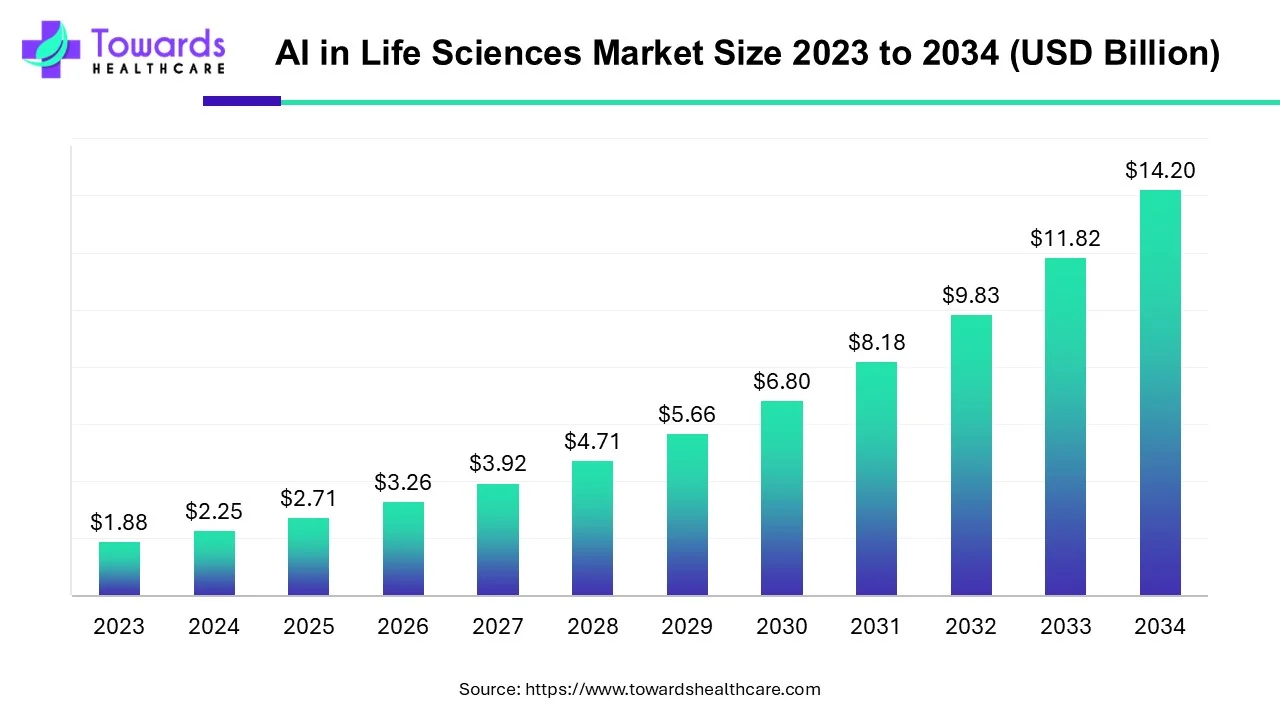
AI In Life Sciences Market Size 2025 - 2034

Download the free sample and get the complete insights and forecasts report on this market @ https://www.towardshealthcare.com/download-sample/5043

Market Size Analysis 

Global Market Size (2024–2034)

➢2024: USD 2.25 billion

➢2025: USD 2.71 billion

➢2034: USD 14.20 billion

➢CAGR: 20.21% from 2024 to 2034

➢Growth Drivers:

➢Rising adoption of AI for drug discovery

➢Increasing clinical trial efficiency

➢Personalized medicine and predictive analytics

Offering Segmentation

➢Software: Dominated in 2024 due to user-friendly platforms, cloud integration, and subscription-based models.

➢Services: Fastest-growing segment due to customized AI solutions, centralized operations, and expertise support.

➢Hardware: Supports AI infrastructure and analytics tools for large-scale operations.

Deployment Segmentation

➢Cloud: Largest revenue share in 2024 due to scalability, remote access, cost-effectiveness, and backup options.

➢On-Premise: High growth expected due to enhanced data privacy, security, and control over sensitive health data.

Investment & Funding Trends

➢LogicFlo AI raised $2.7 million in July 2025 to improve AI productivity in pharma, biotech, and medtech sectors.

➢Growing venture capital support in Asia-Pacific and North America fuels AI adoption.

AI Adoption in Life Sciences

➢Widespread use across drug discovery, clinical trials, patient care, predictive analytics, and regulatory compliance.

➢Driven by increasing availability of biomedical datasets and machine learning tools.

Market Trends

AI for Next-Generation Clinical Trials

➢AI combines EHR, genomics, wearables, and trial data for patient identification.

➢Predictive analytics reduces trial timelines and improves outcomes.

Strategic Frameworks

➢EY-Parthenon and Microsoft (Feb 2025) launched AI Maturity Framework to integrate AI across life science organizations.

Rising Investments

➢Venture funding in life science startups (China, India, North America) accelerates AI adoption.

➢NIH invests ~$48 billion annually to support AI in biomedical research.

Personalized Medicine

➢AI predicts patient responses based on genomics and health data, reducing adverse reactions.

Drug Discovery Optimization

➢AI predicts safety and efficacy of drug candidates, accelerates target identification, and optimizes trial designs.

Data-Driven Operations

➢Cloud adoption allows real-time analytics, remote monitoring, and cost-effective storage.

Global Regulatory Support

➢FDA has approved 1,247 AI/ML-based medical devices as of July 2025.

➢Governments (Germany, UK, Canada) actively support AI integration in life sciences.

Asia-Pacific Market Growth

➢Rapid biotech startup growth and government initiatives for AI awareness boost the market.

AI-Enabled Predictive Analytics

➢Identifies high-risk patients and predicts disease progression to improve preventive care.

Integration with Big Data

➢Machine learning algorithms analyze large biomedical datasets for drug discovery and patient outcome optimization.

Top 10 AI Roles/Impact in Life Sciences 

Accelerated Drug Discovery

➢Mechanism: AI leverages machine learning (ML) and deep learning algorithms to analyze massive chemical, molecular, and genomic datasets.

➢Impact: Speeds up target identification, reduces reliance on trial-and-error experiments.

➢Example: Predicts drug efficacy and safety profiles before preclinical testing.

➢Benefit: Shortens the traditional drug discovery cycle from years to months.

➢Outcome: Enables rapid response to emerging diseases or pandemics.

➢Optimized Clinical Trials

➢Mechanism: AI algorithms identify the best-fit patient populations by analyzing historical trial data, EHRs, and genomics.

➢Impact: Reduces trial duration and cost, increases statistical significance of outcomes.

➢Example: AI models predict which patients will respond favorably to experimental drugs.

➢Benefit: Improves recruitment efficiency, minimizes dropouts.

➢Outcome: Faster regulatory approval due to more reliable trial results.

Personalized Treatment Plans

➢Mechanism: AI integrates genomics, phenotypic data, medical history, and lifestyle factors.

➢Impact: Creates individualized therapeutic plans tailored to each patient.

➢Example: Predicts likelihood of adverse reactions to specific drugs.

➢Benefit: Enhances treatment efficacy and patient safety.

➢Outcome: Reduces healthcare costs by avoiding ineffective treatments.

Predictive Analytics for Risk Management

➢Mechanism: Uses historical datasets and predictive models to forecast disease progression or treatment risks.

➢Impact: Identifies high-risk patients and potential adverse events in advance.

➢Example: Predicts hospital readmissions or severe side effects.

➢Benefit: Proactive intervention prevents complications.

➢Outcome: Improves overall patient outcomes and safety.

Data Integration

➢Mechanism: AI consolidates structured and unstructured data from EHRs, wearables, proteomics, and genomics.

➢Impact: Enables holistic patient analysis and systems-level understanding of diseases.

➢Example: Integrates clinical trial data with real-world evidence for decision-making.

➢Benefit: Streamlines research and enables more accurate clinical predictions.

➢Outcome: Supports precision medicine and accelerates R&D productivity.

Regulatory Compliance

➢Mechanism: AI monitors trial data in real-time and ensures adherence to regulatory standards.

➢Impact: Automates documentation, reporting, and audit processes.

➢Example: Tracks deviations in trial protocols or safety reporting.

➢Benefit: Reduces risk of regulatory penalties or trial rejection.

➢Outcome: Enhances trust and reliability in the life sciences sector.

Cost Optimization

➢Mechanism: AI identifies inefficiencies in research, clinical trials, and supply chains.

➢Impact: Minimizes wastage in drug development, inventory management, and trial execution.

➢Example: Predicts which compounds are unlikely to succeed, avoiding unnecessary lab tests.

➢Benefit: Reduces financial burden on pharmaceutical companies.

➢Outcome: Enables reinvestment in more promising R&D projects.

Real-Time Monitoring

➢Mechanism: AI-powered sensors and dashboards track patient vitals and trial progression continuously.

➢Impact: Early detection of anomalies during clinical trials or patient treatment.

➢Example: Wearables monitor heart rate, glucose levels, or adverse reactions in trials.

➢Benefit: Enables immediate intervention when issues arise.

➢Outcome: Improves patient safety and trial accuracy.

Enhanced Patient Recruitment

➢Mechanism: AI analyzes demographic, genetic, and behavioral data to match patients to suitable trials.

➢Impact: Ensures faster and more precise recruitment.

➢Example: Identifies underrepresented patient populations for inclusivity.

➢Benefit: Reduces delays due to slow recruitment.

➢Outcome: Accelerates clinical development timelines.

Knowledge Management

➢Mechanism: AI organizes and interprets vast biomedical datasets for researchers.

➢Impact: Enables discovery of novel insights from historical and real-time data.

➢Example: ML algorithms identify previously unknown drug interactions or mechanisms.

➢Benefit: Supports informed decision-making in R&D.

➢Outcome: Fosters innovation and continuous improvement in life sciences.

Regional Insights 

North America

Overview: Largest market due to mature healthcare infrastructure and high R&D investment.

U.S.:

➢NIH invests $48B annually for biomedical research.

➢FDA supports 1,247 AI/ML-based medical devices as of July 2025.

➢High concentration of pharma and biotech firms enables AI adoption at scale.

Canada:

➢$25.9B invested in 175 life science companies.

➢Government AI initiative: $2B (2024–2025) for tools and innovation.

Europe

Overview: Strong infrastructure, favorable policies, and government backing.

Germany:

➢AI Action Plan supports healthcare research and economic growth.

➢Regulatory frameworks encourage innovation in AI deployment.

UK:

➢£82M investment for AI-driven therapeutics.

➢AI White Paper published to guide ethical and safe AI use.

Asia-Pacific

Overview: Fastest-growing region due to government incentives and startup ecosystem expansion.

China:

➢3,000 life science companies, 189 AI-focused startups.

➢VC funding $1.7B in 2024.

India:

➢Biotech startups grew from 5,365 to 8,531 (2021–2023).

➢Projected 35,460 startups by 2030; strong digital adoption supports AI integration.

LAMEA

➢Emerging adoption due to increasing healthcare infrastructure.

➢AI awareness programs and workshops enhance uptake.

➢Potential growth driven by untapped market opportunities.

Market Dynamics 

Drivers

Rising Personalized Medicine Demand:

➢Patients and healthcare providers demand treatments tailored to individual genetics and conditions.

Advanced Therapeutics:

➢Increased R&D in chronic disease therapies and biologics drives AI adoption.

Growing Clinical Trials:

➢Rising trial volume and data complexity necessitate AI-powered efficiency.

Government & Venture Funding:

➢Public and private investments encourage AI innovation in life sciences.

Restraints

Data Privacy Concerns:

➢On-premise deployments face challenges with HIPAA, GDPR, and local regulations.

High Initial Investment:

➢Cost of AI software, cloud infrastructure, and skilled workforce is significant.

Integration Complexity:

➢Merging AI systems with existing legacy healthcare systems is challenging.

Opportunities

Global Clinical Trials Expansion:

➢AI can streamline multi-country trials and enhance patient diversity.

Predictive Analytics Applications:

➢Anticipates adverse events, optimizing trial safety and treatment plans.

Cloud-Based AI Solutions:

➢Offers scalable, cost-effective access to AI analytics across regions.

Emerging Markets Penetration:

➢Asia-Pacific and LAMEA present untapped AI adoption potential.

Challenges

Regulatory Hurdles:

➢Approval and validation processes for AI in healthcare are complex and evolving.

Skilled Workforce Shortage:

➢AI adoption requires trained personnel in ML, bioinformatics, and life sciences.

Data Standardization:

➢Fragmented health datasets impede AI model accuracy.

Cybersecurity Threats:

➢AI systems handling sensitive patient data are vulnerable to breaches.

Top 10 Companies in AI in Life Science Market

1. NVIDIA

Overview: Pioneer in AI hardware and GPU solutions, enabling high-performance computing for life sciences.

Products: NVIDIA Clara, AI compute platforms, GPUs (A100, H100), AI-powered workflow accelerators.

Strengths:

➢Industry leader in processing speed for genomics and bioinformatics.

➢Extensive pharma and biotech partnerships (e.g., AstraZeneca, Schrödinger).

➢Supports AI-driven drug discovery pipelines globally.

Positioning: Backbone of AI infrastructure for life sciences R&D.

2. Medidata (Dassault Systèmes Company)

Overview: Market leader in AI-enabled clinical trial management systems.

Products: Medidata Rave, AI-powered analytics for patient monitoring and trial optimization.

Strengths:

➢30+ years of expertise in life sciences software.

➢Trusted by 90%+ top pharma companies for trial management.

➢Strong collaborations with biotech and CROs.

Positioning: Gold standard for AI-driven clinical trial platforms.

3. Axtria, Inc.

Overview: Enterprise AI and analytics company serving life sciences across R&D, commercial, and clinical operations.

Products: Axtria InsightsMAx, Axtria SalesIQ, Axtria MarketingIQ.

Strengths:

➢Enables end-to-end AI adoption.

➢Drives measurable ROI for pharma and biotech firms.

➢Focus on experimentation and enterprise scalability.

Positioning: Leader in enterprise-grade AI platforms for life sciences.

4. IQVIA

Overview: Global leader in health data analytics and AI-powered services.

Products: AI agents (powered by NVIDIA), IQVIA CORE analytics engine.

Strengths:

➢1B+ patient records integrated into predictive analytics.

➢Deep experience in clinical trial services and healthcare consulting.

➢Custom AI agents improve R&D, market access, and commercialization workflows.

Positioning: Trusted AI powerhouse with unmatched healthcare data access.

5. EY-Parthenon

Overview: Global consultancy integrating AI into life sciences strategies.

Products: AI Maturity Framework, digital transformation blueprints.

Strengths:

➢Deep expertise in regulatory and compliance guidance.

➢Focuses on organizational readiness for AI adoption.

➢Works with pharma leadership on strategic AI roadmaps.

Positioning: Strategic advisory partner driving AI adoption in life sciences.

6. Microsoft

Overview: Leading provider of scalable AI and cloud solutions for healthcare.

Products: Azure AI, BioGPT (AI model for biomedical research), Azure Genomics.

Strengths:

➢Cloud-native, globally scalable AI ecosystem.

➢Strong partnerships with Novartis, Johnson & Johnson, and Moderna.

➢Provides generative AI for literature review, trial analysis, and EHR data integration.

Positioning: The enabler of cloud-based AI transformation in life sciences.

7. Relation Therapeutics, Inc.

Overview: Early-stage biotech leveraging AI for drug discovery.

Products: Predictive models for molecule activity, safety, and precision targeting.

Strengths:

➢Focus on rare diseases and unmet therapeutic needs.

➢Uses proprietary AI models to accelerate preclinical decision-making.

Positioning: Innovator in AI-driven drug discovery for niche disease areas.

8. Quris Technologies Ltd.

Overview: Clinical-stage AI company optimizing trials and patient outcomes.

Products: AI-powered predictive models for trial design and patient recruitment.

Strengths:

➢Significant reduction in trial duration and costs.

➢Strong emphasis on predictive human-relevant models (reduces reliance on animals).

Positioning: Emerging leader in AI-enabled clinical trial innovation.

9. Recursion Pharmaceuticals

Overview: Biotech firm harnessing AI to map human biology and accelerate drug discovery.

Products: Recursion OS (proprietary AI platform for biological data).

Strengths:

➢Uses imaging + ML to discover novel molecules.

➢Partnerships with Roche/Genentech and Bayer.

➢Focuses on rare diseases and oncology.

Positioning: Hybrid biotech-AI company redefining drug discovery pipelines.

10. Insilico Medicine

Overview: Global leader in generative AI for drug discovery and biomarker identification.

Products: Pharma.AI platform, PandaOmics (target discovery), Chemistry42 (molecule design).

Strengths:

➢First AI-discovered drug entered Phase II clinical trials (fibrosis).

➢Rapid iteration of drug candidates at reduced cost.

➢Recognized for accuracy in biomarker and target prediction.

Positioning: Pioneer in generative AI drug discovery with proven clinical pipeline success.

Latest Announcements

Medidata (Anthony Costello, CEO):

➢AI-powered trial optimization now integrated across oncology studies.

➢Beyond trials: expanding into patient-centric outcomes and real-world evidence analytics.

➢Strengthening collaborations with biotech firms for sustainable clinical impact.

Axtria, Inc. (April 2025):

➢Launched Axtria InsightsMAx, an enterprise AI solution for R&D and commercial ops.

➢Designed for experimentation, faster deployment, and measurable ROI acceleration.

➢Positioned as a “one-stop AI engine” for global life sciences.

IQVIA (June 2025):

➢Introduced AI agents at NVIDIA GTC Paris, co-developed with NVIDIA.

➢Focused on workflow automation and insight generation in pharma R&D.

➢Early adopters report 25–30% faster analysis of large trial datasets.

Recent Developments 

LogicFlo AI Funding (July 2025):

➢Raised $2.7M seed funding to build composable AI agents for regulated pharma workflows.

➢Enhances productivity by automating repetitive compliance and data review tasks.

EY-Parthenon & Microsoft Report (Feb 2025):

➢Released AI Maturity Framework for Life Sciences.

➢Helps organizations benchmark AI readiness, identify gaps, and scale AI adoption safely.

Clinical Trial Growth:

544,730 trials registered globally (as of July 14, 2025).

➢AI adoption increasing across trial design, recruitment, monitoring, and reporting.

Government Investments:

➢USA (NIH): $48B/year to biomedical R&D, heavily AI-integrated.

➢UK: £82M into AI therapeutics (focused on oncology and rare diseases).

➢Canada: $2B AI initiative (2024–2025) to support AI-driven healthcare projects.

AI in Life Science Market Segmentation

1. By Offering

a. Software (Dominant Segment)

Adoption Model: Subscription-based SaaS solutions, enabling cost-effective scalability.

Drivers:

➢Growing adoption of AI-powered platforms for clinical trial optimization and drug discovery.

➢Seamless integration with EHR systems, wearables, and lab information systems.

Examples:

➢Medidata Rave (clinical trials), Recursion OS (drug discovery), Axtria InsightsMAx (enterprise analytics).

Outlook: Expected to remain the largest revenue contributor due to continuous updates, automation, and predictive analytics capabilities.

b. Services (Fastest-Growing Segment)

Scope: Consulting, AI implementation, training, workflow integration.

Drivers:

➢High demand for customized AI deployment in pharma and biotech.

➢Rising complexity of AI algorithms requires ongoing support and expertise.

Examples:

➢EY-Parthenon’s AI Maturity Framework consulting services.

➢IQVIA’s AI-enabled clinical trial services.

Outlook: Growth boosted by outsourcing trends in R&D and CRO partnerships.

c. Hardware (Supportive Segment)

Scope: GPUs, AI chips, servers, and data storage units.

Drivers:

➢Rising need for high-performance computing (HPC) for genomics, proteomics, and imaging.

➢Support for data-intensive workflows in AI drug discovery.

Examples:

➢NVIDIA A100 & H100 GPUs for large-scale AI models.

Outlook: While not the dominant segment, hardware acts as the foundation layer for AI infrastructure in life sciences.

2. By Deployment

a. Cloud (Largest Share)

Drivers:

➢On-demand scalability and pay-per-use models reduce infrastructure costs.

➢Facilitates cross-border collaborations in clinical trials.

➢Enables integration with real-world data (RWD) and wearable health monitoring devices.

Examples:

➢Microsoft Azure AI for genomics and research.

➢Amazon AWS AI for large-scale biomedical datasets.

Outlook: Expected to dominate as cloud-native AI ecosystems become the backbone of global R&D.

b. On-Premise (High-Growth Niche)

Drivers:

➢Organizations prioritizing data privacy, compliance, and control.

➢Preferred by hospitals, CROs, and pharma companies dealing with sensitive patient data (HIPAA, GDPR compliance).

Examples:

➢Pharma giants using dedicated AI servers for proprietary drug discovery pipelines.

Outlook: Though smaller in scale than cloud, on-premise adoption will expand steadily in regulated industries and regions with strict data laws (Europe, Japan).

3. By Application

a. Drug Discovery (Dominant Application)

Drivers:

➢Rising global R&D in chronic diseases (cancer, diabetes, neurodegenerative disorders).

➢Generative AI models accelerating hit-to-lead and lead optimization.

Examples:

➢Insilico Medicine’s AI-designed fibrosis drug in Phase II trials.

➢Recursion Pharmaceuticals mapping human biology with AI imaging.

Outlook: Will remain the largest application due to continuous demand for new therapeutics.

b. Clinical Trials (High-Growth Segment)

Drivers:

➢AI improves patient recruitment, site selection, and real-time monitoring.

➢Reduces trial costs (estimated savings: 20–30%).

Examples:

Quris Technologies’ predictive models for patient selection.

Medidata’s AI-powered clinical trial analytics.

Outlook: Growing importance as the number of registered trials exceeds 540,000 globally (2025).

c. Personalized Medicine (Transformational Segment)

Drivers:

➢Growing adoption of genomic profiling and biomarker-based therapies.

➢AI integrates patient history, lifestyle, and omics data for customized treatment.

Examples:

➢Microsoft’s BioGPT aiding genomic research.

➢AI-based oncology platforms tailoring cancer treatments.

Outlook: Fastest adoption in oncology, rare diseases, and immunotherapies.

d. Medical Diagnosis (Emerging Segment)

Drivers:

➢AI-powered predictive diagnostics enable early detection of diseases.

➢Increasing use of AI imaging for radiology, pathology, and genomics.

Examples:

➢FDA-approved AI devices for radiology (1,200+ AI/ML-enabled devices in the U.S.).

Outlook: Expected to surge with AI-enabled imaging platforms and remote diagnostics adoption.

e. Biotechnology (Supportive Segment)

Drivers:

➢Supports gene editing, proteomics, and biomarker discovery.

➢AI integrates molecular datasets for faster therapeutic development.

Examples:

➢CRISPR + AI collaborations for precision gene therapies.

Outlook: Will grow in parallel with biotech startup expansion in Asia-Pacific and Europe.

4. By Region

a. North America (Largest Market)

Drivers:

➢Advanced healthcare infrastructure and R&D leadership.

➢NIH invests ~$48B annually; FDA supportive of AI in clinical workflows.

Key Countries:

U.S.: Hub for AI startups, pharma giants, and biotech R&D.

Canada: $2B AI initiative (2024–2025) + $25.9B life science funding.

Outlook: Will continue to dominate, especially in AI-powered clinical trials and drug discovery.

b. Europe (Policy-Driven Growth)

Drivers:

➢Strong regulatory frameworks (AI White Paper, GDPR).

➢Government investments in AI therapeutics and R&D infrastructure.

Key Countries:

Germany: AI Action Plan boosting healthcare research.

UK: £82M funding for AI in therapeutics.

Outlook: Growth supported by ethical AI frameworks and public-private partnerships.

c. Asia-Pacific (Fastest-Growing Region)

Drivers:

➢Rapid expansion of biotech startups and AI-focused ventures.

➢Government incentives for healthcare digitization and AI adoption.

Key Countries:

China: 3,000 life sciences companies, 189 AI-focused startups, $1.7B VC funding (2024).

India: Biotech startups surged from 5,365 to 8,531 (2021–2023), projected 35,460 by 2030.

Outlook: Strongest CAGR, driven by startup ecosystem + government AI investments.

d. LAMEA (Emerging Market)

Drivers:

➢Improving healthcare infrastructure and rising AI awareness programs.

➢Growing partnerships with multinational pharma and tech companies.

Outlook: Early-stage adoption but high potential due to untapped markets in Middle East & Africa.

1 What is the size of the AI in life sciences market?

➢Valued at USD 2.25B in 2024, projected USD 2.71B in 2025, expected USD 14.20B by 2034.

2 Which segment dominates the market by offering?

➢Software dominates due to user-friendly platforms, cloud integration, and subscription-based adoption.

3 What is the fastest-growing region in the market?

Asia-Pacific, driven by biotech startups, government programs, and venture funding.

4 How does AI impact drug discovery and clinical trials?

➢AI accelerates drug discovery, predicts efficacy and safety, improves patient selection, and reduces trial timelines.

5 Who are the top companies in AI in life sciences?

➢NVIDIA, Medidata, Axtria, IQVIA, EY-Parthenon, Microsoft, Relation Therapeutics, Quris Technologies, Recursion Pharmaceuticals, Insilico Medicine.

Access our exclusive, data-rich dashboard dedicated to the healthcare market – built specifically for decision-makers, strategists, and industry leaders. The dashboard features comprehensive statistical data, segment-wise market breakdowns, regional performance shares, detailed company profiles, annual updates, and much more. From market sizing to competitive intelligence, this powerful tool is one-stop solution to your gateway.

Access the Dashboard: https://www.towardshealthcare.com/access-dashboard

Immediate Delivery Available | Buy This Premium Research @ https://www.towardshealthcare.com/price/5043

Become a valued research partner with us – https://www.towardshealthcare.com/schedule-meeting

You can place an order or ask any questions, please feel free to contact us at sales@towardshealthcare.com

Powering Healthcare Leaders with Real-Time Insights: https://www.towardshealthcare.com/healthcare-intelligence-platform

Europe Region – +44 778 256 0738

North America Region – +1 8044 4193 44

APAC Region: +91 9356 9282 04

Web: https://www.towardshealthcare.com

Find us on social platforms: LinkedInTwitterInstagram | Medium | Pinterest

Leave a Comment

Your email address will not be published. Required fields are marked *

Scroll to Top