Several powerful factors are fueling this next phase of market growth. First, the rising complexity of biological datasets has pushed the biotech industry toward data-centric R&D. High-throughput screening, next-generation sequencing (NGS), and advanced proteomics generate terabytes of data that require AI for efficient interpretation.
Second, public and private investments in AI-driven biotech continue to grow. Global biotech R&D spending crossed USD 20 billion in 2024, and a significant portion of this capital now flows toward AI-driven drug development platforms and automated computational workflows.
The AI in biotechnology market size reached US$ 3.89 billion in 2025 and is anticipate to increase to US$ 4.63 billion in 2026. By 2035, the market is forecasted to achieve a value of around US$ 22.23 billion, growing at a CAGR of 19.04%.
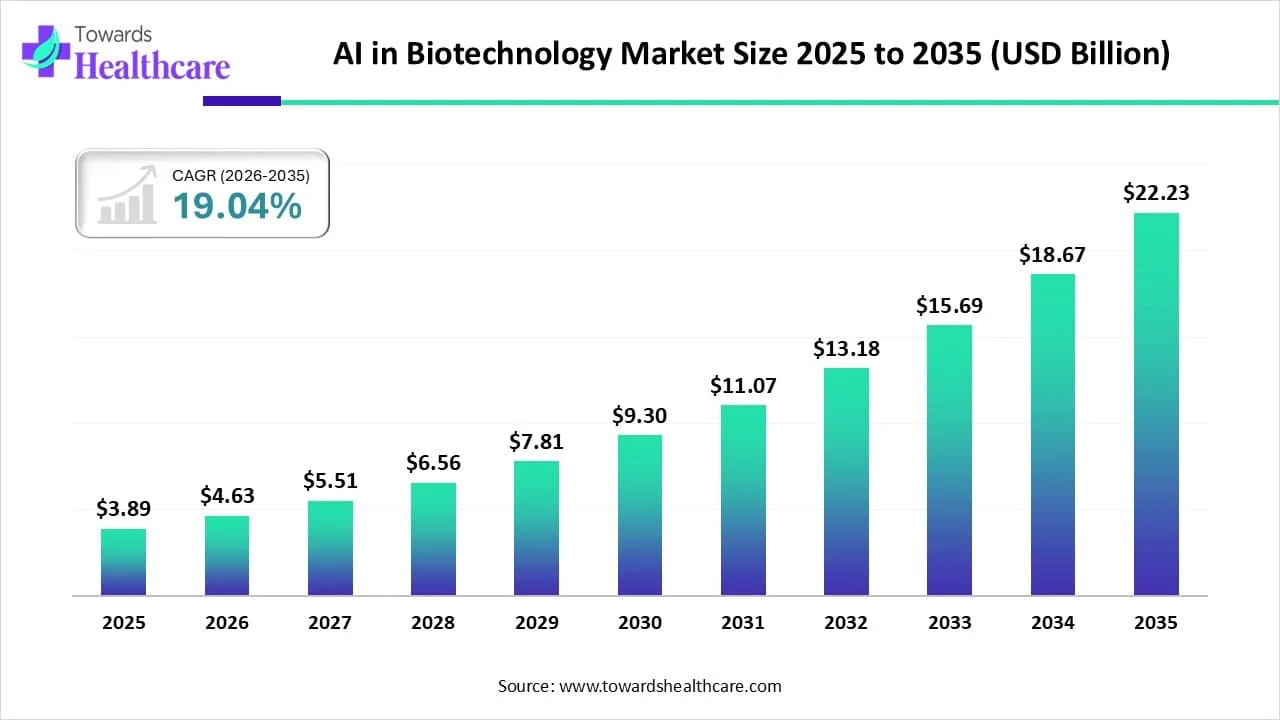
Image Source: Towards Healthcare
Third, strategic collaborations between technology giants and biotech innovators are accelerating adoption. Companies like NVIDIA, Microsoft Azure, and Alphabet/DeepMind are investing heavily in AI infrastructure designed specifically for biotechnology research. These collaborations enable biotechnology firms, especially startups, to access AI tools without requiring large upfront investments.
Fourth, the industry’s shift toward personalized medicine and precision oncology demands analytic tools that can process patient-specific genetic, proteomic, and phenotypic datasets. AI is uniquely positioned to power these next-generation therapeutic solutions.
Together, these drivers ensure that AI will remain a critical force pushing the biotechnology market toward deeper innovation, faster discovery, lower costs, and scalable global impact.
How Is North America Leading the Global AI in Biotechnology Market?
North America accounted for 50% of the global revenue in 2024, making it the undisputed leader in AI-enabled biotech solutions. This dominance is rooted in several structural advantages. The region is home to a highly developed pharmaceutical sector, robust computational infrastructure, and major AI-driven biotech companies. The U.S. has also implemented strong federal initiatives supporting AI-driven research, particularly in precision oncology, genomics, rare diseases, and clinical trial optimization.
Additionally, the U.S. boasts a thriving ecosystem of startups, venture capital firms, and innovation hubs. Powerful initiatives such as the National Cancer Institute’s Childhood Cancer Data Initiative, a USD 500 million program, are fostering large-scale data collection and AI-driven discovery.
Canada is also emerging as a strong contributor. Nearly 87% of Canadian healthcare organizations now use AI in some form, reflecting rapid adoption across diagnostics, drug discovery, and genomics. The country’s federal AI programs and national innovation centers have supported hundreds of AI-focused biotech projects, further strengthening its position.
Together, the U.S. and Canada form a highly competitive AI-bioeconomy powered by academic institutions, research labs, cloud platform providers, CROs, and technology giants.
How Is Asia-Pacific Becoming the Fastest-Growing Region in AI-Driven Biotech Innovation?
Asia-Pacific is projected to grow at the fastest CAGR during the forecast period. Several countries across the region are actively integrating AI into research workflows, diagnostics, and advanced computational biology.
China is propelling growth through massive investments in AI infrastructure and health data systems. With centralized hospital data from 38,000+ healthcare institutions, China has created one of the world’s largest medical datasets, fueling next-generation drug discovery, genomics-based diagnostics, and clinical modeling.
India is following a similar growth trajectory. The IndiaAI Mission’s investment of ₹10,371 crore ($1.2 billion) aims to strengthen AI infrastructure, develop indigenous AI models, and accelerate research in biotechnology. India’s new BioE3 Policy encourages sustainable biomanufacturing and establishes national bio-AI hubs, creating a strong foundation for AI integration in research, agriculture, and biopharma.
Japan, South Korea, Thailand, and Singapore are also investing in multi-omics research, computational labs, and AI-driven diagnostics, accelerating the region’s overall growth.
How Is Europe Strengthening Its Position Through Policy, Regulation, and Investment?
Europe is building an innovation-forward AI-enabled biotechnology ecosystem through large-scale investments, ethical frameworks, and collaborative research networks. The European Union has launched a €200 billion AI investment plan to accelerate infrastructure development, including high-performance computing hubs for biotech research.
The introduction of the Artificial Intelligence Act in August 2024 ensures safe, transparent, and ethical deployment of AI in healthcare and biotechnology. This regulatory stability is encouraging more companies to invest in AI-enabled R&D.
Countries like Germany are taking a leadership role. Germany’s €5.5 billion national AI strategy aims to integrate AI into 10% of its GDP by 2030. The creation of the Innovation Park Artificial Intelligence (IPAI), a large-scale industrial research campus, reflects the country’s commitment to advancing human-centered AI and computational biotech research.
Finland, Sweden, Norway, Italy, and France are also building AI factories and data centers supporting startups, academia, and biotech innovators.
Which Application Segment Is Driving the Market’s Strongest Growth?
The dominant segment in 2024 was drug discovery and lead generation, accounting for 36% of total revenue. This dominance is the result of widespread adoption of AI-driven platforms that reduce discovery timelines by up to 30%. AI algorithms streamline target identification, molecule screening, binding prediction, and early-stage modeling, enabling pharmaceutical companies to accelerate R&D pipelines.
This segment is expected to maintain its leadership as biopharma companies continue investing heavily in computational drug discovery.
However, the agriculture and industrial biotechnology segment is emerging as the fastest-growing category. With rising interest in biofertilizers, engineered enzymes, sustainable biomanufacturing, and climate-resilient crops, this segment is attracting investments exceeding USD 5 billion. Governments worldwide are encouraging the adoption of bio-based technologies and eco-friendly agricultural systems powered by AI-driven research and modelling.
Why Are Classical Machine Learning and Deep Learning Models Still Dominating the Market?
Although generative AI is growing rapidly, classical ML and deep learning models continue to dominate with 30% revenue share in 2024. Their widespread adoption across predictive analytics, molecular modeling, and biomarker discovery ensures their continued relevance.
Over 100 AI-driven drug discovery platforms currently rely on these models. Coupled with global investments of USD 3.5 billion in AI-based R&D, classical ML and deep learning remain foundational technologies for biotech research, powering tasks such as:
-
toxicity prediction
-
drug-target interaction modeling
-
protein structure interpretation
-
omics data classification
Generative AI will grow faster in the coming decade, but classical machine learning remains the backbone of most deployed systems.
Why Are SaaS and Cloud AI Platforms Leading the Commercial Model Segment?
In 2024, SaaS and cloud AI platforms dominated with a 48% revenue share, driven by their scalability, flexibility, and cost efficiency. Biotech firms prefer cloud-based AI platforms because they offer immediate access to high-performance computing and collaborative workflows without requiring large infrastructure investments.
These platforms enable seamless integration with existing pipelines, real-time data sharing across global teams, and on-demand scaling during complex simulations or large dataset processing.
Cloud-based AI solutions also support:
-
automated lab workflows
-
in-silico experiments
-
multi-user collaboration
-
rapid deployment of new models
As a result, the SaaS model is expected to remain the fastest-growing segment during the forecast period.
How Are Large Pharmaceutical Companies Maintaining Their Dominance in the AI-Biotech Ecosystem?
In 2024, large pharma and big biotech companies held 52% of the total market, making them the largest adopters of AI. Their strong financial capabilities, global research networks, and vast clinical pipelines enable them to be early adopters of advanced computational platforms.
Major biopharma companies are integrating AI across:
-
lead optimization
-
preclinical modelling
-
clinical trial design
-
supply chain automation
-
bioprocessing optimization
These organizations have the resources to invest in enterprise-level AI platforms, on-premise deployments, and large-scale data integration systems, enabling them to leverage AI at scale.
Meanwhile, biotech startups and virtual biotechs are rapidly emerging as the fastest-growing end-user category. With minimal infrastructure needs and strong venture capital support, these firms are agile, innovation-driven, and early adopters of generative AI-powered drug discovery.
Which Companies Are Emerging as Key Players in the AI in Biotechnology Market?
A wide range of organizations, from AI-native biotech companies to global technology giants—are driving the market forward. Leading players include:
Exscientia, Recursion Pharmaceuticals, Insilico Medicine, Atomwise, Valo Health, BenevolentAI, Deep Genomics, Cyclica/Numinus, Relay Therapeutics, Schrödinger, NVIDIA, Microsoft Azure, Alphabet/DeepMind, IQVIA, Certara, Evotec, Charles River/Labcorp, Benchling, and collaborative data platform providers worldwide.
Several major developments in 2024–2025 highlight growing momentum:
Insilico Medicine launched the Nach01 foundation model on AWS Marketplace, giving researchers access to structural and spatial AI models for advanced drug design.
NVIDIA and Illumina partnered to integrate multi-omics tools through DRAGEN and BioNeMo, strengthening global genomics and computational R&D.
These innovations are redefining how companies accelerate discovery, reduce costs, and scale research efficiently.
How Are Governments Supporting AI-Driven Biotech Development?
Governments across the world have initiated major programs to support AI integration into biotech R&D. In the U.S., DARPA’s Biological Technologies Office allocated USD 4.5 million to AI-biotech innovation projects aimed at strengthening modelling, warfighter health, and defense-focused applications.
India approved the BioE3 Biotechnology Policy and launched biomanufacturing initiatives to support eco-friendly industrial biotechnology. The government is establishing biofoundries, AI-Bio hubs, and green biomanufacturing facilities.
China, Europe, Canada, Japan, and several Middle Eastern nations are also implementing policies that support AI infrastructure, HPC deployment, multi-omics data sharing, and regulatory frameworks.
These initiatives ensure that AI becomes deeply integrated into national biotechnology ecosystems.
What Does the Future Hold for the AI in Biotechnology Market?
The AI-enabled biotechnology market is entering a transformative decade full of unprecedented innovations. By 2035, AI will lead to faster, cheaper, and more accurate breakthroughs in drug discovery, gene editing, precision medicine, and bioprocessing.
Generative AI models will become core engines for molecular design. Automated robotic labs will handle experimental workflows. Digital twins will simulate cellular behaviour and optimize clinical outcomes. Omics-based diagnostics will become mainstream. Biomanufacturing systems will operate with real-time AI-driven optimization.
In summary, AI will not just support biotechnology, it will reinvent it.
With strong momentum, cross-industry collaboration, rising investor confidence, and rapid advancements in computational technologies, the global AI-driven biotechnology landscape is set to grow dramatically in the coming decade.
Access our exclusive, data-rich dashboard dedicated to the biotechnology industries – built specifically for decision-makers, strategists, and industry leaders. The dashboard features comprehensive statistical data, segment-wise market breakdowns, regional performance shares, detailed company profiles, annual updates, and much more. From market sizing to competitive intelligence, this powerful tool is one-stop solution to your gateway.
Access the Dashboard: https://www.towardshealthcare.com/access-dashboard
Checkout AI in Biotechnology Market Report Now at: https://www.towardshealthcare.com/checkout/6312
Become a valued research partner with us – https://www.towardshealthcare.com/schedule-meeting
You can place an order or ask any questions, please feel free to contact us at [email protected]
Powering Healthcare Leaders with Real-Time Insights: https://www.towardshealthcare.com/healthcare-intelligence-platform
Europe Region – +44 778 256 0738
North America Region – +1 8044 4193 44
APAC Region: +91 9356 9282 04
Visit Our Website: https://www.towardshealthcare.com
Find us on social platforms: LinkedIn | Twitter | Instagram | Medium | Pinterest