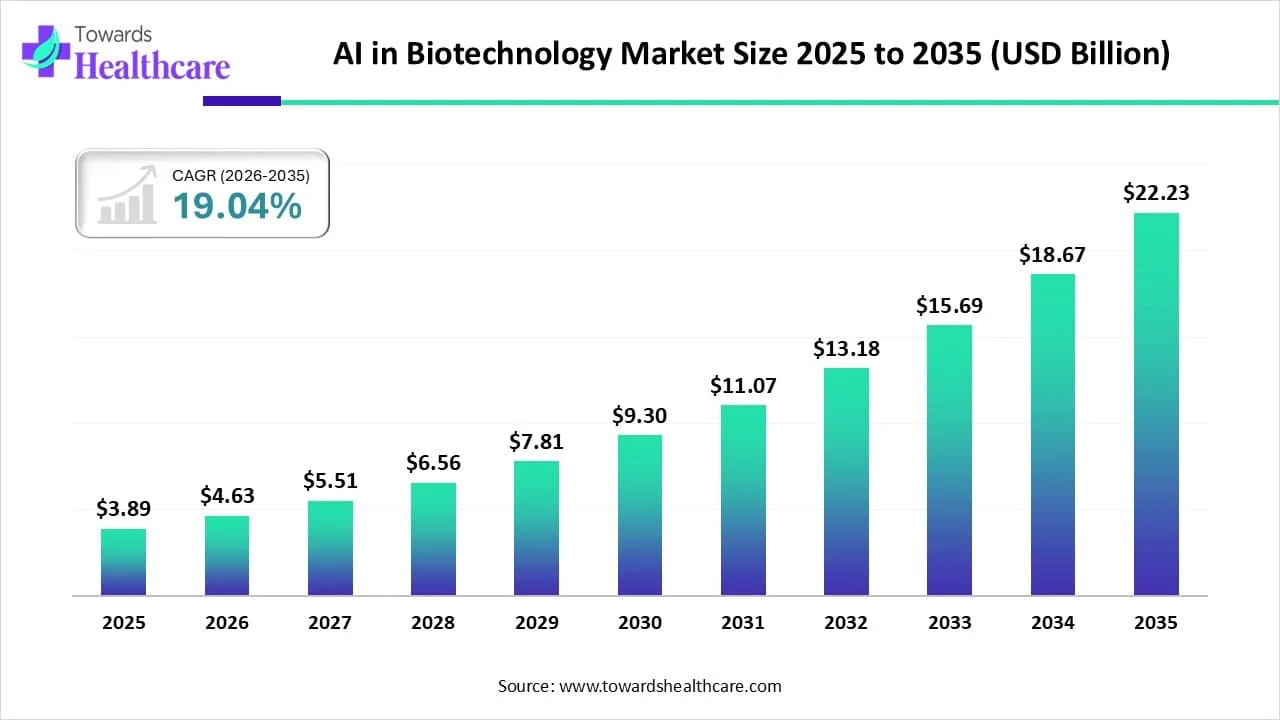
The AI in biotechnology market has emerged as one of the most dynamic and rapidly expanding sectors within the global life sciences industry. As of 2025, the market reached a valuation of approximately USD 3.89 billion, reflecting the growing adoption of artificial intelligence across diverse areas of biotechnology, from drug discovery to genomics, protein engineering, and personalized medicine. By 2026, analysts project the market to grow to USD 4.63 billion, while long-term forecasts suggest it could reach around USD 22.23 billion by 2035, representing a compound annual growth rate of 19.04%. This remarkable growth underscores the transformative potential of AI in accelerating biotechnological innovation and optimizing research processes that were traditionally resource-intensive, time-consuming, and costly.
Download Free Sample: https://www.towardshealthcare.com/download-sample/6312
AI technologies have reshaped the way biotechnology research is conducted. Advanced computational methods now allow researchers to process vast datasets efficiently, generate predictive models, and optimize experimental designs with unprecedented speed and accuracy. The integration of AI into biotechnology has facilitated breakthroughs in multiple domains, particularly drug discovery and development. Drug discovery, historically characterized by high costs and long development cycles, has been revolutionized by AI-driven platforms capable of identifying promising molecules, predicting their interactions, and even generating novel compounds using generative models. These platforms reduce discovery timelines by almost a third, enabling pharmaceutical companies to accelerate pipeline progression and bring innovative therapies to market faster than ever before.
Regional Dynamics: Market Leaders and Emerging Hubs
The market dynamics of AI in biotechnology reveal strong regional variation, with North America leading the sector due to its advanced biotech infrastructure, robust research and development investment, and supportive regulatory frameworks. In 2024, North America accounted for approximately 50 percent of the global market share. The United States, in particular, has heavily invested in AI-driven drug discovery, precision medicine, and computational biology. Programs such as the National Cancer Institute’s Childhood Cancer Data Initiative, a ten-year, USD 500 million initiative, reflect the country’s commitment to integrating AI into healthcare research. These initiatives enable comprehensive data collection, secure sharing of sensitive medical information, and enhanced predictive modeling, thereby accelerating the development of targeted therapies.
Canadian efforts complement this expansion, with a significant proportion of healthcare organizations adopting AI in diagnostics and research, alongside national programs supporting AI-biotechnology startups. Asia-Pacific is emerging as a high-growth market in AI-driven biotechnology. Countries such as China and India are leveraging AI to address both healthcare challenges and biotechnological innovation. China’s centralized health data systems, encompassing information from over 38,000 hospitals, provide a unique opportunity for large-scale AI-driven drug discovery and clinical research. Generative AI applications are increasingly used to design novel molecules and optimize therapeutic pathways. India’s strategic initiatives, including the BioE3 biotechnology policy and the IndiaAI Mission, are fostering AI integration into biotech through funding for AI infrastructure, startup support, and academic programs in bioinformatics and AI healthcare.
Europe, while slower in market share compared to North America, has strategically invested in AI in biotechnology through policy initiatives and research collaborations. The European Union’s substantial investment plan and the implementation of the Artificial Intelligence Act in 2024 emphasize safe and ethical deployment of AI in biotech research. Countries such as Germany, Finland, and Sweden have established AI Factories and innovation hubs to facilitate collaboration between startups, academic institutions, and industry players. Germany’s national AI strategy, coupled with initiatives like the Innovation Park Artificial Intelligence in Heilbronn, exemplifies Europe’s approach to fostering cutting-edge AI solutions while maintaining regulatory oversight, ensuring trust and safety in AI-driven biotechnological applications.
Technological Drivers of AI in Biotechnology
At the core of AI in biotechnology, technological innovation drives market growth. Classical machine learning and deep learning models currently dominate the market, accounting for roughly 30 percent of revenue in 2024. These models are widely employed for predictive analytics, drug-target identification, biomarker discovery, and protein structure prediction. Their versatility and proven efficacy have led to widespread adoption across pharmaceutical companies and research institutions, enabling faster decision-making and reducing the risk of experimental failures.
Emerging technologies such as generative AI are gaining momentum. Generative AI has demonstrated remarkable potential in designing novel molecules, optimizing molecular structures, and accelerating lead generation. As investment in AI-driven drug discovery intensifies, the generative AI segment is expected to grow at an exceptional pace, potentially transforming early-stage R&D workflows and reducing time-to-market for new therapeutics. Graph neural networks are increasingly applied for molecular modeling, protein-ligand interactions, and biological pathway simulations. Natural language processing and knowledge graphs facilitate literature and patent data mining, allowing rapid extraction of actionable insights. Digital twins and physics-hybrid models simulate biological processes virtually, reducing experimental errors and accelerating innovation. Explainable AI ensures transparency and builds trust in AI predictions, particularly in regulated environments such as healthcare and biotechnology.
Commercial Models and Market Segmentation
SaaS and cloud-based AI platforms lead the market commercially, accounting for nearly half of the revenue share in 2024. These platforms offer scalability, flexibility, and ease of deployment, enabling biotech and pharmaceutical companies to implement AI-driven workflows rapidly without significant upfront infrastructure investments. Cloud platforms facilitate remote collaboration, streamline data accessibility, and allow integration with existing AI tools. Their ability to handle large-scale computational tasks is particularly beneficial for genomics and proteomics research, which require processing enormous datasets. Other commercial models, such as collaborative partnerships, licensing arrangements, and fee-for-service engagements, further enhance the market by enabling tailored solutions for large pharma, startups, and research organizations.
Market segmentation highlights the strategic role of end-user types in driving AI adoption. Large pharmaceutical companies and big biotech firms account for over half of the market share, leveraging their extensive R&D capabilities and financial resources to deploy advanced AI platforms. Their established infrastructure and global pipelines make them primary beneficiaries of AI-enabled efficiency gains in drug discovery, clinical development, and biomanufacturing optimization. Biotech startups and virtual biotech firms are emerging as agile players capable of adopting cloud-based AI tools and computational models rapidly. Supported by government initiatives, incubators, and venture capital funding, these startups focus on niche therapeutic areas and innovative approaches, expanding the scope and diversity of AI applications in biotechnology.
Transforming Drug Discovery and Clinical Research
The AI in biotechnology market spans a wide range of applications, from drug discovery and lead generation to preclinical research, clinical development, bioprocessing optimization, diagnostics, and industrial biotech applications. Drug discovery remains the largest segment, driven by AI-enabled screening platforms that reduce timelines and enhance success rates. Preclinical research and biomarker discovery benefit from predictive modeling and AI-driven analysis of biological data, facilitating more precise and efficient experimentation. Clinical trial optimization, including patient recruitment and trial design, leverages AI to improve outcome predictability and reduce operational costs. Bioprocessing and manufacturing optimization, incorporating predictive analytics, automation, and real-time monitoring, enhance production efficiency and quality control. Diagnostics and companion diagnostics employ AI for image analysis, multi-omics data interpretation, and early disease detection, as demonstrated by AI-based cancer detection systems in India that analyze hundreds of thousands of radiology and pathology images to accurately detect common cancers.
Industrial and Agriculture biotech applications are witnessing rapid growth, leveraging AI to enhance biofertilizer development, genetically engineered crops, and enzyme-based industrial processes. Over 120 new biotech products are projected to launch globally in this segment, supported by government policies promoting eco-friendly biotechnology and sustainable manufacturing. This integration of AI into agricultural and industrial biotechnology is expected to revolutionize these sectors by improving efficiency, reducing environmental impact, and creating new market opportunities.
Investment Trends and Strategic Collaborations
Investment trends within the AI in biotechnology market reveal strong interest from venture capital, tech giants, and pharmaceutical companies. Strategic acquisitions, partnerships, and collaborations accelerate innovation and enable market expansion. Virginia-based Zephyr AI raised USD 111 million to advance AI-driven precision medicine, focusing on oncology and cardiometabolic diseases. Atomwise secured USD 123 million in Series C funding and partnered with Sanofi to explore potential drug targets. NVIDIA’s deal with Microsoft, involving over 100,000 GPUs for internal AI projects, highlights the importance of high-performance computing in large-scale AI adoption. Similarly, Exscientia’s acquisition by Recursion Pharmaceuticals combines AI drug discovery expertise with robust development capabilities, illustrating the trend of consolidating AI innovation within established biotech frameworks.
Sustainability and the Future of AI in Biotechnology
The future of AI in biotechnology emphasizes sustainability and efficiency. AI-driven approaches minimize the reliance on resource-intensive research, optimize laboratory energy consumption, reduce experimental waste, and enable eco-friendly drug development. Predictive modeling allows researchers to simulate experiments in silico, reducing the need for extensive wet-lab testing. These capabilities lower costs, reduce environmental impact, and accelerate the development of therapeutics to address global health challenges. AI’s ability to analyze complex datasets enables more personalized medicine approaches, improving treatment outcomes while promoting scalable and sustainable R&D practices.
Global collaboration also defines AI-driven biotech innovation. Partnerships between pharmaceutical companies, AI platforms, cloud providers, and research institutions accelerate breakthroughs in drug discovery, clinical trials, and biomanufacturing. Insilico Medicine’s introduction of the Nach01 foundation model on AWS Marketplace demonstrates how AI tools can be scaled for global access, enhancing efficiency in drug design. Nvidia and Illumina’s collaboration integrates AI with genomics, facilitating multi-omics analysis and expanding access to predictive technologies worldwide.
The AI in biotechnology market continues to evolve rapidly, reshaping the boundaries of research, production, and healthcare delivery. Emerging trends suggest growing integration of AI with real-world data, predictive healthcare models, and personalized medicine approaches. Industrial and agricultural biotechnology will increasingly benefit from AI, offering solutions for sustainable bio-manufacturing, optimized crop yields, and environmentally conscious production methods. Startups and virtual biotech firms will drive niche innovations, while large pharmaceutical players and technology giants scale AI integration across global R&D pipelines. Governments and investors remain key enablers, funding AI initiatives, supporting infrastructure, and encouraging ethical innovation practices.
By 2035, the AI in biotechnology market is expected to surpass USD 22 billion, fueled by continuous technological innovation, strategic investments, and the proliferation of AI-enabled tools across drug discovery, diagnostics, and biomanufacturing. The sector exemplifies the future of biotechnology—a landscape where technology and biology intersect seamlessly to solve complex scientific challenges, drive economic growth, and transform human health on a global scale. The journey of AI in biotechnology is only beginning, and its potential to reshape industries, accelerate breakthroughs, and improve lives is virtually limitless.
Access our exclusive, data-rich dashboard dedicated to the Biotechnology sector – built specifically for decision-makers, strategists, and industry leaders. The dashboard features comprehensive statistical data, segment-wise market breakdowns, regional performance shares, detailed company profiles, annual updates, and much more. From market sizing to competitive intelligence, this powerful tool is one-stop solution to your gateway.
Access the Dashboard: https://www.towardshealthcare.com/access-dashboard
Checkout AI in Biotechnology Market Report Now at: https://www.towardshealthcare.com/checkout/6312
Become a valued research partner with us – https://www.towardshealthcare.com/schedule-meeting
You can place an order or ask any questions, please feel free to contact us at [email protected]
Powering Healthcare Leaders with Real-Time Insights: https://www.towardshealthcare.com/healthcare-intelligence-platform
Europe Region – +44 778 256 0738
North America Region – +1 8044 4193 44
APAC Region: +91 9356 9282 04
Visit Our Website: https://www.towardshealthcare.com
Find us on social platforms: LinkedIn | Twitter | Instagram | Medium | Pinterest