The healthcare industry has always struggled with a paradox: as medicine becomes more advanced, the systems supporting it grow increasingly complex and time-consuming. Clinicians spend more hours on documentation than on direct patient care, patients face long wait times and fragmented communication, and healthcare systems wrestle with rising costs and workforce shortages. Against this backdrop, AI voice agents are emerging not as a futuristic experiment, but as a practical response to some of healthcare’s most persistent challenges.
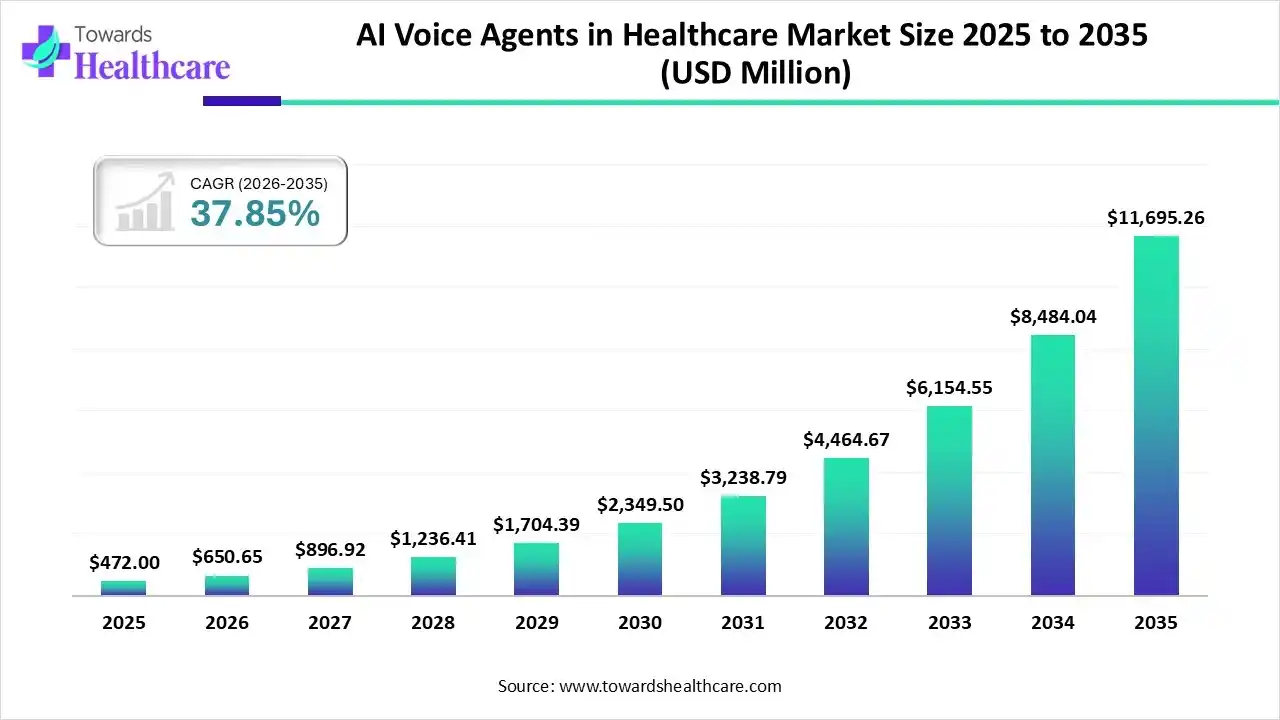
By 2025, the global AI voice agents in healthcare market reached an estimated value of USD 472 million. What makes this figure noteworthy is not its size today, but the trajectory ahead. Market projections indicate growth to USD 650.65 million in 2026 and a dramatic expansion to nearly USD 11.7 billion by 2035. This represents a compound annual growth rate approaching 38 percent, a pace that signals not incremental adoption but a structural shift in how healthcare communication and workflows operate.
Download Free Sample:
https://www.towardshealthcare.com/download-sample/6511
This growth is not driven by hype alone. It reflects a deeper transformation in how healthcare systems interact with patients, manage data, and support clinical decision-making in an increasingly digital-first environment.
Why Healthcare Is Finally Ready to Talk to Machines
For decades, voice technology existed at the fringes of healthcare, often limited to basic dictation tools that struggled with medical terminology, accents, and clinical nuance. What has changed over the past few years is the maturity of natural language processing, speech recognition, and machine learning. Modern AI voice agents do not simply transcribe speech; they understand context, intent, and workflow.
Healthcare providers now operate in an environment defined by telehealth expansion, value-based care models, and patient expectations shaped by consumer technology. Patients expect healthcare interactions to be as seamless as booking a ride or speaking to a digital assistant at home. At the same time, clinicians face unprecedented burnout, driven in large part by administrative overload. AI voice agents sit at the intersection of these pressures, offering a way to improve patient experience while easing operational strain.
Unlike chatbots confined to text interfaces, voice agents mirror natural human communication. This makes them particularly powerful in healthcare, where empathy, clarity, and accessibility matter as much as efficiency. Voice-based systems lower barriers for elderly patients, individuals with limited digital literacy, and populations in remote or underserved regions.
From Appointment Scheduling to Clinical Intelligence
The earliest use cases for AI voice agents focused on administrative tasks such as appointment scheduling, reminders, and basic patient inquiries. While these applications remain important, the scope has expanded significantly. Today’s voice agents actively support patient engagement, clinical workflows, and even elements of decision support.
In patient-facing roles, AI voice agents provide round-the-clock assistance, answer questions about medications, track symptoms, and guide patients through pre- and post-visit instructions. These interactions improve adherence and continuity of care, particularly for chronic disease management. For providers, voice agents capture clinical notes during consultations, automate data entry into electronic health records, and reduce time spent navigating complex IT systems.
The integration with EHRs represents one of the most consequential developments in this market. When voice agents document encounters in real time and structure data accurately, they reduce errors, improve data quality, and free clinicians to focus on patient interaction rather than screens. This shift has profound implications for clinician satisfaction and patient trust.
Conversational AI Takes the Lead
Within the AI voice agents ecosystem, conversational AI platforms dominate the market, accounting for roughly 40 percent of revenue in 2025. Their leadership stems from versatility. These platforms handle patient communication, scheduling, care navigation, and telehealth interactions within a single conversational framework. Their ability to integrate with existing healthcare systems makes them attractive to hospitals and clinics seeking scalable solutions rather than fragmented tools.
At the same time, virtual health assistants are gaining momentum at an even faster pace. These systems offer personalized, always-on support that aligns with the broader shift toward preventive and patient-centered care. As healthcare moves beyond episodic treatment toward continuous engagement, virtual assistants become a natural extension of the care team.
Cloud, Scale, and the Speed of Adoption
Deployment models tell another part of the story. Cloud-based AI voice agents captured more than half of market revenue in 2025 and continue to grow at the fastest rate. Cloud infrastructure enables rapid deployment, continuous updates, and seamless integration across multiple facilities. For large health systems managing thousands of patient interactions daily, scalability is not optional.
Cloud deployment also supports advanced analytics and machine learning models that improve over time. As voice agents process more interactions, they refine their understanding of clinical language, patient behavior, and workflow patterns. This learning loop is central to the long-term value proposition of AI voice agents.
Patient Engagement as the Primary Driver
Among application areas, patient engagement and support remain the largest segment, representing nearly half of the market in 2025. This dominance reflects a fundamental truth: communication is at the heart of healthcare outcomes. Missed appointments, medication non-adherence, and unclear instructions cost healthcare systems billions each year and compromise patient health.
AI voice agents address these gaps through consistent, personalized communication. They remind patients about medications, follow up after procedures, and provide reassurance outside traditional clinic hours. Over time, these seemingly small interactions add up to measurable improvements in satisfaction and outcomes.
Clinical workflow assistance, however, is emerging as the fastest-growing application. As providers seek to reduce burnout and improve productivity, voice-driven documentation and task automation move from optional enhancements to operational necessities.
Technology Foundations That Matter
Natural language processing and speech recognition underpin the current generation of AI voice agents, accounting for nearly 45 percent of market revenue in 2025. These technologies enable accurate transcription and conversational understanding in complex clinical environments. Yet the fastest growth lies in machine learning and advanced AI algorithms, which transform voice agents from reactive tools into proactive assistants.
By combining voice interaction with predictive analytics, AI agents can identify trends, flag potential risks, and support clinical decisions. This convergence of communication and intelligence represents the next phase of evolution, where voice agents move beyond execution to insight generation.
Hospitals Lead, but Pharma Is Catching Up
Hospitals and health systems remain the largest end users, capturing about half of the market in 2025. Their scale, complexity, and resource availability make them early adopters of voice technology. Large health systems benefit most immediately from workflow automation and EHR integration.
Pharmaceutical and biotech companies, however, are emerging as the fastest-growing end-user segment. Their interest reflects expanding use cases in clinical trials, patient support programs, pharmacovigilance, and market access operations. As drug development becomes more data-intensive and patient-centric, AI voice agents offer new ways to manage communication at scale.
North America Sets the Pace, Asia Pacific Accelerates
Geographically, North America dominates the AI voice agents in healthcare market, accounting for roughly 35 percent of revenue in 2025. The region benefits from advanced healthcare IT infrastructure, high digital health investment, and strong regulatory frameworks that support innovation. The United States, in particular, leads in adoption due to widespread EHR usage and a culture of technological experimentation in healthcare delivery.
Asia Pacific tells a different but equally compelling story. While starting from a smaller base, the region is expected to grow at the fastest rate during the forecast period. Large populations, rising healthcare demand, and government-backed digital health initiatives create fertile ground for AI voice agents. Countries such as China and India are investing heavily in healthcare digitization, laying the foundation for scalable voice-based solutions that can reach both urban and rural populations.
Europe occupies a steady middle ground, with significant growth driven by strong public healthcare systems and increasing focus on efficiency and patient experience. Regulatory emphasis on data protection has slowed adoption in some cases, but it has also pushed vendors to build more secure and compliant solutions.
Investment, Policy, and Momentum
Recent investments and government initiatives underscore the strategic importance of AI voice agents. Funding rounds targeting AI-driven healthcare automation signal confidence in long-term demand. National digital health missions, particularly in emerging markets, provide the infrastructure needed for voice agents to integrate with unified health records and standardized data frameworks.
The establishment of centers of excellence for AI in healthcare reflects a broader recognition that voice agents are not standalone tools but part of a larger digital ecosystem encompassing diagnostics, treatment planning, and population health management.
Competitive Landscape Shaped by Real-World Impact
Leading vendors in this market distinguish themselves not through marketing claims but through real-world deployment and measurable outcomes. Solutions that reduce clinician documentation time, improve call center efficiency, or enhance patient satisfaction gain traction quickly. Vendors such as Suki AI, Orbita, Nuance, Sensely, and Infinitus Systems have built reputations around solving specific, high-value problems rather than offering generic AI capabilities.
Their success highlights an important lesson: in healthcare, technology adoption follows trust and utility, not novelty.
Challenges That Cannot Be Ignored
Despite rapid growth, AI voice agents face real challenges. Implementation costs remain a barrier for smaller facilities. Variability in accents, languages, and clinical environments tests the limits of voice recognition accuracy. Resistance from healthcare professionals, often rooted in workflow disruption or data privacy concerns, requires thoughtful change management.
Regulatory compliance adds another layer of complexity. Healthcare data is among the most sensitive information handled by any industry. Voice agents must meet stringent standards for security, consent, and transparency to earn and maintain trust.
Access our exclusive, data-rich dashboard dedicated to the healthcare market – built specifically for decision-makers, strategists, and industry leaders. The dashboard features comprehensive statistical data, segment-wise market breakdowns, regional performance shares, detailed company profiles, annual updates, and much more. From market sizing to competitive intelligence, this powerful tool is one-stop solution to your gateway.
Access the Dashboard: https://www.towardshealthcare.com/access-dashboard
Checkout AI Voice Agents in Healthcare Market Report Now at: https://www.towardshealthcare.com/checkout/6511
Become a valued research partner with us – https://www.towardshealthcare.com/schedule-meeting
You can place an order or ask any questions, please feel free to contact us at [email protected]
Powering Healthcare Leaders with Real-Time Insights: https://www.towardshealthcare.com/healthcare-intelligence-platform
Europe Region – +44 778 256 0738
North America Region – +1 8044 4193 44
APAC Region: +91 9356 9282 04
Visit Our Website: https://www.towardshealthcare.com
Find us on social platforms: LinkedIn | Twitter | Instagram | Medium | Pinterest