Pharmaceutical packaging rarely gets the spotlight it deserves. Patients remember the medicine, not the blister pack. Regulators focus on the formulation, not the carton. Yet anyone with deep exposure to the pharmaceutical ecosystem knows that packaging is no longer a supporting function, it is a strategic pillar. Over the past decade, the pharmaceutical packaging market has shifted from being a cost-driven operational necessity to a value-driven enabler of safety, trust, compliance, and efficiency.
Today, packaging decisions influence drug stability, patient adherence, supply chain transparency, anti-counterfeiting efforts, and even brand credibility. As global healthcare systems expand and drug portfolios diversify, packaging has quietly evolved into one of the most dynamic segments of the pharmaceutical value chain.
The global pharmaceutical packaging market was estimated at US$ 184.23 billion in 2026 and is projected to grow to US$ 425.25 billion by 2035, rising at a compound annual growth rate (CAGR) of 9.74% from 2026 to 2035.
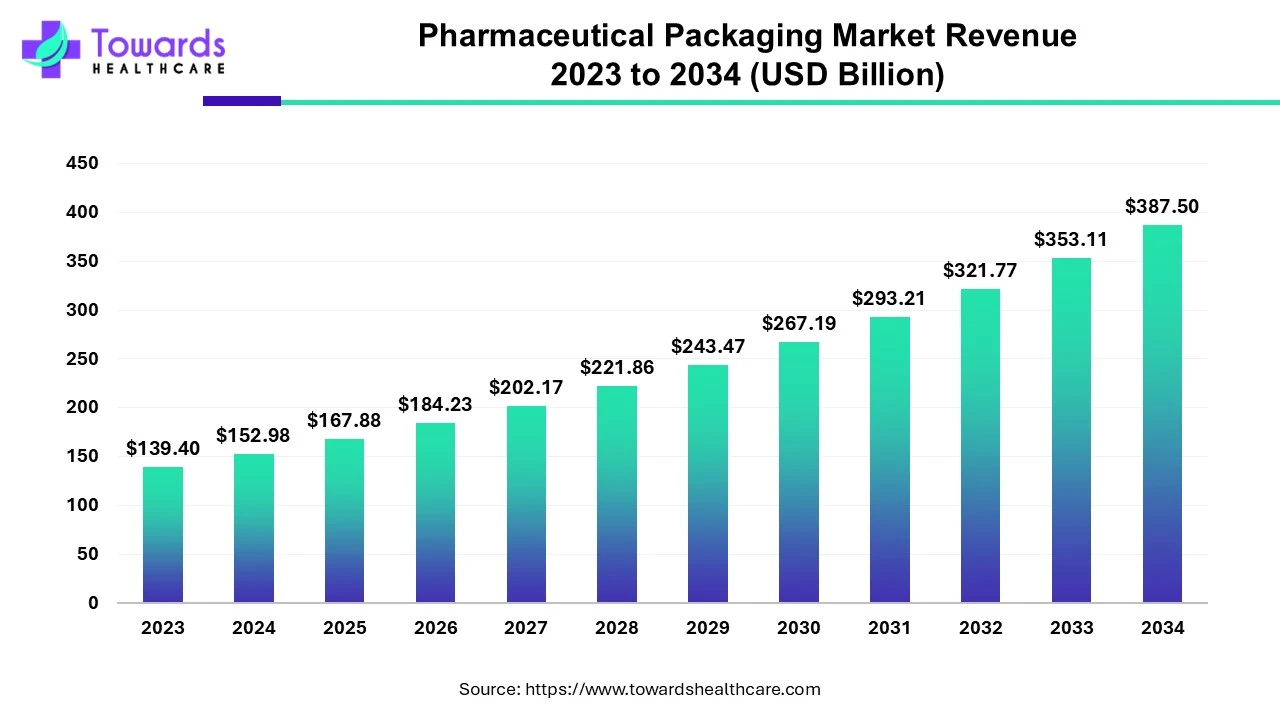
Download Free Sample Now and Get the Complete Report Easily at: https://www.towardshealthcare.com/download-sample/5247
Smart Packaging: When Protection Meets Intelligence
One of the most defining shifts in pharmaceutical packaging is the rise of smart packaging. Earlier, packaging existed to protect the drug from light, moisture, oxygen, and physical damage. That role still exists, but it has expanded significantly. Modern packaging now communicates, verifies, monitors, and sometimes even interacts.
Counterfeiting remains one of the most persistent threats to the pharmaceutical industry. Fake medicines not only erode revenue but also put patient lives at risk. Smart packaging addresses this challenge head-on. Technologies such as holograms, QR codes, NFC tags, and RFID labels have become powerful tools in ensuring product authenticity. These elements are difficult to replicate and easy to verify, enabling regulators, distributors, healthcare providers, and even patients to confirm legitimacy in seconds.
Beyond authentication, smart packaging now supports product tracking and condition monitoring. Temperature-sensitive drugs, biologics, and specialty injectables benefit immensely from packaging that can record and transmit data across the supply chain. With IoT integration gaining momentum, packaging is transforming into a data carrier, enabling real-time visibility into product movement, storage conditions, and shelf-life performance.
This evolution is not experimental anymore. It reflects a broader industry realization that packaging intelligence directly impacts patient safety, regulatory compliance, and operational resilience.
Why Plastics and Polymers Continue to Dominate
Despite growing conversations around sustainability, plastics and polymers remain the dominant material segment in pharmaceutical packaging. This dominance is not accidental. It is the result of decades of material science optimization, regulatory familiarity, and manufacturing efficiency.
Plastic packaging offers a combination of attributes that few materials can match at scale. It is lightweight, cost-effective, versatile, and easy to mold into complex designs. From bottles and blister packs to prefilled syringes and caps, plastics enable high-volume, high-precision production with consistent quality.
Materials such as PVC, PET, PE, and PP have become industry standards in primary packaging. Their chemical stability, barrier properties, and compatibility with various drug formulations make them indispensable. Moreover, plastics support tamper-evident designs that strengthen patient trust and deter misuse.
While innovation continues in alternative materials, plastics remain deeply embedded in pharmaceutical packaging infrastructure. Any transition away from them will require not only technological readiness but also regulatory alignment and large-scale manufacturability.
Paper and Paperboard: The Quiet Growth Story
While plastics dominate, paper and paperboard are steadily rewriting their role in pharmaceutical packaging. Traditionally viewed as secondary or tertiary packaging materials, they are now gaining renewed relevance due to sustainability pressures and design innovation.
Paper-based materials serve a critical role in communicating identity and information. Cartons, inserts, sachets, and blister backings carry essential regulatory details, dosage instructions, safety warnings, and branding elements. Over time, advancements in coating and lamination technologies have improved their barrier performance, making them more reliable and protective.
The growth of paper and paperboard reflects a broader industry shift toward eco-conscious packaging strategies. Pharmaceutical companies increasingly recognize that sustainability is not optional. It influences investor sentiment, regulatory frameworks, and public perception.
Innovations such as compact blister designs and push-through paperboard solutions demonstrate that paper-based packaging is not merely an environmental alternative but also a functional and user-friendly one. This segment’s growth signals a future where sustainability and performance no longer compete, they coexist.
Primary Packaging: Where Responsibility Is Absolute
Primary packaging remains the most critical segment in the pharmaceutical packaging market. It is the first and closest point of contact between the drug and the outside world. Any failure here directly compromises product safety, efficacy, and sterility.
Vials, ampoules, prefilled syringes, tablets, blister packs, and bottles all fall under primary packaging. Each format demands precise material selection based on the drug’s sensitivity to light, moisture, oxygen, and temperature. In many cases, manufacturers rely on combinations of materials to achieve optimal protection.
The continued dominance of primary packaging reflects rising drug complexity. Biologics, specialty therapies, and personalized medicines place higher demands on packaging performance. As drug formulations evolve, primary packaging must keep pace to ensure stability throughout the product’s lifecycle, from manufacturing to patient use.
This segment’s rapid growth underscores a simple truth: the pharmaceutical industry cannot afford compromise at the primary packaging level.
Oral Drugs: The Volume Engine of Packaging Demand
Oral drugs continue to dominate pharmaceutical production volumes, and their impact on packaging demand is substantial. Tablets, capsules, powders, chewables, syrups, and oral vaccines account for a significant share of global drug consumption.
The widespread use of generics and over-the-counter medications further amplifies this demand. These products require cost-efficient, scalable, and compliant packaging solutions that can support mass distribution without sacrificing safety.
Oral drug packaging emphasizes convenience and adherence. Blister packs with clear dosage visibility, child-resistant bottles, and tamper-evident seals play a crucial role in patient compliance. As healthcare shifts toward preventive care and self-medication, oral drug packaging continues to expand both in volume and sophistication.
Injectables: Precision Packaging for Precision Medicine
Injectables represent the fastest-growing drug delivery segment, and packaging is central to that growth. Injectable drugs often involve high-value formulations with strict sterility and stability requirements. Packaging failures here are not tolerated.
Glass, particularly borosilicate type I glass, remains the gold standard for injectable primary packaging due to its chemical resistance and clarity. However, advanced plastics are gaining ground in specific applications where flexibility, break resistance, and lightweight design offer advantages.
Drug-device combination products further elevate packaging complexity. Prefilled syringes, auto-injectors, and infusion systems require packaging that supports not just containment but also device performance. Every material decision influences usability, accuracy, and patient safety.
As biologics, vaccines, and injectable therapies continue to grow, packaging innovation will remain tightly linked to therapeutic advancement.
Pharma Manufacturing: Where Packaging Strategy Takes Control
Pharmaceutical manufacturers dominate end-use demand in the packaging market for a clear reason: control. Many companies operate in-house packaging facilities, especially for primary packaging, to maintain quality assurance and protect intellectual property.
Packaging design has become a strategic asset. Proprietary formats, anti-counterfeiting features, and patented closures help companies differentiate products and safeguard brand integrity. Manufacturers also manage large-scale warehousing and tertiary packaging operations to ensure efficient distribution across global markets.
Government investments, public-private collaborations, and expanding healthcare access continue to fuel pharmaceutical manufacturing growth. Packaging scales alongside this expansion, adapting to regulatory diversity, logistical complexity, and rising production volumes.
Access our exclusive, data-rich dashboard dedicated to the healthcare market – built specifically for decision-makers, strategists, and industry leaders. The dashboard features comprehensive statistical data, segment-wise market breakdowns, regional performance shares, detailed company profiles, annual updates, and much more. From market sizing to competitive intelligence, this powerful tool is one-stop solution to your gateway.
Access the Dashboard: https://www.towardshealthcare.com/access-dashboard
Checkout Pharmaceutical Packaging Market Report Now at: https://www.towardshealthcare.com/checkout/5247
Become a valued research partner with us – https://www.towardshealthcare.com/schedule-meeting
You can place an order or ask any questions, please feel free to contact us at [email protected]
Powering Healthcare Leaders with Real-Time Insights: https://www.towardshealthcare.com/healthcare-intelligence-platform
Europe Region – +44 778 256 0738
North America Region – +1 8044 4193 44
APAC Region: +91 9356 9282 04
Visit Our Website: https://www.towardshealthcare.com
Find us on social platforms: LinkedIn | Twitter | Instagram | Medium | Pinterest