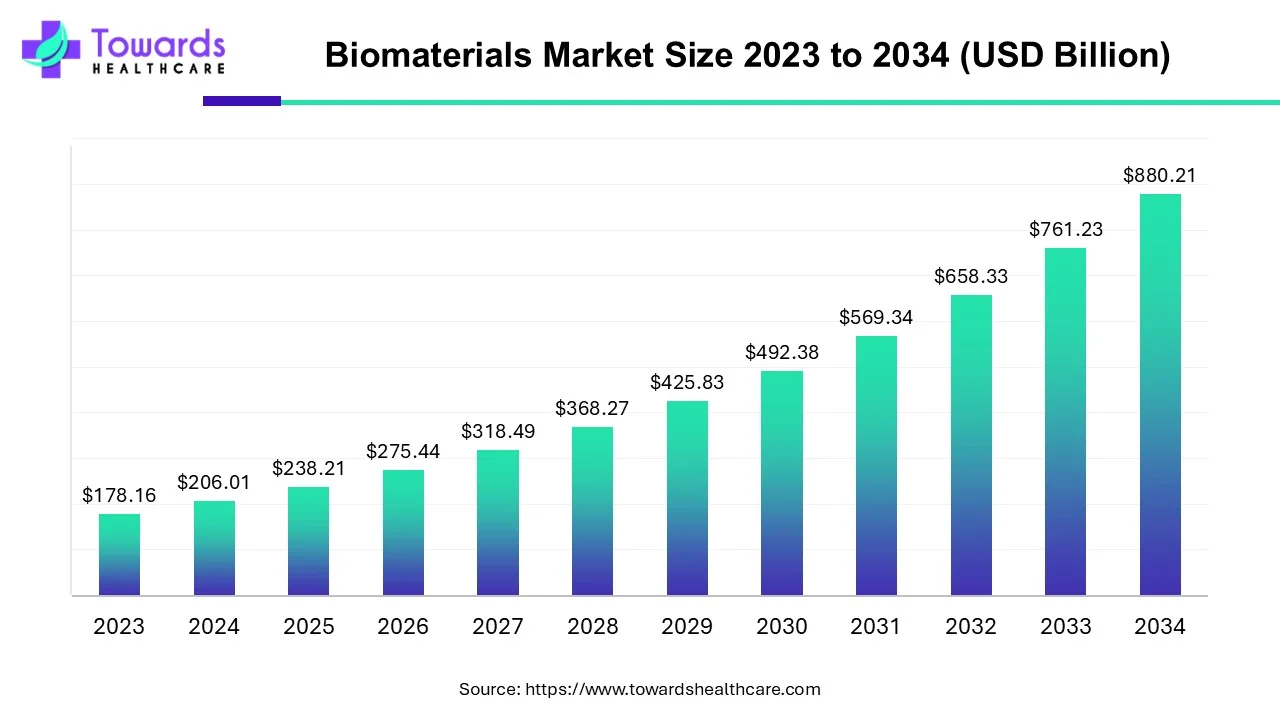
The global biomaterials market is no longer a niche segment serving only implants and prosthetics. It has evolved into one of the most influential pillars of modern medicine, shaping how diseases are treated, injuries are healed, and quality of life is restored. With the market projected to grow from USD 238.21 billion in 2025 to USD 880.21 billion by 2034 at a CAGR of 15.63%, biomaterials are emerging as the backbone of next-generation healthcare solutions. This growth reflects more than numbers; it signals a structural shift in how medicine interacts with the human body.
Download Free Sample Now and Get the Complete Report Easily at: https://www.towardshealthcare.com/download-sample/5173
Biomaterials today extend far beyond traditional metals and plastics. They integrate biology, chemistry, engineering, and clinical science into materials that actively participate in healing. From orthopedic implants that integrate with bone to bio-absorbable wound dressings that disappear once their job is done, biomaterials are redefining what medical materials are expected to do.
From Passive Support to Active Healing
For decades, medical materials were designed primarily to replace or support damaged tissues. Modern biomaterials, however, actively communicate with the body. They guide cell growth, regulate inflammation, and support tissue regeneration. This shift has placed biomaterials at the center of regenerative medicine, tissue engineering, and advanced medical device development.
Whether used in contact lenses, dental implants, artificial heart valves, or joint replacements, biomaterials now aim to replicate the structure and function of natural tissues. Many materials are biodegradable or bio-absorbable, allowing the body to gradually replace them with its own tissue. This capability reduces long-term complications and improves patient outcomes, making biomaterials indispensable in contemporary clinical practice.
Why Wound Healing Is Driving Demand Worldwide
One of the strongest growth drivers in the biomaterials market is wound healing. Chronic wounds remain a persistent challenge, especially among aging populations and patients with diabetes, cardiovascular disease, or post-surgical complications. The rising number of surgeries worldwide has further amplified the incidence of complex wounds that require advanced treatment solutions.
Biomaterials play a critical role in wound healing by supporting cell migration, tissue regeneration, and structural stability at the wound site. Materials such as collagen, gelatin, fibrinogen, silk, and composite scaffolds provide the right balance of strength, flexibility, porosity, and biocompatibility. These properties allow wounds to heal faster while minimizing scarring and tissue contraction.
With millions of chronic wound cases reported annually across the U.S. and Europe, and hundreds of millions of acute and traumatic wounds worldwide, the demand for advanced wound-care biomaterials continues to rise. As diabetes prevalence grows globally, wound management solutions built on biomaterials are expected to remain a central focus for healthcare systems.
The Biocompatibility Challenge That Still Holds the Market Back
Despite remarkable progress, biocompatibility remains one of the most complex challenges in the biomaterials industry. A biomaterial must not only perform its intended mechanical or structural function but must also trigger an appropriate response from the host tissue. This balance is difficult to achieve and varies depending on application, patient condition, and implantation duration.
Biocompatibility evaluation involves multiple levels of testing and long-term observation. Even today, disagreements persist around the compatibility of certain materials, especially when used in long-term or high-stress applications. The multidisciplinary nature of biocompatibility research reflects the complexity of the problem, requiring collaboration across materials science, biology, immunology, and clinical medicine.
Improving biocompatibility remains a priority because it directly impacts device lifespan, safety, and clinical success. Addressing this restraint will define the next phase of innovation in biomaterials.
Supramolecular Biomaterials Are Opening a New Chapter
Among the most promising developments in the field is the rise of supramolecular biomaterials. These materials rely on noncovalent interactions, allowing them to mimic the dynamic and responsive behavior of natural biological systems. Unlike conventional materials, supramolecular biomaterials can sense changes in their environment and respond accordingly.
Researchers are exploring materials that activate or deactivate in response to physiological stimuli, release therapeutic agents on demand, or replicate biological signaling pathways. Such capabilities position supramolecular biomaterials as powerful tools for treating injuries, chronic diseases, and degenerative conditions. Their adaptability could redefine how implants and therapeutic devices interact with the body.
Metallic Biomaterials Still Anchor the Market
Metallic biomaterials continue to dominate the market, holding the largest revenue share. Their unmatched strength and durability make them essential for load-bearing applications such as orthopedic fixations, joint replacements, spinal implants, dental implants, and cardiovascular devices. Metallic systems provide structural integrity in environments where failure is not an option.
Their applications extend beyond hard tissues into neurovascular and cardiovascular devices, including aneurysm clips, artificial heart valves, and vascular stents. Continuous improvements in surface coatings and alloy composition are enhancing their biocompatibility and long-term performance, ensuring metals remain a cornerstone of medical implants.
Natural Biomaterials Are Gaining Momentum
While metals dominate today, natural biomaterials are gaining attention for their regenerative potential. Sourced from plants, animals, and microbial systems, these materials closely resemble the extracellular matrix found in human tissues. Their intrinsic bioactivity supports cell adhesion, proliferation, and differentiation.
Natural biomaterials offer an ideal platform for tissue engineering and regenerative medicine, especially when combined with autologous or genetically modified cells. Their structural flexibility and biological compatibility make them well-suited for creating living implants and biomimetic scaffolds. As demand grows for personalized and regenerative therapies, natural biomaterials are expected to see strong growth during the forecast period.
Orthopedics Leads, but Plastic Surgery Accelerates Fastest
Orthopedics remains the largest application segment, reflecting the widespread use of biomaterials in treating musculoskeletal injuries and disorders. From bone regeneration to cartilage repair and ligament reconstruction, orthopedic biomaterials address both trauma-related and degenerative conditions.
At the same time, plastic surgery is emerging as the fastest-growing application area. Advances in biocompatible and biodegradable materials, coupled with strict safety regulations, have expanded biomaterial use in cosmetic and reconstructive procedures. The integration of three-dimensional printing has further accelerated innovation, enabling the creation of highly precise and customized bio-scaffolds.
Regional Dynamics Reveal a Shifting Global Landscape
North America continues to dominate the biomaterials market, supported by strong regulatory frameworks, robust R&D funding, and the presence of major industry players. High prevalence of orthopedic conditions, cardiovascular diseases, and surgical procedures further fuels demand for advanced biomaterials.
Asia Pacific, however, represents the fastest-growing region. Rising healthcare expenditure, expanding middle-class populations, and growing awareness of biomaterial applications are driving rapid adoption. Countries such as China, India, and South Korea are emerging as key producers and innovators, supported by regulatory initiatives and increasing research activity.
Europe also shows steady growth, driven by an aging population, rising chronic disease burden, and advanced healthcare infrastructure. Strong research ecosystems in countries like Germany and the UK continue to support innovation in biomaterials and tissue engineering.
Innovation Is Redefining Competitive Boundaries
Recent developments highlight the pace of innovation reshaping the biomaterials market. From jellyfish-derived collagen matrices to bioengineered insulin-producing implants and renewable polymer platforms, the industry is expanding beyond conventional boundaries. These advancements demonstrate how biomaterials are intersecting with biotechnology, sustainability, and precision medicine.
Leading companies are investing heavily in research, digital integration, and scalable manufacturing, ensuring biomaterials remain central to future medical breakthroughs.
A Market Shaped by Science, Medicine, and Human Need
After more than a decade of observing this market’s evolution, one trend stands out clearly. Biomaterials are no longer passive components of medical devices; they are active participants in healing and regeneration. Their role in addressing global health challenges, from chronic wounds to aging-related disorders, makes them indispensable to the future of medicine.
As science continues to bridge the gap between synthetic materials and living systems, the biomaterials market is poised to redefine how healthcare is delivered. The question is no longer whether biomaterials will shape the future of medicine, but how far their impact will reach.
Access our exclusive, data-rich dashboard dedicated to the therapeutic area sector – built specifically for decision-makers, strategists, and industry leaders. The dashboard features comprehensive statistical data, segment-wise market breakdowns, regional performance shares, detailed company profiles, annual updates, and much more. From market sizing to competitive intelligence, this powerful tool is one-stop solution to your gateway.
Access the Dashboard: https://www.towardshealthcare.com/access-dashboard
Checkout Biosimilars Market Report Now at: https://www.towardshealthcare.com/checkout/5173
Become a valued research partner with us – https://www.towardshealthcare.com/schedule-meeting
You can place an order or ask any questions, please feel free to contact us at [email protected]
Powering Healthcare Leaders with Real-Time Insights: https://www.towardshealthcare.com/healthcare-intelligence-platform
Europe Region – +44 778 256 0738
North America Region – +1 8044 4193 44
APAC Region: +91 9356 9282 04
Visit Our Website: https://www.towardshealthcare.com
Find us on social platforms: LinkedIn | Twitter | Instagram | Medium | Pinterest