The Blood Product Market Enters a Defining Decade
The blood product market has quietly become one of the most critical pillars of modern healthcare. While it rarely attracts headlines like breakthrough cancer drugs or gene therapies, its role is fundamental. Every surgery, trauma response, cancer treatment, childbirth complication, and chronic blood disorder relies on a stable and safe supply of blood products. As global healthcare systems face rising patient loads, aging populations, and complex diseases, the demand for blood products is no longer optional, it is unavoidable.
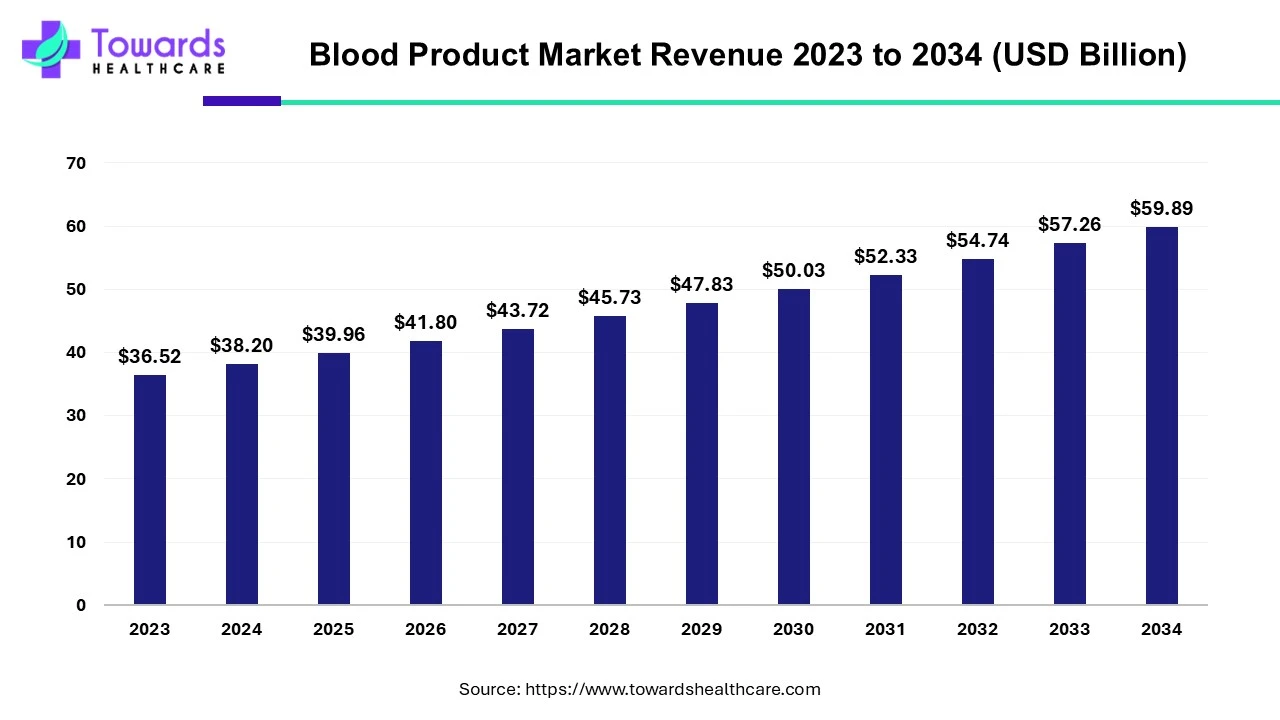
In 2026, the global blood product market was valued at approximately USD 41.8 billion. By 2035, it is expected to reach USD 62.65 billion, growing at a steady compound annual growth rate of 4.6 percent. This growth is not speculative. It is driven by unavoidable clinical needs, demographic shifts, and expanding access to healthcare across emerging economies. Blood, unlike most medical products, cannot be fully synthesized at scale yet, making its availability both precious and fragile.
𝐃𝐨𝐰𝐧𝐥𝐨𝐚𝐝 𝐅𝐫𝐞𝐞 𝐒𝐚𝐦𝐩𝐥𝐞: https://www.towardshealthcare.com/download-sample/5292
Why Blood Products Remain Irreplaceable
Blood products are not a single entity but a complex ecosystem that includes whole blood, red blood cells, platelets, plasma, cryoprecipitate, and white blood cells. Each component serves a distinct medical purpose. Red blood cells restore oxygen delivery in patients suffering from anemia or acute blood loss. Platelets prevent life-threatening bleeding, especially in cancer patients undergoing chemotherapy. Plasma supports trauma care, burn treatment, and shock management. Cryoprecipitate plays a crucial role in controlling bleeding disorders, while white blood cells help restore immune function in vulnerable patients.
What makes blood products unique is their immediate impact. A unit of blood can mean the difference between life and death within minutes. Unlike most pharmaceuticals, demand cannot be delayed, substituted, or postponed. Emergencies do not wait for supply chains to stabilize.
Cancer: A Silent Force Driving Demand
One of the strongest forces shaping the blood product market is the global rise in cancer cases. Millions of new diagnoses occur every year, and cancer therapies often suppress bone marrow function, drastically reducing platelet and red blood cell counts. For these patients, transfusions are not supportive care, they are essential treatment.
The economic burden of cancer is immense, with global costs projected to exceed 25 trillion international dollars between 2020 and 2050. Platelet transfusions alone represent a significant portion of blood product usage, particularly in hematological cancers. As cancer survival rates improve due to better diagnostics and therapies, patients live longer and often require repeated transfusions over extended periods. This paradox of success, longer survival leading to higher blood demand, is reshaping transfusion medicine.
A Market Built on Human Willingness
Despite technological advancements, blood donation still depends on human generosity. This dependency represents both the strength and vulnerability of the blood product market. In high-income countries, which house only sixteen percent of the global population, nearly forty percent of worldwide blood donations take place. Meanwhile, many low- and middle-income regions struggle to meet basic transfusion needs.
Globally, over 118 million blood donations are collected each year across more than 13,000 blood centers in 169 countries. Yet shortages remain common. Eligibility restrictions due to anemia, infectious diseases, chronic illnesses, and lifestyle factors further shrink the donor pool. Cultural beliefs, lack of awareness, and limited infrastructure compound the problem, particularly in rural and underserved areas.
This imbalance places immense pressure on blood banks and healthcare systems, forcing them to manage supply with precision while preparing for unpredictable surges in demand.
North America Sets the Pace
North America continues to dominate the global blood product market, supported by strong donation cultures, advanced infrastructure, and sustained government involvement. The United States leads this regional dominance through consistent public awareness campaigns and extensive collaboration among government bodies, nonprofit organizations, and private stakeholders.
Every two seconds, someone in the United States requires blood or platelets. Approximately 6.8 million Americans donate blood annually, resulting in the collection of over 13.6 million units of red blood cells and whole blood. Each year, nearly 16 million blood components are transfused across the country. Chronic conditions such as sickle cell disease and the high incidence of cancer further fuel ongoing demand.
This system works because of robust logistics, advanced screening technologies, and regulatory oversight that prioritizes safety and traceability. North America’s leadership, however, also highlights the stark contrast with regions still building foundational blood infrastructure.
Asia Pacific Emerges as the Growth Engine
While North America leads in revenue, Asia Pacific is becoming the fastest-growing region in the blood product market. Population growth alone creates enormous transfusion demand, but the real shift lies in government-driven awareness and infrastructure expansion.
India provides a compelling example. Every two seconds, someone in the country requires a blood transfusion. Annually, over 14.6 million transfusions are needed. By late 2023, India had more than 4,100 authorized blood banks, spanning both public and private sectors. Government-led digital initiatives have helped register millions of donors, signaling a move toward more organized and transparent blood collection systems.
As healthcare access expands across China, Southeast Asia, and other developing economies, blood products are becoming integral to modern medical care rather than emergency-only resources.
Europe Builds Strength Through Awareness and Regulation
Europe’s blood product market reflects a balance of regulation, collaboration, and public engagement. Rising awareness of blood disorders and structured donation initiatives have contributed to steady growth across the region. European governments actively support research into transfusion medicine and blood-based therapies, reinforcing long-term market stability.
Across the European Union, an estimated 60,000 to 70,000 units of blood are required daily. Countries such as Spain transfuse approximately two million blood products annually, while the United Kingdom relies on more than 5,000 donations every day to sustain its healthcare system. Regulatory bodies ensure rigorous safety standards, fostering public trust and consistent donor participation.
The Middle East and Africa Find Their Momentum
The Middle East and Africa are transitioning from dependency to development in the blood product market. Rising cases of hematological disorders, improved healthcare access, and government-led initiatives are gradually strengthening blood supply systems. Investments in storage infrastructure and processing technologies are reducing wastage and improving distribution efficiency.
Collaborations between global technology providers and regional healthcare institutions are particularly impactful. These partnerships introduce advanced blood processing and storage systems, enabling local centers to meet international standards and reduce reliance on imports.
Red Blood Cells Lead the Market for a Reason
Among all blood products, red blood cells dominate both usage and revenue. They remain the most frequently transfused component, essential for trauma care, surgeries, chronic anemia, and emergency medicine. Their demand spans every age group and medical specialty, making them the backbone of transfusion services worldwide.
As populations age and chronic conditions become more prevalent, red blood cell transfusions will continue to rise. This trend alone ensures sustained growth for the broader blood product market.
Hospitals and Blood Stations Shape Demand
Blood stations currently hold the largest share of the market due to their central role in collection, testing, storage, and distribution. These facilities serve as the backbone of transfusion networks, supplying hospitals and clinics efficiently.
Hospitals, however, represent the fastest-growing end-use segment. Nearly all major transfusion events occur within hospital settings, including surgeries, childbirth complications, accident trauma, and cancer treatments. As hospitals expand capacity and adopt advanced care models, their reliance on a consistent blood supply intensifies.
Innovation Challenges the Old Model
The future of the blood product market may be defined by innovation rather than donation alone. Artificial blood and lab-grown red blood cells are no longer theoretical concepts. Researchers are developing engineered products that replicate oxygen delivery without immune compatibility issues. These advancements could eliminate blood type matching, extend shelf life to years, and enable storage at room temperature.
Clinical trials exploring artificial blood derived from human hemoglobin mark a pivotal moment. If proven safe and effective, these solutions could revolutionize transfusion medicine, particularly in emergency scenarios, remote locations, and disaster zones.
Industry Leaders Adapt to a Changing Landscape
Major companies in the blood product market are evolving beyond traditional plasma collection and diagnostics. Organizations such as Grifols and CSL Behring have expanded into advanced therapies, immunology, and specialty care, reflecting the growing complexity of blood-based medicine.
Revenue growth among leading players underscores sustained demand and innovation-driven diversification. Plasma-derived therapies, in particular, have emerged as strong growth drivers, addressing conditions beyond traditional transfusion use.
A Market Defined by Responsibility
The blood product market carries a responsibility unlike any other. It operates at the intersection of science, ethics, logistics, and human empathy. Growth is not merely a financial metric; it represents improved access to life-saving care.
As healthcare systems confront rising demand, donor shortages, and evolving disease patterns, the market’s future will depend on trust, innovation, and global cooperation. Artificial blood may one day reduce dependency on donors, but until then, human participation remains irreplaceable.
The coming decade will test whether the world can balance innovation with compassion, efficiency with safety, and growth with equity. One thing remains certain: as long as medicine saves lives, blood products will remain at its core.
Access our exclusive, data-rich dashboard dedicated to the therapeutic area sector – built specifically for decision-makers, strategists, and industry leaders. The dashboard features comprehensive statistical data, segment-wise market breakdowns, regional performance shares, detailed company profiles, annual updates, and much more. From market sizing to competitive intelligence, this powerful tool is one-stop solution to your gateway.
Access the Dashboard: https://www.towardshealthcare.com/access-dashboard
Checkout Blood Product Market Report Now at: https://www.towardshealthcare.com/checkout/5292
Become a valued research partner with us – https://www.towardshealthcare.com/schedule-meeting
You can place an order or ask any questions, please feel free to contact us at [email protected]
Powering Healthcare Leaders with Real-Time Insights: https://www.towardshealthcare.com/healthcare-intelligence-platform
Europe Region – +44 778 256 0738
North America Region – +1 8044 4193 44
APAC Region: +91 9356 9282 04
Visit Our Website: https://www.towardshealthcare.com
Find us on social platforms: LinkedIn | Twitter | Instagram | Medium | Pinterest