Healthcare no longer lives only inside hospital walls. It now travels in pockets, rests on wrists, and speaks through screens. Disease management apps are quietly reshaping how people live with chronic and acute conditions, and the numbers show this shift is only accelerating.
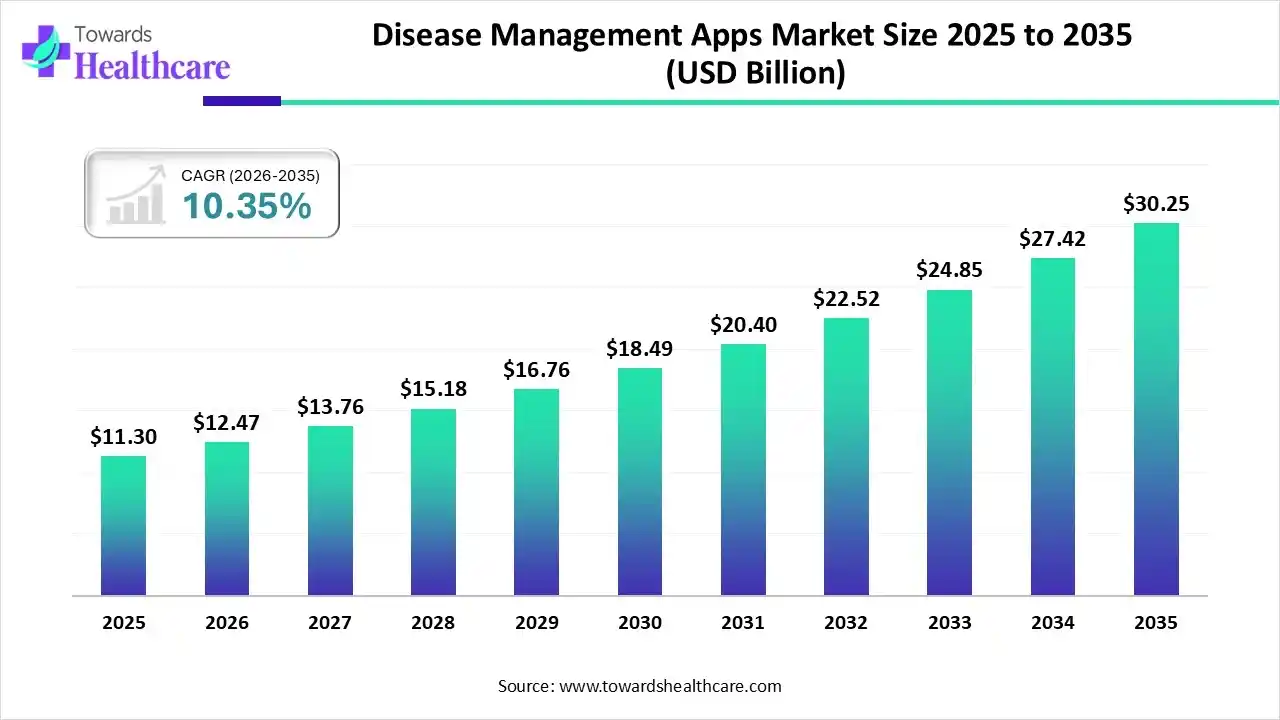
The global disease management apps market stood at USD 11.30 billion in 2025. It is expected to grow to USD 12.47 billion in 2026 and surge to nearly USD 30.25 billion by 2035, expanding at a steady CAGR of 10.35%. This is not just growth; it reflects a structural change in how healthcare operates and how patients participate in their own care.
Download Free Sample: https://www.towardshealthcare.com/download-sample/6502
Healthcare Steps Out of the Clinic and Into Daily Life
Disease management apps form a digital ecosystem of mobile and web-based platforms that help patients track symptoms, monitor vitals, follow treatment plans, and connect with healthcare providers. These tools support conditions ranging from diabetes and cardiovascular diseases to respiratory and mental health disorders.
Instead of waiting for periodic appointments, patients now engage in continuous care. They log glucose levels, receive medication reminders, consult doctors via telehealth, and share real-time data with care teams. This shift reduces gaps in treatment, improves adherence, and supports earlier interventions.
Hospitals and health systems led adoption in 2025, holding 40% of the market share. However, individual patients and consumers are expected to grow at the fastest pace over the coming years. The power dynamic is shifting. Patients are no longer passive recipients; they are active participants in decision-making.
Diabetes Leads Today, Cardiac Care Races Ahead
Among product categories, diabetes management apps dominated with a 35% revenue share in 2025. This reflects the global burden of diabetes and the demand for daily glucose monitoring, insulin tracking, and diet management.
However, cardiovascular disease apps are projected to grow at the highest rate during the forecast period. With heart conditions requiring continuous monitoring and lifestyle adjustments, digital tools are becoming central to preventive cardiology and post-treatment care.
Remote patient monitoring emerged as the dominant application segment in 2025, capturing 40% of market share. At the same time, medication and treatment adherence apps are expected to grow fastest. In chronic care, consistency determines outcomes, and digital reminders are proving to be powerful allies.
Cloud Dominates, Hybrid Expands
Technology infrastructure plays a crucial role in this market’s expansion. Cloud-based deployment accounted for 60% of the market in 2025. Cloud systems allow secure data storage, real-time synchronization, and integration with electronic health records.
Looking ahead, hybrid models, combining cloud and local storage, are expected to expand rapidly. Healthcare providers want flexibility. They seek the scalability of the cloud while maintaining localized control over sensitive data.
AI Moves from Buzzword to Backbone
Artificial intelligence now drives much of the intelligence behind disease management apps. Machine learning algorithms analyze patient data to detect patterns, predict complications, and personalize treatment plans.
Natural language processing enables apps to interpret patient inputs through text or voice. AI-driven systems integrate with clinical databases and wearable devices, improving diagnostic precision and enhancing daily self-management.
Instead of generic advice, patients receive personalized insights based on their behavior, biometrics, and historical data. This shift from reactive to predictive care defines the next phase of digital health.
Smartphones, Wearables, and the Consumerization of Care
As of 2024, nearly 4.88 billion people use smartphones globally. This massive penetration has created the infrastructure for mobile health adoption at scale.
Smart wearables equipped with AI-enabled sensors now deliver real-time health data to clinicians. These devices track heart rate variability, oxygen levels, sleep cycles, and activity patterns. The integration between apps and wearables enhances lifestyle interventions and enables earlier clinical responses.
Healthcare has become consumer-driven. Patients expect convenience, transparency, and personalization, similar to other digital services they use daily. Disease management apps meet this expectation by placing healthcare within reach, anytime and anywhere.
Regional Momentum: A Global Shift in Motion
North America led the market in 2025, accounting for 35% of total revenue. Advanced healthcare infrastructure, strong digital adoption, and supportive telehealth policies contribute to this dominance.
Meanwhile, Asia-Pacific is expected to witness the fastest growth during the forecast period. Rapid smartphone adoption, expanding internet connectivity, and increasing awareness of chronic disease management are driving regional expansion.
Governments across regions are supporting telehealth initiatives, funding digital health programs, and encouraging remote monitoring to reduce pressure on traditional healthcare systems.
Beyond Convenience: A System-Level Transformation
Disease management apps are not merely convenience tools. They address systemic healthcare challenges, rising chronic disease prevalence, increasing healthcare costs, physician shortages, and uneven access to care.
By enabling early detection, improving treatment adherence, and facilitating remote monitoring, these apps reduce hospital readmissions and optimize resource allocation. They create a continuous feedback loop between patients and providers, strengthening long-term health outcomes.
The Road to 2035: Care That Listens, Learns, and Responds
By 2035, the disease management apps market is projected to reach USD 30.25 billion. But beyond revenue projections lies a deeper transformation. Healthcare is evolving from episodic treatment to continuous engagement.
Technology no longer stands outside medicine, it operates at its core. Apps track, analyze, remind, alert, and guide. Patients gain visibility into their own health patterns. Providers gain actionable insights. Systems gain efficiency.
The real story is not just market expansion. It is the merging of technology with everyday healing—where data meets empathy, and digital tools support human resilience.
Disease management apps are no longer optional add-ons. They are becoming lifelines in a healthcare landscape that demands speed, precision, and patient empowerment.
Access our exclusive, data-rich dashboard dedicated to the healthcare IT market – built specifically for decision-makers, strategists, and industry leaders. The dashboard features comprehensive statistical data, segment-wise market breakdowns, regional performance shares, detailed company profiles, annual updates, and much more. From market sizing to competitive intelligence, this powerful tool is one-stop solution to your gateway.
Access the Dashboard: https://www.towardshealthcare.com/access-dashboard
Checkout Disease Management Apps Market Report Now at: https://www.towardshealthcare.com/checkout/6502
You can place an order or ask any questions, please feel free to contact us at [email protected]
Europe Region – +44 778 256 0738
North America Region – +1 8044 4193 44
APAC Region: +91 9356 9282 04
Visit Our Website: https://www.towardshealthcare.com
Find us on social platforms: LinkedIn | Twitter | Instagram | Medium | Pinterest