In less than a decade, CRISPR has evolved from a scientific curiosity into one of the most powerful tools ever created for editing DNA. What once took years of complex genetic engineering can now be done with unprecedented precision, speed, and efficiency. This shift is not just changing medicine; it is redefining agriculture, diagnostics, and the very concept of disease treatment.
By 2026, the global CRISPR market is expected to reach USD 3.64 billion, and by 2035, it is projected to surpass USD 9.49 billion, growing at a steady CAGR of 11.24%. Behind these numbers lies a deeper story: a technology moving from theory to real-world impact.
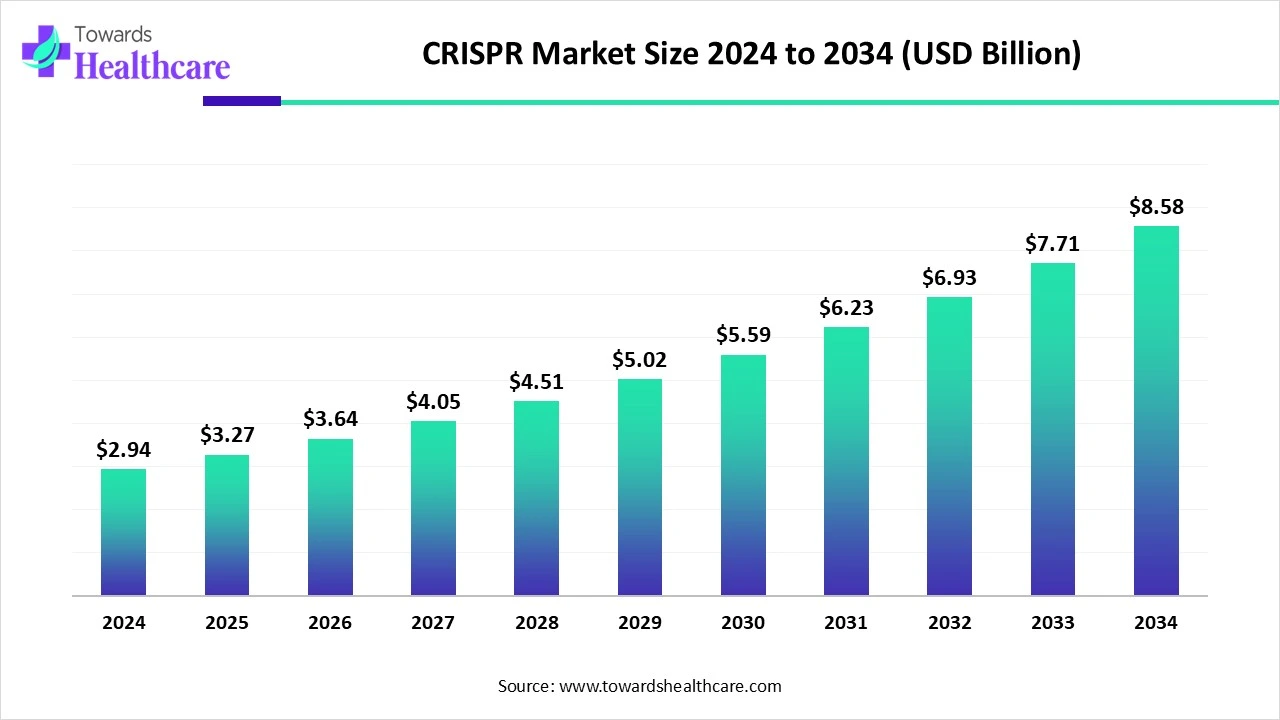
This article explores how fast CRISPR is transforming healthcare, agriculture, and diagnostics; and why its influence is only beginning.
CRISPR, Explained Like a Human Would
CRISPR—short for Clustered Regularly Interspaced Short Palindromic Repeats—acts like a molecular pair of scissors. It allows scientists to cut DNA at specific locations and rewrite genetic instructions with remarkable accuracy.
Earlier gene-editing methods were slow, expensive, and imprecise. CRISPR changed that. With systems like Cas9, Cas12, and Cas13, researchers can now correct mutations, silence faulty genes, or introduce beneficial traits across living organisms.
What makes CRISPR truly transformative is not just what it does—but how accessible it has become. Academic labs, biotech startups, and pharmaceutical giants alike now rely on CRISPR to accelerate discovery and innovation.
From Experiment to Industry: Why the Market Is Growing So Fast
The CRISPR market is not growing because of hype. It is expanding because the technology solves real problems.
Several forces are driving this growth:
-
A rising demand for gene-editing therapies
-
Expanding use in precision medicine
-
Breakthroughs in oncology and rare diseases
-
Increasing investment in biotechnology R&D
-
Growing applications in agriculture and food security
-
The emergence of CRISPR-based diagnostics
North America currently leads the market, accounting for nearly 48% of global revenue, supported by advanced research infrastructure and favorable regulatory frameworks. Meanwhile, Asia-Pacific is emerging as the fastest-growing region, driven by government initiatives, large patient populations, and rapid biotech innovation.
CRISPR is no longer confined to research—it is becoming an industry.
Healthcare: Editing Disease at Its Source
Why CRISPR Is Different from Traditional Medicine
Most conventional treatments manage symptoms. CRISPR aims to eliminate the cause.
Instead of lifelong medication, gene editing offers the possibility of one-time, durable treatments. This shift is especially powerful for inherited diseases where a single faulty gene causes lifelong suffering.
Blood disorders such as sickle cell disease and beta-thalassemia have become early success stories. The approval of CASGEVY, the first CRISPR-based therapy for genetic blood disorders in the UK and U.S., marked a turning point. It demonstrated that CRISPR could move from clinical trials to real patients.
This success has reshaped confidence across the healthcare ecosystem.
Ex Vivo vs. In Vivo: Two Paths to the Same Goal
CRISPR therapies follow two main delivery approaches:
-
Ex vivo editing, where cells are edited outside the body and reinfused
-
In vivo editing, where genes are edited directly inside the body
In 2024, ex vivo methods dominated the market, capturing around 58% of revenue, thanks to their safety and quality control advantages. However, in vivo approaches are growing faster, driven by advances in delivery systems like lipid nanoparticles and viral vectors.
As delivery technologies improve, CRISPR’s therapeutic reach will expand to organs once considered untouchable—such as the brain and heart.
Cancer, Rare Diseases, and Beyond
CRISPR is also reshaping oncology. By engineering immune cells to better recognize and destroy tumors, researchers are unlocking new frontiers in cancer treatment.
Rare genetic diseases—once neglected due to small patient populations—are now becoming viable targets. The success of Editas Medicine’s EDIT101 trial for inherited blindness shows how CRISPR can restore function where none existed before.
This is not incremental progress. It is a fundamental shift in how medicine approaches disease.
Diagnostics: Faster Answers When Time Matters Most
CRISPR is not just a treatment tool—it is becoming a powerful diagnostic platform.
CRISPR-based diagnostics can detect genetic material from viruses and bacteria with extraordinary sensitivity. Unlike traditional PCR tests, these tools can be faster, cheaper, and easier to deploy in low-resource settings.
During global health crises, speed matters. CRISPR-based lateral flow and isothermal assays are helping clinicians detect infectious diseases quickly and accurately.
As healthcare systems move toward early detection and prevention, CRISPR diagnostics are expected to play a critical role.
Agriculture: Feeding a Growing World with Fewer Resources
Why CRISPR Matters Beyond Hospitals
The global population is rising. Climate change is stressing food systems. Traditional breeding methods cannot keep up.
CRISPR offers a solution.
By precisely editing plant genomes, scientists can:
-
Increase crop yield
-
Improve resistance to pests and drought
-
Enhance nutritional value
-
Reduce dependency on chemical pesticides
Unlike genetically modified organisms (GMOs) of the past, CRISPR-edited crops can be indistinguishable from naturally bred varieties—making regulatory acceptance easier in many regions.
This has made agriculture and food technology firms the fastest-growing end-user segment in the CRISPR market.
Sustainability Meets Precision
CRISPR allows farmers to grow more food using fewer resources. Crops can be engineered to thrive in harsh climates, resist disease, and maintain quality during transport.
As food security becomes a global priority, CRISPR is emerging as a critical tool for sustainable agriculture.
AI and CRISPR: A Powerful Partnership
Artificial intelligence is accelerating CRISPR’s evolution.
AI helps researchers:
-
Identify optimal gene targets
-
Predict off-target effects
-
Design more effective guide RNAs
-
Analyze massive genomic datasets
This integration reduces trial-and-error in laboratories and shortens development timelines. AI-driven CRISPR research is enabling safer therapies, faster diagnostics, and more efficient agricultural innovation.
Together, AI and CRISPR are transforming biology into a data-driven science.
Market Segments: Where the Momentum Is Strongest
Products Still Lead, Services Gain Speed
CRISPR products—reagents, enzymes, plasmids, and kits; accounted for around 42% of market revenue in 2024. Their widespread use in research and biotech labs makes them indispensable.
At the same time, CRISPR services are growing faster. Outsourced genome editing, screening, and custom projects are increasingly attractive to smaller biotech firms and academic institutions seeking speed and expertise without heavy infrastructure costs.
Biomedical Research Remains the Foundation
Biomedical research and functional genomics remain the backbone of the CRISPR market, holding nearly 46% of revenue in 2024. These applications fuel discoveries that later become therapies, diagnostics, and commercial products.
As long as scientific curiosity drives innovation, this segment will continue to lead.
Regional Perspectives: Innovation Without Borders
North America: The Market Leader
North America dominates due to strong funding, advanced infrastructure, and early adoption of gene-editing technologies. The U.S. continues to validate CRISPR through landmark approvals and large-scale clinical trials.
Asia-Pacific: The Fastest Climber
China and India are investing heavily in CRISPR research across healthcare and agriculture. Government support, expanding biotech ecosystems, and large unmet medical needs are accelerating growth across the region.
Europe: Innovation with Oversight
Europe balances innovation with ethical responsibility. Countries like Germany and the UK are advancing CRISPR research through strong academic-industry collaboration while maintaining rigorous regulatory oversight.
Ethics: The Brakes That Keep the Engine Safe
CRISPR’s power raises difficult questions.
Editing human genes; especially germline cells; sparks ethical debates around safety, consent, and long-term consequences. Regulatory caution slows approvals but also builds public trust.
These challenges do not stop progress. They shape it responsibly.
Industry Momentum: Collaboration Over Competition
The CRISPR ecosystem thrives on collaboration. Companies such as CRISPR Therapeutics AG, Editas Medicine, Inc., Intellia Therapeutics, Inc., Beam Therapeutics, Inc., and Verve Therapeutics, Inc. are pushing therapeutic boundaries.
Meanwhile, platform and tools providers like Agilent Technologies, Inc., Thermo Fisher Scientific, Inc., Synthego Corporation, and Mammoth Biosciences are enabling the broader ecosystem.
Strategic partnerships and licensing agreements are accelerating commercialization while spreading innovation globally.
What the Future Looks Like
CRISPR’s journey is still in its early chapters.
Over the next decade, expect to see:
-
More one-time gene therapies
-
Wider use of in vivo editing
-
Expansion into preventive medicine
-
Greater adoption in food and climate resilience
-
Deeper integration with AI and automation
CRISPR is not replacing traditional medicine—it is redefining what medicine can be.
Final Thought: How Fast Can CRISPR Transform the World?
Faster than most people realize.
CRISPR is already curing diseases once considered untreatable, strengthening crops against climate stress, and delivering diagnostics at unprecedented speed. Its growth is steady, its applications are expanding, and its impact is deeply human.
This is not a distant future. It is happening now—quietly, precisely, and with transformative potential.
The real question is no longer if CRISPR will change healthcare, agriculture, and diagnostics.
It is how far it will go—and how responsibly we choose to use it.
Access our exclusive, data-rich dashboard dedicated to the biotechnology sector – built specifically for decision-makers, strategists, and industry leaders. The dashboard features comprehensive statistical data, segment-wise market breakdowns, regional performance shares, detailed company profiles, annual updates, and much more. From market sizing to competitive intelligence, this powerful tool is one-stop solution to your gateway.
Access the Dashboard: https://www.towardshealthcare.com/access-dashboard
Checkout CRISPR Market Report Now at: https://www.towardshealthcare.com/checkout/5966
You can place an order or ask any questions, please feel free to contact us at [email protected]
Europe Region – +44 778 256 0738
North America Region – +1 8044 4193 44
APAC Region: +91 9356 9282 04
Visit Our Website: https://www.towardshealthcare.com
Find us on social platforms: LinkedIn | Twitter | Instagram | Medium | Pinterest