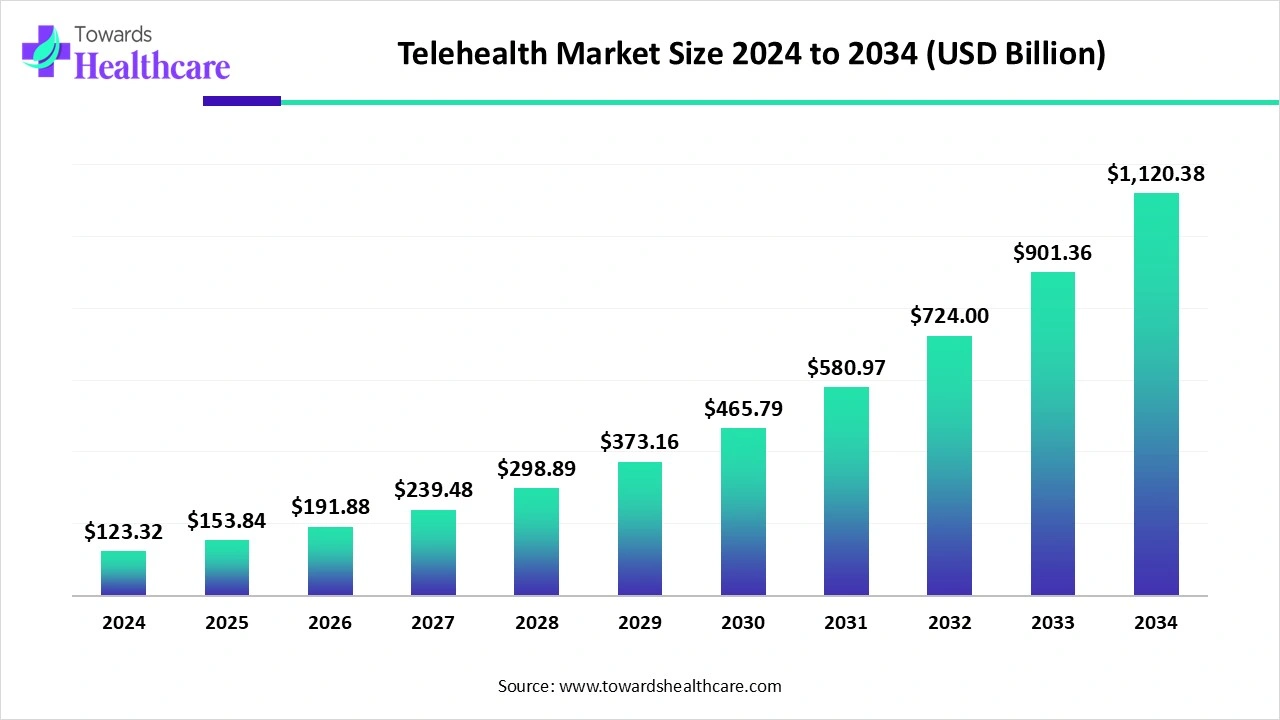
The global telehealth market stands at USD 153.84 billion in 2025, grows to USD 191.88 billion in 2026, and is projected to surge to nearly USD 1,402.1 billion by 2035, expanding at a remarkable 24.73% CAGR. This is not incremental growth — it is systemic transformation.
Download Free Sample with Customized Feature as per Your Goals: https://www.towardshealthcare.com/download-sample/6183
From virtual consultations to AI-enabled monitoring, telehealth is reshaping how healthcare systems operate, how physicians engage patients, and how governments allocate resources. The next decade will not just expand telehealth; it will normalize it.
Healthcare Leaves the Building
Telehealth refers to the use of digital communication technologies — video conferencing, mobile applications, cloud platforms, remote monitoring tools, and AI-driven systems — to deliver healthcare services at a distance. What began as virtual consultations has expanded into chronic disease management, behavioral therapy, tele-ICU systems, teleradiology, dermatology diagnostics, and post-acute care monitoring.
Healthcare is no longer a location. It is a connected ecosystem.
Aging populations, rising chronic disease prevalence, physician shortages, and favorable reimbursement frameworks continue to drive adoption. Advances in AI, IoT devices, wearable health sensors, and 5G connectivity further strengthen the infrastructure that supports virtual care.
Why Telehealth Growth Looks Relentless
Several structural forces fuel this unprecedented expansion.
1. Chronic Diseases Are Reshaping Demand
Chronic illnesses such as diabetes, cardiovascular disorders, respiratory diseases, and mental health conditions require continuous monitoring. Telehealth provides a cost-effective and scalable solution.
Remote patient monitoring allows physicians to track blood glucose, blood pressure, oxygen saturation, and heart rate in real time. Instead of episodic visits, care becomes continuous.
The demand for remote monitoring continues to rise, especially among elderly populations and individuals living in rural or underserved areas.
2. Healthcare Workforce Shortages Demand Efficiency
The World Health Organization projects a global shortfall of millions of healthcare workers by 2030. Telehealth enables providers to extend their reach. Physicians can consult patients across cities and even across borders without physical relocation.
Telehealth does not replace clinicians — it amplifies them.
3. Governments Are Actively Supporting Digital Healthcare
Governments across regions actively promote telehealth adoption through regulatory reforms, funding programs, and reimbursement policies.
In the United States, reimbursement frameworks from the Centers for Medicare & Medicaid Services (CMS) encourage telehealth usage. In Germany, the Digital Healthcare Act supports digital treatment adoption and enables reimbursement through public insurance systems. India’s e-Sanjeevani platform has served over 36 crore teleconsultations since 2020, expanding digital healthcare access at scale.
Policy alignment accelerates adoption.
Artificial Intelligence Is Powering the Next Leap
AI has moved from experimental to operational within telehealth ecosystems.
AI-driven systems analyze large volumes of patient data and generate clinical insights. Machine learning models predict deterioration risks. NLP tools assist physicians in documentation and cross-language communication. Conversational AI platforms provide 24/7 patient interaction and triage support.
Companies such as MEDvidi have launched AI-enabled clinician platforms to streamline diagnostics, treatment planning, and patient engagement.
AI does not replace doctors — it reduces cognitive load, accelerates decision-making, and enhances precision.
Market Segments Reveal Where the Action Is
Telehealth growth is not uniform. Certain segments dominate, while others accelerate rapidly.
Services Lead Today
By component, services accounted for the largest share in 2024. Many small and medium healthcare providers lack the infrastructure to deploy independent telehealth systems. Service providers offer integrated teleconsultation, telepsychiatry, tele-ICU, and remote monitoring solutions without heavy upfront investments.
Services reduce complexity.
Software Platforms Accelerate Tomorrow
Software platforms represent the fastest-growing segment. Hospitals and clinics increasingly prefer owning customizable systems that manage scheduling, billing, patient records, and secure communications.
Cloud-based platforms enhance scalability and integration with EHR systems.
Teleconsultation Drives Volume
By application, teleconsultation remains the dominant segment. Patients prefer convenient phone or video appointments for general practice and specialty care. The model eliminates waiting times and reduces travel expenses.
Mental Health Gains Momentum
Mental health and behavioral therapy show the highest growth trajectory. Virtual counseling offers privacy, safety, and accessibility. Governments actively promote telepsychiatry to address rising mental health burdens.
Cloud Platforms Dominate Delivery
Web-based and cloud platforms command the highest revenue share. They allow real-time data access, storage scalability, and integration with multiple healthcare tools.
Mobile-based applications, however, are expanding faster. They enable on-demand audio-video calls, medication reminders, AI chat interfaces, and personalized notifications.
Healthcare increasingly lives in smartphones.
North America: The Current Epicenter
North America holds approximately 41% of the global telehealth market share.
The United States demonstrates deep integration. Over half of Americans have used telehealth services. Most hospitals have adopted electronic health records, and telemedicine solutions now appear in the majority of healthcare institutions.
The U.S. telehealth market alone is expected to expand from $42.61 billion in 2024 to $358.96 billion by 2034, reflecting sustained institutional support and technology adoption.
Canada also maintains a dynamic telehealth environment. Numerous startups operate within the ecosystem, and established players such as Teladoc Health, Inc., Siemens Healthineers, and WELL Health Technologies continue expanding digital solutions.
Asia-Pacific: The Fastest Growth Story
Asia-Pacific is expected to witness the fastest growth over the coming decade.
China Builds Infrastructure at Scale
China faces significant chronic disease burdens among its elderly population. At the same time, the country rapidly expands 5G infrastructure and prepares for next-generation connectivity. Advanced telecom penetration lowers barriers to digital health adoption.
India Expands Access Digitally
India demonstrates how telehealth can scale in emerging markets. The government-backed e-Sanjeevani platform has delivered millions of consultations. Initiatives such as Tele-MANAS address mental health needs.
Chronic disease prevalence among adults further strengthens demand for remote monitoring and teleconsultation.
Europe Strengthens Digital Health Frameworks
Europe actively integrates digital tools into national healthcare systems.
Germany promotes digital treatment applications under structured reimbursement policies. The United Kingdom invests heavily in medtech innovation to reduce waiting lists and expand virtual ward capacity.
European healthcare systems recognize telehealth as a cost-control and efficiency tool.
Mergers and Strategic Alliances Redefine the Landscape
Telehealth players increasingly consolidate capabilities through acquisitions and partnerships.
The American Telemedicine Association’s ATA Action group acquired the Digital Therapeutics Alliance to form the Advancing Digital Health Coalition. Such strategic moves strengthen advocacy, standardization, and digital health integration.
Healthcare technology no longer operates in silos. Ecosystem building defines competitive advantage.
Key Players Driving Innovation
The telehealth ecosystem includes platform developers, medtech giants, connectivity providers, and specialized service operators.
Major participants include:
-
Teladoc Health, Inc.
-
Amwell
-
MDLIVE
-
Doctor on Demand
-
Practo
-
Babylon Health
-
Medtronic
-
Philips Healthcare
-
GE HealthCare
-
Cisco Systems, Inc.
These organizations integrate AI, cloud computing, wearable devices, and secure communication infrastructure to build scalable telehealth ecosystems.
Privacy: The Critical Challenge
Despite impressive growth, telehealth faces legitimate concerns around data privacy and cybersecurity.
Remote systems collect sensitive patient data. Data breaches or unauthorized access can erode trust quickly. Providers must implement encrypted communication channels, secure cloud storage, multi-factor authentication, and compliance with regional data protection regulations.
Trust underpins adoption.
Without robust cybersecurity frameworks, market expansion could slow.
The Rise of Mixed Reality in Virtual Care
Mixed reality technologies — including virtual reality (VR) and augmented reality (AR) — present new possibilities.
AR headsets can guide surgeons during remote procedures. VR can enhance patient engagement during therapy sessions. Immersive experiences reduce psychological distance between physician and patient.
Telehealth is not just about video calls. It is evolving into experiential healthcare.
Employers and Payers Enter the Arena
Healthcare providers led early adoption. Now payers and employers increasingly embrace telehealth.
Employers use telehealth platforms to reduce absenteeism and boost workforce productivity. Employees can access consultations without taking leave. Insurance payers gain transparency into treatment pathways and medication adherence, improving reimbursement management.
Telehealth strengthens preventive care economics.
Telehealth as an Equalizer
Beyond economics and efficiency, telehealth addresses healthcare inequality.
Rural populations gain access to urban specialists. Patients with mobility limitations receive care at home. Individuals facing social stigma can seek mental health support privately.
Telehealth democratizes access.
A Decade of Structural Change
Between 2025 and 2035, the telehealth market expands nearly ninefold. Few healthcare segments demonstrate this scale of projected acceleration.
Several structural shifts define the coming decade:
-
AI-driven predictive care becomes mainstream.
-
Mobile-first healthcare dominates patient interaction.
-
Hybrid models blend in-person and virtual visits.
-
Digital therapeutics integrate into treatment plans.
-
Regulatory frameworks mature and standardize globally.
Telehealth will not replace hospitals. It will redefine how hospitals operate.
Access our exclusive, data-rich dashboard dedicated to the healthcare IT sector – built specifically for decision-makers, strategists, and industry leaders. The dashboard features comprehensive statistical data, segment-wise market breakdowns, regional performance shares, detailed company profiles, annual updates, and much more. From market sizing to competitive intelligence, this powerful tool is one-stop solution to your gateway.
Access the Dashboard: https://www.towardshealthcare.com/access-dashboard
Checkout Telehealth Market Report Now at: https://www.towardshealthcare.com/checkout/6183
You can place an order or ask any questions, please feel free to contact us at [email protected]
Europe Region – +44 778 256 0738
North America Region – +1 8044 4193 44
APAC Region: +91 9356 9282 04
Visit Our Website: https://www.towardshealthcare.com
Find us on social platforms: LinkedIn | Twitter | Instagram | Medium | Pinterest