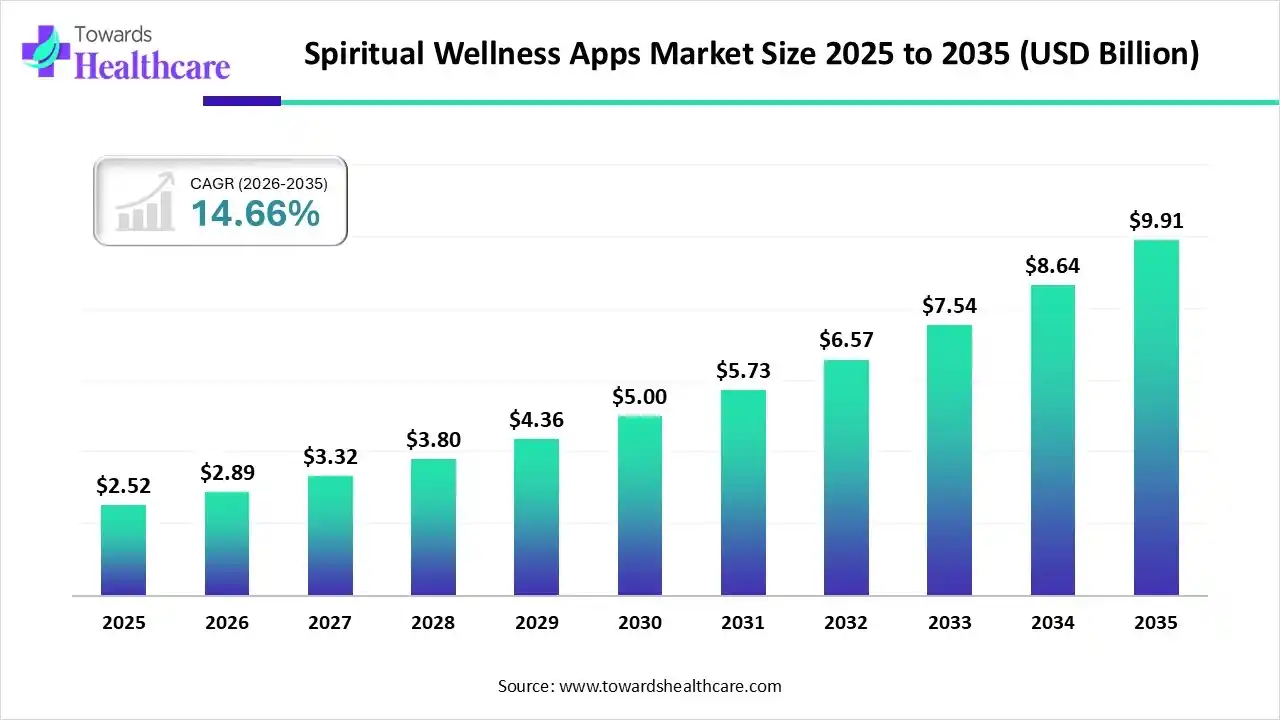
The global spiritual wellness apps market is entering a decisive growth phase. Valued at USD 2.52 billion in 2025, the market is projected to reach USD 2.89 billion in 2026 and surge to nearly USD 9.91 billion by 2035, expanding at a compelling 14.66% CAGR.
Download Free Sample: https://www.towardshealthcare.com/download-sample/6482
This is not just a story about app downloads. It is a story about how millions of people are reshaping their relationship with spirituality, mindfulness, faith, and mental resilience—through a screen they already carry in their pockets.
Spirituality has always evolved with society. Today, it evolves with algorithms, augmented reality, and artificial intelligence.
The Shift: When Spiritual Practice Meets Digital Infrastructure
A decade ago, spirituality meant temples, churches, meditation centers, yoga studios, and retreat halls. Today, it also means push notifications for gratitude reminders, AI-guided meditations, mood-based breathing exercises, and even virtual spiritual retreats.
Apps like Calm, Headspace, and Insight Timer normalized digital meditation. What started as guided breathing sessions evolved into structured mental fitness ecosystems.
Meanwhile, faith-driven platforms such as Pray.com introduced structured daily devotion into app culture. New entrants like Selfgazer and Vedic AstroGPT began blending astrology, AI interpretation, and personalized guidance.
The market is no longer limited to meditation timers. It now spans:
-
Guided mindfulness programs
-
Dream analysis and affirmation tracking
-
Yoga and movement-based spirituality
-
Faith-specific prayer platforms
-
AI-driven spiritual chatbots
-
Immersive AR/VR meditation experiences
Spiritual wellness apps are no longer niche—they are becoming lifestyle infrastructure.
Why 2026 Is a Tipping Point
The year 2026 marks a pivotal moment for this industry.
Three macro-forces are accelerating adoption:
1. Mental Health Awareness Has Gone Mainstream
Gen Z and Millennials openly discuss anxiety, burnout, and emotional regulation. Employers integrate meditation into corporate wellness programs. Schools introduce mindfulness modules. People no longer see meditation as optional—it is becoming preventive mental care.
2. Smartphone Penetration Is Nearly Universal
Smartphones dominate device usage in this sector. The smartphones segment held the largest share in 2025 because users demand instant access—guided meditation during a commute, journaling before bed, or prayer reminders during work breaks.
5G connectivity and improved battery life now support uninterrupted sessions, live events, and streaming spiritual content globally.
3. AI Personalization Has Matured
AI has shifted these apps from static libraries to adaptive systems. Instead of searching manually for content, users receive hyper-personalized suggestions based on mood inputs, behavior tracking, sleep data, and engagement patterns.
An AI oracle trained on specific teachings can now simulate philosophical dialogue. Chatbots inspired by Buddhist thought answer ethical questions. AI-driven mood mapping suggests breathwork techniques tailored to real-time stress.
Technology is no longer just hosting spirituality—it is shaping it.
The Platform Battle: Android vs. iOS
In 2025, Android led revenue share due to its global dominance and accessibility. Emerging markets, especially across Asia Pacific, rely heavily on Android devices, making it a powerful channel for expansion.
However, iOS is expected to grow at the fastest rate. Premium user demographics, higher in-app spending, and tighter ecosystem integration make Apple’s platform highly attractive.
Apps like YouVersion Bible App and Sadhguru continue expanding within iOS ecosystems. Apple’s evolution toward integrated health intelligence—including AI integration into wellness tracking—positions iOS as a strategic growth frontier.
The platform race is not about operating systems. It is about ecosystem control.
Wearables: The Next Frontier of Spiritual Biofeedback
While smartphones dominate today, wearable devices are emerging as the fastest-growing segment.
Devices such as Muse S Gen 2 and Neurable MW75 integrate EEG sensors to monitor brain activity during meditation sessions.
This introduces a radical shift: spirituality quantified.
Users can now track:
-
Brainwave patterns during meditation
-
Real-time stress indicators
-
Sleep depth and quality
-
Heart rate variability
The integration of biofeedback makes meditation measurable. And what becomes measurable often becomes habitual.
Subscription Models: Paid Dominates, Free Expands
In 2025, paid (in-app purchase) subscriptions dominated market share. Users increasingly pay for:
-
Deep-dive meditation courses
-
Long-form guided programs
-
Specialized teacher access
-
Community features
-
Advanced tracking analytics
However, the free model is growing rapidly. Freemium strategies attract wide user bases, monetizing through optional upgrades.
Free newsletters, podcasts, and faith-based broadcasts help platforms build trust before converting users to premium tiers.
This dual strategy ensures both accessibility and revenue scalability.
Meditation Leads, But Yoga Moves Fast
Meditation and mindfulness apps dominated the market in 2025. Corporate wellness integration and pandemic-driven home practices accelerated adoption.
Examples include:
-
Waking Up for philosophical mindfulness
-
Simple Habit for busy professionals
-
Aura for personalized daily exercises
But yoga and movement-based spirituality apps are expanding at a faster CAGR.
Notably, the World Health Organization launched the WHO mYoga app to promote accessible yoga practices globally.
The fusion of breath, movement, and digital instruction appeals strongly to users seeking embodied spirituality—not just mental exercises.
Regional Spotlight: Where Growth Accelerates
North America: Innovation Hub
North America dominated the market in 2025. Cultural openness to therapy, self-optimization trends, and high disposable income drive adoption.
In the U.S., immersive AR meditation, AI-guided affirmations, and hybrid faith-health apps are expanding rapidly.
The University of Rochester’s collaboration with the Sol mental health app illustrates how academic institutions are entering the digital wellness ecosystem.
Asia Pacific: Fastest Growth Engine
Asia Pacific is expected to expand at the fastest rate through 2035.
Key drivers include:
-
Urban stress and work pressure
-
Rapid smartphone penetration
-
Government-backed wellness initiatives
Singapore stands out for high CAGR projections. Home-grown apps such as MindFi and Intellect demonstrate regional innovation.
India’s digital spirituality ecosystem also shows strong momentum. Platforms like AppsForBharat secured major funding to scale AI-enabled devotional services.
Europe: Regulation Meets Digital Health
Europe’s growth is influenced by digital health regulation frameworks. Germany’s DiGA system allows certified health apps to be prescribed and reimbursed.
Apps like 7Mind and Moodfit are expanding within this structured ecosystem.
Europe demonstrates how regulatory alignment can legitimize digital spirituality within formal healthcare.
Investment Momentum Signals Confidence
Recent funding activity confirms investor belief in long-term viability.
-
AppsForBharat secured $20M in Series C funding in 2025.
-
Utsav raised ₹6.35 crore to expand devotion-focused features.
-
Spiritual and wellness summits in India reported investment proposals worth thousands of crores.
Capital is flowing toward platforms that combine spirituality, AI, and scalable digital infrastructure.
The AR/VR Revolution: Spirituality Goes Immersive
Developers are exploring augmented and virtual reality to deepen engagement.
Headspace introduced immersive experiences such as Headspace XR. Virtual retreats simulate natural landscapes. Breathwork sessions occur inside interactive digital environments.
This is not entertainment. It is experiential spirituality.
As hardware adoption increases—especially through advanced headsets—spiritual immersion could become a new category altogether.
SWOT Snapshot: Where the Market Stands
Strengths
-
AI-enabled personalization increases retention
-
Global smartphone accessibility lowers barriers
-
Gamification builds consistent practice habits
Weaknesses
-
Digital cannot fully replace human mentorship
-
Data privacy concerns remain critical
Opportunities
-
Wearable integration for real-time feedback
-
Virtual retreats and metaverse spirituality
-
In-app communities connecting like-minded users
Threats
-
Regulatory inconsistencies across regions
-
Over-commercialization risking authenticity
The sector’s sustainability will depend on balancing growth with genuine well-being.
The Human Question: Can Technology Deepen Spirituality?
The fundamental debate persists.
Can an algorithm guide enlightenment?
Can a chatbot replicate compassion?
Can a wearable measure transcendence?
The market’s growth suggests that users believe technology can at least support their journey.
Spiritual wellness apps do not claim to replace spiritual leaders or communities. Instead, they offer accessibility. A 10-minute meditation during a lunch break. A guided prayer during travel. A mood tracker that prevents emotional spirals.
In a hyper-connected, high-pressure world, digital spirituality provides structure.
The Road to 2035: What Comes Next?
By 2035, the spiritual wellness apps market is expected to approach USD 10 billion. The future likely includes:
-
AI companions that evolve alongside users
-
Hybrid online-offline retreat ecosystems
-
Integrated biometric-driven meditation programs
-
Insurance-recognized digital spiritual therapies
-
Greater faith-specific customization
Collaboration between therapists, psychologists, spiritual teachers, and tech developers will define credibility.
The next phase will not be about downloads. It will be about depth.
Conclusion: A Silent Digital Revolution
Spiritual wellness apps represent more than a growing market segment. They represent a cultural transformation.
The ancient pursuit of inner peace has entered the digital era—not as a replacement for tradition, but as its evolution.
From AI-guided insight to VR meditation landscapes, the sector stands at the intersection of consciousness and code.
The question is no longer whether spirituality belongs in the digital world.
The real question is:
How deeply will technology shape the next generation of spiritual experience?
Access our exclusive, data-rich dashboard dedicated to the healthcare IT market – built specifically for decision-makers, strategists, and industry leaders. The dashboard features comprehensive statistical data, segment-wise market breakdowns, regional performance shares, detailed company profiles, annual updates, and much more. From market sizing to competitive intelligence, this powerful tool is one-stop solution to your gateway.
Access the Dashboard: https://www.towardshealthcare.com/access-dashboard
Checkout Spiritual Wellness Apps Market Report Now at: https://www.towardshealthcare.com/checkout/6482
You can place an order or ask any questions, please feel free to contact us at [email protected]
Europe Region – +44 778 256 0738
North America Region – +1 8044 4193 44
APAC Region: +91 9356 9282 04
Visit Our Website: https://www.towardshealthcare.com
Find us on social platforms: LinkedIn | Twitter | Instagram | Medium | Pinterest