The global heart rate monitor market is no longer confined to athletes timing their sprints or gym enthusiasts tracking calories. It has evolved into a sophisticated ecosystem that connects fitness, preventive healthcare, digital technology, and clinical monitoring.
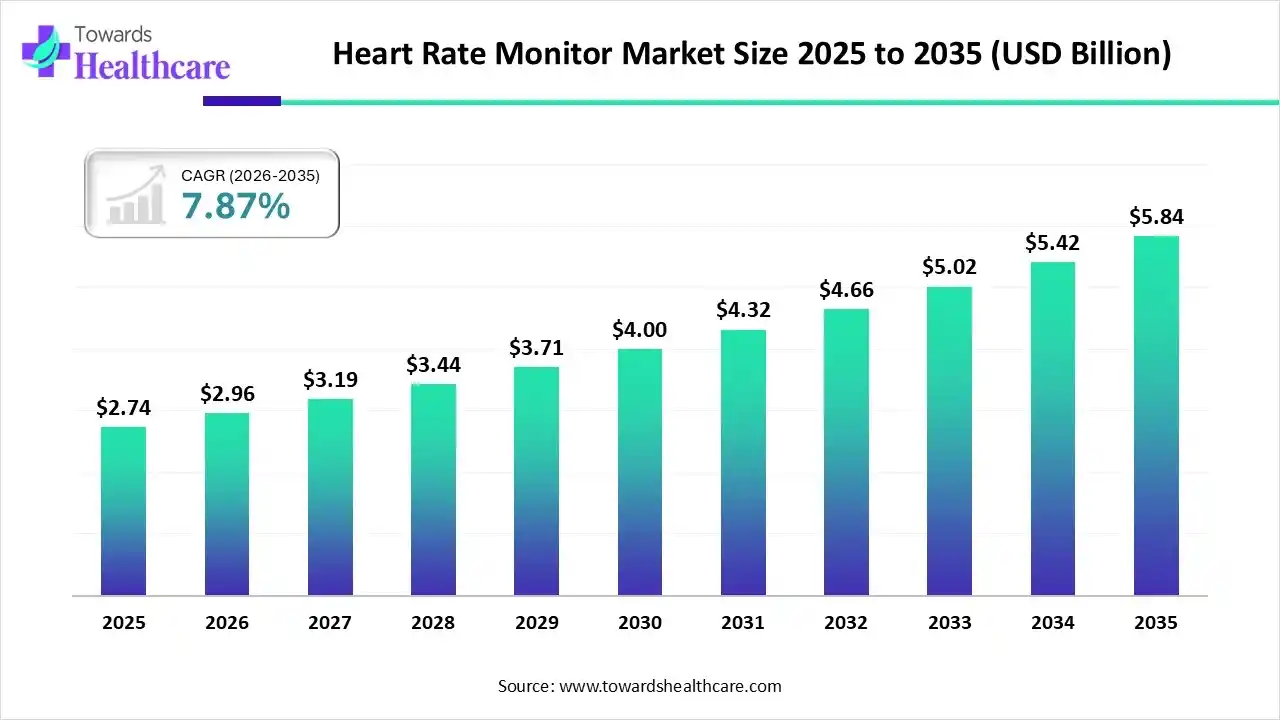
In 2025, the market stood at US$ 2.74 billion, climbed to US$ 2.96 billion in 2026, and is projected to reach US$ 5.84 billion by 2035. With a projected CAGR of 7.87% between 2026 and 2035, the industry reflects a steady yet impactful transformation in how individuals and healthcare systems perceive cardiovascular health.
Download Free Sample: https://www.towardshealthcare.com/download-sample/6555
This is not just market growth. It is a shift in mindset. People want data. They want control. And they want real-time health intelligence.
The Pulse of a Digital Health Revolution
A heart rate monitor is an electronic device that measures and tracks heartbeats in real time. What once required hospital equipment now fits comfortably on a wrist or chest strap. These devices help users:
-
Monitor workout intensity
-
Detect abnormal heart rhythms
-
Track resting heart rate trends
-
Support preventive cardiovascular care
-
Contribute to clinical research and remote monitoring
As cardiovascular diseases remain a major global health burden, continuous heart rate monitoring has become more relevant than ever. The line between consumer wellness and clinical healthcare continues to blur.
Market Momentum: Where Growth Meets Purpose
The heart rate monitor market is growing because three powerful forces are converging:
-
Rising Health Awareness – People actively track steps, sleep, stress, and heart rate as part of daily routines.
-
Expanding Fitness Culture – Running clubs, marathons, home workouts, and sports training drive demand for real-time performance tracking.
-
Clinical & Remote Monitoring Expansion – Hospitals and research institutions increasingly use wearable technology for continuous patient observation.
North America dominated the market in 2025 with a 35% share, driven by advanced healthcare infrastructure and strong adoption of wearable technology. However, Asia-Pacific is emerging as the fastest-growing region, supported by rising smartphone penetration, expanding middle-class populations, and growing digital health initiatives.
Wearables Take the Lead: Convenience Wins
Why Wearable Monitors Dominate
Wearable heart rate monitors captured 50% of the market share in 2025. Smartwatches and fitness bands allow continuous monitoring without disrupting daily life. They sync seamlessly with smartphones and apps, delivering dashboards, trend analysis, and alerts.
Major players such as Apple, Samsung, and Garmin have transformed heart rate tracking into a lifestyle feature.
Consumers no longer see heart rate monitoring as a medical tool. They see it as a daily companion.
Accuracy Matters: The Rise of Chest Strap Monitors
While wrist-based devices dominate in volume, chest strap monitors are growing at the fastest CAGR. These devices account for around 20% of the market and are favored by professional athletes and serious fitness enthusiasts.
Chest straps deliver higher accuracy during intense activity because they measure electrical signals directly from the heart. Brands like Polar and Wahoo continue to innovate in this segment, offering Bluetooth and ANT+ connectivity for seamless integration with performance apps.
For high-performance training and clinical validation, precision remains non-negotiable.
Optical vs. ECG: Technology Shapes the Future
Optical Sensors (PPG): The Mass Market Engine
Optical sensors using photoplethysmography (PPG) led the market with 40% share in 2025. These sensors use light to measure blood flow changes beneath the skin. They are:
-
Non-invasive
-
Comfortable
-
Suitable for continuous monitoring
-
Easily integrated into smartwatches
This technology drives the popularity of consumer wearables.
ECG-Based Monitoring: Clinical-Grade Growth
Electrocardiogram (ECG)-based monitoring is the fastest-growing technology segment with 30% share. ECG systems provide detailed rhythm analysis and detect abnormalities such as atrial fibrillation.
Companies like Philips, Nihon Kohden, and Masimo focus heavily on clinical-grade cardiac monitoring.
Meanwhile, consumer brands integrate ECG capabilities into wearables. Fitbit and Apple have introduced ECG features in select models, making advanced cardiac insights accessible to the public.
This dual growth across consumer and medical segments signals long-term industry stability.
AI Steps In: Smart Algorithms, Smarter Monitoring
Artificial intelligence is transforming heart rate monitors from passive trackers into proactive health companions.
AI enhances:
-
Signal filtering during motion
-
Real-time anomaly detection
-
Personalized training zones
-
Predictive alerts for irregular rhythms
-
Adaptive fitness coaching
Instead of just recording heart rate, devices now interpret it.
For example, collaboration between Apple and iRhythm Technologies aims to integrate long-term rhythm monitoring data into consumer health platforms, bridging clinical insight with everyday wearables.
AI reduces noise. It improves accuracy. It transforms raw data into meaningful decisions.
Fitness Still Leads — But Healthcare Is Catching Up
Fitness & Sports Tracking: The Dominant Application
Fitness and sports tracking held 45% market share in 2025. Runners, cyclists, swimmers, and gym-goers rely on heart rate zones to:
-
Optimize fat burn
-
Improve endurance
-
Avoid overtraining
-
Measure recovery
Wearables provide instant feedback that influences behavior in real time.
Research & Clinical Studies: The Fastest-Growing Application
Research and health studies represent the fastest-growing segment at 15% share. Universities and research institutes increasingly use wearables to gather large-scale physiological data.
Continuous monitoring improves:
-
Cardiovascular studies
-
Drug trial assessments
-
Stress and sleep research
-
Sports science experiments
This transition from episodic measurement to continuous tracking reshapes clinical data collection.
Cloud and App Integration: Data Without Borders
The on-person wearable segment holds 60% market share, but cloud-based and app-integrated systems are expanding rapidly.
Cloud integration enables:
-
Remote patient monitoring
-
Real-time physician access
-
Long-term data storage
-
Trend visualization
-
Secure data sharing
Telehealth platforms increasingly rely on wearable-generated data. Healthcare providers now track patients outside hospital walls.
This shift reduces hospital visits, supports chronic disease management, and enhances preventive care.
Direct Sales vs. E-Commerce: A Changing Buying Pattern
Direct sales channels dominate with 50% share, driven by in-store experiences and personalized product guidance. However, e-commerce platforms are the fastest-growing distribution channel, accounting for 25% share.
Consumers prefer:
-
Quick price comparisons
-
Customer reviews
-
Home delivery
-
Digital payment convenience
As internet penetration expands globally, online sales will continue to gain momentum.
Regional Spotlight: Who Leads and Who Accelerates?
North America: A Mature but Powerful Market
North America held 35% share in 2025. The United States leads due to:
-
High wearable adoption
-
Strong healthcare infrastructure
-
Early regulatory frameworks
-
Preventive health awareness
Investment in digital health and remote monitoring strengthens the region’s dominance.
Asia-Pacific: The Fastest Growth Engine
Asia-Pacific, with 30% share, is the fastest-growing region. Countries like China and India experience rising health awareness and rapid adoption of affordable wearable devices.
China’s strong manufacturing ecosystem and digital health initiatives position it as a regional leader. Expanding middle-class populations and smartphone usage accelerate demand.
Europe: Stability Through Preventive Care
Europe holds approximately 25% share and continues to grow steadily. An aging population and strong public healthcare systems drive demand for remote cardiac monitoring.
The UK and Germany lead regional adoption, supported by digital healthcare programs and regulatory frameworks.
Inorganic Growth: Partnerships Fuel Innovation
Strategic collaborations strengthen market expansion:
-
Fitbit partnered with Lifesense to co-develop new wearable lines.
-
Apple collaborated with iRhythm Technologies to enhance long-term rhythm tracking integration.
Such partnerships accelerate product innovation, regulatory acceptance, and global distribution.
SWOT Snapshot: Where the Market Stands
Strengths
-
Non-invasive real-time monitoring
-
Broad consumer adoption
-
Rapid technological innovation
-
Integration with digital ecosystems
Weaknesses
-
Accuracy issues during high motion
-
Battery life limitations
-
Data privacy concerns
Opportunities
-
Remote patient monitoring
-
Aging population growth
-
Emerging economy fitness adoption
-
Telehealth integration
Threats
-
High competition and price pressure
-
Regulatory compliance complexity
-
Cybersecurity risks
The market’s resilience lies in continuous technological advancement.
Beyond Fitness: A Preventive Healthcare Backbone
Heart rate monitors are becoming preventive health tools. They help detect irregular rhythms early, enabling timely intervention.
Hospitals and clinics increasingly integrate wearable data into patient management systems. Remote monitoring programs allow physicians to track recovery, medication response, and cardiovascular risk without requiring hospital admission.
The industry is moving from reactive treatment to proactive health management.
Value Chain: From Innovation to User Engagement
Research & Development
Companies like Polar invest heavily in sensor innovation, battery optimization, and algorithm refinement.
Clinical Validation & Approval
Regulatory bodies such as the U.S. Food and Drug Administration oversee device safety and performance validation before commercialization.
Patient Support & Data Services
Organizations like Mayo Clinic implement remote patient monitoring programs that leverage wearable data to enhance patient care.
The value chain ensures that innovation translates into trust.
Future Outlook: What Happens by 2035?
By 2035, the heart rate monitor market is expected to reach US$ 5.84 billion. Growth will not depend solely on device sales but on ecosystem expansion.
We will likely see:
-
More AI-driven predictive analytics
-
Enhanced battery efficiency
-
Multi-parameter biosensors
-
Greater telehealth integration
-
Wider adoption in emerging economies
The boundary between consumer electronics and medical devices will continue to narrow.
Final Beat: Why This Market Matters
The heart rate monitor market represents more than financial expansion. It reflects a societal shift toward preventive health, self-monitoring, and digital integration.
People now take ownership of their cardiovascular data. Healthcare providers gain access to continuous, real-world insights. Researchers collect broader datasets. Athletes optimize performance with precision.
Every heartbeat carries information. The technology to capture and interpret that information is becoming more accessible, intelligent, and essential.
The question is no longer whether heart rate monitoring will expand. The question is how deeply it will integrate into daily life and healthcare systems worldwide.
And judging by the current trajectory, the answer is clear: every beat truly counts.
Access our exclusive, data-rich dashboard dedicated to the medical devices industry – built specifically for decision-makers, strategists, and industry leaders. The dashboard features comprehensive statistical data, segment-wise market breakdowns, regional performance shares, detailed company profiles, annual updates, and much more. From market sizing to competitive intelligence, this powerful tool is one-stop solution to your gateway.
Access the Dashboard: https://www.towardshealthcare.com/access-dashboard
Checkout Heart Rate Monitor Market Report Now at: https://www.towardshealthcare.com/checkout/6555
You can place an order or ask any questions, please feel free to contact us at [email protected]
Europe Region – +44 778 256 0738
North America Region – +1 8044 4193 44
APAC Region: +91 9356 9282 04
Visit Our Website: https://www.towardshealthcare.com
Find us on social platforms: LinkedIn | Twitter | Instagram | Medium | Pinterest