Basal cell carcinoma (BCC) is quietly becoming one of the most talked-about health concerns worldwide. Often dismissed as a minor skin condition, BCC is the most common type of skin cancer, affecting millions each year. If left untreated, it can spread to other parts of the body and cause significant complications. The global market for BCC treatment is evolving rapidly, driven by rising cases, innovative therapies, and a growing focus on patient-centric care.
Why Basal Cell Carcinoma Deserves More Attention
Basal cell carcinoma develops in the basal cells, located in the lowest layer of the skin’s epidermis. It usually starts as a small, shiny bump or a flat, scaly patch that grows slowly over time. While BCC rarely spreads aggressively, advanced cases can affect vital organs like the kidneys, lungs, and lymph nodes. The challenge is not just treatment but also early detection, which significantly influences patient outcomes.
With increasing sun exposure, aging populations, and lifestyle factors like tanning beds, more people are at risk than ever before. For instance, in the United States alone, about 5.4 million cases of basal and squamous cell cancers are diagnosed each year. BCC makes up roughly 80% of these cases, highlighting its prevalence and the urgent need for effective management.
How Technology is Transforming BCC Treatment
The treatment landscape for BCC is experiencing a technological revolution. Traditional surgery has long been the gold standard, especially Mohs surgery, which removes cancer layer by layer with minimal damage to surrounding skin. This method is highly effective, offering high cure rates and low recurrence.
But surgery is no longer the only solution. Innovations such as intralesional injections, topical therapies, and targeted medications are gaining popularity. These less invasive approaches offer quicker recovery and fewer complications, appealing to patients who seek alternatives to traditional surgery.
Artificial Intelligence (AI) and machine learning are also changing the game. AI tools now help analyze medical images, improving the speed and accuracy of BCC diagnosis. Some AI-driven apps have even achieved over 80% diagnostic accuracy in clinical trials. These tools are making it possible to detect skin cancers earlier, plan treatments more precisely, and monitor patients more effectively.
Rising Cases Push the Market Forward
The BCC treatment market is on a steady upward trajectory. From USD 3.68 billion in 2025, it is projected to reach USD 4.06 billion in 2026 and nearly USD 10 billion by 2035, growing at a CAGR of 10.48%. North America dominates the market, accounting for 60% of the share, driven by advanced healthcare infrastructure, high awareness, and greater access to treatments.
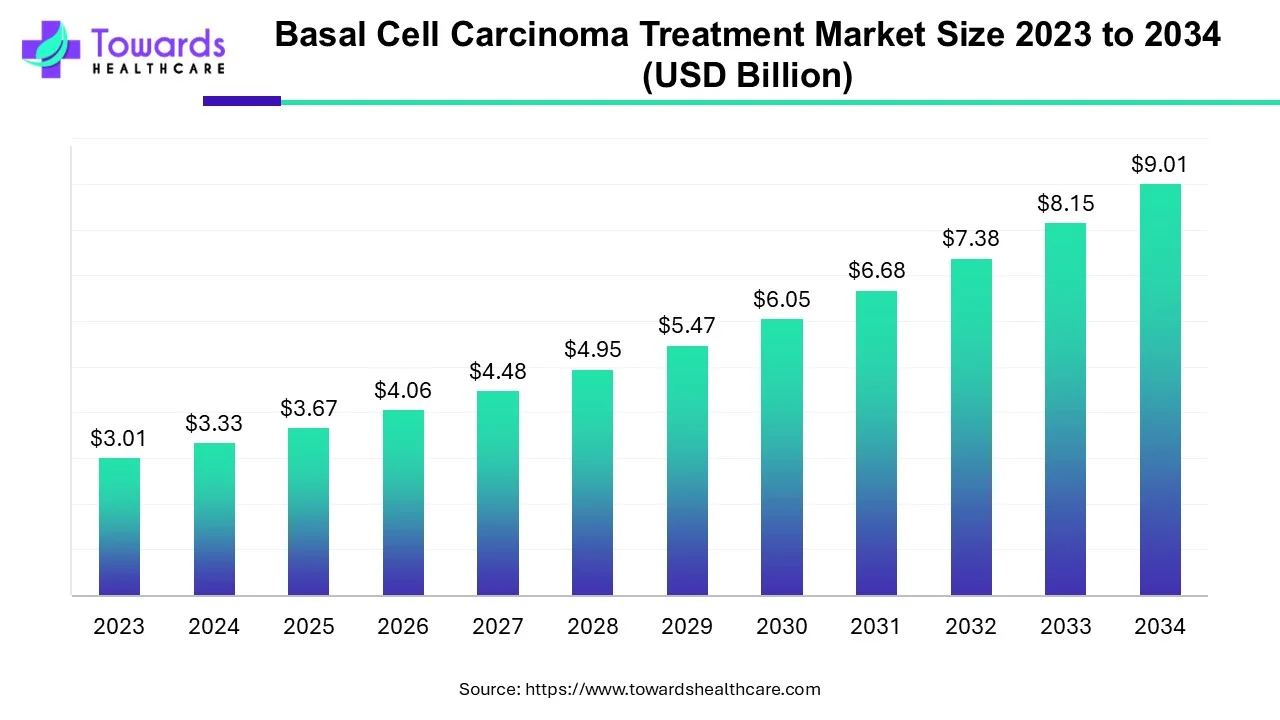
Download the free sample and get the complete insights and forecasts report on this market @ https://www.towardshealthcare.com/download-sample/5497
Meanwhile, the Asia-Pacific region is emerging as the fastest-growing market. Rising urbanization, increased UV exposure, and improved healthcare facilities are driving the adoption of advanced therapies in countries like China, India, and Japan. Australia also stands out, with two out of three individuals expected to develop skin cancer by age 70.
Breaking Down the Treatments
Surgery Still Leads: Surgery remains the most trusted option, particularly Mohs surgery. Its precision and minimal scarring make it ideal for sensitive areas like the face. Every year, hundreds of thousands of surgeries are performed in the U.S. alone, reflecting both demand and effectiveness.
Intralesional Injections Are Catching Up: These targeted treatments deliver medications directly into tumors, reducing the need for extensive surgery. Immune checkpoint inhibitors and chemotherapeutic agents have shown promising results, offering less invasive alternatives with faster recovery times.
Topical Medications and Oral Therapies: Options like 5-fluorouracil, imiquimod, and Vismodegib are providing patients with flexible treatment plans. Topical therapies are particularly useful for early-stage or superficial lesions, while oral medications are increasingly applied for advanced or hard-to-treat cases.
Regional Insights: Where Change is Happening
United States: With millions affected each year, the U.S. is a leader in BCC treatment adoption. Advanced diagnostics, awareness campaigns, and robust healthcare systems are fueling market growth.
Canada: Rising UV exposure and an aging population are driving demand. Nonmelanoma skin cancer cases increased by 77% between 2017 and 2023, highlighting a growing need for effective treatment.
Asia-Pacific: Countries like China and India are investing in modern healthcare infrastructure and awareness campaigns. Rising skin cancer cases due to sun exposure and lifestyle changes make this region a hotbed for market growth.
Europe: With strong healthcare systems and advanced medical technologies, Europe continues to provide effective treatment access. Countries like Germany and the UK are focusing on early detection and patient-centered care.
Latin America & MEA: Increasing recreational sun exposure and fair-skinned populations in subtropical climates are raising BCC cases. Improved awareness and healthcare access are slowly expanding treatment adoption.
Innovations Shaping the Future
Several breakthroughs are reshaping the way BCC is detected and treated:
-
AI-Powered Screening: Apps and handheld devices are helping dermatologists identify BCC faster and more accurately.
-
Portable Detection Devices: Sensors analyzing volatile organic compounds (VOCs) from skin lesions aim to simplify early detection.
-
Personalized Medicine: Treatments tailored to a patient’s genetic makeup and tumor characteristics are improving outcomes.
-
New Topical Therapies: Combinations like calcipotriene and fluorouracil support targeted, office-friendly treatments.
These innovations are not just improving survival rates—they are also reducing the physical, emotional, and financial burden on patients.
What This Means for Patients
For patients, the future of BCC treatment is hopeful. Less invasive options, faster diagnoses, and tailored therapies mean better results with fewer side effects. Early detection is becoming more accessible through AI tools, mobile apps, and public awareness campaigns. Patients now have more choices than ever, from traditional surgery to cutting-edge immunotherapies and topical treatments.
As the BCC treatment market continues to expand, innovation and technology will play a central role. Rising cases worldwide, coupled with smarter diagnostics and personalized care, promise to make treatments more efficient, precise, and patient-friendly. From North America to Asia-Pacific, the focus is shifting from simply managing cancer to enhancing the quality of life for those affected.
Basal cell carcinoma may be common, but the way it’s treated is changing dramatically. With AI, personalized medicine, and new therapies entering the market, patients and healthcare providers are finally seeing a brighter, more proactive future.
Access our exclusive, data-rich dashboard dedicated to the healthcare market – built specifically for decision-makers, strategists, and industry leaders. The dashboard features comprehensive statistical data, segment-wise market breakdowns, regional performance shares, detailed company profiles, annual updates, and much more. From market sizing to competitive intelligence, this powerful tool is one-stop solution to your gateway.
Access the Dashboard: https://www.towardshealthcare.com/access-dashboard
Checkout Basal Cell Carcinoma Treatment Market Report Now at: https://www.towardshealthcare.com/checkout/5497
You can place an order or ask any questions, please feel free to contact us at [email protected]
Europe Region – +44 778 256 0738
North America Region – +1 8044 4193 44
APAC Region: +91 9356 9282 04
Visit Our Website: https://www.towardshealthcare.com
Find us on social platforms: LinkedIn | Twitter | Instagram | Medium | Pinterest