Single cell analysis is changing how researchers understand life. Instead of studying a bulk sample, scientists now examine individual cells. This approach reveals subtle biological differences that were previously invisible.
As technology evolves, the single cell analysis market is expanding rapidly. The market stood at USD 5.19 billion in 2024, grew to USD 6.16 billion in 2025, and analysts expect it to reach around USD 29.15 billion by 2034.
Such growth reflects a strong 18.74% CAGR between 2025 and 2034, showing how critical this technology has become for modern research, diagnostics, and drug development.
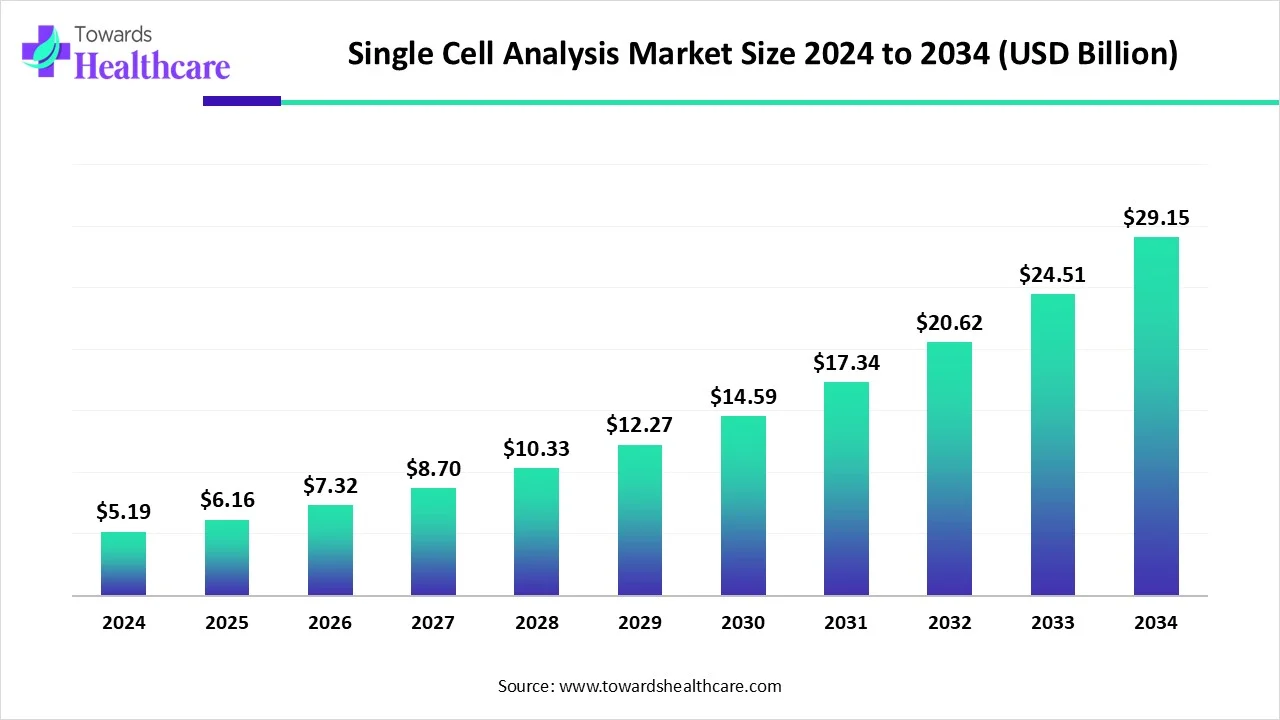
Download the free sample and get the complete insights and forecasts report on this market @ https://www.towardshealthcare.com/download-sample/5682
Why Studying One Cell Matters More Than Ever
Human tissues contain millions of cells, yet not all behave the same way. Even inside a tumor, some cells may grow aggressively while others remain dormant.
Single-cell analysis helps researchers detect these hidden variations. By examining each cell individually, scientists can understand how diseases begin, evolve, and resist treatments.
This approach is particularly powerful in areas like cancer biology, immunology, and regenerative medicine. Instead of guessing how a disease spreads, researchers can track the behavior of specific cells.
That level of insight is transforming the way medical science approaches complex health problems.
Key Forces Powering the Market’s Rapid Growth
Several global trends are pushing the adoption of single-cell analysis technologies.
The increasing burden of chronic diseases has created a strong need for precise diagnostics. Researchers and pharmaceutical companies want deeper biological insights to design targeted treatments.
At the same time, technological breakthroughs in sequencing, microfluidics, and bioinformatics have made these tools more powerful and accessible.
The following factors play a major role in accelerating the market:
-
Rising global cases of cancer and autoimmune diseases
-
Rapid progress in genomics and next-generation sequencing technologies
-
Increasing investment in personalized medicine research
-
Expanding focus on stem cell and regenerative medicine studies
These drivers continue to reshape research laboratories and clinical environments worldwide.
North America Leads While Asia Pacific Accelerates
Regional trends reveal interesting shifts in scientific investment and healthcare innovation.
North America currently dominates the global market, accounting for about 41% of the total share in 2024. Strong research infrastructure, advanced healthcare systems, and large biotechnology investments support this leadership.
The region also hosts many major life-science companies and research institutions that actively develop single-cell technologies.
Meanwhile, Asia Pacific is emerging as the fastest-growing region. Countries across the region are expanding biomedical research funding and strengthening their biotechnology ecosystems.
Growing academic collaborations, improved laboratory infrastructure, and increasing pharmaceutical research activities continue to push regional growth forward.
Products Driving the Technology Revolution
Single-cell analysis relies on multiple tools, technologies, and workflows. Each component plays a critical role in generating accurate cellular insights.
Among product categories, consumables dominated the market in 2024. These include reagents, assay kits, and laboratory materials that researchers use during experiments.
Because scientists frequently use these consumables during testing and analysis, demand remains consistently high.
However, instruments are expected to grow at a strong pace in the coming years. New platforms such as automated sequencing systems and microfluidic devices are making single-cell studies faster and more precise.
As research expands, laboratories continue investing in advanced analytical equipment.
Cancer Research Stands at the Center of Innovation
Cancer remains one of the biggest global health challenges. Understanding how tumors develop requires detailed knowledge of cellular behavior.
Single-cell analysis allows scientists to examine individual tumor cells. This helps researchers identify mutations, track disease progression, and predict treatment responses.
The cancer application segment dominated the market in 2024 due to its importance in oncology research.
However, immunology is expected to grow rapidly in the coming years. Studying immune cells individually helps scientists understand immune responses, infections, and vaccine effectiveness.
This knowledge plays a vital role in developing modern immunotherapies and precision treatments.
AI Meets Biology: A Powerful Scientific Partnership
Artificial intelligence is becoming an essential partner in single-cell analysis.
Modern experiments generate massive volumes of biological data. Each experiment can produce thousands or even millions of cellular data points. Interpreting this information manually would be extremely difficult.
AI algorithms help researchers process this data faster and uncover hidden patterns.
These systems support scientists by:
-
Identifying gene expression patterns within individual cells
-
Detecting disease-related cellular signatures
-
Accelerating drug discovery and clinical research
-
Improving the accuracy of complex biological analyses
By combining artificial intelligence with genomics and bioinformatics, researchers can explore cellular systems with unprecedented depth.
This fusion of biology and technology is shaping the future of healthcare research.
Challenges That Still Limit Wider Adoption
Despite strong growth potential, several challenges still affect the market.
Advanced laboratory instruments used in single-cell analysis often require significant investment. Equipment such as flow cytometers and microfluidic platforms can be expensive to acquire and maintain.
In addition to equipment costs, laboratories must also invest in reagents, consumables, and skilled researchers capable of handling complex data analysis.
These financial and technical barriers may slow adoption, especially in developing regions.
However, as technologies mature and become more scalable, many experts expect these limitations to gradually decline.
Breakthrough Innovations Are Opening New Possibilities
Scientific innovation continues to push the boundaries of what single-cell analysis can achieve.
New technologies are enabling researchers to study multiple biological layers within the same cell. This approach, often called multi-omics analysis, combines genomics, transcriptomics, proteomics, and epigenetics.
By integrating these data sources, scientists gain a more comprehensive view of cellular behavior.
Advancements in microfluidics, droplet-based sequencing, and spatial transcriptomics are also helping researchers map cellular interactions within tissues.
These breakthroughs are expanding the role of single-cell analysis across numerous scientific fields.
Academic Laboratories Remain Key Users
Universities and research institutions play a major role in driving market demand.
Academic and research laboratories accounted for the largest end-use segment in 2024. These institutions conduct foundational studies that push the limits of biomedical science.
They investigate disease mechanisms, explore genetic pathways, and test innovative technologies.
At the same time, pharmaceutical and biotechnology companies are increasingly adopting single-cell analysis to improve drug discovery and development processes.
This collaboration between academic researchers and industry leaders is accelerating innovation across the life sciences sector.
The Future of Medicine May Begin with a Single Cell
The rise of single-cell analysis marks one of the most exciting transformations in modern biology.
By focusing on individual cells, scientists are uncovering the hidden complexity of human health and disease. This knowledge is helping researchers develop targeted therapies, improve diagnostics, and understand biological systems at a deeper level.
With rapid technological progress and growing global investment, the market is set to expand dramatically over the next decade.
As research continues to evolve, one thing becomes clear: sometimes the smallest unit of life holds the biggest scientific answers.
Access our exclusive, data-rich dashboard dedicated to the diagnostics sector – built specifically for decision-makers, strategists, and industry leaders. The dashboard features comprehensive statistical data, segment-wise market breakdowns, regional performance shares, detailed company profiles, annual updates, and much more. From market sizing to competitive intelligence, this powerful tool is one-stop solution to your gateway.
Access the Dashboard: https://www.towardshealthcare.com/access-dashboard
Checkout the Market Report Now at: https://www.towardshealthcare.com/checkout/5682
You can place an order or ask any questions, please feel free to contact us at [email protected]
Europe Region – +44 778 256 0738
North America Region – +1 8044 4193 44
APAC Region: +91 9356 9282 04
Visit Our Website: https://www.towardshealthcare.com
Find us on social platforms: LinkedIn | Twitter | Instagram | Medium