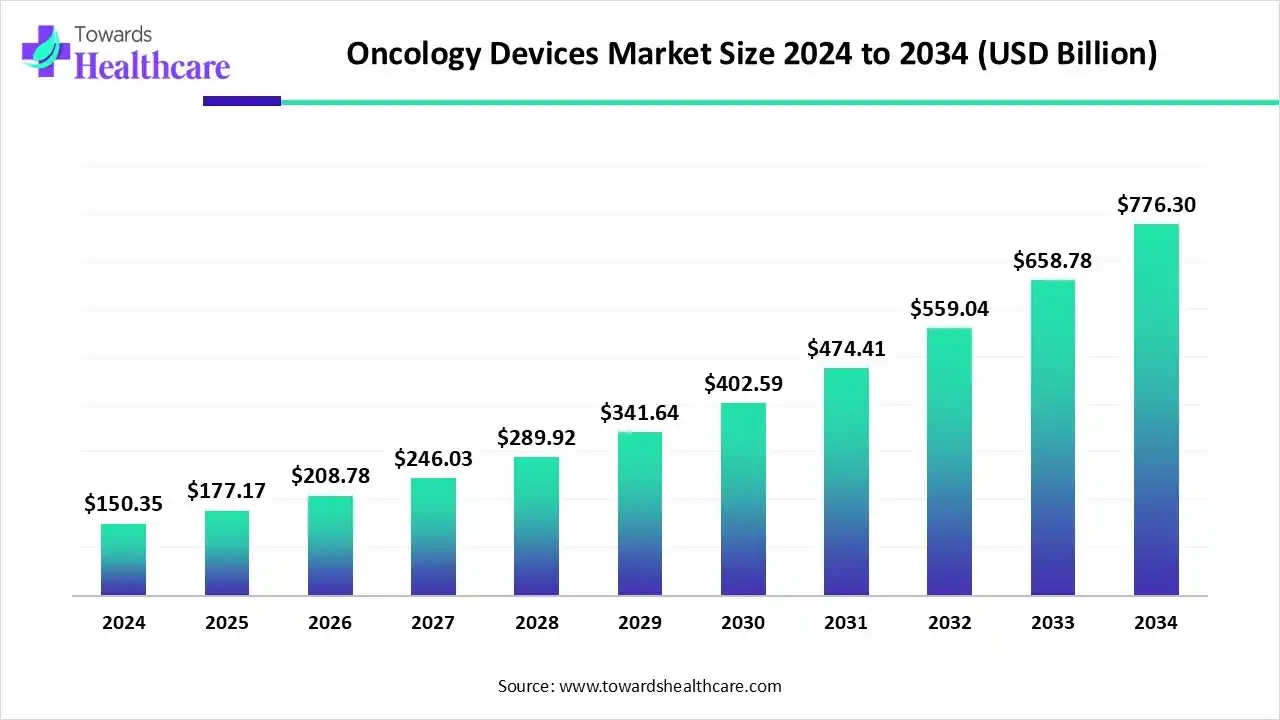
The oncology devices market reflects this transformation. The industry reached USD 150.35 billion in 2024 and is projected to expand rapidly to USD 776.3 billion by 2034, growing at a remarkable 17.84% CAGR. Behind this surge lies a powerful mix of scientific innovation, rising cancer prevalence, and an urgent demand for faster and more accurate treatments.
Download the free sample and get the complete insights and forecasts report on this market @ https://www.towardshealthcare.com/download-sample/6323
Healthcare systems across the world now rely heavily on advanced oncology equipment to improve survival rates and patient outcomes.
Why Oncology Devices Are Becoming the Backbone of Cancer Care
Modern oncology devices combine imaging, robotics, diagnostics, and treatment technologies into integrated clinical systems. These technologies enable doctors to detect tumors earlier and treat them with far greater precision.
Hospitals and cancer centers today use devices not only for diagnosis but also for targeted therapy, monitoring treatment response, and guiding surgical procedures.
The oncology devices ecosystem includes several critical technologies:
-
Diagnostic imaging tools such as CT scans, MRI, PET scans, and ultrasound
-
Radiation therapy systems for targeted tumor destruction
-
Robotic surgical systems and minimally invasive instruments
-
Interventional oncology tools including catheters, ablation systems, and embolization devices
These innovations allow clinicians to treat cancer more effectively while protecting healthy tissue.
The AI Shift: How Smart Devices Are Changing Cancer Detection
Artificial intelligence has become one of the most powerful tools in oncology technology. AI algorithms now analyze complex imaging data and help clinicians identify early signs of cancer that traditional analysis might miss.
AI-assisted imaging systems can detect subtle patterns in CT scans or MRIs, enabling earlier diagnosis and faster treatment decisions.
These systems also support radiologists by prioritizing urgent cases, improving workflow efficiency, and reducing diagnostic errors.
As machine learning evolves, AI will likely become a core component of nearly every oncology device—from imaging platforms to robotic surgical systems.
Radiation Therapy Systems Lead the Technology Landscape
Radiation therapy systems remain one of the most widely used oncology technologies. These systems accounted for around 28% of the market in 2024, reflecting their essential role in cancer treatment.
Modern radiation therapy equipment delivers highly controlled doses of radiation that target tumors with exceptional accuracy.
Doctors can now combine imaging data with advanced planning software to map the exact location of cancer cells before treatment begins. This precision significantly reduces damage to surrounding healthy tissues.
The next generation of radiation therapy technologies also integrates adaptive imaging and real-time monitoring, making treatments safer and more personalized.
Imaging Devices Are Driving the Next Growth Wave
While radiation therapy dominates today, diagnostic imaging systems are expected to grow at the fastest rate in the coming years.
Early detection remains the most powerful weapon against cancer. Imaging technologies allow physicians to identify tumors at earlier stages when treatment is more effective.
Advanced imaging platforms now support:
-
Molecular imaging that reveals tumor behavior at the cellular level
-
Image-guided procedures that improve surgical accuracy
-
Continuous monitoring of tumor response during treatment
These capabilities are pushing imaging systems to the center of modern oncology strategies.
The Rise of Interventional Oncology and Robotic Surgery
Cancer treatment is moving steadily toward minimally invasive procedures. Interventional oncology and robotic surgical systems are leading this shift.
These technologies allow doctors to treat tumors using image-guided procedures that require smaller incisions and shorter recovery times.
Robotic systems provide surgeons with enhanced precision, improved visualization, and greater control during complex operations.
As these technologies advance, they are transforming traditional surgical oncology into a more patient-friendly and highly precise field.
Hospitals Continue to Drive Demand
Hospitals and comprehensive cancer centers remain the largest users of oncology devices, accounting for more than 60% of market demand.
These institutions require sophisticated imaging systems, radiation platforms, surgical robots, and advanced treatment planning software to support complex oncology procedures.
At the same time, outpatient oncology clinics and ambulatory surgical centers are expanding rapidly. These facilities increasingly perform diagnostic imaging, biopsies, and certain cancer treatments outside traditional hospital settings.
This shift toward outpatient care is expected to reshape how oncology devices are deployed across healthcare systems.
North America Leads While Asia-Pacific Accelerates
North America currently dominates the global oncology devices market, capturing roughly 40% of the total share.
The region benefits from strong healthcare infrastructure, high investment in research and development, and favorable regulatory frameworks.
Research institutions, government initiatives, and advanced cancer treatment centers have created an environment that encourages continuous innovation in oncology technologies.
However, Asia-Pacific is emerging as the fastest-growing region. Rising cancer cases, expanding healthcare infrastructure, and growing investments in medical technology are fueling this momentum.
Countries such as China, India, and Japan are strengthening their oncology research capabilities while expanding access to advanced diagnostic and treatment technologies.
Investment Is Fueling a New Wave of Innovation
The rapid expansion of oncology devices would not be possible without strong financial backing.
Venture capital firms, healthcare investors, and private equity groups are actively funding companies that develop innovative cancer technologies.
These investments support research in areas such as AI-powered diagnostics, robotic surgery platforms, and next-generation radiation therapy systems.
Several startups are also exploring new approaches to cancer treatment, including home-based therapy devices and point-of-care diagnostic tools.
Such developments suggest that oncology devices will continue evolving far beyond traditional hospital equipment.
Sustainability Enters the Oncology Technology Space
Another emerging trend in the industry is sustainability. Medical device manufacturers are increasingly focusing on environmentally responsible production and supply chains.
Companies are adopting greener manufacturing practices, recyclable materials, and energy-efficient technologies.
Sustainable innovation is becoming particularly important as healthcare systems aim to reduce environmental impact while maintaining high standards of patient care.
This shift reflects a broader transformation across the global medical technology industry.
Access our exclusive, data-rich dashboard dedicated to the medical devices indsutry – built specifically for decision-makers, strategists, and industry leaders. The dashboard features comprehensive statistical data, segment-wise market breakdowns, regional performance shares, detailed company profiles, annual updates, and much more. From market sizing to competitive intelligence, this powerful tool is one-stop solution to your gateway.
Access the Dashboard: https://www.towardshealthcare.com/access-dashboard
Checkout the Market Report Now at: https://www.towardshealthcare.com/checkout/6323
You can place an order or ask any questions, please feel free to contact us at [email protected]
Europe Region – +44 778 256 0738
North America Region – +1 8044 4193 44
APAC Region: +91 9356 9282 04
Visit Our Website: https://www.towardshealthcare.com
Find us on social platforms: LinkedIn | Twitter | Instagram | Medium