Industries across pharmaceuticals, food, agriculture, and cosmetics increasingly rely on microscopic capsules that protect and deliver active ingredients more efficiently. These capsules may be invisible to the naked eye, but their impact is becoming impossible to ignore.
The global microencapsulation technology market reflects this momentum. The market reached US$ 7.56 billion in 2024 and grew to US$ 8.17 billion in 2025. Analysts expect it to climb to US$ 16.43 billion by 2034, expanding at a steady 8.07% CAGR between 2025 and 2034.
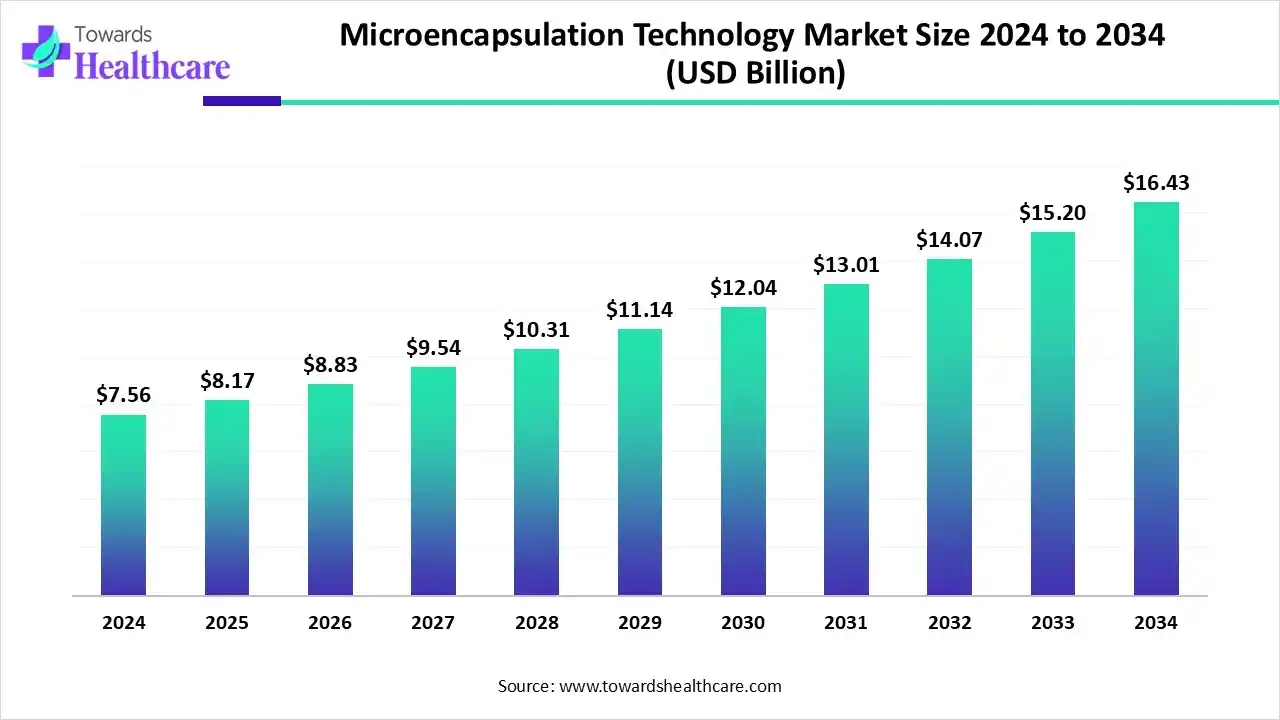
Download the free sample and get the complete insights and forecasts report on this market @ https://www.towardshealthcare.com/download-sample/6386
This growth shows how industries are embracing smarter delivery systems for chemicals, drugs, nutrients, and fragrances.
What Exactly Is Microencapsulation?
Microencapsulation refers to a technique that encloses tiny particles of active materials inside protective shells. These shells act like miniature containers that control when and how the ingredients are released.
Manufacturers often use this process to stabilize sensitive materials such as vitamins, flavors, drugs, or enzymes.
The protective coating shields the core ingredient from heat, moisture, oxygen, and chemical reactions. At the same time, it allows companies to release the ingredient gradually or precisely when needed.
The process helps solve many product challenges. It improves stability, masks unpleasant taste or odor, and enhances the effectiveness of the active ingredient.
Why Industries Are Rapidly Adopting It
Modern industries demand precision, efficiency, and longer shelf life. Microencapsulation addresses all three.
Companies now use the technology to improve product performance without changing the core ingredient itself.
Some key benefits include:
-
Controlled release of active ingredients that improves product efficiency
-
Protection of sensitive compounds from environmental damage
-
Taste and odor masking in foods and pharmaceuticals
-
Improved product stability and shelf life
Because of these advantages, companies are integrating microencapsulation into drug development, nutritional supplements, functional foods, cosmetics, and even agricultural chemicals.
Pharmaceuticals Lead the Market
The pharmaceutical and healthcare sector currently dominates the microencapsulation landscape.
In 2024, pharmaceutical and healthcare actives accounted for about 34% of the market share. Drug developers increasingly rely on encapsulation to improve drug delivery systems.
Traditional medicines sometimes release active ingredients too quickly or cause unwanted side effects. Microencapsulation helps overcome these issues by releasing drugs in a controlled manner.
This approach improves therapeutic efficiency while reducing toxicity risks. It also allows researchers to design targeted delivery systems that send drugs exactly where they are needed in the body.
As precision medicine continues to evolve, encapsulated drug formulations are likely to become even more common.
Polymers Shape the Structure of Microcapsules
Shell materials play a crucial role in the effectiveness of microencapsulation. Among them, polymers currently dominate the market.
In 2024, the polymer segment captured around 42% of total revenue. These materials provide strength, flexibility, and stability to the microcapsule structure.
Researchers increasingly prefer biodegradable polymers because they combine safety with sustainability. These materials break down naturally while still protecting the encapsulated ingredient.
Meanwhile, lipids and waxes are emerging as the fastest-growing shell materials. Their compatibility with food, cosmetic, and pharmaceutical formulations makes them particularly attractive for natural and clean-label products.
Spray Drying Remains the Workhorse Technology
Several technologies support the microencapsulation process, but spray drying continues to lead the field.
This technique held approximately 37% market share in 2024.
Spray drying works by converting liquid mixtures into dry powder particles while simultaneously forming protective coatings around active ingredients. It offers several advantages compared with other methods.
These advantages include:
-
High production speed and efficiency
-
Lower operational costs
-
Flexibility for different particle sizes
-
Compatibility with multiple industries
Because of its scalability and cost-effectiveness, manufacturers frequently use spray drying in food processing, pharmaceuticals, agriculture, and cosmetics.
Artificial Intelligence Begins to Reshape Encapsulation
The future of microencapsulation will likely depend heavily on digital technologies.
Artificial intelligence and machine learning are starting to transform how scientists design encapsulation systems. Researchers can now analyze massive datasets to predict how materials behave during the encapsulation process.
AI tools help scientists optimize shell composition, release profiles, and production conditions. This data-driven approach reduces trial-and-error experiments and speeds up product development.
In the coming years, AI could revolutionize several aspects of the industry:
-
Predicting the best encapsulation materials for specific applications
-
Improving quality control in manufacturing
-
Accelerating materials discovery for biodegradable capsules
These advancements may unlock new possibilities in drug delivery, functional foods, and agricultural innovations.
Personal Care and Cosmetics Open New Opportunities
While pharmaceuticals dominate today, personal care and cosmetics are emerging as one of the fastest-growing application areas.
Beauty brands increasingly incorporate active ingredients such as vitamins, antioxidants, and fragrances into skincare and cosmetic products.
However, these ingredients often degrade when exposed to air or light. Microencapsulation helps solve this problem by protecting them until the moment of application.
The technology also enhances sensory experiences. Encapsulated fragrances, for example, can release gradually throughout the day.
As consumer demand for high-performance beauty products continues to grow, microencapsulation may become a key differentiator in cosmetic formulations.
North America Leads the Global Market
North America currently holds the largest share of the global microencapsulation technology market.
In 2024, the region accounted for approximately 35% of total revenue. Several factors contribute to this leadership position.
The region hosts a strong pharmaceutical and biotechnology ecosystem supported by advanced research infrastructure. Companies actively invest in drug delivery innovation and high-performance materials.
The United States alone recorded $722.5 billion in pharmaceutical spending in 2023, highlighting the scale of healthcare investment driving technological adoption.
Such investments encourage continuous innovation in encapsulation technologies.
Asia Pacific Emerges as the Growth Engine
While North America leads today, Asia Pacific is rapidly becoming the fastest-growing market.
Countries like China and India are investing heavily in pharmaceuticals, food processing, and agricultural technology. These industries increasingly adopt microencapsulation to enhance product quality and stability.
China’s pharmaceutical sector, for example, now contributes nearly 30% of global drug development activity. Rising drug approvals and research investments are creating new demand for advanced drug delivery technologies.
Growing consumer markets, expanding industrial bases, and increasing regulatory focus on product quality are expected to fuel the region’s growth.
Europe Strengthens Its Innovation Base
Europe also plays a critical role in the global microencapsulation ecosystem.
Countries such as Germany, the United Kingdom, France, and Italy have established strong research capabilities and advanced manufacturing infrastructure.
Germany stands out in particular due to its robust healthcare sector and leadership in medical technology development. The country hosts one of the largest medical technology markets globally.
This environment supports innovation in encapsulation materials, coatings, and pharmaceutical delivery systems.
A Technology with Expanding Possibilities
Microencapsulation may sound like a niche scientific process, but its applications extend far beyond laboratories.
From improving drug therapies to stabilizing nutrients in food and enhancing the performance of cosmetics, the technology quietly powers many products used in everyday life.
As industries pursue greater efficiency, sustainability, and precision, the demand for smarter delivery systems will only grow.
Tiny capsules may hold the key to some of the biggest innovations in modern science and industry.
Access our exclusive, data-rich dashboard dedicated to the life sciences industry – built specifically for decision-makers, strategists, and industry leaders. The dashboard features comprehensive statistical data, segment-wise market breakdowns, regional performance shares, detailed company profiles, annual updates, and much more. From market sizing to competitive intelligence, this powerful tool is one-stop solution to your gateway.
Access the Dashboard: https://www.towardshealthcare.com/access-dashboard
Checkout the Market Report Now at: https://www.towardshealthcare.com/checkout/6386
You can place an order or ask any questions, please feel free to contact us at [email protected]
Europe Region – +44 778 256 0738
North America Region – +1 8044 4193 44
APAC Region: +91 9356 9282 04
Visit Our Website: https://www.towardshealthcare.com
Find us on social platforms: LinkedIn | Twitter | Instagram | Medium