Magnetic Resonance Imaging has always been one of the most powerful diagnostic tools.
But now, when artificial intelligence steps in, MRI is no longer just imaging—it becomes decision support.
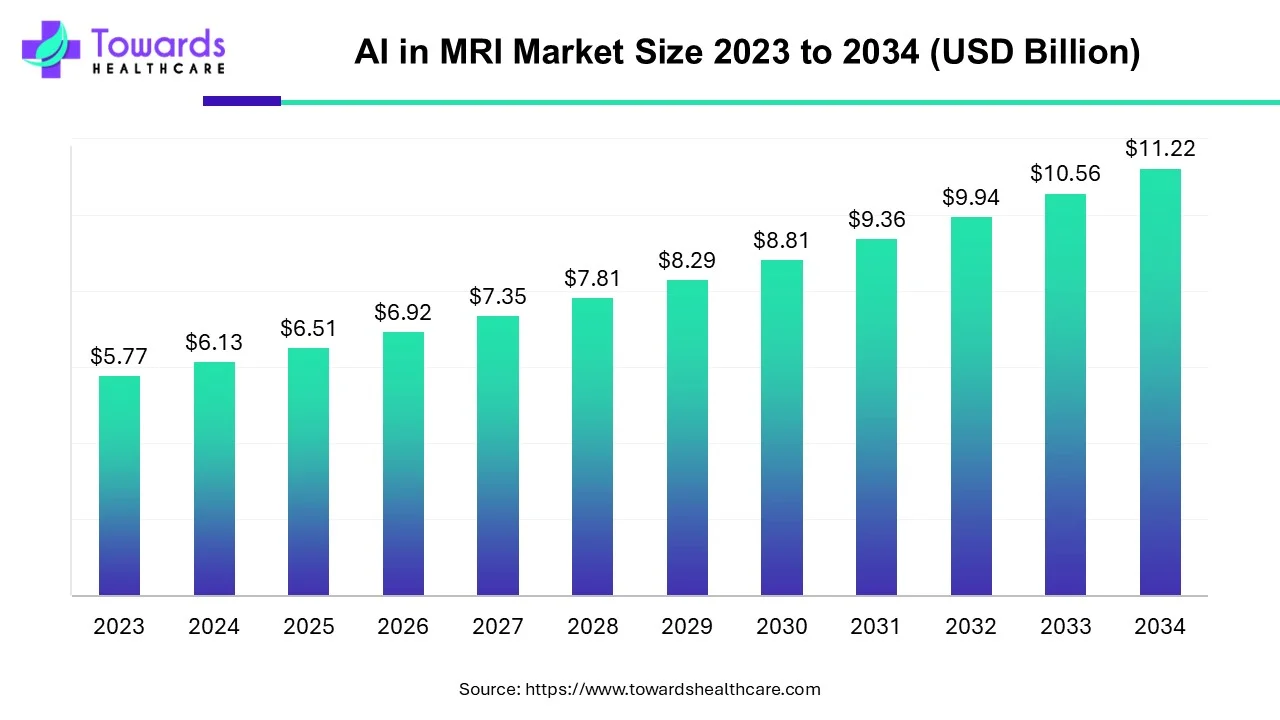
The global AI in MRI market is projected to grow from USD 6.13 billion in 2024 to USD 11.22 billion by 2034, reflecting steady momentum.
This growth signals something deeper: healthcare is shifting from reactive diagnosis to predictive intelligence.
When Data Starts Thinking
AI doesn’t replace radiologists—it strengthens them.
It processes thousands of image slices in seconds and highlights what the human eye might miss under pressure.
In practical terms, this means faster diagnosis, better accuracy, and fewer repeat scans.
Radiology is moving from interpretation to intelligent interpretation.
-
AI models today can detect brain tumors with over 90% accuracy in controlled studies
-
Hospitals using AI-assisted imaging report 20–30% reduction in reporting time
-
Diagnostic error rates in imaging drop by nearly 5–10% with AI assistance
This shift is not theoretical—it is already unfolding in real clinical environments.
From Images to Insights
MRI traditionally captures structure.
AI adds context, prediction, and pattern recognition.
In neurology, AI helps detect early-stage conditions like Alzheimer’s by analyzing subtle tissue changes.
In cardiology, it reduces scan time and improves clarity in complex heart imaging.
The real breakthrough lies in predictive analysis.
AI can now estimate disease progression, not just identify it.
The Pandemic That Changed Imaging Forever
COVID-19 did more than strain healthcare systems—it accelerated digital adoption.
Hospitals needed remote diagnostics, and AI became a necessity, not a luxury.
Radiologists began reviewing scans from different locations, supported by AI tools that flagged abnormalities automatically.
Telemedicine and remote imaging workflows became mainstream almost overnight.
-
Telehealth usage increased by 38x globally during the pandemic peak
-
AI-based imaging tools saw adoption growth of nearly 25% year-on-year post-2020
-
Remote diagnostics reduced patient wait times by up to 40% in some hospitals
This was not a temporary shift—it permanently changed how imaging operates.
Hospitals Lead, But the Cloud Follows
Hospitals remain the largest users of AI in MRI.
They benefit from quicker turnaround times and improved patient outcomes.
However, infrastructure is evolving.
While on-premise systems held around 60% market share in 2022, cloud adoption is rising rapidly.
Cloud-based AI offers flexibility, scalability, and easier collaboration across locations.
It allows even smaller diagnostic centers to access advanced capabilities without heavy upfront investment.
Innovation Is Coming From Everywhere
The AI in MRI ecosystem is not driven by a single player.
It is a mix of healthcare giants, startups, and research institutions.
Collaborations are shaping the future.
Recent partnerships focus on reducing scan time, improving workflow, and expanding access to early detection tools.
From full-body AI scans to cardiac imaging optimization, innovation is targeting real-world inefficiencies.
The goal is simple: make imaging faster, smarter, and more accessible.
The Barriers We Can’t Ignore
Despite the momentum, challenges remain.
Technology alone cannot transform healthcare without the right ecosystem.
A major issue is the shortage of trained professionals who can operate and interpret AI-driven systems.
Even the most advanced tools require human understanding and oversight.
Cost is another barrier.
Setting up AI-enabled MRI infrastructure demands significant investment, which limits adoption in smaller facilities.
Yet, as technology matures, costs are expected to decline—just as we’ve seen in other digital sectors.
Emerging Markets, Emerging Opportunities
The next wave of growth will not come only from developed regions.
Countries like India, China, and Brazil are becoming key drivers of adoption.
Rising patient populations and increasing healthcare awareness are pushing demand for faster diagnostics.
Governments are also investing heavily in AI to strengthen healthcare systems.
China, for instance, aims to become a global AI leader by 2030, backed by strong funding and policy support.
India’s diagnostics sector is expanding rapidly, with imaging demand growing at over 8–10% annually.
This creates a powerful opportunity for AI-driven MRI solutions to scale globally.
The Future: Smarter, Faster, More Human
AI in MRI is not just about machines—it’s about better care.
It reduces the burden on doctors and improves outcomes for patients.
The future of imaging will not depend on sharper images alone.
It will depend on how intelligently those images are understood.
As AI continues to evolve, MRI will move beyond diagnosis into prevention.
And when that happens, healthcare will no longer wait for disease—it will anticipate it.
Access our exclusive, data-rich dashboard dedicated to the medical devices industry – built specifically for decision-makers, strategists, and industry leaders. The dashboard features comprehensive statistical data, segment-wise market breakdowns, regional performance shares, detailed company profiles, annual updates, and much more. From market sizing to competitive intelligence, this powerful tool is one-stop solution to your gateway.
Access the Dashboard: https://www.towardshealthcare.com/access-dashboard
Checkout the Market Report Now at: https://www.towardshealthcare.com/checkout/5020
You can place an order or ask any questions, please feel free to contact us at [email protected]
Europe Region – +44 778 256 0738
North America Region – +1 8044 4193 44
APAC Region: +91 9356 9282 04
Visit Our Website: https://www.towardshealthcare.com
Find us on social platforms: LinkedIn | Twitter | Instagram | Medium