The AI in medical imaging market size is forecasted to expand from USD 1.79 billion in 2025 to USD 26.23 billion by 2034, growing at a CAGR of 34.8% from 2025 to 2034, as a result of the rising number of cross-industry collaborations, and extensive adoption of big data.
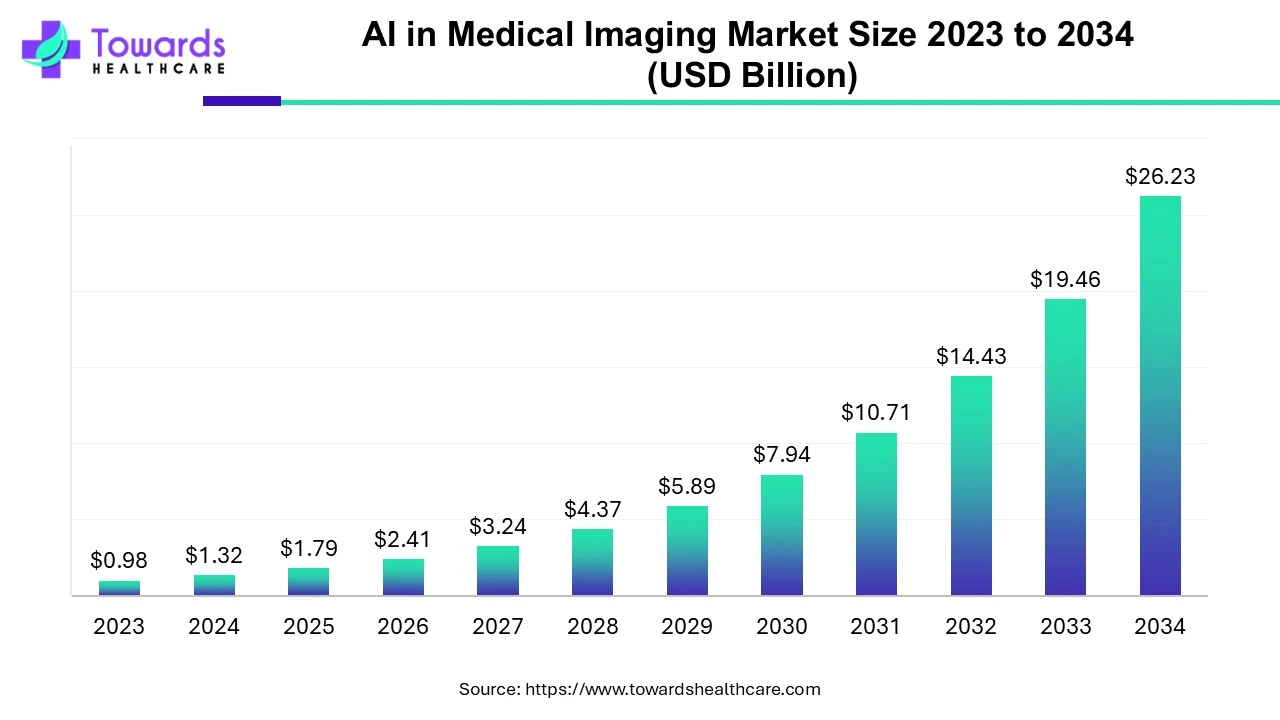
Download Free Sample: https://www.towardshealthcare.com/download-sample/5032
As imaging volumes surge globally, radiologists face increasing pressure. AI steps in not to replace them, but to enhance their capabilities and improve patient outcomes.
The Data Explosion That Changed Everything
Medical imaging generates massive volumes of data every day. A single CT scan can produce hundreds of images, each requiring careful analysis. Traditionally, reviewing these scans could take up to 20 minutes per patient.
Now, AI-powered systems can process similar datasets in under a minute. This shift is not just about speed—it’s about accuracy, consistency, and early detection.
Healthcare systems worldwide are rapidly digitizing. Over 90% of hospitals in developed regions have adopted electronic health records (EHRs), creating a rich ecosystem of structured and unstructured data. AI thrives in this environment, turning raw data into actionable insights.
Where AI Is Making the Biggest Impact
AI applications in medical imaging are expanding across multiple specialties. Radiology is becoming one of the most AI-integrated fields in modern medicine.
Here’s where AI is creating the strongest impact:
-
Neurology: Detects strokes and brain abnormalities within seconds
-
Oncology: Identifies tumors and predicts malignancy risks
-
Cardiology: Assists in analyzing heart structure and function
-
Breast Imaging: Improves early detection rates in screening programs
Studies show that AI-assisted diagnostics can improve detection accuracy by up to 20% in certain conditions. This is particularly critical in diseases where early diagnosis directly impacts survival rates.
Deep Learning Leads the Charge
Deep learning, a subset of machine learning, has become the backbone of AI in imaging. It mimics the human brain using layered neural networks to recognize patterns in data.
These systems learn from millions of images. Over time, they become highly efficient at identifying even the smallest anomalies that might go unnoticed by the human eye.
For example, AI models trained on large datasets have demonstrated over 90% accuracy in detecting conditions like pneumonia and diabetic retinopathy. This level of precision is pushing the boundaries of traditional diagnostics.
AI + Big Data = Smarter Healthcare
The combination of AI and big data is unlocking new possibilities. Medical imaging is no longer limited to visual interpretation—it now integrates clinical, genetic, and behavioral data.
This convergence enables:
-
Predictive analysis: Forecast disease progression before symptoms worsen
-
Personalized treatment: Tailor therapies based on patient-specific data
-
Population health insights: Identify trends across large patient groups
Globally, healthcare data is expected to grow at a compound annual rate of 36%, making AI essential for managing and interpreting this information effectively.
Collaboration Is Fueling Innovation
AI growth in medical imaging is not happening in isolation. Strategic collaborations between healthcare providers, tech companies, and research institutions are accelerating innovation.
These partnerships bring together clinical expertise and advanced computing power. As a result, new tools are emerging that improve workflow efficiency, automate reporting, and prioritize critical cases.
This collaborative approach is helping healthcare systems scale AI adoption while maintaining quality and reliability.
The Human Factor Still Matters
Despite rapid advancements, AI faces resistance from some healthcare professionals. Many worry about over-reliance on technology or the potential loss of human judgment.
However, the reality is different. AI works best as an assistant, not a replacement. Radiologists bring context, experience, and empathy—qualities machines cannot replicate.
AI handles repetitive and time-consuming tasks, allowing doctors to focus on complex decision-making and patient interaction. This balance creates a more efficient and human-centered healthcare system.
Challenges That Cannot Be Ignored
While AI offers significant benefits, several challenges remain:
-
Trust and transparency: Clinicians need explainable AI systems
-
Data privacy: Patient data must be protected at every level
-
Integration issues: AI tools must fit seamlessly into existing workflows
-
Skill gaps: Professionals need training to use AI effectively
Addressing these challenges is critical for long-term adoption and success.
The future of AI in medical imaging goes beyond diagnostics. Emerging technologies aim to create “human-aware” AI systems that understand context, adapt to user needs, and provide meaningful insights.
Imagine AI systems that not only detect disease but also explain their reasoning, suggest treatment options, and continuously learn from outcomes.
This evolution will redefine how healthcare professionals interact with technology.
Access our exclusive, data-rich dashboard dedicated to the medical imaging industry – built specifically for decision-makers, strategists, and industry leaders. The dashboard features comprehensive statistical data, segment-wise market breakdowns, regional performance shares, detailed company profiles, annual updates, and much more. From market sizing to competitive intelligence, this powerful tool is one-stop solution to your gateway.
Access the Dashboard: https://www.towardshealthcare.com/access-dashboard
Checkout the Market Report Now at: https://www.towardshealthcare.com/checkout/5032
You can place an order or ask any questions, please feel free to contact us at [email protected]
Europe Region – +44 778 256 0738
North America Region – +1 8044 4193 44
APAC Region: +91 9356 9282 04
Visit Our Website: https://www.towardshealthcare.com
Find us on social platforms: LinkedIn | Twitter | Instagram | Medium