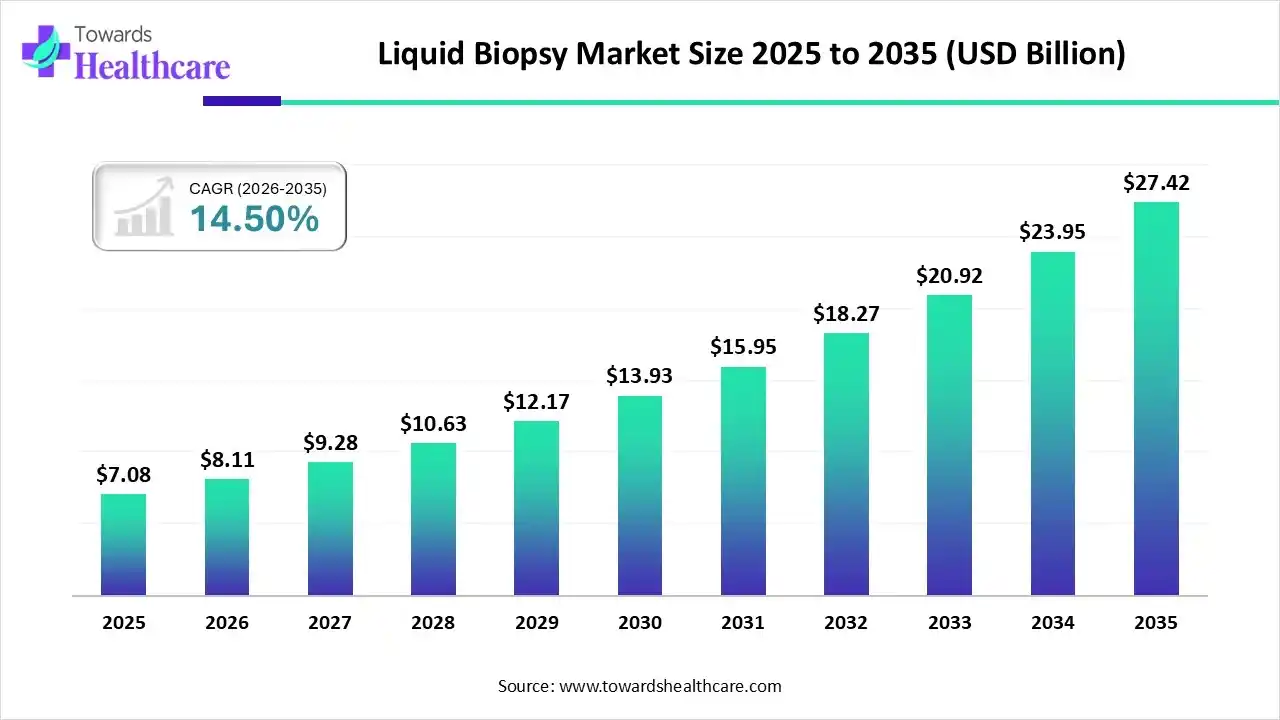
Liquid biopsy, once considered an experimental approach, is now shaping the future of diagnostics. With the global market projected to grow from USD 7.08 billion in 2025 to USD 27.42 billion by 2035, this technology is no longer a niche innovation; it’s becoming mainstream healthcare infrastructure.
Download Free Sample: https://www.towardshealthcare.com/download-sample/5031
What makes this shift powerful is not just the numbers, but the promise: detecting cancer earlier, faster, and without invasive procedures.
From Needles to Data: A Shift in Cancer Diagnosis
Traditional biopsies often require surgery, hospital stays, and recovery time.
Liquid biopsy changes that narrative completely. It uses blood, urine, or other body fluids to detect cancer-related biomarkers, making the process simpler and safer.
This shift matters because patients no longer need to undergo painful procedures just to confirm a diagnosis. Doctors can now track cancer progression in real-time, without repeated surgical interventions.
The result? Faster decisions, better monitoring, and a more patient-friendly approach to care.
Why the Market Is Growing So Rapidly
The rapid rise of the liquid biopsy market is not accidental. It’s driven by a combination of medical urgency and technological breakthroughs.
Cancer cases are increasing globally, and healthcare systems are under pressure to detect diseases earlier and treat them more effectively. Liquid biopsy fits perfectly into this need.
At the same time, advancements in genomics and molecular diagnostics have made it possible to detect even the smallest traces of tumor DNA in the bloodstream.
Key growth drivers include:
-
Rising global cancer burden and demand for early detection
-
Increased preference for minimally invasive diagnostic methods
-
Advancements in next-generation sequencing (NGS) and PCR technologies
-
Growing focus on personalized and precision medicine
This combination is pushing the industry toward a steady 14.5% CAGR between 2026 and 2035.
Technology That Thinks: The Role of AI
Artificial intelligence is taking liquid biopsy to the next level.
Instead of just detecting biomarkers, AI systems analyze massive datasets to uncover patterns that human analysis might miss.
This allows doctors to identify specific mutations, predict treatment responses, and even discover new drug targets.
AI-powered platforms are also automating workflows—from sample analysis to clinical insights—making diagnostics faster and more accurate.
In simple terms, liquid biopsy is no longer just a test. It’s becoming an intelligent diagnostic ecosystem.
Breaking Down What Drives Innovation
Several innovations are redefining how liquid biopsy works and what it can achieve.
One of the most impactful developments is multi-analyte testing. These tests analyze multiple biomarkers in a single sample, giving a more complete picture of the disease.
Another major breakthrough is next-generation sequencing (NGS), which enables high-precision detection of genetic mutations from a single tube of blood.
Here’s what’s driving innovation today:
-
Multi-gene parallel analysis improving diagnostic accuracy
-
Digital PCR enabling faster and more sensitive detection
-
Exosome and microvesicle research unlocking new biomarkers
-
Integration of AI for real-time data interpretation
These advancements are not just improving diagnostics—they are transforming how we understand cancer itself.
Beyond Cancer: Expanding Clinical Applications
While cancer remains the dominant application, liquid biopsy is expanding into new areas.
Reproductive health is emerging as a fast-growing segment. Doctors now use liquid biopsy techniques for prenatal testing and monitoring pregnancy-related conditions without invasive procedures.
In clinical settings, its role is also evolving. It helps in therapy selection, early screening, and recurrence monitoring, giving doctors a comprehensive tool for patient management.
This expansion shows that liquid biopsy is not just a cancer tool—it’s becoming a broader diagnostic solution.
Regional Momentum: Who Leads the Race?
North America currently dominates the liquid biopsy market, driven by strong healthcare infrastructure, advanced research, and supportive regulatory frameworks.
The region continues to invest heavily in cancer diagnostics, with leading companies pushing innovation and adoption.
However, the real growth story lies in Asia-Pacific. Countries like China, Japan, and India are rapidly advancing in genomics research and healthcare technology.
Rising awareness, increasing healthcare investments, and a growing patient population are turning Asia-Pacific into the fastest-growing region in this space.
Europe is also gaining momentum, supported by government initiatives and increased funding for cancer screening technologies.
Opportunities That Could Reshape Healthcare
Liquid biopsy opens doors to possibilities that were once difficult to achieve.
It enables early detection of cancer, sometimes even before symptoms appear. It allows continuous monitoring without discomfort. And most importantly, it supports personalized treatment plans based on individual genetic profiles.
These capabilities are creating new opportunities:
-
Earlier diagnosis leading to better survival rates
-
Cost-effective monitoring compared to traditional methods
-
Personalized medicine tailored to each patient
-
Improved efficiency in clinical trials and drug development
This is where healthcare begins to shift from reactive to proactive.
Challenges Still Holding It Back
Despite its promise, liquid biopsy is not without limitations.
One major concern is sensitivity. In early-stage cancers or certain tumor types, the amount of detectable DNA in the bloodstream may be too low for accurate detection.
There are also issues related to standardization. Different testing methods and protocols can lead to inconsistent results, making regulatory approval more complex.
Cost remains another barrier, especially in developing regions where advanced diagnostic tools are not easily accessible.
These challenges highlight that while the technology is powerful, it still requires refinement and wider accessibility.
The future of liquid biopsy looks promising, but it will be shaped by how well the industry addresses its current limitations.
Ongoing research is focused on improving sensitivity, discovering new biomarkers, and integrating advanced technologies like AI and high-performance computing.
As these improvements take shape, liquid biopsy could become a routine part of healthcare—not just for cancer, but for multiple diseases.
What we are witnessing today is not just market growth. It’s the transformation of diagnostics into something faster, smarter, and far more human-centric.
And if the current trajectory continues, a simple blood test might soon become one of the most powerful tools in modern medicine.
Access our exclusive, data-rich dashboard dedicated to the biotechnology sector – built specifically for decision-makers, strategists, and industry leaders. The dashboard features comprehensive statistical data, segment-wise market breakdowns, regional performance shares, detailed company profiles, annual updates, and much more. From market sizing to competitive intelligence, this powerful tool is one-stop solution to your gateway.
Access the Dashboard: https://www.towardshealthcare.com/access-dashboard
Checkout the Market Report Now at: https://www.towardshealthcare.com/checkout/5031
You can place an order or ask any questions, please feel free to contact us at [email protected]
Europe Region – +44 778 256 0738
North America Region – +1 8044 4193 44
APAC Region: +91 9356 9282 04
Visit Our Website: https://www.towardshealthcare.com
Find us on social platforms: LinkedIn | Twitter | Instagram | Medium