The blood pressure monitoring device market is not just growing; it is accelerating with purpose.
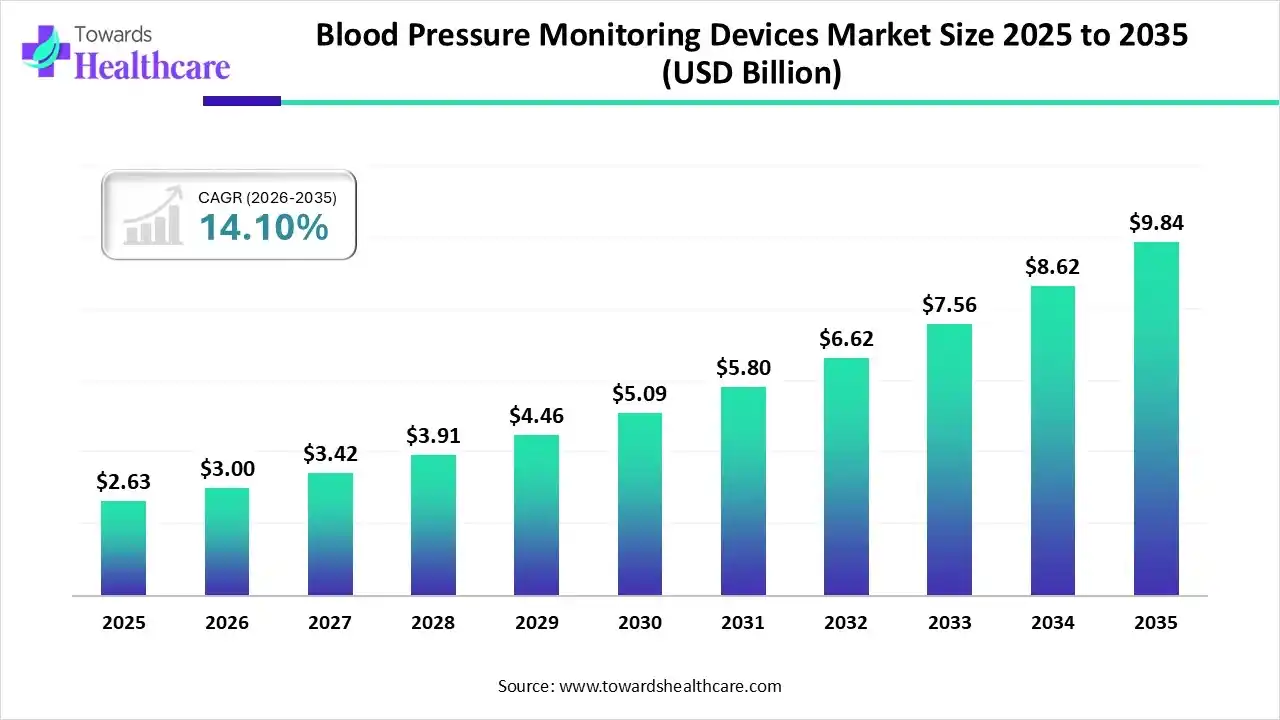
From a valuation of USD 2.63 billion in 2025 to an expected USD 9.84 billion by 2035, the projected 14.10% CAGR tells a deeper story.
Download Free Sample: https://www.towardshealthcare.com/download-sample/5048
This growth reflects more than business expansion. It signals a shift in how people understand, track, and take control of their health in real time.
Hypertension: The Quiet Driver of Demand
High blood pressure does not make noise, but its impact is massive.
With over a billion people affected globally, hypertension has quietly become one of the biggest health risks.
People are no longer waiting for symptoms.
They are actively monitoring their health, and that behavior is directly pushing demand for accessible and reliable blood pressure devices.
-
Sedentary lifestyles and stress levels continue to rise
-
Early diagnosis is becoming a priority, not an option
-
Preventive healthcare is gaining real attention
This shift from “treatment” to “tracking” is reshaping the entire market.
From Clinics to Homes: A Major Behavior Shift
A few years ago, checking blood pressure meant visiting a clinic.
Today, it happens at home, at work, or even while traveling.
Digital monitors and wearable devices have made this possible.
People want convenience, and the market is delivering it fast.
Smart devices now offer more than readings.
They provide trends, alerts, and even insights that help users understand their health patterns better.
This transition has turned patients into active participants in their own care.
Technology Is Not Just Improving—It’s Redefining
Innovation in this space is not incremental; it is transformational.
Devices are becoming smarter, faster, and more intuitive.
Cuffless monitoring technology is one such breakthrough.
It removes discomfort while maintaining accuracy, making regular monitoring easier than ever.
Key advancements shaping the market include:
-
Integration with mobile apps for real-time tracking
-
Cloud connectivity for data storage and sharing
-
AI-based insights for better health decisions
Technology is no longer supporting healthcare—it is leading it.
Remote Monitoring: The Game Changer
Healthcare is no longer confined within hospital walls.
Remote patient monitoring is redefining how care is delivered.
Doctors can now track patients’ blood pressure without physical visits.
This reduces hospital burden and ensures continuous care.
For patients, it means fewer disruptions and more control.
For providers, it means better data and faster decision-making.
This shift is especially powerful for chronic conditions like hypertension, where consistency matters more than occasional checkups.
North America Leads, But Asia Pacific Rises Fast
North America continues to dominate the market.
High awareness, advanced healthcare systems, and strong technology adoption drive its leadership.
However, the real momentum is building in Asia Pacific.
Rapid urbanization, lifestyle changes, and increasing healthcare awareness are fueling demand.
India, in particular, stands out.
With a large population and rising hypertension cases, the need for monitoring devices is growing rapidly.
People are becoming more health-conscious, and affordable devices are making access easier.
Europe and MEA: Growth Through Structure and Support
Europe is strengthening its position through strict regulations and quality standards.
This ensures safer and more reliable devices, boosting user trust.
Meanwhile, the Middle East and Africa are emerging steadily.
Government initiatives, healthcare investments, and awareness campaigns are opening new opportunities.
These regions may not lead today, but they are building strong foundations for future growth.
Innovation Meets Competition
The market is highly competitive, and that is a good thing.
Competition pushes companies to innovate faster and better.
Manufacturers are not just launching products—they are solving problems.
They are focusing on accuracy, portability, and ease of use.
-
New product launches are expanding into untapped regions
-
Companies are improving design to simplify user experience
-
Continuous upgrades are making devices more reliable
This competitive pressure ensures that users get better solutions every year.
The Hidden Challenge: Complexity
While innovation drives growth, it also brings complexity.
Advanced devices often come with features that are difficult for some users to understand.
Elderly users and non-tech-savvy individuals may struggle with complicated interfaces.
This can lead to incorrect usage or complete avoidance.
To address this, the industry must simplify without compromising functionality.
User-friendly design is no longer optional—it is essential.
Government Actions Are Making a Difference
Public health initiatives are playing a crucial role in expanding access.
From device donations to awareness programs, governments are stepping in actively.
Such efforts are not just improving healthcare infrastructure.
They are also encouraging early detection and prevention.
When accessibility increases, adoption naturally follows.
The Future: Personalized and Predictive Care
The next phase of this market will focus on personalization.
Devices will not just measure—they will predict and guide.
With data analytics and AI integration, users will receive tailored insights.
This will help in preventing complications before they occur.
Healthcare will become proactive rather than reactive.
And blood pressure monitoring devices will sit at the center of this transformation.