The non-viral gene delivery technologies market is entering a powerful growth phase, quietly reshaping the future of gene therapy and precision medicine.
With a projected value of $13.38 billion by 2035, this market is no longer experimental; it is becoming foundational to next-generation healthcare.
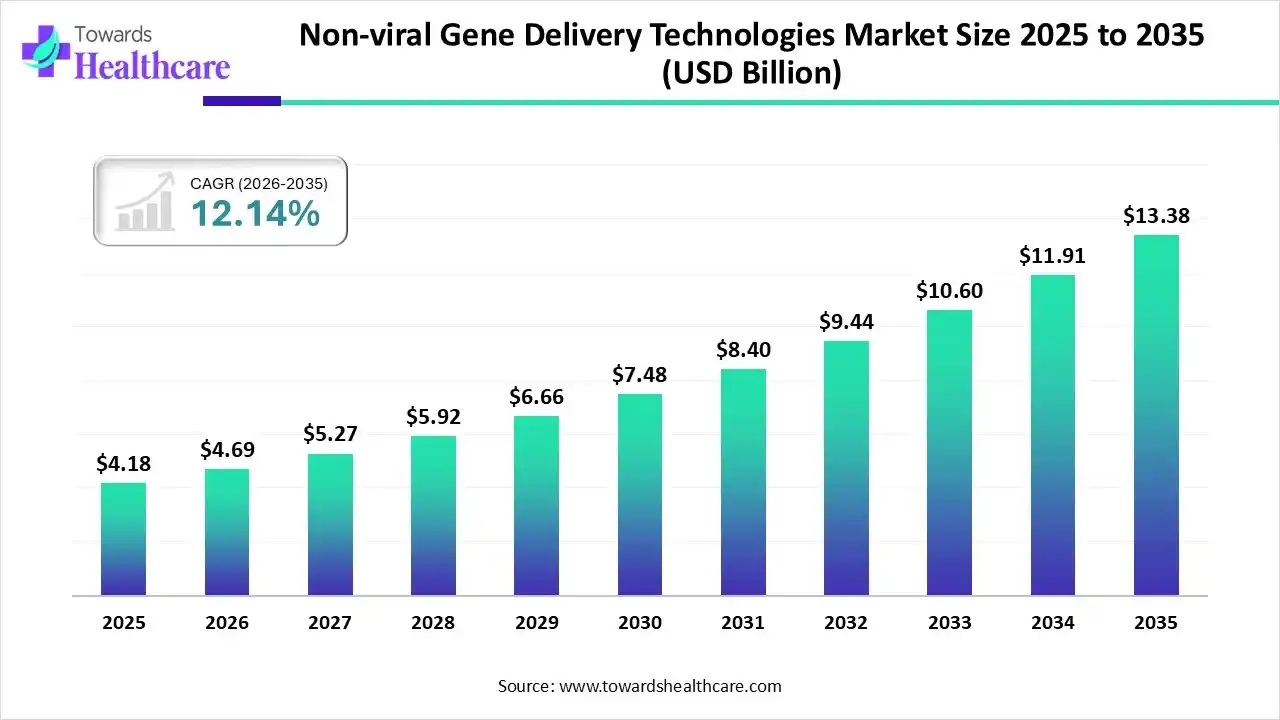
Download Free Sample: https://www.towardshealthcare.com/download-sample/6614
Unlike viral methods, non-viral systems are steadily gaining trust for their safety, flexibility, and scalability. As innovation accelerates, these technologies are moving from research labs into real-world therapeutic applications.
A Safer Shift: Why Non-Viral Methods Are Gaining Ground
The healthcare industry is rethinking how genetic material should be delivered into cells.
Non-viral gene delivery offers a safer and more controllable alternative, avoiding many risks associated with viral vectors.
These systems reduce immune responses and allow repeated dosing, which is critical for chronic and complex diseases.
They also simplify production, making them more viable for large-scale use.
At the core, non-viral vectors can deliver different genetic materials like plasmid DNA, mRNA, and gene-editing tools. This flexibility is a major reason behind their growing adoption.
From Lab Curiosity to Market Reality
Not long ago, non-viral delivery was seen as less effective compared to viral systems.
Today, that perception is rapidly changing.
Advancements in nanotechnology and material science have significantly improved delivery efficiency. Researchers are now designing carriers that can navigate biological barriers more effectively.
The result is a steady shift—from experimental research to real clinical potential.
Key Forces Driving Market Expansion
Several underlying factors are pushing this market forward at a rapid pace.
Healthcare systems are demanding safer therapies, while biotech innovation is unlocking new possibilities.
Here are the most important growth drivers:
- Rising demand for targeted and personalized gene therapies
- Increasing prevalence of genetic and chronic diseases
- Continuous innovation in nanotechnology and biomaterials
- Strong investment in biotech startups and research ecosystems
These forces are not acting in isolation—they are reinforcing each other, accelerating market maturity.
AI Is Rewriting the Rules of Gene Delivery
Artificial intelligence is quietly becoming a game-changer in this space.
It is not just supporting research—it is actively reshaping how delivery systems are designed.
AI models can simulate cellular environments, predict delivery efficiency, and reduce off-target effects.
This leads to smarter, more precise gene delivery mechanisms.
More importantly, AI enables personalization.
Therapies can now be tailored based on a patient’s genetic profile, improving outcomes and reducing risks.
Breakthrough Trends You Should Watch Closely
Innovation in non-viral delivery is happening at multiple levels, from materials to mechanisms.
Some emerging trends are already redefining what’s possible.
Lipid Nanoparticles (LNPs) are gaining massive traction due to their success in mRNA-based therapies.
They offer a safe and efficient way to transport genetic material into cells.
DNA Origami is another fascinating development.
It allows scientists to fold DNA into precise nanostructures, improving delivery accuracy and stability.
Exosome-Based Delivery is also emerging as a natural and biocompatible approach.
These cell-derived vesicles can deliver genetic material with minimal toxicity.
Segment Insights: Where the Real Momentum Lies
Different segments within the market are evolving at different speeds.
Understanding these dynamics helps in identifying where the future is heading.
- Chemical delivery methods are leading the market due to their adaptability and ease of modification
- Research applications dominate currently, driven by academic and experimental use
- Therapeutic applications are growing fastest, signaling a shift toward real-world treatments
This transition from research to therapeutics is a strong indicator of market maturity.
Why Research Institutions Still Lead the Game
Academic and research institutes continue to dominate the end-use landscape.
They act as the innovation engine of this market.
These institutions have the flexibility to experiment, modify delivery systems, and test new concepts.
Their work lays the foundation for future clinical applications.
As funding and collaboration increase, their role will remain critical in shaping the next wave of breakthroughs.
Regional Power Play: Who’s Leading and Who’s Catching Up
Geography plays a crucial role in determining how fast this market evolves.
Different regions are contributing in unique ways.
North America remains the dominant force.
Strong biotech ecosystems, research funding, and innovation hubs are driving its leadership.
Europe is rapidly scaling up, especially in biologics production.
Strategic investments and regulatory support are strengthening its position.
Asia Pacific is the fastest-growing region.
Rising healthcare awareness, increasing investments, and expanding infrastructure are fueling demand.
India, in particular, is seeing growth through digital healthcare adoption and public-private partnerships.
Challenges Still Holding the Market Back
Despite strong growth, the market is not without obstacles.
Certain technical and biological challenges still limit its full potential.
Non-viral systems often face issues with delivery efficiency and short-lived gene expression.
Transporting large genetic materials also remains complex.
Additionally, biological barriers inside the human body can reduce the effectiveness of delivery systems.
Overcoming these challenges will define the next phase of innovation.
Opportunities That Could Redefine the Future
The future of non-viral gene delivery looks promising, especially with ongoing advancements in science and technology.
New opportunities are emerging across multiple dimensions.
- Development of nucleic acid-based drugs targeting previously “undruggable” diseases
- Improved intracellular trafficking and cellular uptake mechanisms
- Expansion of precision medicine and personalized therapy models
These opportunities are not just incremental—they have the potential to transform how diseases are treated.
The Road Ahead: From Innovation to Impact
The non-viral gene delivery technologies market is moving beyond theory and into action.
What was once a scientific challenge is now becoming a clinical solution.
As AI, nanotechnology, and biotechnology converge, the possibilities will only expand.
The focus will shift from “can we deliver genes safely?” to “how effectively can we treat diseases?”
The next decade will likely witness a transition from experimental success to widespread therapeutic adoption.
Access our exclusive, data-rich dashboard dedicated to the healthcare market – built specifically for decision-makers, strategists, and industry leaders. The dashboard features comprehensive statistical data, segment-wise market breakdowns, regional performance shares, detailed company profiles, annual updates, and much more. From market sizing to competitive intelligence, this powerful tool is one-stop solution to your gateway.
Access the Dashboard: https://www.towardshealthcare.com/access-dashboard
Checkout the Market Report Now at: https://www.towardshealthcare.com/checkout/6614
You can place an order or ask any questions, please feel free to contact us at [email protected]
Europe Region – +44 778 256 0738
North America Region – +1 8044 4193 44
APAC Region: +91 9356 9282 04
Visit Our Website: https://www.towardshealthcare.com
Find us on social platforms: LinkedIn | Twitter | Instagram | Medium