Cell and gene therapy drug delivery devices are no longer just scientific breakthroughs; they are becoming real treatment options.
But the real question is: how do these complex therapies safely reach patients?
In 2025, drug delivery devices are not just support tools; they are shaping treatment success.
From hospitals to homes, the way therapies are delivered is evolving faster than expected.
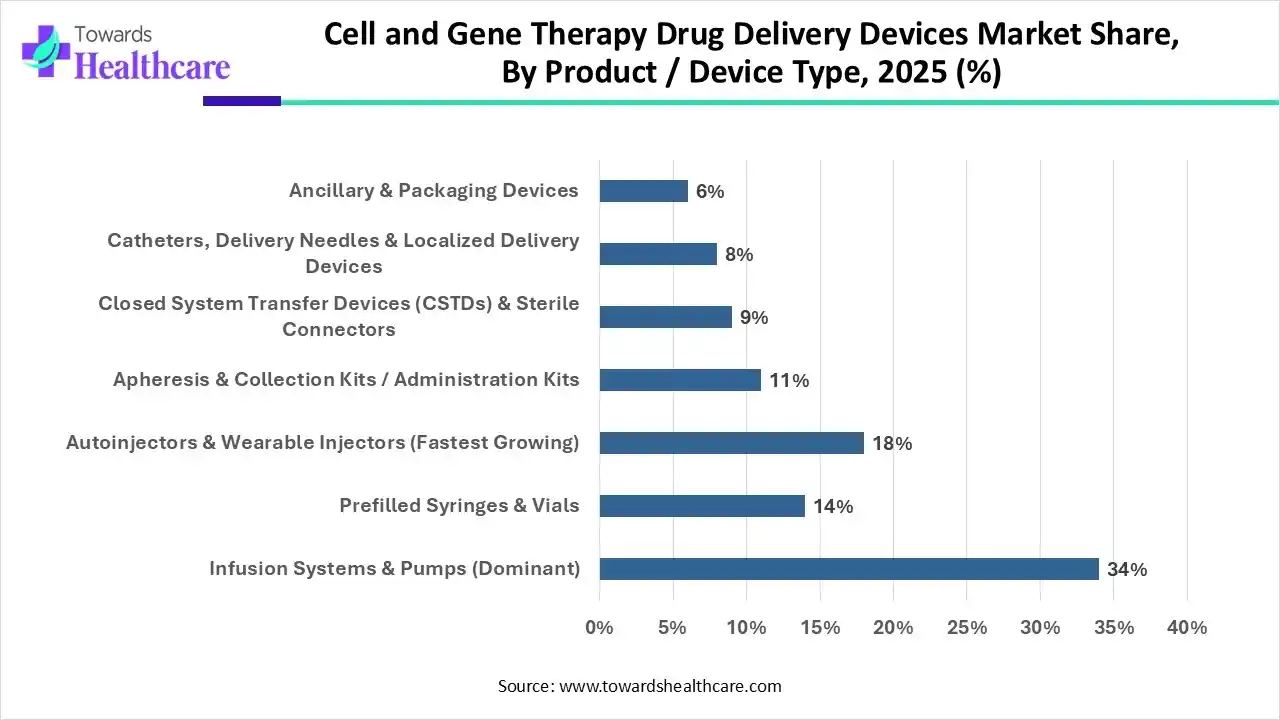
Infusion Systems Lead the Race; But Why 34% Matters
Our experts provide in-depth market segments, trends, and competitor data so you don’t have to guess.
Get the complete market report today: Download Now
Infusion systems and pumps dominated the market with a 34% share in 2025.
This is not just about numbers; it reflects how critical controlled delivery has become.
These systems simplify the administration of complex therapies.
Doctors rely on them because they offer precision, flexibility, and real-time monitoring.
What makes them stand out?
- They work across both hospital and home settings
- They support programmable and controlled dosing
- They reduce risks during high-value therapy administration
At the same time, the demand for home-based care is rising.
This shift is quietly pushing infusion systems into a central role in treatment delivery.
Patient Comfort Drives the Rise of Smart Injectors
While infusion systems lead, autoinjectors and wearable injectors are rapidly gaining ground.
They are changing how patients experience treatment.
These devices focus on simplicity and comfort.
Patients can receive therapy with minimal disruption to their daily lives.
More importantly, they solve real problems; like dosing errors and low adherence.
With features like sensors and connectivity, they are turning drug delivery into a smarter process.
Why Autologous Therapies Hold a Massive 45% Share
Autologous cell therapy administration captured a dominant 45% share in 2025.
This reflects a deeper shift toward personalized medicine.
Doctors prefer these therapies because they use the patient’s own cells.
This reduces the chances of immune rejection and improves outcomes.
The growth of this segment is driven by:
- Increasing use in cancer and rare disease treatments
- Better infrastructure for handling patient-specific therapies
- Devices designed specifically for safe and efficient delivery
As healthcare becomes more personalized, this segment is expected to remain strong.
Your next decision matters more than ever.
Get expert insights with stats, segments, and competitor data; buy today and feel confident: https://www.towardshealthcare.com/checkout/6096
The Fast Rise of In Vivo Gene Therapy (18%)
In vivo gene therapy delivery holds 18% share and is the fastest-growing segment.
It simplifies treatment by eliminating the need for cell extraction.
This approach allows therapies to be delivered directly into the body.
It opens doors for outpatient and even home-based treatments.
Innovations in vectors, nanoparticles, and targeting technologies are pushing this segment forward.
At the same time, partnerships between biotech firms and research institutions are accelerating development.
Delivery Routes: Why Intravenous Leads with 50%
When it comes to delivery routes, intravenous and intracavitary infusion dominate with a 50% share.
This route remains the most practical and widely accepted option.
It allows therapies to be delivered efficiently across the body.
Healthcare providers trust it because it fits easily into existing workflows.
Its dominance comes from:
- Simplicity in administration
- Compatibility with advanced monitoring systems
- Strong safety and clinical familiarity
However, new methods are emerging.
Intrathecal and intracerebral delivery are gaining attention for treating neurological conditions.
They help bypass barriers like the blood-brain barrier, making treatments more effective.
Hospitals Still Rule—With a 58% Share
Hospitals and specialty clinics led the market with a 58% share in 2025.
This dominance reflects the complexity of cell and gene therapies.
These treatments require expert handling, specialized infrastructure, and continuous monitoring.
Hospitals provide all of this under one roof.
Patients also trust these settings for high-risk therapies.
As a result, hospitals remain the primary point of care.
But Home Care Is Quietly Disrupting the System
While hospitals dominate, ambulatory and home infusion is the fastest-growing segment.
This shift is driven by convenience and accessibility.
Patients now prefer receiving treatment without frequent hospital visits.
Portable and wearable devices are making this possible.
This trend signals a bigger transformation—healthcare is moving closer to patients.
Technology That Changed the Game: 57% Share for Closed Systems
Single-use, closed-system technologies captured a 57% share in 2025.
They are becoming the backbone of safe therapy delivery.
These systems reduce contamination risks and improve process reliability.
They also simplify operations, making them ideal for both clinical and commercial use.
Their growing adoption shows one clear thing—efficiency and safety now go hand in hand.
Wearable Injectors: The Future of Continuous Care
Wearable, on-body high-volume injectors are emerging as the fastest-growing technology segment.
They represent the next phase of patient-centric care.
These devices allow continuous or scheduled dosing.
Patients no longer need to visit clinics frequently.
With digital tracking and automated alerts, they bring transparency and control.
They also support complex therapies that require large volumes over time.
A Market That Reflects a Bigger Healthcare Shift
The cell and gene therapy drug delivery devices market is not just growing—it is evolving.
Each segment tells a story of changing priorities.
From 34% infusion systems to 45% autologous therapies,
from 50% intravenous delivery to 58% hospital dominance,
and 57% closed-system technologies—every number reflects a shift toward safer, smarter, and more patient-focused care.
This is not just innovation.
It is a transformation in how healthcare thinks, operates, and delivers hope.
Access our exclusive, data-rich dashboard dedicated to the healthcare market – built specifically for decision-makers, strategists, and industry leaders. The dashboard features comprehensive statistical data, segment-wise market breakdowns, regional performance shares, detailed company profiles, annual updates, and much more. From market sizing to competitive intelligence, this powerful tool is one-stop solution to your gateway.
Access the Dashboard: https://www.towardshealthcare.com/access-dashboard
About Us
Healthcare Web Wire is part of Towards Healthcare which is a leading global provider of technological solutions, clinical research services, and advanced analytics, with a strong emphasis on life science research. Dedicated to advancing innovation in the life sciences sector, we build strategic partnerships that generate actionable insights and transformative breakthroughs. As a global strategy consulting firm, we empower life science leaders to gain a competitive edge, drive research excellence, and accelerate sustainable growth.
You can place an order or ask any questions, please feel free to contact us at [email protected]
Europe Region – +44 778 256 0738
North America Region – +1 8044 4193 44
APAC Region: +91 9356 9282 04
Visit Our Website: https://www.towardshealthcare.com
Find us on social platforms: LinkedIn | Twitter | Instagram | Medium