Healthcare is not just evolving—it is transforming at the point where treatment meets the patient. Drug delivery devices are no longer simple tools; they are becoming intelligent systems that shape how therapies work inside the body.
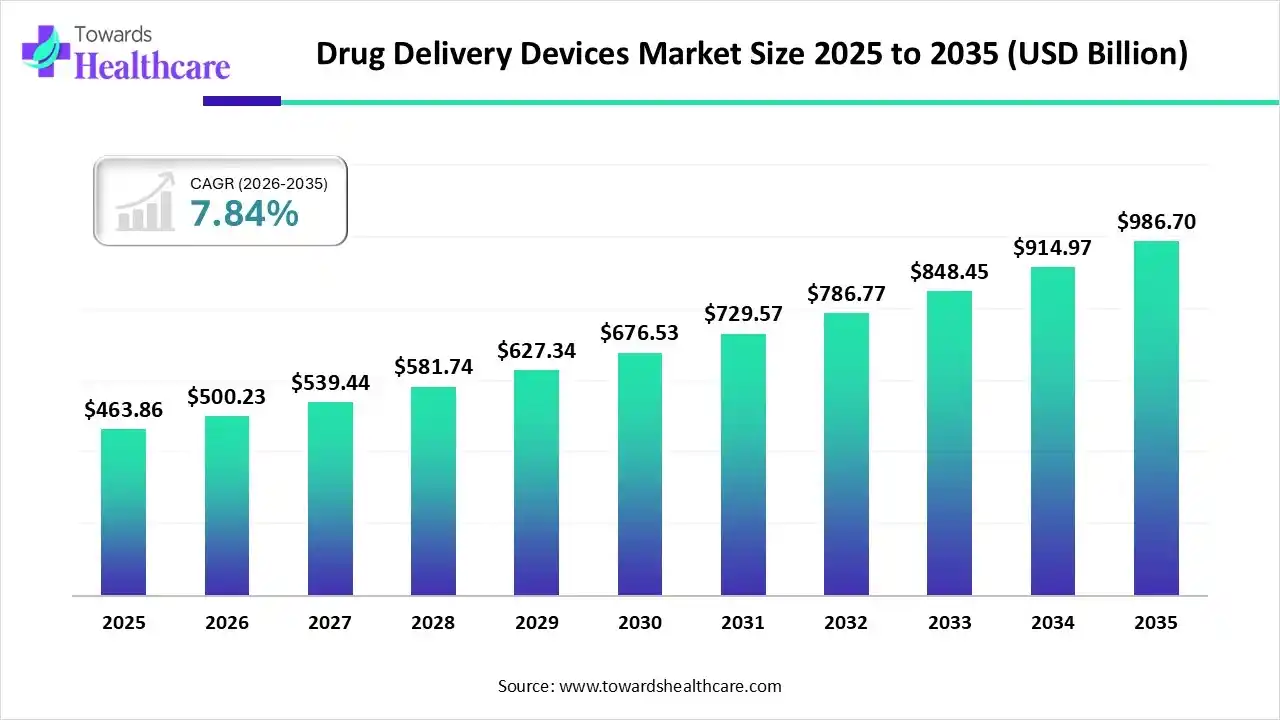
From insulin pens to wearable injectors, these devices now define treatment outcomes as much as the drugs themselves. The market, valued at $500.23 billion in 2026, is projected to nearly double to $986.7 billion by 2035, growing steadily at a 7.84% CAGR.
Download Free Sample: https://www.towardshealthcare.com/download-sample/6609
This growth is not random. It reflects a deeper shift toward precision, personalization, and patient control.
Why Drug Delivery Devices Are Becoming Indispensable
Healthcare systems worldwide are dealing with a rising burden of chronic diseases. Diabetes, respiratory disorders, and neurological conditions demand continuous and accurate drug administration.
Traditional methods often fall short. That is where modern drug delivery devices step in—ensuring controlled dosage, targeted delivery, and improved patient compliance.
Patients today expect more than treatment. They expect convenience, comfort, and control.
From Hospitals to Homes: The Shift Is Real
One of the most significant changes in this market is the move from hospital-based care to home-based treatment.
Devices are becoming simpler, safer, and more intuitive. This allows patients to manage their conditions without constant medical supervision.
This shift is driven by:
- Increasing chronic disease cases requiring long-term care
- Rising healthcare costs pushing for home-based solutions
- Growing awareness among patients about self-care
- Aging populations needing continuous but convenient treatment
The result is a healthcare model that feels less clinical and more personal.
Smart Devices Are Redefining Treatment
Technology is playing a central role in this transformation. Drug delivery devices are now integrating with digital platforms, turning into smart health companions.
Artificial intelligence is enabling:
- Real-time monitoring of patient responses
- Predictive insights for better treatment adjustments
- Personalized drug delivery based on patient data
- Integration with telehealth systems for remote care
These innovations are not just improving efficiency. They are improving lives by reducing errors and increasing treatment success rates.
Inhalers Lead Today, But Injectables Shape Tomorrow
Different product segments within the market are evolving at different speeds.
Inhalers currently dominate due to the global rise in respiratory conditions. Their non-invasive nature and quick action make them highly preferred.
However, injection devices are expected to grow the fastest.
Why? Because modern therapies—especially biologics—require precise and efficient delivery into the bloodstream.
This includes devices like:
- Auto-injectors
- Prefilled syringes
- Wearable injectors
These tools are becoming essential for managing complex conditions with accuracy and ease.
Diabetes Drives Demand Like No Other
Among all applications, diabetes remains the largest contributor to the market.
Daily insulin administration requires reliable and user-friendly devices. This has fueled innovation in insulin pumps, pens, and continuous delivery systems.
At the same time, central nervous system disorders are emerging as a high-growth segment.
As neurological conditions rise globally, the need for advanced delivery systems capable of crossing complex biological barriers is increasing.
Hospitals Still Lead, But Change Is Coming
Hospitals currently dominate the end-use segment due to their infrastructure, skilled staff, and high patient volume.
But this dominance is gradually shifting.
Diagnostic centers and home care settings are gaining importance. Faster diagnosis, improved accessibility, and patient preference for convenience are driving this transition.
The future will not eliminate hospitals—but it will reduce dependency on them for routine treatments.
Regional Dynamics: Growth Is Uneven but Promising
Different regions are contributing to this market in unique ways.
North America leads due to advanced healthcare systems, strong R&D investments, and high awareness levels.
Asia Pacific, however, is the fastest-growing region. Its growth is powered by:
- Large population base
- Increasing chronic disease cases
- Expanding healthcare infrastructure
- Government and private sector support
Europe is also showing steady progress, driven by innovation and a growing focus on home-based care.
Innovation Is Not Optional—It Is Survival
The competitive landscape in this market is intense. Companies are not just competing on products but on innovation and user experience.
The focus areas include:
- Development of smart and connected devices
- Integration with mobile applications
- Miniaturization for portability
- Enhancing safety and reducing errors
Even small improvements can significantly impact patient outcomes. That is why innovation cycles are becoming faster and more aggressive.
Inside the Value Chain: Where Real Work Happens
Behind every device is a complex ecosystem that ensures safety, efficiency, and reliability.
The value chain includes:
- Research and development focused on advanced technologies
- Clinical trials to validate safety and effectiveness
- Formulation processes ensuring compatibility between drug and device
- Patient support systems providing training and assistance
Each stage plays a critical role in delivering a device that patients can trust.
Opportunities Are Massive—But So Are the Challenges
The market is full of opportunities, but it is not without obstacles.
On one hand, rising diseases and technological advancements are pushing demand. On the other, challenges like high costs and strict regulations create barriers.
Key challenges include:
- Expensive device development and manufacturing
- Complex regulatory approvals slowing innovation
- Risk of dosing errors and safety concerns
- Rapid technological changes making products obsolete quickly
Companies must balance innovation with compliance to stay competitive.
Recent Moves Signal Strong Future Confidence
Recent investments and funding activities indicate strong confidence in this market’s future.
Significant capital is flowing into companies developing advanced delivery systems. These investments are focused on scaling manufacturing and improving technology platforms.
This trend highlights one thing clearly—the industry is preparing for long-term expansion.
The Bigger Picture: It’s About Control and Precision
At its core, the drug delivery devices market is not just about devices. It is about giving control back to patients.
It is about making treatments more precise, more accessible, and more aligned with real-life needs.
The future will likely see devices that:
- Adapt in real time to patient conditions
- Communicate seamlessly with healthcare providers
- Deliver drugs with near-perfect accuracy
- Blend into daily life without disruption
Access our exclusive, data-rich dashboard dedicated to the medical devices sector – built specifically for decision-makers, strategists, and industry leaders. The dashboard features comprehensive statistical data, segment-wise market breakdowns, regional performance shares, detailed company profiles, annual updates, and much more. From market sizing to competitive intelligence, this powerful tool is one-stop solution to your gateway.
Access the Dashboard: https://www.towardshealthcare.com/access-dashboard
Checkout the Market Report Now at: https://www.towardshealthcare.com/checkout/6609
You can place an order or ask any questions, please feel free to contact us at sales@towardshealthcare.com
Europe Region – +44 778 256 0738
North America Region – +1 8044 4193 44
APAC Region: +91 9356 9282 04
Visit Our Website: https://www.towardshealthcare.com
Find us on social platforms: LinkedIn | Twitter | Instagram | Medium
About the Author