Flow Cytometry Market Hits $9.80 Billion by 2035; What’s Powering This 7% Surge?
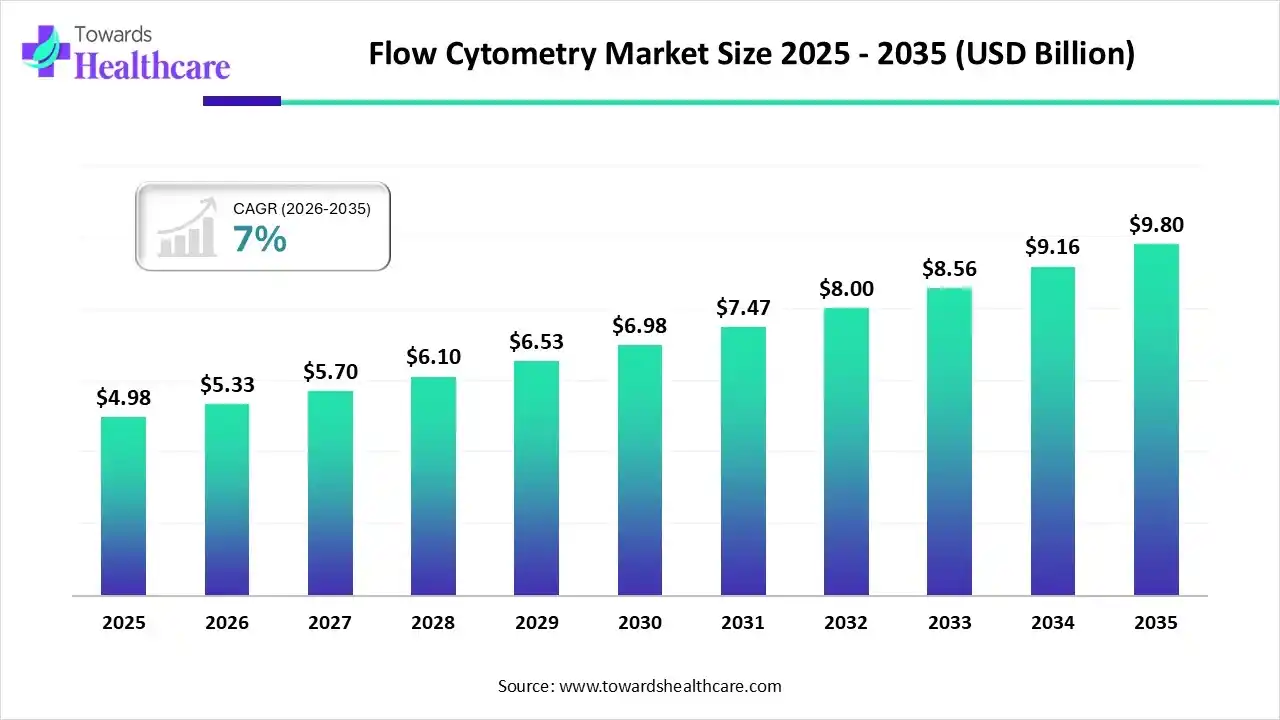
The flow cytometry market reached $4.98 billion in 2025 and is projected to hit $9.80 billion by 2035, growing at a 7% CAGR.
Don’t miss what your competitors already know | Get the complete Flow Cytometry Market report now | Checkout First then BUY
North America accounted for the largest regional share at around 38% in 2024, driven by strong research ecosystems.
Meanwhile, Asia-Pacific is expected to record the fastest growth, with CAGR exceeding 8% during the forecast period.
Segment-wise dominance adds more clarity:
- Instruments contributed over 40% of total market revenue in 2024
- Clinical applications held more than 35% share globally
- Academic institutes accounted for nearly 30% of end-use demand
These figures show how deeply embedded flow cytometry has become across sectors.
Table of Contents
ToggleFrom Machines to Meaning: Technology Gets Smarter
Modern flow cytometry has moved far beyond basic cell counting.
New systems now combine high-speed lasers, advanced detectors, and multi-parameter analysis.
This allows researchers to process thousands of cells per second with up to 20+ parameters simultaneously.
Innovation is accelerating across multiple layers:
- Spectral flow cytometry improves multiplexing capacity by 2–3x compared to traditional systems
- Advanced fluorescent dyes enhance detection sensitivity by over 50%
- Integration with single-cell analysis is enabling deeper biological insights
These advancements are expanding both speed and scientific depth.
Why Instruments Still Lead; but Software is Catching Up
Instruments remain the backbone of the market, contributing the largest share.
High-end cytometers dominate because of their essential role in diagnostics and research workflows.
However, software is emerging as the fastest-growing segment.
Software adoption is expected to grow at a CAGR above 9%, driven by rising data complexity.
It enables real-time analysis, cloud storage, and remote accessibility across devices.
This shift reflects a transition from hardware dependency to data-driven intelligence.
Healthcare Leads, But Industry is Rising Fast
Clinical applications continue to dominate the market.
They account for over one-third of total usage, particularly in cancer diagnostics and immunology.
Flow cytometry is widely used to detect leukemia, lymphoma, and immune deficiencies.
At the same time, industrial applications are gaining traction.
The pharmaceutical sector is using it in over 60% of early-stage drug discovery workflows.
Microbiology and food industries are also adopting it for quality monitoring.
This expanding scope is creating a multi-industry demand curve.
Regional Power Play: Who’s Leading the Race?
North America leads the global market with a share of approximately 38%, supported by strong R&D investments.
The U.S. alone has approved over 45 cell and gene therapies, increasing reliance on advanced cell analysis tools.
Government-backed standardization programs further strengthen adoption.
Asia-Pacific is emerging as the fastest-growing region.
China contributes a significant portion of global research output, with 40+ clinical studies using flow cytometry.
India and Japan are investing heavily in digital health and personalized medicine.
Europe is growing steadily, focusing on clinical standardization and regulatory compliance.
This ensures reproducibility and accuracy across laboratories.
Opportunities Are Expanding Beyond the Microscope
Flow cytometry is no longer limited to research labs.
Its applications now extend to immunotherapy, stem cell research, and precision medicine.
These fields are expected to grow at double-digit rates, increasing demand for advanced analysis tools.
Key opportunity areas include:
- Personalized medicine adoption rising by over 10% annually
- Increasing use in oncology, which accounts for nearly 25% of applications
- Expansion in biotech startups and CROs globally
This adaptability makes the technology future-ready.
The Challenges No One Talks About
Despite strong growth, barriers remain significant.
The cost of flow cytometers ranges between $100,000 and $500,000, limiting access in developing regions.
This creates a gap between technological capability and real-world adoption.
Another challenge is variability.
Differences in instruments and protocols can lead to up to 15–20% variation in results.
This impacts reproducibility, especially in clinical settings.
Solving these issues will be critical for scaling the technology globally.
What’s Next? A Data-Driven Future
The future of flow cytometry lies in integration.
Combining AI, big data, and genomics will unlock deeper cellular insights.
AI-driven analysis is expected to reduce data interpretation time by over 30%.
Faster systems, smarter software, and cost-effective solutions are on the horizon.
This will expand adoption beyond advanced labs into mainstream healthcare.
A Market That Reflects the Future of Medicine
Flow cytometry is not just growing—it is evolving.
Its rise mirrors a larger shift toward precision medicine and data-driven healthcare.
With nearly 2x market growth expected by 2035, its impact will only deepen.
In this transformation, flow cytometry is not just a tool.
It is becoming a foundation for the future of diagnostics and treatment.
Important Announcement
Access our exclusive, data-rich dashboard dedicated to the healthcare market – built specifically for decision-makers, strategists, and industry leaders. The dashboard features comprehensive statistical data, segment-wise market breakdowns, regional performance shares, detailed company profiles, annual updates, and much more. From market sizing to competitive intelligence, this powerful tool is one-stop solution to your gateway.
Access the Dashboard: https://www.towardshealthcare.com/access-dashboard
About Us
Healthcare Web Wire is a part of Towards Healthcare is a leading global provider of technological solutions, clinical research services, and advanced analytics, with a strong emphasis on life science research. Dedicated to advancing innovation in the life sciences sector, we build strategic partnerships that generate actionable insights and transformative breakthroughs. As a global strategy consulting firm, we empower life science leaders to gain a competitive edge, drive research excellence, and accelerate sustainable growth.
You can place an order or ask any questions, please feel free to contact us at sales@towardshealthcare.com
Europe Region – +44 778 256 0738
North America Region – +1 8044 4193 44
APAC Region: +91 9356 9282 04
Visit Our Website: https://www.towardshealthcare.com
Find us on social platforms: LinkedIn | Twitter | Instagram | Medium
About the Author