Genomics Market Size, Shares and Industry Reports 2034

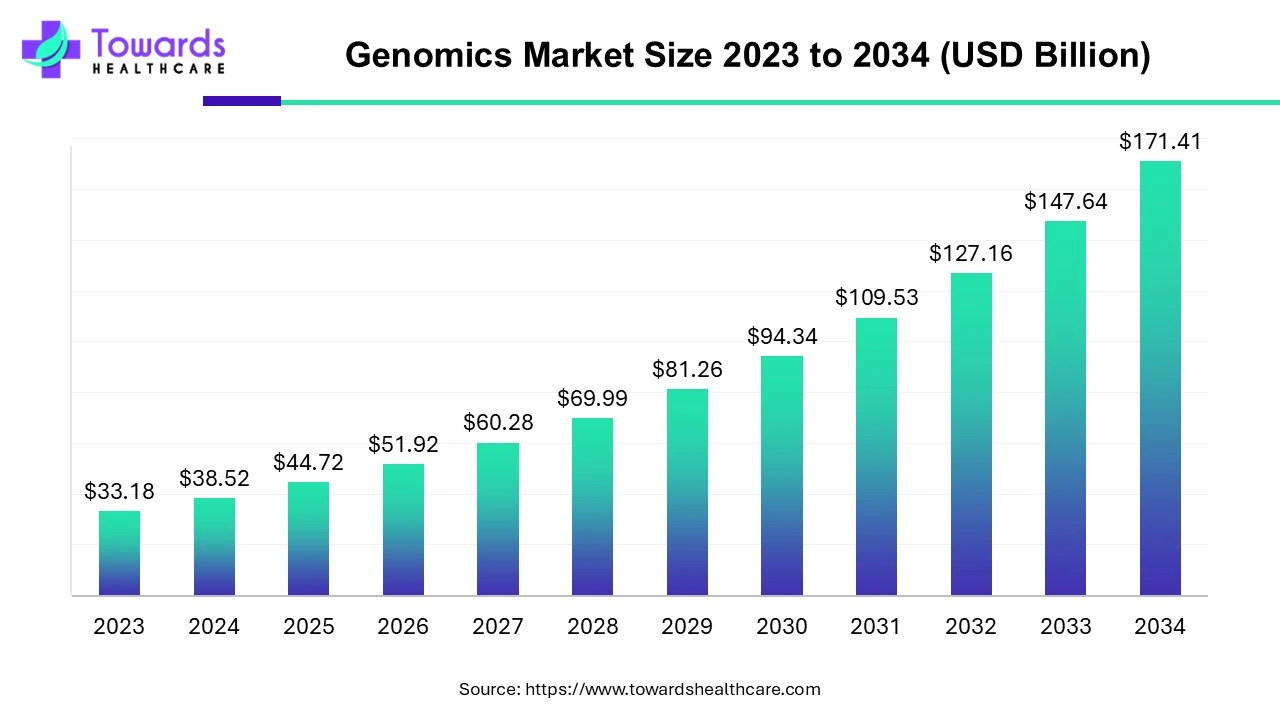
The global genomics market size is projected to reach USD 171.41 billion by 2034, growing from USD 44.72 billion in 2025 at a CAGR of 16.1%, driven by technological advancements, AI integration, and the rising demand for personalized medicine.
Download the Free Sample of Genomics Market Now and Get the Complete Report Easily at: https://www.towardshealthcare.com/download-sample/5065
Table of Contents
ToggleMarket Size and Growth Insights
Market Value Expansion:
●2024: USD 38.52 billion
●2025: USD 44.72 billion
●2034: USD 171.41 billion
●CAGR (2025–2034): 16.1%
Dominant Region:
●North America led the market in 2024 due to advanced infrastructure, high R&D funding, and strong adoption of precision medicine.
●Asia-Pacific projected as the fastest-growing region driven by genomics-focused government programs in India, Japan, and China.
Leading Technology:
●Polymerase Chain Reaction (PCR) held the largest market share in 2024 and is projected to be the fastest-growing technology due to accuracy, cost-effectiveness, and use in drug discovery.
Major Segments by Deliverables:
●Products: Dominated in 2024 (sequencing kits, microarray kits, reagents, and instruments).
●Services: Expected to grow steadily owing to cost-efficient outsourcing of genomic testing.
End-User Insights:
●Pharmaceutical & Biotechnology Companies: Largest contributors due to new product launches and R&D activities.
●Hospitals & Clinics: Rapidly expanding as genomics integrates with diagnostics and patient-specific treatments.
Market Trends
AI Collaboration in Genomics (NVIDIA–Illumina–Mayo Clinic, 2025):
●NVIDIA’s partnership to accelerate drug discovery with agentic AI transforms research capabilities across the $10 trillion healthcare sector.
WHO Ethical Guidelines (2024):
●Framework established for ethical genomic data use and sharing, ensuring equitable and responsible global collaboration.
Investment in AI-Powered Genomic Infrastructure (Accenture & 1910 Genetics, 2024):
●Collaboration supports AI-driven drug target identification and cost-effective therapeutics.
Government Initiatives (India, 2025):
●Launch of IBDC genomic dataset making India self-reliant in genomic data and advancing precision medicine.
Expansion of NGS (Next-Generation Sequencing):
●Enhanced accessibility due to cost reductions and improved throughput.
Multi-Omics Integration:
●Cross-disciplinary integration (proteomics, metabolomics) enhances understanding of disease mechanisms.
Rise of Functional Genomics:
●Increasing R&D in gene expression and disease cause identification accelerates market expansion.
Strategic Collaborations:
●GeneDx acquisition of Fabric Genomics (2025) merges AI interpretation and genomic medicine.
Emerging Data Privacy Regulations:
●Stricter frameworks across Europe and North America ensuring secure genomic data handling.
Shift to Clinical Implementation:
●Hospitals adopting genomic testing for chronic and rare diseases to improve diagnostic precision.
10 Deep AI Impacts and Roles in the Genomics Market
Genomic Data Interpretation:
●AI algorithms decode complex patterns across billions of sequences, enhancing diagnostic accuracy.
Predictive Disease Modeling:
●Machine learning predicts disease susceptibility, treatment responses, and hereditary risks.
3D Genome Structural Analysis:
●AI can compute thousands of 3D genome structures rapidly, supporting advanced research.
Data Integration Across EHRs:
●AI links genomic data with electronic health records to create holistic patient profiles.
Drug Discovery Optimization:
●NVIDIA’s AI accelerates drug identification and clinical trial design efficiency.
Automation of Sequencing Analysis:
●Reduces manual interpretation errors and speeds up genetic variant annotation.
AI-Powered Diagnostics:
●Models like SCADE by Valted Seq deliver real-time genomic interpretation for clinical use.
Personalized Therapy Design:
●AI tailors treatments to genetic and phenotypic profiles, enabling precision oncology.
Bioinformatics Enhancement:
●Advanced algorithms support multi-omics data integration and biomarker discovery.
Scalable Infrastructure for Genomics Data:
●AI cloud systems ensure efficient management of petabyte-scale datasets for research and clinical institutions.
Regional Insights
North America (Leading Region)
Dominance Drivers:
●Robust research funding (NHGRI budget of USD 639 million in 2025).
●Early adoption of genomic initiatives such as the Precision Medicine Initiative.
Industry Presence:
●Home to top players like Illumina, Thermo Fisher, and NVIDIA.
Regulatory Support:
●Favorable U.S. FDA approvals for gene therapies (15 approved by 2024).
Europe
●Key Markets: UK, Germany, France.
●Regulatory Framework: Strong compliance standards for genetic testing enhance reliability.
●Focus Area: Integration of genomics in national healthcare systems.
●Collaborative Programs: EU-funded research advancing personalized healthcare.
Asia-Pacific (Fastest-Growing Region)
Growth Catalysts:
●National genomic data programs (India’s IBDC, China’s genome sequencing initiatives).
●Government investments in precision medicine.
Emerging Players:
●Regional biotech startups integrating AI in sequencing.
Opportunity:
●Large population base and rising chronic disease burden.
Latin America & MEA
●Latin America: Brazil and Argentina are expanding genomic diagnostic centers.
●Middle East & Africa: UAE and Saudi Arabia investing in national genome projects, establishing data centers for precision medicine.
Market Dynamics
Drivers
●Rising prevalence of genetic disorders (70–80 million affected globally).
●Technological advancement in sequencing and PCR.
●Declining sequencing costs improving accessibility.
●Integration of genomics with precision medicine.
●Strong collaborations between AI and genomics companies.
Restraints
●Complexity in interpreting genomic data.
●Lack of skilled bioinformaticians.
●Ethical and privacy concerns.
●Inconsistent reimbursement policies.
●High initial setup costs.
Opportunities
●Multi-omics integration (genomics + proteomics + metabolomics).
●AI-driven drug discovery and diagnostics.
●Expansion in developing regions (India, China).
●New genomic data frameworks enabling global research.
●Agricultural and forensics applications expanding non-clinical revenue.
Challenges
●Data overload and limited functional variant understanding.
●Fragmented global regulatory landscape.
●Security vulnerabilities in genomic databases.
Top 10 Leading Companies in 2025
Illumina Inc.
●Product: NGS platforms and sequencing kits.
●Strength: Market leader with extensive genomic databases and collaborations (AGD initiative).
Thermo Fisher Scientific
●Product: PCR instruments, reagents, sequencing solutions.
●Strength: Global supply network and R&D dominance.
NVIDIA Corporation
●Product: AI computing platforms for genomic data.
●Strength: Industry-leading in AI-based drug discovery and healthcare partnerships.
Danaher Corporation
●Product: Genomic analysis instruments (Cytiva, Beckman Coulter brands).
●Strength: Broad biosciences portfolio and technological innovation.
Agilent Technologies
●Product: Genomic microarrays and bioinformatics software.
●Strength: Precision diagnostics and R&D collaborations.
Qiagen N.V.
●Product: Sample prep and PCR diagnostic kits.
●Strength: Expertise in molecular testing for infectious diseases.
Oxford Nanopore Technologies
●Product: Real-time sequencing devices (MinION, PromethION).
●Strength: Portable, rapid, and scalable sequencing solutions.
Bio-Rad Laboratories
●Product: Digital PCR systems and analytical tools.
●Strength: High-quality genomic testing tools for clinical diagnostics.
Eurofins Scientific
●Product: Genomic testing and laboratory services.
●Strength: Global laboratory presence and multi-industry service range.
F. Hoffmann-La Roche AG
●Product: Diagnostic kits and companion diagnostics.
●Strength: Extensive R&D collaborations (e.g., Janssen Biotech).
Latest Announcements
●10x Genomics (2025):
Announced new single-cell and spatial biology products, enhancing research scalability and data depth.
●NVIDIA (2025):
Expanded partnerships with Mayo Clinic, Illumina, and Arch Institute to drive AI transformation in genomics.
●India’s IBDC Launch (2025):
National genomic data set enabling domestic and global research independence.
Recent Developments
●Ultima Genomics (Feb 2025):
Launched UG 100 Solaris with new chemistry and software, increasing output by 50% and reducing costs by 20%.
●GeneDx Acquisition (Apr 2025):
Acquired Fabric Genomics to integrate AI in genomic interpretation.
●Fore Genomics & Inocras Partnership (Feb 2025):
Focused on enhancing pediatric genomic health screening.
●Singular Genomics Systems Acquisition (Feb 2025):
Acquired by Deerfield Management, emphasizing expansion in NGS and spatial multiomics.
●CareDx & Dovetail Genomics (Oct 2024):
Partnership for advanced HLA genotyping in transplant genomics.
●Valted Seq Launch (Apr 2025):
Introduced AI-driven Single Cell AI Discovery Engine for advanced biomarker discovery.
Segments Covered
A. By Technology
Polymerase Chain Reaction (PCR)
●Dominance: PCR accounted for the largest market share in 2024 and is projected to remain dominant through 2034.
●Key Role: Enables the amplification of specific DNA sequences, essential for molecular diagnostics and research.
Advancements:
●Introduction of digital PCR (dPCR) and real-time PCR (qPCR) enhances accuracy and quantitative capabilities.
●Widely used in disease detection, genotyping, gene expression analysis, and mutational studies.
●Advantages: High specificity, low cost, and scalability across clinical and research environments.
●Growth Factor: Increasing usage in infectious disease diagnostics and oncology research.
Sequencing
●Core Technology: Includes Next-Generation Sequencing (NGS) and Whole Genome Sequencing (WGS).
●Key Function: Allows high-throughput analysis of genetic material, identifying mutations, and mapping genomes.
●Market Impact: Falling sequencing costs and AI integration have accelerated adoption in clinical genomics.
●Applications: Oncology, prenatal testing, pharmacogenomics, and rare disease identification.
●Future Scope: Long-read sequencing and single-cell genomics driving precision medicine advancements.
Flow Cytometry
●Purpose: Enables cell sorting, biomarker detection, and genomic profiling at the cellular level.
●Use Case: Integrates with genomics to identify gene expression patterns in specific cell populations.
●Emerging Area: Increasing use in immunogenomics and oncology diagnostics.
Microarrays
●Function: Facilitate large-scale gene profiling and expression analysis.
●Application: SNP analysis, gene expression monitoring, and epigenetic studies.
●Significance: Offers cost-effective analysis of thousands of genes simultaneously.
●Trend: Declining use in standalone form, but gaining relevance when integrated with NGS for validation.
Others (CRISPR, Bioinformatics, & Genotyping Platforms)
●CRISPR Technology: Revolutionizing genome editing for therapeutic and research purposes.
●Bioinformatics Platforms: Provide analytical tools for sequencing data interpretation.
●Emerging Technologies: Include single-cell multi-omics and high-resolution melt (HRM) assays enhancing genomic data resolution.
B. By Deliverables
Products
●Definition: Includes consumables, instruments, and software used in genomics.
Subsegments:
●Instruments/Systems/Software: Sequencers, analyzers, PCR systems, microarray scanners.
●Consumables & Reagents: Kits, buffers, enzymes, probes used for experiments.
●Dominance: Accounted for the majority market share in 2024 due to continuous usage and replacement demand.
●Applications: Core research laboratories, diagnostic centers, and pharmaceutical R&D.
●Trend: Miniaturization of devices and software integration for real-time genomic data analysis.
Services
●Definition: Outsourced or contract-based genomic analysis and sequencing services.
Subsegments:
●NGS-based Services: Whole genome and exome sequencing for healthcare and research.
●Biomarker Translation Services: Identification of biomarkers for drug response and disease prediction.
●Computational Genomics: AI-powered bioinformatics pipelines for interpreting massive data.
●Core Genomics Services: RNA/DNA extraction, library preparation, and annotation services.
●Growth Trend: Increasing outsourcing by academic institutes and small biotech companies.
●Benefit: Reduces infrastructure and expertise costs while ensuring high-quality analysis.
C. By End-Use
●Pharmaceutical & Biotechnology Companies
●Largest Segment (2024): Accounted for the highest revenue share due to extensive R&D initiatives.
●Role: Utilize genomics for target identification, biomarker discovery, and drug development.
●Growth Factor: Increasing approvals of gene therapies (15 by the U.S. FDA as of 2024).
●Infrastructure: Advanced labs, collaborations with AI firms, and regulatory support for personalized drugs.
Hospitals & Clinics
●Growth Rate: Fastest-growing end-user segment in 2024.
●Role: Adoption of genomics in diagnostics, oncology, and chronic disease management.
Drivers:
●Rising chronic disease prevalence and hospitalizations.
●Integration of genomics into patient care for personalized treatment plans.
●Reimbursement support for genetic testing.
Academic & Government Institutes
●Function: Serve as innovation hubs for genomic data generation and research.
●Key Contributors: Initiatives like NHGRI (U.S.), All of Us Research Program, and Indian Genomic Data Center (IBDC).
●Objective: Strengthen public health genomics and train next-generation scientists.
Clinical Research Organizations (CROs)
●Role: Conduct genomic studies for pharmaceutical partners, enabling faster drug trials.
●Emerging Trend: Increasing collaboration with AI-driven bioinformatics firms for data interpretation.
Others (Diagnostic Centers, Forensic Labs, Agricultural Genomics)
●Forensics: DNA fingerprinting and criminal investigation.
●Agriculture: Crop and livestock genomics improving yield and resistance.
●Diagnostics: Early disease detection through rapid sequencing platforms.
D. By Region
1. North America
Market Leadership: Largest revenue contributor in 2024.
Key Drivers:
●Advanced genomic infrastructure and funding.
●Presence of major players like Illumina, Thermo Fisher, and NVIDIA.
●Precision Medicine Initiative and “All of Us” program promoting large-scale sequencing.
Supportive Ecosystem:
●NHGRI budget increased to USD 639 million (2025).
●Regulatory clarity under the U.S. FDA for genetic therapies.
Outlook:
●Continued dominance with robust R&D collaborations between academia and industry.
2. Europe
Major Countries: UK, Germany, France, Italy, and Spain.
Growth Factors:
●National genome projects and strong ethical frameworks for data protection.
●Expanding clinical genomics testing adoption.
Healthcare Integration:
●Precision medicine incorporated into public health systems.
Research Initiatives:
●Cross-border collaborations under Horizon Europe boosting genomics innovation.
3. Asia-Pacific
Fastest-Growing Region (CAGR > 18%)
Drivers:
●Government initiatives such as India’s PRIP and IBDC genomic data program.
●Rapid adoption of sequencing in Japan and China.
●Large patient pool with genetic disorder prevalence.
Highlights:
●In March 2025, Illumina & Nashville Biosciences completed 250,000 genome sequences for AGD, aiding Asian data mapping.
Future Potential:
●Expansion of genomics startups and biobanks in emerging nations.
4. Latin America
Key Markets: Brazil and Argentina.
Focus: Adoption of genomic diagnostics in cancer and infectious disease studies.
Barriers: Limited research funding and infrastructure compared to developed regions.
Outlook: Government health programs supporting genomic literacy and genetic testing awareness.
5. Middle East & Africa (MEA)
Leading Countries: UAE, Saudi Arabia, South Africa.
Initiatives: National genome projects like the Saudi Genome Program.
Growth Drivers:
●Increasing investment in healthcare digitization.
●Expansion of medical research collaborations with U.S. and European institutes.
Challenges: Data privacy policies and shortage of bioinformatics expertise.
Top 5 FAQs
-
What is the projected market size of the genomics market by 2034?
The market is expected to reach USD 171.41 billion by 2034 from USD 44.72 billion in 2025. -
Which region dominates the genomics market?
North America led in 2024, while Asia-Pacific is the fastest-growing region. -
Which technology leads the genomics market?
PCR technology held the largest share in 2024 and is expected to grow fastest. -
What are the key growth drivers?
Increasing prevalence of genetic disorders, AI integration, and demand for precision medicine. -
Who are the major players?
Illumina, Thermo Fisher, NVIDIA, Agilent, Qiagen, Bio-Rad, Eurofins, Danaher, Roche, and Oxford Nanopore.
Access our exclusive, data-rich dashboard dedicated to the biotechnology industry – built specifically for decision-makers, strategists, and industry leaders. The dashboard features comprehensive statistical data, segment-wise market breakdowns, regional performance shares, detailed company profiles, annual updates, and much more. From market sizing to competitive intelligence, this powerful tool is one-stop solution to your gateway.
Access the Dashboard: https://www.towardshealthcare.com/access-dashboard
Order your Genomics Market report now at: https://www.towardshealthcare.com/checkout/5065
Become a valued research partner with us – https://www.towardshealthcare.com/schedule-meeting
You can place an order or ask any questions, please feel free to contact us at sales@towardshealthcare.com
Powering Healthcare Leaders with Real-Time Insights: https://www.towardshealthcare.com/healthcare-intelligence-platform
Europe Region – +44 778 256 0738
North America Region – +1 8044 4193 44
APAC Region: +91 9356 9282 04
Visit Our Website:https://www.towardshealthcare.com
Find us on social platforms: LinkedIn | Twitter | Instagram | Medium | Pinterest
About the Author