
AI in Breast Imaging Market Set to Soar USD 734.24 Million by 2032

Global Rise in Cancer Prevalence Sparks Increased Demand for AI in Breast Imaging Market
Breast cancer is a prevalent global health concern, ranking among the most common cancers worldwide, according to the World Health Organisation (WHO). Breast cancer is the most frequent cancer in women, impacting both developed and developing countries. The prevalence of breast cancers varies geographically and is influenced by factors such as age, genetics, hormonal influences and lifestyle. For Instance, according to the American Cancer Society 2023 estimates, invasive breast cancer will be diagnosed in women in about 297,790 new cases. There will be roughly 55,720 new diagnoses of Ductal Carcinoma In situ (DCIS). There will be 43,700 female breast cancer deaths.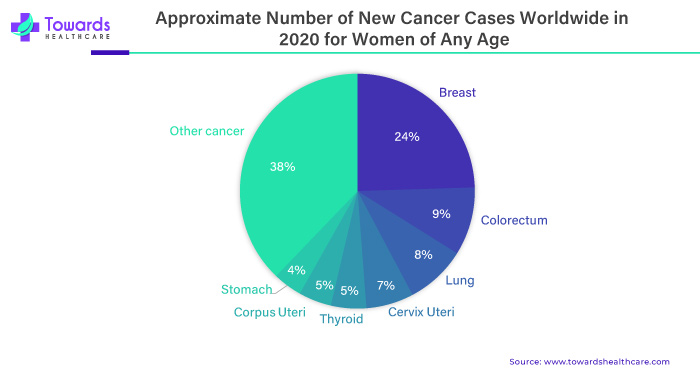 The prevalence underscores the critical need for early diagnosis, as timely intervention significantly improves treatment outcomes and survival rates. Early detection of breast cancer is crucial for several reasons:
| Improve Treatment Efficacy | Detecting breast cancer at an early stage allows for less aggressive and more effective treatment options. Physical and emotional impact on individuals. This contributes to an improved overall quality of life for breast cancer patients. |
| Reduce Mortality Rate | Early diagnosis substantially decreases the mortality rate associated with breast cancer. |
| Enhance Quality of Life | Early detection, less invasive treatment approaches, minimising the physical and emotional impact on individuals. This contributes to an improved overall quality of life for breast cancer patients. |
Precision Imaging Analysis:
- AI algorithms can analyze mammograms and other imaging data with high precision, aiding in the early identification of potential abnormalities or cancerous lesions.
Reduce False Positive:
- AI helps minimize false-positive results, providing more reliable diagnoses and reducing unnecessary anxiety and patient follow-up procedures.
Efficient Screening Processes:
- Automated screening processes powered by AI contribute to more efficient and timely breast cancer screenings, addressing the growing demand for broader population coverage.
The Integration of AI in Breast Imaging Market Offers Transformative Opportunities Across Healthcare
In 2021, the National Institute of Health released an article about More than 20 FDA-approved AI in breast imaging market applications resulting from recent advancements. However, they are only sometimes adopted, and their overall utilization could be higher. AI development faces particular opportunities and challenges in the field of breast imaging. The primary form of breast cancer screening is mammography. Application of artificial intelligence, breast density measurement, workflow enhancement, quality assessment, treatment response evaluation, and image enhancement. The trend toward early detection is attributed to improvements in treatment, increased public awareness of the disease, and earlier detection through breast cancer screening. Next-generation technology advancements are essential for sensitive, accurate, and reasonably priced healthcare. Although biomarkers such as DNA, RNA, Protein, and epigenetics contribute to our understanding of breast cancer, their worldwide non-reproducibility limits their applicability. The best form of prevention is awareness; formalized screening programs are essential to empowering women via self-screening and education. Individuals at high risk can benefit from clinical consultations and counselling. Moreover, innovation and teamwork are closely associated with the growth of the AI imaging market. The use of Artificial Intelligence in medical imaging has increased dramatically due to strategic alliances and partnerships. This cooperative approach offers a promising synergy between medical knowledge and cutting-edge technology, improving diagnostic capabilities and playing a critical role in the ongoing fight against breast cancer.Collaboration Highlights Among Existing AI in Breast Imaging Market Players
- In November 2022, Google Health and CAD, Inc. announced a strategic partnership to integrate Google Health's AI technology into the iCAD portfolio of breast imaging AI Solutions. The innovation focused on improving the accuracy and expanding the availability of breast cancer screenings. This partnership aimed to validate and incorporate Google Health's mammography AI technology into CAD's products to enhance breast cancer detection and assess short-term personal cancer risk for the millions globally diagnosed with breast cancer each year.
- In September 2023, Healthyr partnered with Koning Health to provide advanced, non-invasive breast health solutions through at-home health tests and solutions. The collaboration sought to empower women worldwide with innovative breast imaging technology.
- In October 2023, Medicom Technologies Inc. announced a partnership with Onsite Women's Health. With a dedicated mission to elevate the patient and clinician journey, they focused on advancement in medical image exchange, setting the stage for transformative improvements in breast cancer detection.
AI in Breast Imaging Market Restrictions Caused by Regulations
Secure laws are essential protections for patient safety, data security, and the dependability of medical equipment in the healthcare sector. These rules become a safeguard as well as a significant obstacle when it comes to incorporating AI in breast imaging market. Healthcare regulations are intended to ensure the moral application of technology in medical settings. Stringent compliance requirements frequently typify them. Compliance in the context of AI applications for breast imaging refers to adhering to guidelines for patient confidentiality, data privacy, and the general safety of the AI algorithms. The safeguarding of private patient information is one important factor. Large datasets, such as patient records and medical images, are frequently the basis for AI systems used in breast imaging. Complying with data privacy regulations, like the US Health Insurance Portability and Accountability Act (HIPAA), complicates the integration process. It is crucial to ensure AI Applications handle patient data securely and keep it private. Additionally, safety regulations are essential for AI systems employed in medical diagnosis. Regulatory bodies frequently demand thorough validation to prove the accuracy, consistency, and dependability of AI algorithms. Extensive testing on various datasets is part of this validation process to ensure the AI system works well in a range of scenarios and demographics. To successfully navigate these regulatory obstacles, great care must be taken during the development, testing, and implementation stages of AI solutions for breast imaging. The extensive validation process and strict adherence to compliance guidelines add to the implementation's time-consuming complexity. Companies and developers must spend money on clinical trials, regulatory approvals, and system optimization to meet stringent requirements—the more extended time frames for releasing AI solutions on the market result from these regulatory obstacles. Implementation delays may impact the overall rate of advancement in AI technologies for breast imaging. The complexity of compliance procedures has grown, making things more complicated overall, especially for smaller businesses with fewer resources. Furthermore, strict healthcare laws are necessary to preserve the accuracy of medical technologies, but they also create barriers to the quick adoption of AI in breast imaging market. To fully utilize AI's potential to improve breast cancer detection and diagnosis, stakeholders must balance innovation and compliance.AI in Breast Market Substantial Growth Brought by End Users
- Hospitals and Clinics: AI in breast imaging market streamlines the diagnostic process by assisting healthcare professionals in analyzing mammograms quickly and accurately. This efficiency leads to faster diagnosis and improved patient outcomes.
- Diagnostic Imaging Centres: Diagnostic imaging centres benefit from AI's ability to efficiently handle large volumes of imaging data. AI algorithms can automate routine tasks, allowing radiologists to focus on more complex cases, ultimately enhancing workflow.
- Research Institutes: Research institutes play a crucial role in developing and refining AI algorithms for breast imaging. Their contributions lead to continuous advancements, pushing the boundaries of technology and improving the overall effectiveness of AI applications in detecting and diagnosing breast abnormalities.
Geographical Landscape
In 2022, North America was the dominant market for Artificial Intelligence in breast imaging. The growth in this market is attributed to the increasing incidence of breast cancer in the region. For Instance, according to the American Cancer Society of Clinical Oncology, the U.S. alone is estimated to have 287850 new cases of invasive breast cancer, 51,400 cases of DCIS and 43,250 breast cancer-related deaths among women in 2022. The impact on market expansion is due to the high prevalence of breast cancer in the U.S., which is expected to drive the expansion of the breast imaging industry in North America.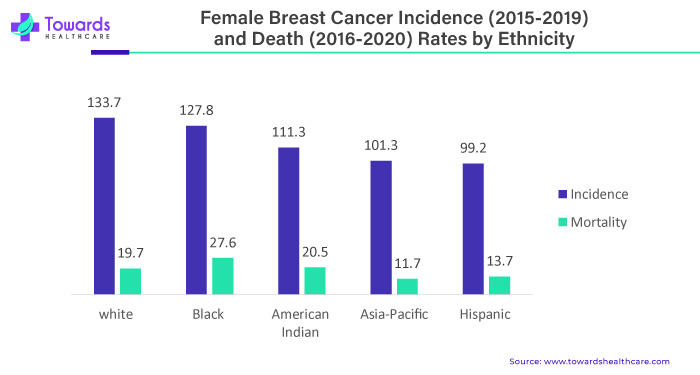 The global artificial intelligence in breast imaging market is expected to experience its fastest expansion in the Asia-Pacific region. The rising incidence of breast cancer is a significant and responsible factor that propels market growth.
For Instance, according to the Centers for Disease Control and Prevention, breast cancer is the most common malignancy in most Asian nations, irrespective of race or ethnicity. Significant research and development expenditures on breast cancer treatment contribute to market expansion. Advancement in breast imaging technologies plays a role in driving the market forward.
Navigating the Growth Trajectory: Key Factors
1. Rising Incidence of Breast Cancer
The foremost driver propelling the expansion of the AI in breast imaging market is the alarming increase in breast cancer cases. As this health concern continues to affect lives globally, there is a pressing need for advanced diagnostic tools, and AI steps in as a pivotal solution. By leveraging machine learning algorithms, AI facilitates early detection, improving treatment outcomes and overall patient care.2. Technological Advancements: Catalyst for Transformation
The landscape of breast imaging is undergoing a paradigm shift, largely attributed to rapid technological advancements. Cutting-edge innovations in AI empower healthcare professionals with more accurate and efficient diagnostic capabilities. From image recognition to predictive analytics, these technologies contribute to a comprehensive understanding of breast health, ensuring timely interventions and personalized treatment plans.
Get a Sample of this Report
AI in Breast Imaging Market