

AI in Healthcare Market to Reach USD 355.78 Billion by 2032

AI's Impact on Specific Healthcare Domains
In healthcare, deep learning emerges as a game-changer in tracing potential cancerous areas in medical images. Speech recognition, a facet of natural language processing, benefits from deep learning, albeit with inherent complexities. Despite the intricacies, these advancements significantly enhance medical diagnostics and language-related tasks.Harnessing Big Data for Healthcare Insights
The healthcare industry's embrace of big data, comprising extensive datasets from diverse sources, is transforming diagnostics and treatment decisions. Advanced analytical techniques make sense of this voluminous data, leading to faster diagnoses and treatment decisions.Redefining Healthcare Economics: AI's Role in Cost Reduction
Artificial intelligence's application in healthcare offers a myriad of benefits, from improved diagnoses to predicting health issues and delivering personalized care. The integration of AI translates into substantial cost savings, estimated at a staggering $150 billion annually, enabling healthcare professionals to focus more on patient treatment.Harvard's Endorsement of AI: A Game-Changer in Treatment Costs
Harvard's School of Public Health advocates for AI in diagnosis, projecting potential savings of up to 50% in treatment costs while concurrently enhancing health outcomes by 40%. This paradigm shift improves clinical operations, quality, and safety in healthcare.Navigating Challenges: The Roadblocks to AI Adoption in Healthcare
While the promise of AI in healthcare is immense, adoption hurdles loom large. Cost considerations, resistance to change among healthcare providers, and the lack of standardized rules for AI models pose challenges. Additionally, limited data access and integration issues hinder the seamless integration of AI applications in healthcare.Overcoming Data Access Challenges: Imperative for AI Integration
The optimal utilization of AI in healthcare is contingent upon high-quality data access. The restricted access to comprehensive data within the healthcare sector impedes the efficacy of AI applications. Strategic solutions are imperative to ensure seamless data access and collection, paving the way for advanced AI implementations in healthcare.Driving Growth: End Users as Catalysts in the AI in Healthcare Market
Pharmaceutical and biotechnology companies leverage AI algorithms for drug discovery, revolutionizing the identification of potential drug targets and expediting the drug development process. The role of end users, including healthcare professionals and organizations, is pivotal in steering the growth of AI in the healthcare market.AI's Prowess in Cancer Detection
AI in healthcare significantly aids doctors in accurate diagnoses, reduces errors, and operates 24/7, ensuring continuous service to patients. The application of radiomics, coupled with machine learning, enhances cancer treatment through personalized radiotherapy based on precise analyses of medical images and data.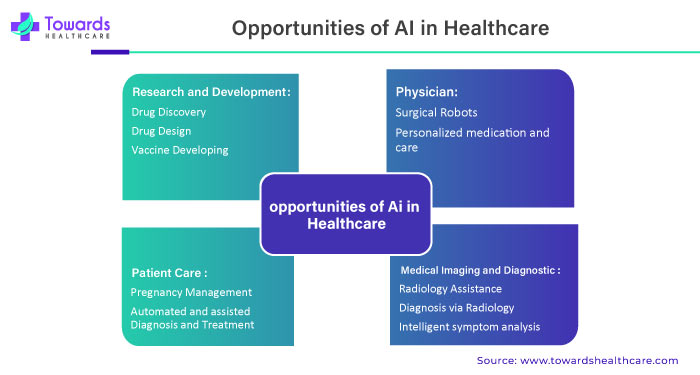
Exploring Opportunities: Geographical Landscape and Recent Developments
The global AI in healthcare market's trajectory is influenced by geographical trends, with North America leading the way due to its robust healthcare infrastructure. The Asia Pacific is poised for rapid growth, fueled by a burgeoning geriatric population, medical tourism, government initiatives, and increasing demands for high-quality healthcare.Pioneering Collaborations and Innovations
Recent developments underscore the dynamism of the AI in healthcare market. Collaborations between AI companies and pharmaceutical giants, such as Exscintia's partnership with nine pharmaceutical companies, showcase the industry's commitment to advancing drug discovery. IBM Watson's WFO, an AI tool for oncology, exemplifies the continuous efforts to enhance treatment decisions through comprehensive data analysis.Competitive Landscape:
Companies are trying to gain a competitive advantage by performing a few crucial measures. They're putting more into R&D, developing innovative and novel solutions, carrying them to market, working with other technology companies, and offering unique amenities. These strategies help them establish one another and exceed their competition. Additionally, the market continues to grow due to people being aware and appreciating the growing number of new artificial intelligence (AI) startups. All of this points to the market becoming more dynamic and larger. Google has recently launched a generative Artificial Intelligence Tool for the industry to work with healthcare organizations and professionals. AI vertex Search is a tool used to identify essential and accurate medical information more quickly, allowing users to search through various data sources, including patients' electronic health records and clinical notes. Medtronic India recently announced a partnership with the artificial intelligence startup Qure.Ai to improve stroke therapy. Through a "hub-and-spoke" network, this partnership aims to incorporate Qure's artificial intelligence-powered products into primary and comprehensive stroke centres.
Get a Sample of this Report
AI in Healthcare Market
