

AI in Ultrasound Imaging Market to Reach USD 2.57 Bn by 2034 at 8.6% CAGR (2025–2034)

Market Size
➤Base year (2025): USD 1.15 Bn.
➤2030 (projection at stated CAGR 8.6%): USD 1.74 Bn (middle-of-decade adoption inflection from AI-assisted echo, OB/GYN, and PoCUS).
➤2034 (headline projection): USD 2.57 Bn.
➤Absolute dollar opportunity (2025–2034): USD 1.42 Bn incremental revenue.
➤Regional concentration (2023): North America >29.75% share, aided by strong infrastructure and reimbursement.
➤Solution mix signals (2024): Software tools led; Services fastest-growing as providers seek managed AI expertise and workflow support.
➤Technology mix signals (2024): 2D/3D/4D led; extracorporeal shockwave and Doppler see AI-driven upgrades; therapeutic HIFU/ESWL benefit from AI guidance.
➤End-user weight (2024): Hospitals dominated; research labs & diagnostic centers set to expand fastest.
Market Trends
➤3D/real-time 4D push: AI-assisted plane finding and reconstruction upgrade surgical precision and fetal assessments, lifting demand for premium imaging platforms.
➤Workflow automation: Auto-measurements, quality control, anomaly checklists, and study completeness reduce scan times and inter-operator variability.
➤PoCUS normalization: Guidance AI lowers skill barriers, enabling high-quality echo/abdominal scans in EDs, wards, and remote clinics.
➤Edge + cloud convergence: On-device inference for latency/privacy; cloud for fleet analytics, model updates, and reporting—software leads, services scale.
➤Regulatory momentum: FDA 2023 guidance-type approvals for ultrasound AI (adult echo image-capture guidance) unlock broader clinical use.
Consolidation & capability stacking: GE HealthCare–Intelligent Ultrasound (2024, USD 51M); Ultrasight–Mayo Clinic (2024); Philips AI cardio platform (2024); Samsung Z20 women’s health (2025); Wipro GE Versana Premier R3 (2025, “Make in India”).
➤Ethics & governance drag: Privacy, black-box explainability, and consent complexities pace adoption in some geographies.
➤AI-enhanced Doppler & therapy planning: Better flow quantification and shockwave targeting improve outcomes in cardio and renal stone workflows.
➤Vendor UI unification: Intuitive UI across product lines (e.g., Philips EPIQ/Affiniti) lowers training time and boosts multi-site standardization.
➤Rising diagnostic load: CVD, GI, and OB/GYN volumes strain radiology; AI triage + reporting sustains throughput and quality.
10 Deep Roles/Impacts of AI in Ultrasound Imaging
➤Plane detection & probe guidance: Real-time visual cues help non-experts acquire diagnostic-quality views in echo and fetal scans.
➤Auto-measurements & quantification: Consistent calipers (e.g., biometrics, ejection fraction proxies, intima-media thickness) cut reading time.
➤Anomaly highlighting & QA: Automated flags in standard planes (cardiac valves, fetal CNS/heart, liver/thyroid nodules) improve sensitivity.
➤Reconstruction & denoising: AI-based beamforming/speckle reduction refines 2D/3D/4D anatomy visibility at lower power.
➤Scan completeness checklists: Auto-populated checklists reduce omissions and speed sign-off, essential for OB anomaly scans.
➤Triage & worklist prioritisations: Suspicious studies bubble to the top; benign studies fast-tracked to discharge or routine follow-up.
➤Therapy guidance: ESWL targeting and HIFU planning optimize dose/trajectory for efficiency and tissue safety.
➤Doppler intelligence: Cleaner flow profiles, aliasing reduction, and velocity estimation assist vascular/cardiac decisions.
➤Training & competency leveling: AI overlays shrink learning curves; standardized outputs enable multi-center consistency.
➤Operational analytics: Fleet-level dashboards, protocol adherence, and variability tracking drive continuous improvement.
Regional Insights
North America (leader)
➣Adoption drivers: Advanced infrastructure, favorable reimbursement, and top med-tech vendors ensure rapid AI deployment.
➣United States: Strong R&D funding, regulatory clarity, and chronic disease burden expand AI-enhanced echo/vascular and OB volumes.
➣Canada: 3D/4D + AI upgrades efficiency; public investments and aging demographics push non-invasive diagnostics.
Europe
➣System readiness: Robust regulation, digitization, and hospital networks accelerate AI QA and workflow tools.
➣United Kingdom: NHS programs (e.g., AI in breast screening) alleviate backlogs; AI addresses radiologist shortages and reduces wait times.
➣Germany: ML innovation + industry-academia consortia drive early-diagnostic use cases and precision cardiology.
Asia-Pacific (fastest growth)
➣Cost-efficient manufacturing: APAC supplies affordable ultrasound devices; AI layers increase value without hardware overhaul.
➣China: Early detection push, aging population, and government innovation support spur hospital adoption of AI echo and liver US.
➣India: National digital health initiatives and Make in India manufacturing (Wipro GE Bangalore) improve access; portable AI-enabled PoCUS widens rural coverage.
Latin America
➣Value proposition: AI cuts per-study time and supports task-shifting in constrained radiology settings; private chains lead rollouts.
Middle East & Africa
➣Smart-hospital builds: New tertiary centers adopt AI US to standardize training and quality; portable AI aids underserved regions.
Market Dynamics
Drivers
➣Disease prevalence: CVD and GI disorders rising; faster, more accurate diagnostics needed at scale.
➣3D/4D clinical gains: Better fetal and surgical planning outcomes accelerate premium platform upgrades.
➣Workflow pressure: AI automation offsets staffing shortages and rising imaging volumes.
Restraints
➣Privacy & security: Patient data protection and breach risks slow some deployments.
➣Explainability & accountability: Black-box concerns complicate consent and liability frameworks.
➣Skill gaps: Sites need training to exploit AI beyond “demo features.”
Opportunities
➣PoCUS & primary care: Guidance AI unlocks community screening and remote triage.
➣Cloud services: Model lifecycle, multi-site analytics, and managed reporting fuel Services segment growth.
➣Therapeutic US synergy: ESWL/HIFU planning becomes a differentiated AI value pool.
Challenges
➣Validation at scale: Multi-vendor, multi-population robustness and drift management.
➣Integration: PACS/RIS/EMR harmonization and cybersecurity hardening.
➣Procurement models: Aligning AI value with capex/opex realities across regions.
Top 10 Companies
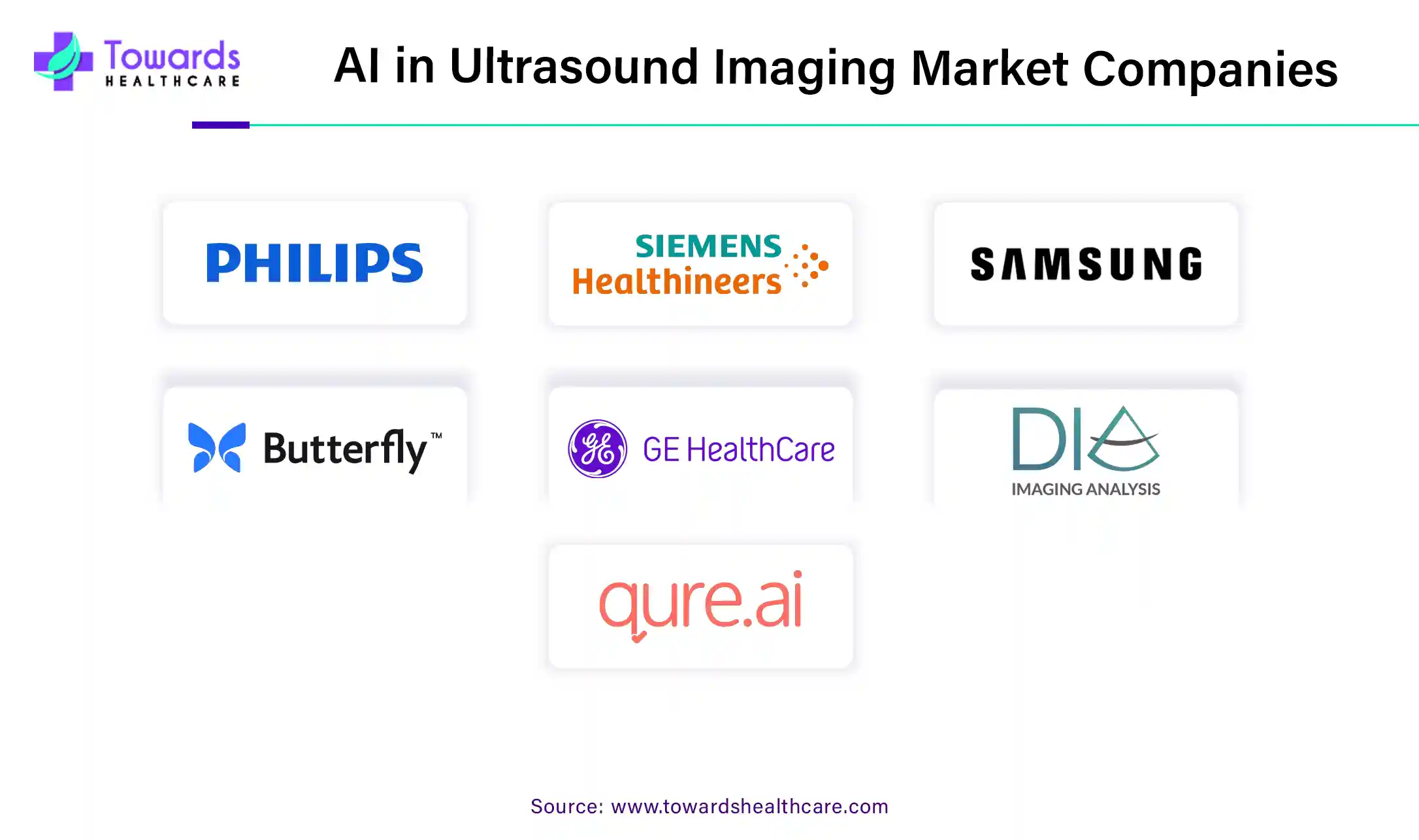
Philips
Product: EPIQ CVx/Affiniti CVx with next-gen AI for cardiovascular ultrasound.
Overview: Focus on end-to-end exam enhancement and intuitive UI across platforms.
Strengths: Deep cardiology portfolio, usability leadership, enterprise integration.
GE HealthCare
Product: Cardiac and PoCUS portfolio; Intelligent Ultrasound AI integrated post-acquisition (2024).
Overview: Global scale across premium carts to handheld; strong echo leadership.
Strengths: Broad channel reach, robust R&D, acquisitive capability stacking.
Wipro GE HealthCare (GE JV, India)
Product: Versana Premier R3 (2025) AI-enabled, manufactured in Bengaluru.
Overview: Localized design/production aligned to “Make in India.”
Strengths: Cost-effective innovation, regulatory familiarity, installed-base leverage.
Siemens Healthineers
Product: AI-augmented ultrasound workflows across imaging franchises.
Overview: Enterprise imaging and cardiology/vascular depth.
Strengths: Integration with broader diagnostic ecosystem; strong QA/measurement AI.
Samsung Healthcare / Boston Imaging
Product: Z20 (2025, women’s health); HERA W10 Elite (OB/GYN with AI, 2023).
Overview: Women’s health and OB leadership with premium image quality.
Strengths: Fast feature iteration, design ergonomics, OB toolset depth.
Butterfly Network
Product: Handheld PoCUS with AI guidance and cloud-based analytics.
Overview: Democratizes ultrasound at the point of care.
Strengths: Portability, price accessibility, edge-cloud architecture.
DiA Imaging Analysis
Product: AI modules for echo quantification and automated measurements.
Overview: Vendor-agnostic software that plugs into existing fleets.
Strengths: Interoperability, rapid deployment, measurable time savings.
Qure.ai
Product: AI for image triage/decision support; expanding into ultrasound use-cases.
Overview: Strong in clinical AI deployments in emerging and developed markets.
Strengths: Speed-to-value, scalable cloud services, public-health use-case experience.
Exo Imaging, Inc.
Product: Portable ultrasound platform with AI-driven workflow.
Overview: Bridging handheld performance with enterprise integration.
Strengths: Hardware-software co-design, PoCUS ergonomics, growing ecosystem.
Ultrasight
Product: AI guidance for cardiac ultrasound acquisition; Mayo Clinic collaboration (2024).
Overview: Lowers echo skill barrier for non-experts and remote settings.
Strengths: Probe guidance leadership, PoCUS enablement, clinical partnerships.

Get a Sample of this Report
AI in Ultrasound Imaging Market