

Anxiety Disorders Treatment Market Forecast, Growth, Shares and Latest Insights 2025

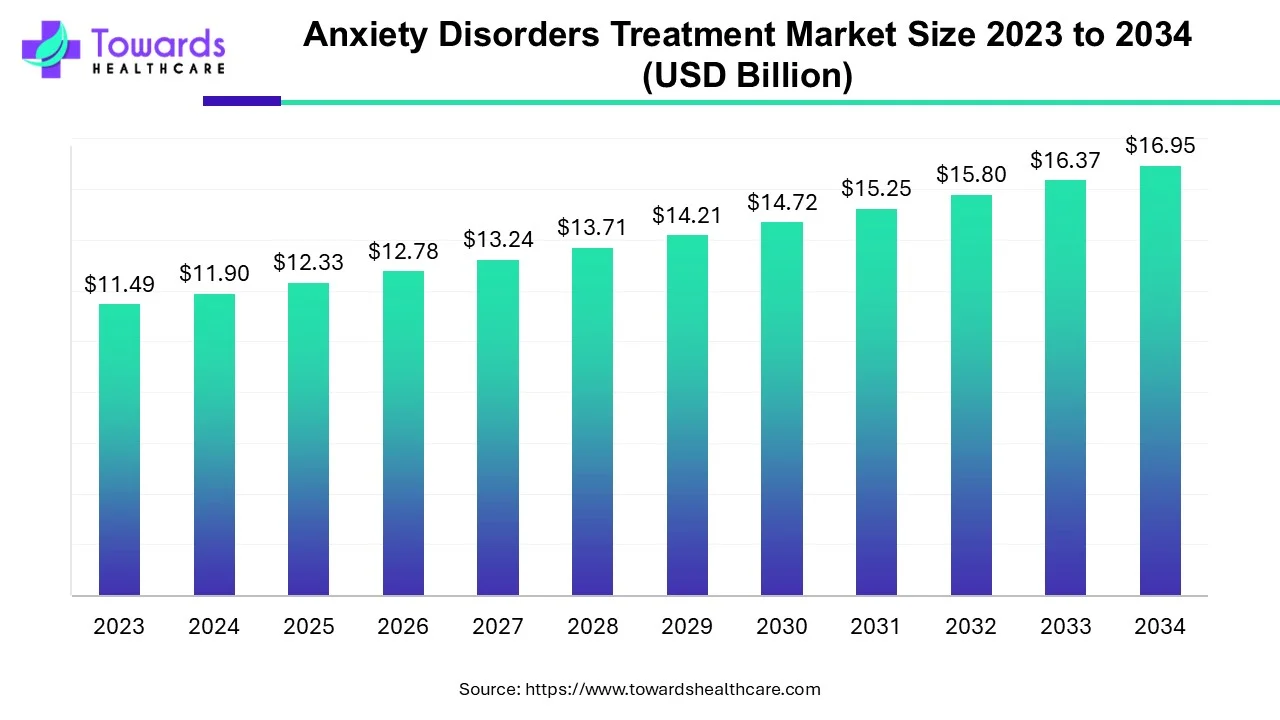
Market size (point-wise)
Key headline figures
◉2025 market size: USD 12.33 billion.
◉2034 market size (forecast): USD 16.95 billion.
◉Absolute growth (2025→2034): USD 4.62 billion (16.95 − 12.33 = 4.62).
◉Average annual absolute increase: ≈ USD 0.51 billion/year (4.62 ÷ 9 ≈ 0.513).
◉Compound annual growth rate (CAGR): 3.6%.
Important 2022 baseline shares (market structure anchors)
◉Disorder type: Generalized Anxiety Disorder (GAD) held the largest share 34% in 2022.
◉Drug class (2022): SSRIs represented the largest drug-class share 32%.
◉Care setting (2022): Hospital outpatient settings dominated with a 71% share.
COVID-era & funding signals that affect market sizing and demand
◉Pandemic prescription spike: A 12% rise in Zoloft prescriptions was recorded in March 2020 (lockdowns, economic stress, social isolation cited as drivers).
◉Research funding (2015–2020): Approximately 76,000 grants from 345 funders across 38 countries — US$18.5 billion invested into mental-health research in that period (≈5% of registered grants; 4% of total research spend). 89% of these funds went to high-income countries and 39% of grants originated in the United States — this concentration shapes R&D and commercialization geography.
◉Digital adoption indicator: Global spending on wellness and mental-health apps rose markedly from 2019–2022 (user data in the brief points to rising investment and consumer spend in mobile/digital mental-health tools).
Market trends
1. Demand side trends
◉Post-COVID demand shock: The pandemic produced a measurable surge in anxiety and depression (e.g., March 2020 Zoloft prescriptions +12%), driving short-term and sustained demand for pharmacotherapy and remote therapy.
◉Growing mental-health awareness: Reduced stigma → more people seeking help → larger addressable market for meds, therapy and digital solutions.
◉Shift to outpatient care: Outpatient hospital settings held 71% of the market in 2022, reflecting preference for community-based and ambulatory management of anxiety (less inpatient care).
2. Treatment mix evolution
◉Pharmacotherapy still central: SSRIs (32% in 2022) retain the largest share among drug classes; benzodiazepines, SNRIs and others remain in use but face scrutiny (dependence risk, guideline shifts).
◉Therapy & hybrid models: CBT and other psychotherapies continue as first-line non-drug options; hybrid care (therapy + meds) grows, including combined digital CBT + pharmacotherapy programs.
◉Rise of digital therapeutics & apps: Investment and consumer spending on apps increased 2019–2022; pharma–digital partnerships (e.g., pharma working with digital CBT providers) are becoming common.
3. Supply side & industry structure
◉Competitive, multi-player landscape: Big pharma, generic manufacturers, specialty mental-health device/service firms, therapy clinic networks and digital-therapeutics startups all compete and collaborate.
◉R&D and M&A activity: Partnerships and consolidation—examples include pharma collaborations and corporate deals in 2020 (Neurocrine–Takeda; Big Rock Partners–NeuroRx). Regulatory approvals for new mechanisms (e.g., intranasal agents such as SPRAVATO) signal changing therapeutic mixes.
◉Funding concentration impacts innovation geography: 89% of mental-health grant funds went to high-income countries (2015–2020), skewing where R&D and clinical trials focus.
4. Access & workforce constraints
◉Shortage of mental-health professionals—especially child/adolescent specialists—constrains capacity, increases wait times, and boosts interest in telehealth and digital scaling solutions.
AI role and impact on the anxiety treatment market
1. Drug discovery & preclinical R&D
◉Role: Machine learning for target identification, compound screening and predicting molecule-target interactions.
◉Impact: Shortens early discovery timelines and reduces costs; increases the chance of novel anxiolytic mechanisms entering the pipeline (helps companies with limited R&D budgets punch above weight).
2. Clinical-trial optimization
◉Role: AI-driven patient-selection (predictive eligibility), adaptive trial designs, and digital biomarkers to improve signal detection.
◉Impact: Higher trial efficiency, lower drop-out, faster readouts — attractive in a market where new mechanisms (e.g., intranasal agents) are emerging and competition for trial participants is intense.
3. Screening, diagnosis & risk stratification
◉Role: Natural language processing (NLP) on clinical notes, voice/text analysis, and passive smartphone/ wearable data to flag anxiety patterns and predict escalation (e.g., panic attacks, suicidal ideation).
◉Impact: Earlier detection, triage prioritization (addresses workforce shortage), and personalization of care plans.
4. Personalized digital therapeutics & adaptive CBT
◉Role: AI personalizes CBT modules, pacing, and coping-strategy suggestions; reinforcement learning adapts content to engagement and symptom changes.
◉Impact: Better engagement, measurable outcomes from app-delivered therapy, potential to substitute or augment in-person CBT (scales access, fits outpatient dominance).
5. Virtual therapy assistants and clinician augmentation
◉Role: Conversational agents to provide between-session support, guided exposure exercises, or to assist clinicians with session notes and measurement-based care.
◉Impact: Reduces clinician burden, improves measurement frequency, and weakens the access bottleneck caused by professional shortages.
6. Remote monitoring & adherence
◉Role: Predictive models using passive sensor data (sleep, activity, social patterns) to trigger interventions or clinician alerts.
◉Impact: Improves medication adherence and therapy engagement, potentially lowering relapse/readmission and improving outpatient outcomes.
7. Real-world evidence & outcomes measurement
◉Role: Aggregate, anonymize and analyze patient-level outcome data from apps, EHRs and registries to demonstrate effectiveness for payers and regulators.
◉Impact: Facilitates reimbursement conversations for digital therapeutics and supports labeling claims for novel therapies.
8. Regulatory, ethical & operational constraints
◉Challenges: Data privacy, algorithmic bias, explainability, and clinical validation requirements. AI tools must meet clinical evidence thresholds to be accepted by clinicians, payers and regulators — this is a practical barrier to immediate, universal adoption.
9. Strategic market implication
Regional insights
North America
Urban concentration & outpatient leadership
◉Metro areas (NYC, LA, Toronto) concentrate specialists, research centers, and advanced clinics. This concentration reinforces outpatient dominance (71% share) and makes adoption of new treatments and digital programs faster in cities.
High funding & market liquidity
◉The U.S. accounted for 39% of mental-health grants (2015–2020), feeding R&D, trials and startup ecosystems (favors rapid commercialization).
Telehealth acceleration
◉Pandemic policy shifts made teletherapy widely accessible, reducing geographic access barriers and increasing the reach of digital therapeutics.
Europe
Regulatory complexity & opportunity
◉EMA pathways (e.g., acceptance of MAA filings such as Vyepti in neuro/neurology space) shape introduction of new products. National reimbursement variation creates both hurdles and pockets of rapid adoption.
Integrated community care models
◉Many European systems emphasize community/outpatient mental-health services, aligning with outpatient share dominance.
Asia Pacific
Cultural stigma & under-resourcing
◉Stigma around mental health in many countries depresses help-seeking, limiting market penetration despite rising need.
Rapid digital adoption but regulatory fragmentation
◉Mobile penetration and app use are high — ripe for digital therapeutics — but country-by-country regulation and reimbursement heterogeneity slow scale.
Workforce gap
◉Lower per-capita mental-health professionals intensifies demand for scalable AI and digital solutions.
Middle East & Africa
Infrastructure & access constraints
◉Limited specialist availability, patchy mental-health infrastructure and variable insurance coverage restrict market growth.
High unmet need
◉Stigma and resource constraints create an underserved opportunity for telehealth and low-cost digital interventions.
South America
Inequality in access
◉Urban centers have reasonable services; rural areas face shortages. Growth driven by private clinics, telehealth and regional generics producers.
Emerging payer interest
◉Growing recognition of productivity losses from untreated anxiety is prompting slow shifts toward coverage of outpatient care and digital tools.
Market dynamics
Key drivers
◉Rising prevalence and awareness — more patients seeking care.
◉Outpatient care preference — efficient, lower-cost care models (71% share).
◉Digital therapeutics & telehealth adoption — expands reach and reduces wait times.
◉Sustained pharma investment and collaborations — partnerships (e.g., pharma + digital CBT) accelerate combined offerings.
Principal restraints
◉Shortage of trained mental-health professionals — limits capacity for therapy and specialist consultations.
◉Funding concentration — heavy skew of research funding to high-income countries may limit innovation tailored for LMIC needs.
◉Regulatory hurdles & reimbursement gaps for digital therapeutics and newer drug classes.
Opportunities
◉AI & digital scaling — address workforce shortages and expand access to evidence-based therapy.
◉Novel mechanisms & regulatory openness — approval pathways for agents like intranasal therapies show regulators are receptive to new approaches for severe presentations.
◉Generics and cost-effective therapies — broadening access in price-sensitive markets (Teva and generics players).
Threats
◉Dependence and safety concerns with some drug classes (e.g., long-term benzodiazepine use).
◉Data privacy & trust issues around app/digital therapeutic data that could limit adoption.
◉Economic cycles — healthcare spending reprioritization could affect access and payer coverage.

Get a Sample of this Report
Anxiety Disorders Treatment Market
