

APAC Life Science Market Size, Key Players, and Insights (2024–2034)

Market Overview
The APAC Life Science Market began at USD 17.51 billion in 2024 and is projected to reach USD 19.46 billion in 2025. By 2034, it is expected to surpass USD 54.81 billion, expanding at a CAGR of 12.09% during 2025–2034.
The market’s growth is attributed to rising R&D investments, expanding laboratory infrastructure, and a surge in personalized medicine adoption. Rapid technological advancements such as Next-Generation Sequencing (NGS), AI-enabled bioinformatics, and high-throughput screening are accelerating research and innovation across the region.
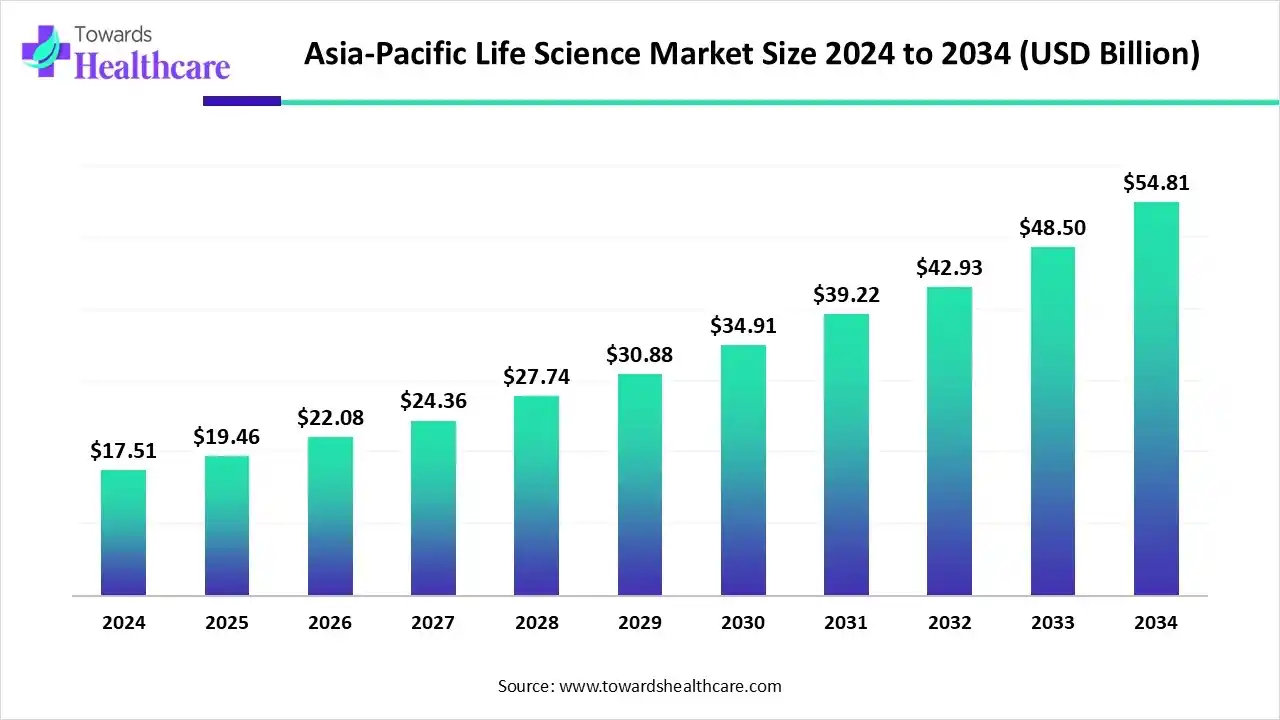
The global life sciences market mirrors this strong trajectory, estimated to grow from USD 98.63 billion in 2025 to USD 269.56 billion by 2034, recording a CAGR of 11.82% — slightly below APAC’s growth rate, indicating the region’s increasing significance.

Quick Market Facts
●The APAC Life Science Market was valued at USD 17.51 billion in 2024.
●It is projected to reach USD 19.46 billion in 2025.
●By 2034, the market is expected to surpass USD 54.81 billion.
●The market is anticipated to grow at a CAGR of 12.09% from 2025 to 2034.
●China emerged as the largest regional contributor, accounting for approximately 35% of total revenue in 2024.
●By product type, instruments dominated with around 48% market share in 2024.
●The reagents & consumables segment is forecast to record the fastest growth rate during the forecast period.
●By technology, genomics led the market with a 43% share in 2024.
●The AI-based bioinformatics platforms segment is expected to grow at the fastest CAGR.
●By application, drug discovery and development accounted for the largest share (around 40%) in 2024.
●The personalized medicine segment is projected to expand at the fastest pace.
●By end user, pharmaceutical and biotechnology companies dominated with a 41% revenue share in 2024.
●Hospitals and clinical research laboratories are expected to emerge as the fastest-growing end-user category over the coming decade.
Market Dynamics
1. Key Growth Drivers
Expanding Research Infrastructure: Rapid establishment of biotech parks, R&D hubs, and life science clusters across China, India, and Singapore.
Government Funding and Support: Initiatives to strengthen biotech innovation, including grants, tax incentives, and public-private partnerships.
Rising Focus on Personalized Medicine: Increasing adoption of molecular diagnostics and genetic testing to deliver targeted therapies.
Digitalization and AI Integration: Adoption of AI-driven bioinformatics and data analytics to enhance accuracy, reduce research time, and accelerate discoveries.
Growth of CRO/CDMO Services: Outsourcing research, development, and manufacturing to regional players like WuXi AppTec and Samsung Biologics.
2. Market Challenges
Regulatory Diversity: Lack of harmonized approval frameworks across countries slows product launches.
Infrastructure Gaps: Developing economies still face challenges in laboratory setup, skilled labor availability, and advanced instrumentation.
Pricing Pressure: Growing competition among reagent and consumable suppliers reduces profit margins.
Data Privacy and Compliance: Complexities surrounding genomic data storage and cross-border research collaborations.
3. Emerging Opportunities
Next-Generation Sequencing (NGS): Expanding genomic studies and population-scale sequencing initiatives.
Cell and Gene Therapy: Rising number of clinical trials and manufacturing facilities across Japan, South Korea, and China.
Laboratory Automation: Adoption of robotics and digital systems to streamline workflows.
AI-Driven Platforms: Predictive analytics and virtual simulation tools enhancing R&D productivity.
Segmental Insights
By Product Type
Instruments – Dominant Segment (48% Market Share in 2024)
●Increasing investment in modern laboratories and life science infrastructure.
●Strong demand for high-throughput, precision analytical tools for research and quality control.
●Growth driven by expanding biotechnology and pharmaceutical industries in China, India, and Japan.
Reagents & Consumables – Fastest Growing Segment
●Surge in molecular biology, genomics, and proteomics applications.
●High demand for assay kits, enzymes, and nucleic acids for experimental workflows.
●Increasing laboratory activities and diagnostics expansion in emerging economies.
Software & Services
●Growing adoption of Laboratory Information Management Systems (LIMS) and bioinformatics software.
●Consulting and training services are gaining traction as institutions modernize laboratory processes.
By Technology
Genomics – Leading Technology (43% Market Share, 2024)
●Expanding applications in disease detection, precision medicine, and agricultural biotechnology.
●Increased funding for population-wide genetic studies and biomarker discovery.
●Integration with AI tools enhances genomic interpretation and therapeutic target identification.
AI-Based Bioinformatics Platforms – Fastest Growing Technology
●Automates biological data management, analysis, and visualization.
●Facilitates virtual drug simulations and predictive modeling.
●Key enabler for large-scale genomics and clinical data analytics.
Other Prominent Technologies
●Proteomics: Growing applications in biomarker discovery and functional protein analysis.
●Cell & Molecular Biology: Rapid adoption of CRISPR, cell culture, and flow cytometry.
●Drug Discovery Tools: Use of combinatorial chemistry, high-throughput screening, and bioassays to shorten development timelines.
●Automation & Robotics: Integration of liquid handling systems and robotic sample management for increased reproducibility.
By Application
Drug Discovery & Development – Largest Segment (40% Market Share, 2024)
●Driven by increased investment in pharmaceutical R&D and growing prevalence of chronic diseases.
●Demand for faster, cost-effective discovery workflows using AI and automation.
●Biopharma companies leveraging integrated life science systems for compound screening and validation.
Personalized Medicine – Fastest Growing Segment
●Focus on patient-specific treatments using genetic and molecular data.
●Increasing use of companion diagnostics, genomic profiling, and AI-driven prediction models.
●Rising funding for precision healthcare initiatives across Japan, Singapore, and South Korea.
Diagnostics & Clinical Testing
●Rapid growth in molecular diagnostics and clinical genomics testing post-pandemic.
●Hospitals and diagnostic centers adopting high-throughput sequencing and automated workflows.
By End User
Pharmaceutical & Biotechnology Companies – Leading Segment (41% Market Share)
●Heavy R&D expenditure for drug and biologic development.
●Use of high-performance instruments and compliant manufacturing systems.
●Increasing partnership with CRO/CDMOs for scalable production and analytical testing.
Hospitals & Clinical Research Laboratories – Fastest Growing End User
●Expansion of clinical research networks and translational research programs.
●Rising adoption of diagnostic and molecular testing systems.
●Government-funded hospital laboratories investing in AI and automation tools.
Academic & Research Institutes
●Active participation in genomics and proteomics research projects.
●Collaboration with industry players to develop new platforms and data analytics capabilities.
Regional Insights
China – Market Leader (≈35% Share in 2024)
●Strong manufacturing base for biotech instruments and reagents.
●High investment in AI-driven life science technologies and healthcare digitalization.
●Favorable regulatory reforms and government-backed biotech clusters.
●Cross-border collaborations with firms from the U.S., Japan, and Europe accelerating innovation.
India – Fastest Growing Regional Market
●Expanding digital health infrastructure and biotechnology ecosystem.
●Rapid growth in genomic and AI-driven research programs.
●Surge in biotech startups, academia–industry collaborations, and venture capital funding.
●Implementation of supportive policies improving research and clinical trial frameworks.
Japan – Biotechnology Innovation Hub
●Strong focus on AI-powered drug discovery and precision medicine.
●Strategic government policies encouraging global R&D partnerships.
●Leading intellectual property framework supporting biotech innovation.
●Integration of advanced robotics and data analytics in research institutions.
South Korea
●Home to major CDMO players like Samsung Biologics and Celltrion.
●Rapid growth in biologics manufacturing and clinical research services.
●Supportive government programs to boost biopharma exports and innovation capacity.
Australia & New Zealand
●Well-established regulatory framework aligned with global standards.
●Strong emphasis on academic-industry research collaborations.
●Expansion of life science innovation clusters in Melbourne, Sydney, and Auckland.
ASEAN Nations
●Increasing government focus on biotechnology-led healthcare modernization.
●Growing partnerships with foreign investors to develop research and diagnostic hubs.
●Rising demand for laboratory equipment and clinical testing solutions in Thailand, Malaysia, and Singapore.
Value Chain Analysis
1. Clinical Trials
●APAC hosts a growing number of clinical trials due to its diverse patient base and cost advantages.
●Countries like China, India, and South Korea attract multinational sponsors for Phase II–IV trials.
●Oracle Life Sciences Solutions such as Clinical Trial Management Systems (CTMS) and Clinical One support trial data management, patient recruitment, and monitoring.
2. Regulatory Approvals
●Regulatory complexity remains a challenge due to country-specific frameworks.
●Japan and Australia follow globally recognized standards (PMDA, TGA).
●Southeast Asian countries are modernizing their approval pathways to attract biotech investments.
3. Patient Support and Services
●Increasing use of digital PSPs (Patient Support Programs) to improve adherence and affordability.
●Integration of mobile health platforms and teleconsultation to enhance patient engagement.
●Partnerships between healthcare providers and life science firms strengthen post-market support.

Get a Sample of this Report
APAC Life Science Market
