

AI-Driven Advancements in the Automated Liquid Handling Technologies Market

Automated Liquid Handling Technologies Market Size, Shares and Trends
The global automated liquid handling technologies market was valued at approximately USD 2.50 billion in 2023 and is anticipated to expand to USD 7.80 billion by 2034. This growth represents a compound annual growth rate (CAGR) of 10.90% from 2024 to 2034.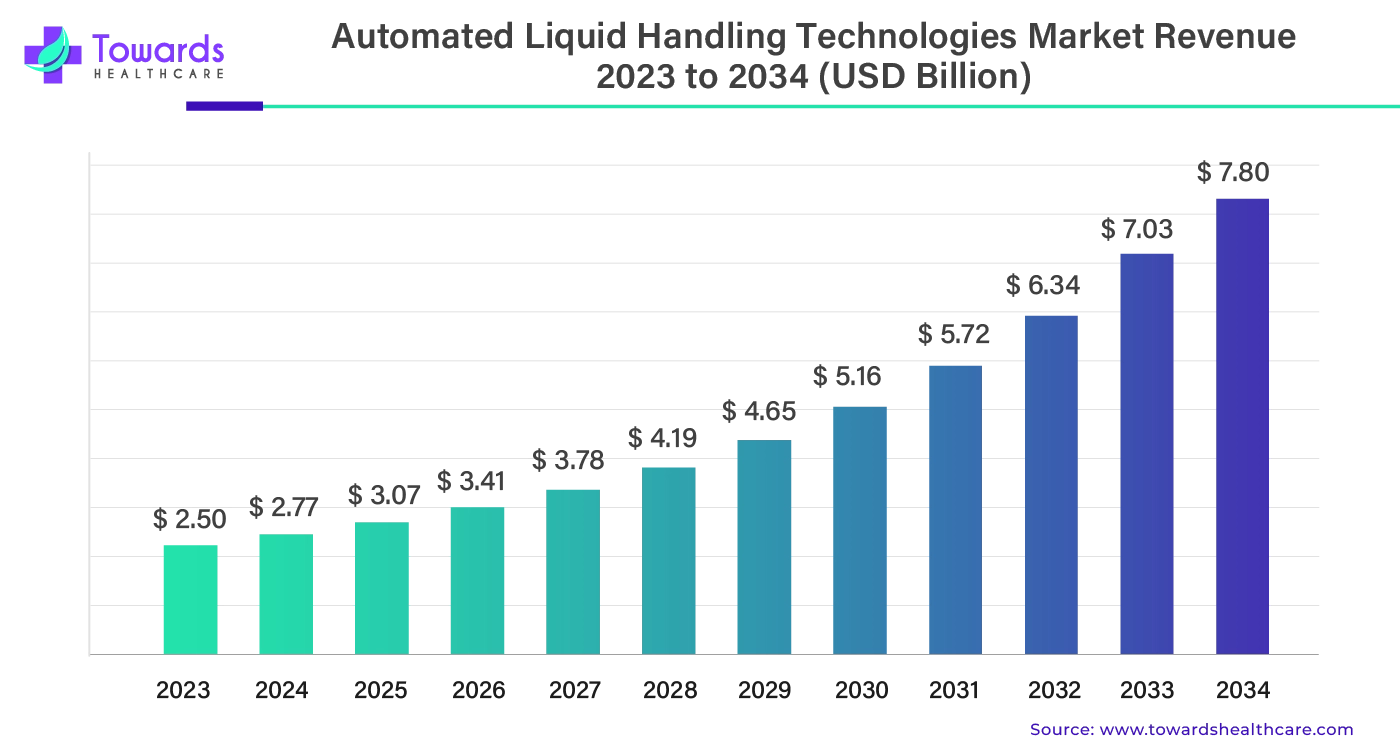 Download statistics of this report @ https://www.towardshealthcare.com/download-statistics/5204
Major Key Insights of the Automated Liquid Handling Technologies Market
- By region, North America dominated the automated liquid handling technologies market share by 40% in 2023.
- By region, Asia Pacific is expected to grow at the fastest rate during the forecast period.
- By product, the automated liquid handling workstations segment dominated the market in 2023.
- By application, the drug discovery & ADME-Tox research segment held the largest share of the market in 2023.
- By application, the cancer & genomic research segment is estimated to grow at the fastest rate during the forecast period.
- By end-use, the pharmaceutical & biotechnology companies segment dominated the market in 2023.
How AI Can Enhance the Automated Liquid Handling Technologies Market?
The integration of artificial intelligence (AI) into automated liquid handling technologies is poised to revolutionize the biotechnology sector, offering several key enhancements:- Data Analysis and Interpretation: AI algorithms can analyze vast amounts of experimental data more quickly and accurately than traditional methods. This capability enables researchers to gain deeper insights into their experiments, identify trends, and make data-driven decisions, ultimately leading to improved outcomes.
- Predictive Maintenance: AI can monitor the performance of liquid handling systems in real time, utilizing machine learning to identify patterns and predict when maintenance is required. This proactive approach helps prevent equipment failures, reduces downtime, and ensures consistent operational efficiency.
- Process Optimization: AI can optimize liquid handling protocols by analyzing factors such as liquid volumes, dispensing speeds, and environmental conditions. By refining these parameters, AI can enhance the precision and accuracy of liquid transfers, resulting in more reliable experimental results.
- Automation of Complex Tasks: AI can enable the automation of complex laboratory processes, such as sample preparation and assay development. By integrating AI-driven liquid handling systems with robotics, laboratories can streamline workflows, reduce human error, and free up researchers to focus on more critical tasks.
- Customizable Workflows: AI technologies can facilitate the development of customizable workflows tailored to specific experimental needs. This adaptability allows laboratories to optimize their processes for a wide range of applications, from high-throughput screening to personalized medicine.
- Improved User Interfaces: AI can enhance user interfaces by incorporating natural language processing and machine learning techniques, making it easier for researchers to interact with liquid handling systems. This user-friendly approach can lead to quicker adoption and more effective use of technology in laboratories.
Top Companies in the Automated Liquid Handling Technologies Market
- Agilent Technologies, Inc.
- AUTOGEN, INC.
- Corning Incorporated
- Danaher
- Hamilton Company
- Aurora Biomed, Inc.
- Eppendorf AG
- Thermo Fisher Scientific, Inc.
- Hudson Robotics
- BioTek Instruments, Inc.
- Analytik Jena AG
- Gilson, Inc.
- QIAGEN
- LABCYTE INC.
- Formulatrix, Inc.
- METTLER TOLEDO
- Lonza
- Tecan Trading AG
- PerkinElmer, Inc.

Get a Sample of this Report
AI-Driven Advancements in the Automated Liquid Handling Technologies Market
