

Behavioral Health Market Trends, Growth and Latest Updates 2025

Market size
Total market (base & forecast)
• 2024 actual: US$173.35 billion.
• 2025 actual: US$185.03 billion.
• 2034 projection: US$332.77 billion.
• Forecast CAGR (2025–2034): 6.74%, which implies roughly 80% nominal growth from 2025 to 2034.
Revenue composition (high-level slices used by report)
• Regional weight (2024): North America 43% of global revenues — largest single regional share.
• By age group (2024): Adults contributed 62% of revenues.
• By payer/funding (2024): Public & social insurance accounted for 52% of revenues.
Growth concentration
• Fastest growing segments (forecast): Asia-Pacific (fastest regional CAGR), Substance Use Disorders (condition), Tele-behavioral/virtual care (modality), Children & Adolescents (age group), Commercial/employer-sponsored (payer).
• This mix indicates expanding private-sector employer demand plus rapid digitization and increased youth demand.
Market scale drivers (quantitative signals embedded in the numbers)
• Large base (mid-hundreds of billions) + mid single-digit CAGR → a mature but scalable market where technology and payer innovations produce incremental acceleration rather than explosive doubling.
Market trends
Rising prevalence & public awareness
• Growing recognition of mental illness — mood & anxiety disorders alone were 44% of revenue in 2024.
• Public campaigns, media coverage and programs (example: India’s Dec 2024 Centres of Excellence) are increasing service demand and detection rates.
Tele-behavioral and virtual care scaling
• Tele-behavioral is the fastest-growing modality in the forecast — driven by convenience, privacy, workforce reach, and integration with primary care.
• Virtual platforms reduce access barriers (geography, stigma) and allow efficient scaling of evidence-based therapies.
Payer mix shifting
• Public/social insurance dominated 2024 (52%), but commercial/employer-sponsored is the fastest-growing payer — employers are expanding mental health benefits to reduce productivity and disability costs.
Shift to outpatient & community care
• Outpatient counselling and psychiatry (38% in 2024) remain the backbone — prevents inpatient escalation and is more cost-effective.
• Growth in community-based crisis services (988-aligned, mobile teams) reflects policy focus on rapid response.
Regional rebalancing
• North America leads (43% in 2024) because of higher spending and coverage; Asia-Pacific is fastest growing due to rising awareness, young populations, and infrastructure investment.
Specialty growth — SUD, youth, geriatrics
• Substance Use Disorders projected to grow fastest among conditions; children & adolescents fastest among age groups, reflecting rising incidence and policy focus.
Consolidation and M&A / platform consolidation
• Large providers, health systems and tech platforms (listed top players) are consolidating services, integrating digital and in-person care to capture care pathways end-to-end.
Regulatory & reimbursement tailwinds
• Policy moves toward parity and virtual care reimbursement are key enablers cited in the report — helping tele-behavioral adoption.
AI role & impact in behavioral health
Clinical augmentation & measurement
• AI can extract signals from clinical notes, session audio/text, and digital biomarkers to support more accurate diagnostics, symptom tracking, and outcome measurement — enabling measurement-based care at scale.
• Example workflows: automated symptom-severity scoring after sessions; identifying treatment non-response early.
Treatment personalization & decision support
• Machine learning models can predict likely responders to specific interventions (CBT, medication classes, intensity levels), enabling stepped-care pathways and optimized resource allocation.
• AI can recommend therapy sequencing (teletherapy → IOP → PHP) based on historical outcomes.
Therapist efficiency & productivity
• Administrative burden reduction: automated documentation, scheduling, billing coding suggestions, and progress note drafts free clinician time for direct care.
• Clinical decision prompts (e.g., suicide risk flags) provide safety nets without replacing clinician judgement.
24/7 digital companions & triage
• Conversational agents (chatbots) and passive monitoring can provide immediate coping tools, crisis de-escalation prompts, and symptom checkers — useful for early intervention and triage to human care when needed.
Population health & payer analytics
• Payers can use AI on claims and engagement data to stratify risk, design preventive outreach, and build value-based contracts tied to measurable mental-health outcomes.
Augmenting scarce specialist capacity
• In regions with clinician shortages, AI tools can extend the reach of scarce specialists through guided self-help, task-sharing supervision, and remote clinician support — lowering the effective barrier to access.
Clinical trials & R&D acceleration
• AI speeds patient identification, outcome signal detection, and adaptive trial designs for digital therapeutics and novel pharmacologic agents.
Ethical, bias & regulatory constraints (critical caveat)
• AI models risk amplifying biases present in training data (race, gender, socioeconomic), necessitating transparency, validation across populations, and regulatory oversight.
• Clinical-grade deployment requires human oversight; AI should be framed as augmentation, not replacement.
Business model impacts
• Vendors that combine AI triage + human clinicians can offer lower-cost, higher-throughput products to employers, payers, and providers — enabling faster adoption in commercial segments.
Data privacy & trust
• Behavioral health is acutely sensitive; AI success depends on secure data governance, consent frameworks, and building user trust.
(These AI roles are drawn from the report’s statements about AI potential and are expanded into specific operational and commercial implications.)
Regional insights
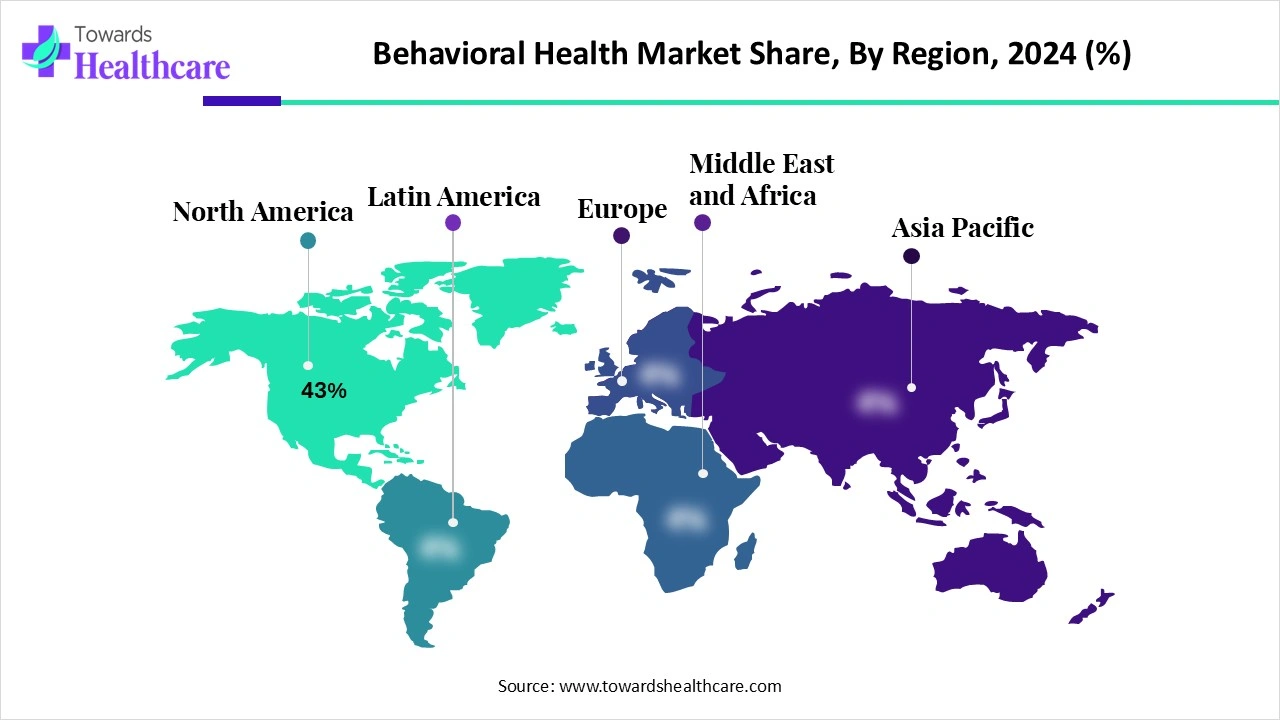
North America (leader 43% in 2024)
High per-capita spend & integrated systems
• Strong private and public payer mix (Medicare/Medicaid + commercial) supports broad coverage and higher provider reimbursement.
Technology adoption & virtual care penetration
• Rapid tele-behavioral uptake due to reimbursement changes and employer benefits expansion.
Policy & infrastructure
• Established crisis systems (988), parity legislation, and investments in workforce training fuel service availability.
Market structure
• Large systems and specialty chains (UHS, Acadia, HCA) dominate inpatient/residential capacity while digital players capture employer/payer segments.
Asia-Pacific (fastest CAGR forecast)
Demand drivers
• Large youth populations, rising substance use in some countries, and increasing public awareness.
Supply constraints & opportunity
• Clinician shortages present — telehealth & task-sharing models are key to scaling access.
Policy momentum
• Governments increasing investments (e.g., India’s Centres of Excellence for mental health) — stimulus to specialist training and infrastructure.
Heterogeneity
• Growth concentrated in urban centres and economically advanced countries (China, Japan, South Korea) but significant catch-up potential in India, SEA.
Europe
Public systems & parity focus
• National health systems provide broad coverage; integration with primary care is central to access.
Digital pilots & cautious regulation
• Many digital therapeutics pilots; regulatory environment balancing innovation and clinical safety.
Latin America & MEA
Under-penetrated market with high unmet need
• Lower baseline spending but large unmet demand — growth potential tied to public funding and NGO initiatives.
Contextual challenges
• Stigma, limited workforce, and infrastructure gaps slow rapid scale without targeted policy effort.
Market dynamics
Drivers
Rising prevalence of depression & anxiety
• Depression affects an estimated 3.8% of global population (user report quote), driving baseline demand — WHO projects major disability impacts by 2030.
Policy & payer support
• Parity laws, telehealth reimbursement, and public insurance expansion (public & social insurance = 52% 2024 revenue) create stable funding.
Employer engagement
• Costs of poor mental health (rising to $6T by 2030 per the report’s cited estimate) push employers towards richer benefits — a fast-growing commercial payer segment.
Technology & telehealth
• Tele-behavioral care expands reach and lowers marginal cost per visit, accelerating adoption in both urban and remote contexts.
Restraints
Workforce shortage
• Shortage of trained behavioral health professionals limiting capacity — major restraint cited in the report.
Stigma & cultural barriers
• In many markets, stigma reduces help-seeking, depressing service uptake despite need.
Data/privacy & regulatory barriers for AI and digital therapeutics
• Compliance costs and the need for clinical validation slow some digital deployments.
Opportunities
AI-enabled scaling
• Use AI for triage, risk stratification, and administrative automation to multiply scarce clinician capacity.
Youth & SUD programs
• Fastest growth in children & adolescents and SUD segments — targeted services create high ROI opportunities.
Value-based contracting & prevention
• Payers leveraging data for preventive outreach and value-based contracts can reward outcomes (reduced hospitalizations, improved functioning).
Cross-sector partnerships
• Collaborations between tech firms, health systems, payers and employers create bundled solutions (digital + human care).
Top companies
Universal Health Services (UHS)
• Product/Offered services: Wide inpatient & outpatient behavioral health facilities, crisis stabilization, residential programs.
• Overview: One of the largest U.S. behavioral health hospital operators.
• Strengths: Extensive physical footprint for acute care, scale advantages in facility operations, payer relationships for inpatient services.
Acadia Healthcare
• Product: Inpatient psychiatric hospitals, outpatient clinics, specialized residential programs.
• Overview: Large behavioral health provider network focused on inpatient/residential care.
• Strengths: Specialty program depth (e.g., SUD, dual-diagnosis), operational expertise in regulated inpatient settings.
HCA Healthcare
• Product: Hospital-based psychiatric units, integrated care pathways.
• Overview: Major hospital system with behavioral health services embedded into broader acute care offerings.
• Strengths: Integration with general medical services, large referral networks, strong EMR & operational platform.
Optum Behavioral Health (UnitedHealth Group)
• Product: Payer/provider behavioral programs, care management, digital tools and network management.
• Overview: Payer-adjacent operator delivering managed behavioral health services.
• Strengths: Data & analytics capability, payer relationships, ability to integrate behavioral benefits into broad insurance products.
Teladoc Health / BetterHelp
• Product: Large teletherapy platforms offering on-demand counseling and subscription models.
• Overview: Consumer and employer-facing virtual mental health services.
• Strengths: Massive user scale, ease of access, employer integrations, brand recognition in direct-to-consumer teletherapy.
Talkspace
• Product: Text and video therapy subscriptions for individuals and employer plans.
• Overview: Digital behavioral health platform focused on scalability.
• Strengths: Flexible engagement models (asynchronous messaging), employer channels.
Headspace Health (Ginger + Headspace)
• Product: Combined offerings: on-demand coaching, therapy, and clinical digital tools (mindfulness content + clinical services).
• Overview: Converged digital mental health + wellbeing content and clinical services.
• Strengths: Evidence-based content library + clinical pathways; strong employer penetration.
Lyra Health / Modern Health / Spring Health / Quartet / Brightline / SonderMind / Array Behavioral Care
• Products: Employer/payer behavioral health platforms, care navigation, clinician networks, virtual + in-person hybrid models.
• Overviews & strengths (common patterns):
Lyra, Modern, Spring: Employer-focused full-stack behavioral health with navigation, coaching, therapy, and outcome tracking. Strengths: data-driven care pathways, employer sales.
Quartet: Focus on primary-care integration and whole-person care coordination. Strengths: PCP integration, referral orchestration.
Brightline: Pediatric & family behavioral health specialist — strength in children & adolescent focus.
SonderMind, Array: Marketplace and clinic operators optimizing clinician recruitment and network management — strength in clinician experience and appointment access.
Magellan Health / Carelon Behavioral Health
• Product: Managed behavioral health services, utilization management, network administration.
• Overview: Established managed care companies offering behavioral health benefits management.
• Strengths: Contracting scale, clinical management, payer integrations.
Priory Group (UK) / Ramsay Health Care / Sheppard Pratt / Lifepoint Behavioral Health
• Product: Regional leaders in inpatient/residential behavioral services, specialized programs.
• Strengths: Local market dominance, clinical program depth, relationships with national health systems.

Get a Sample of this Report
Behavioral Health Market