

Biopharmaceuticals Market Set to Surpass $856 Billion by 2030

Navigating the Biopharmaceuticals Market Growth Trajectory
CAGR as the Engine: Fueling Growth
The projected CAGR of 12.5% serves as the engine, propelling the global biopharmaceuticals market towards substantial growth. This impressive growth rate signifies the sector's adaptability and its pivotal role in shaping the future of pharmaceutical innovation.USD 333.1 Billion to USD 856.1 Billion: A Financial Odyssey
The anticipated financial odyssey from USD 333.1 billion in 2022 to the projected USD 856.1 billion by 2030 marks a significant leap. This monumental surge underscores the market's indispensable role in advancing healthcare solutions globally and positioning itself as a vital player in the pharmaceutical industry. Biopharmaceuticals market Are Complex Medicines Derived From Living Cells Or Organisms And Are Frequently Created Using Cutting-Edge Biotechnological Techniques. A biopharmaceutical, also known as a "biologic," is a medical therapeutic (or drug) derived from a biological source, such as a cell. Biotechnology is used to directly extract proteins and nucleic acids from biological sources to produce biopharmaceuticals market, which are drugs used in medicine. Transgenic organisms are genetically modified plants and animals that are used in the production of biopharmaceuticals market, which are pharmaceuticals made primarily from living organisms. This controversial technology is still in the trial stage.Influencers Fueling The Market Growth
Biopharmaceuticals Market are in High Demand
The primary factor propelling the growth of this is the enormous demand for biopharmaceuticals market brought on by the increase in chronic diseases and the aging population. Additionally, it is anticipated that the ability of biopharmaceuticals to treat untreatable conditions will speed up the market's overall growth. Additionally, the population's growing awareness of the efficacy and accessibility of biopharmaceuticals as well as the expanding healthcare sector is anticipated to temper market growth during the anticipated time frame. The market is expected to grow as a result of the increased efforts being made to develop the biopharmaceutical sector.Hurdles Faced During The Market Expansion
The risk of failure and the high cost of drug development are the main things preventing the global biopharmaceutical industry from expanding. Furthermore, the market is unable to grow internationally due to strict regulatory requirements, high development costs, and the cost of biopharmaceutical drugs. Currently, biopharmaceutical companies, health professionals, and stakeholders face numerous challenges and struggles during the development of new bio drugs and prior to the commercialization of these novel products. For example, according to pharmaceutical protocols, every bio-drug undergoes numerous steps and procedures prior to marketing, including animal and clinical studies. Indeed, this new medicine would be tested on laboratory animals during the development process; however, there may be a scarcity of animal samples or restrictions on their use because there are associations and animal rights organizations that consider the use of some animals in scientific tests or other scientific purposes to be a form of torture and unethical practice.Open Door For The Biopharmaceutical Market
Growing Investments And Research To Foster Innovation
Moreover, it is predicted that the market will benefit greatly from the increased emphasis on research and associated investments. Numerous opportunities for market expansion will also be provided by the increased government funding for the development of the biopharmaceutical industry as well as the increased investments made by market participants in the research and development of new drugs and their clinical trials.Impact Of COVID-19 On The Biopharmaceutical Market
The development of COVID-19 has significantly strained healthcare infrastructure. The pandemic had a moderate impact on the biopharmaceuticals market. The government's implementation of the lockdown and social isolation measures to control the COVID-19 pandemic outbreak resulted in several operations ceasing, supply chains becoming disrupted, business growth slowing down, technology events being postponed, new developments being suspended, as well as having an effect on overall production and sales, which in turn constrained the market's growth. Researchers from all over the world are trying to come up with solutions to this mounting problem. As a result, it is anticipated that there will be a shortage of COVID-19-specific monoclonal antibodies. Itolizumab (ALZUMAb), an anti-CD6 IgG1 monoclonal antibody from Biocon Ltd in India, was approved by the Drugs Controller General of India (DCGI) in July 2020 for the immediate treatment of cytokine release syndrome in patients infected with COVID-19-acute respiratory distress syndrome.Market Scope and Categorization
During the current pandemic, almost all biopharmaceutical market companies in the area have been working to develop efficient COVID-19 treatments, which is anticipated to accelerate the market's growth over the pandemic. The demand for efficient medications will increase due to an increase in research and development spending as well as an increase in the incidence of cancer over the course of the next five years. According to GLOBOCAN 2020, there will be 2,281,658 new cases of cancer in the United States in 2020, along with 612,390 fatalities. As a result of the existence of these growth-determining factors, the market is moving forward and is anticipated to experience significant growth during the anticipated period. According to estimates, the market for biopharmaceuticals market will grow quickly, offering numerous income opportunities.The Largest Market Share is Anticipated to Belong to Monoclonal Antibodies
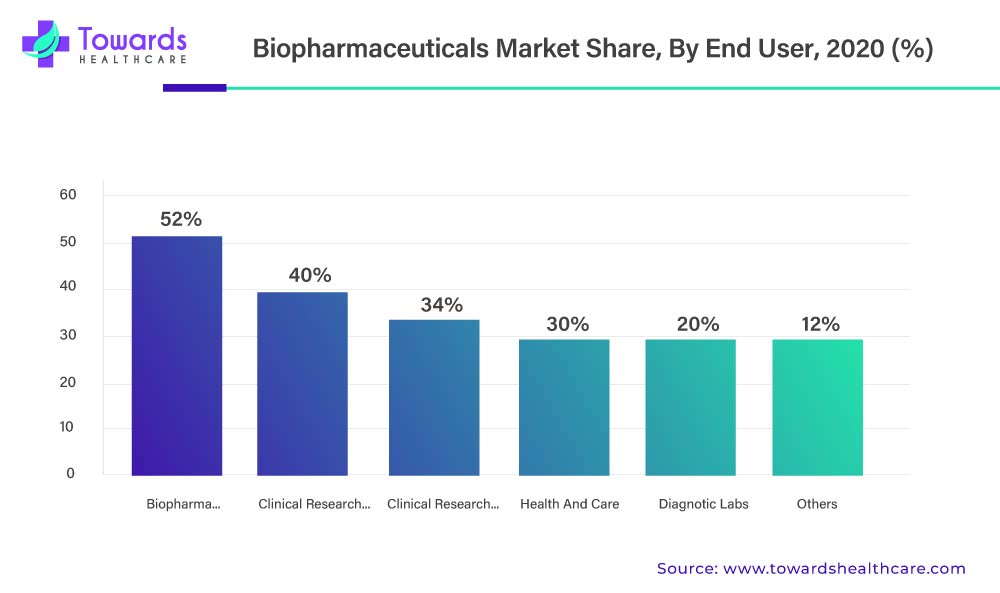
The successful application of monoclonal antibodies and antibody derivatives in therapeutics is the main factor influencing the segment's quick expansion. Monoclonal antibodies have been used as treatments for cardiovascular disease, cancer, rheumatoid arthritis, and multiple sclerosis. Healthcare systems are being heavily burdened by the COVID-19 outbreak. Researchers from all over the world are constantly working to address this growing burden. As a result, the market for monoclonal antibodies that target COVID-19 is anticipated to grow significantly. For instance, the Drug Controller General of India (DCGI) authorized the use of Itolizumab (ALZUMAb), an anti-CD6 IgG1 monoclonal antibody, in July 2020 for the urgent treatment of cytokine release syndrome in acute respiratory distress patients. Additionally, the demand for effective options for disease prevention, treatment, and complete eradication is growing, which is contributing to an increase in pharma R&D spending. Many pharmaceutical firms are concentrating on creating more potent medicines to treat fatal illnesses and enable patients to lead healthier lives with fewer disabilities. Global healthcare spending is essentially driving up R&D activities, which is boosting the number of bio-based pharmaceutical products on the market. A new phase of biological therapies for neoplastic disorders, infectious diseases, and multiple sclerosis has also been made possible by cytokines and interferons (IFNs). These agents mediate their biological effects indirectly, through several immunological and other cells, or accessory proteins.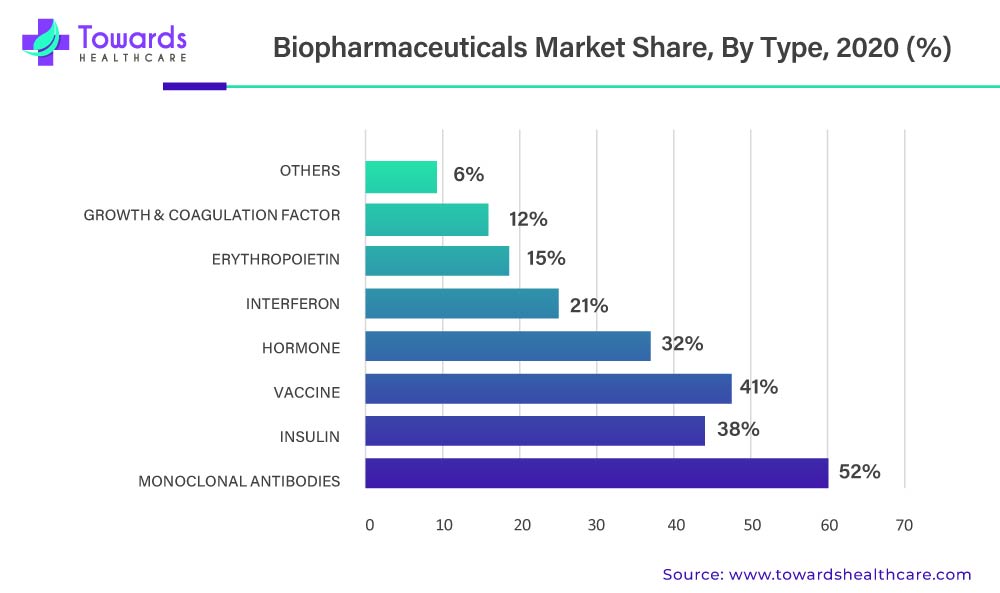 Depending on the end-use sector, the biopharmaceuticals market can be further divided into the following categories: health and care, biopharma companies, diagnostic labs, clinical research institutes, clinical research organizations (CROs), and others. In 2021, the segment representing biopharma companies held the largest market share.
This expansion is mainly due to the significant advancements in modern medicine and their use in treating complex diseases. This segment's growth is currently being further fueled by the recent improvements in molecular medicines and R&D made by numerous top industry players and governmental organizations.
Additionally, the Clinical Research Organizations segment is anticipated to expand at the fastest CAGR of 9.1% from 2022 to 2027 as a result of an increase in research into the creation of new molecular drugs using molecular biology.
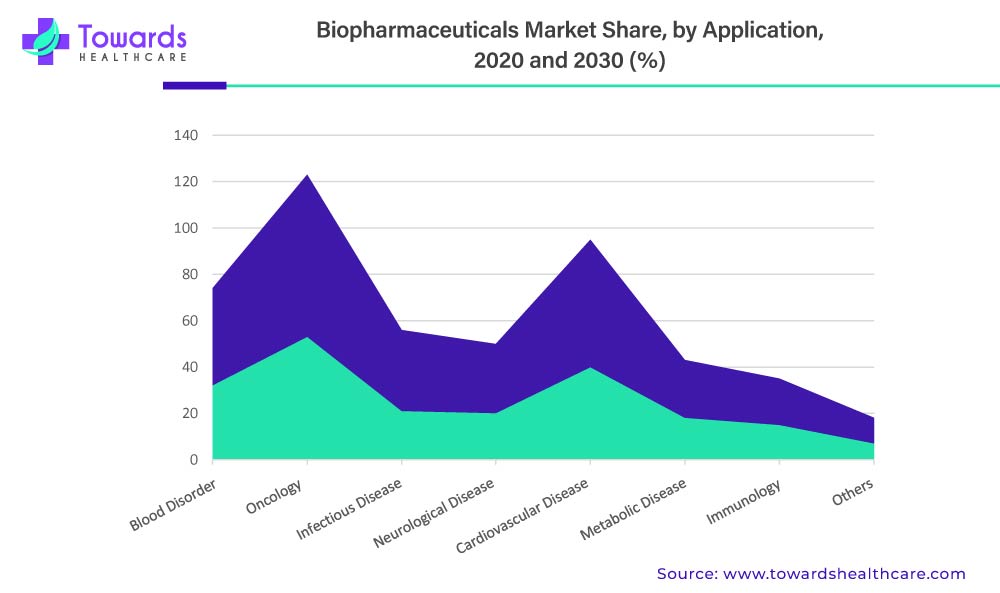
 In terms of revenue, the oncology segment will dominate the global biopharmaceuticals market in 2020. This is simply due to the increased use of biopharmaceuticals market in the treatment of cancers such as lung cancer, breast cancer, colorectal cancer, and prostate cancer. Global cancer cases are increasing at an alarming rate. According to the International Agency for Research on Cancer, the global cancer burden is expected to reach 28.4 million by 2040, up 47% from 2020.
Cardiovascular disease, on the other hand, is expected to be the most opportunistic segment during the forecast period. According to World Health Organization, approximately 17.9 million people die each year as a result of cardiovascular diseases, accounting for approximately 32% of all global deaths. As a result, the increased prevalence of CVDs around the world, as well as rising investments by biopharmaceutical manufacturers in developing innovative CVD drugs, are expected to drive market growth during the forecast period.
 North America is Projected to be the Market King
The primary drivers of the biopharmaceuticals market in North America are the rising burden of chronic diseases and rising investments in research and development activities in the United States. The world's center of life sciences innovation has long been acknowledged to be in the United States. It participates in international capital investments in biopharmaceutical startups.
The North American biopharmaceuticals market is anticipated to grow as a result of the increase in COVID-19-related clinical trials. Nearly 1,750 clinical trials for the creation of vaccines and medications for the treatment of COVID-19 were ongoing as of January 2021, according to the Pharmaceutical Research and Manufacturers of America, 420 of which were based in the United States.


Get a Sample of this Report
Biopharmaceuticals Market
