

Breath Analyzers Market Scope, Forecast, Shares and Key Insights 2025

Market size
Historical / baseline values (anchor points)
●2024 market size: US$ 1.022 billion (reported).
●2025 market size: US$ 1.2 billion (reported).
●2034 projected market size: US$ 5.12 billion (reported).
Growth trajectory & compound growth
●Reported CAGR (2025–2034): 17.44%.
●Implication: a ~4.27× increase from 2025 to 2034 (1.2 → 5.12). This implies strong reinvestment, adoption, and price/ASP expansion across device tiers and services.
Share concentration by product/technology (2024 snapshots — concentration metrics)
●Portable/handheld devices: 58% share of the market by product type (2024). This indicates majority volume and revenues come from consumer and low-cost professional units.
●Electrochemical fuel-cell sensors: 52% share by sensing principle (2024). This indicates fuel-cell tech is the revenue/volume leader among sensing technologies.
Geographic concentration (2024)
●North America: 38% of global market (2024). This is the single largest regional share and suggests a mature, high-value installed base and institutional procurement.
Channel concentration
●Government & institutional procurement dominated distribution channels in 2024 — signalling that public budgets and institutional buying (law enforcement, fleet programs, ignition-interlock) are major demand drivers and stabilize base revenues.
High-growth subsectors embedded in the size
●Ignition interlock systems (product type) are flagged as the fastest growing segment during the forecast period — these tend to be higher ASP, recurring-service businesses (installation, monitoring, compliance), and will contribute disproportionately to future revenue growth versus their 2024 share.
Market trends
Mass consumerization of portable devices
●Portable/handheld devices held 58% (2024). Trend: increased retail & e-commerce penetration and affordability are converting casual buyers (safety/party use) into repeat owners; smartphone integration expands user experience and retention.
Institutionalisation via law enforcement and ignition-interlock
●North America’s 38% share and domination by government procurement implies institutional budgets and mandated programs (ignition interlock, roadside testing) continue to institutionalize device use. Growth in ignition interlocks increases lifetime value and after-sales revenue (monitoring).
Shift to clinical and non-alcohol VOC applications
●Clinical breath analyzers and VOC analysis (disease biomarkers) are maturing: research and pilot clinical studies (e.g., breath tests adjunct to mammography; acetone for diabetes monitoring; electronic-nose lung cancer work) indicate diversification beyond alcohol testing.
Sensor diversification & cost-performance tradeoffs
●Electrochemical fuel-cell sensors dominate (52% in 2024) for accuracy/selectivity in alcohol detection, while MOx (semiconductor metal-oxide) sensors are highlighted as the fastest-growing technology due to low cost and portability—this creates a two-track market: high-accuracy evidential devices vs. low-cost consumer/IoT devices.
AI & analytics integration
●AI is being used to improve accuracy, sensitivity and to detect complex VOC signatures. Integration with smartphone apps and cloud analytics enables pattern recognition, device calibration, and remote monitoring — increasing device utility and data monetization opportunities.
Channel evolution: retail & e-commerce acceleration
●While government procurement dominated 2024, retail & e-commerce is expected to be the fastest growing channel — this accelerates consumer adoption and supports lower unit costs via scale.
Regulatory tightening and supportive programs
●Stricter DUI enforcement and ignition interlock mandates boost demand for certified devices. Conversely, regulatory barriers for clinical adoption slow some diagnostics products, creating a mixed regulatory trend.
Partnerships, M&A, and cross-sector collaborations
●Examples in your brief (Cannabix and Alco Prevention Canada; Cannabix + Omega Labs announcement) show market players are forming partnerships to expand drug testing coverage (cannabis) and broaden addressable markets.
AI impact / role
Signal processing & sensor fusion
●AI enables combining multiple sensor channels (MOx arrays, fuel-cell output, NDIR signals, PTR-MS signatures) to improve discrimination between ethanol and confounders (e.g., ketones, mouth alcohol, other VOCs). This reduces false positives and increases forensic/consumer confidence.
Pattern recognition for disease biomarkers
●Machine-learning models trained on VOC profiles (breathprints) can classify complex disease signatures (e.g., lung cancer, diabetes acetone patterns). AI helps move breath testing from single-analyte detection to multi-marker diagnostics.
Adaptive calibration & drift compensation
●Sensors (especially MOx) suffer drift and environmental sensitivity; AI models running locally or in the cloud can learn correction factors from population data and device history to maintain accuracy without frequent hardware recalibration.
Edge AI for privacy & latency
●For consumer and roadside devices, edge AI (on-device inference) allows immediate results and reduced data transmission, addressing privacy and latency while still benefitting from ML models for decisioning.
Anomaly detection and tamper/fraud detection
●AI models can flag suspicious patterns in breath samples that indicate tampering (e.g., mouth alcohol, spiking) or device misuse. For ignition-interlock and forensic devices this increases evidentiary value.
Biomarker discovery & research acceleration
●Unsupervised and semi-supervised learning on large breath datasets can reveal previously unknown VOC combinations correlated with disease states — enabling new diagnostic product pipelines.
Integration with smartphone ecosystems & user engagement
●AI-driven user coaching, risk predictions, and personalized alerts increase consumer engagement (e.g., predicting impairment risk beyond a single BAC number based on historical patterns).
Regulatory analytics & quality auditing
●For institutional procurement, AI can automate quality control of fleets of devices, traceability logs, and produce audit-ready reports—facilitating compliance.
Service & operational optimization
●Predictive maintenance models for fleet devices and ignition interlock installations reduce downtime and operating costs for monitoring platforms.
Ethical and explainability considerations
●As AI influences forensic or clinical decisions, explainability and model validation become central for regulatory acceptance — explainable AI and validated datasets will be a gating factor for clinical and legal use.
Regional insights
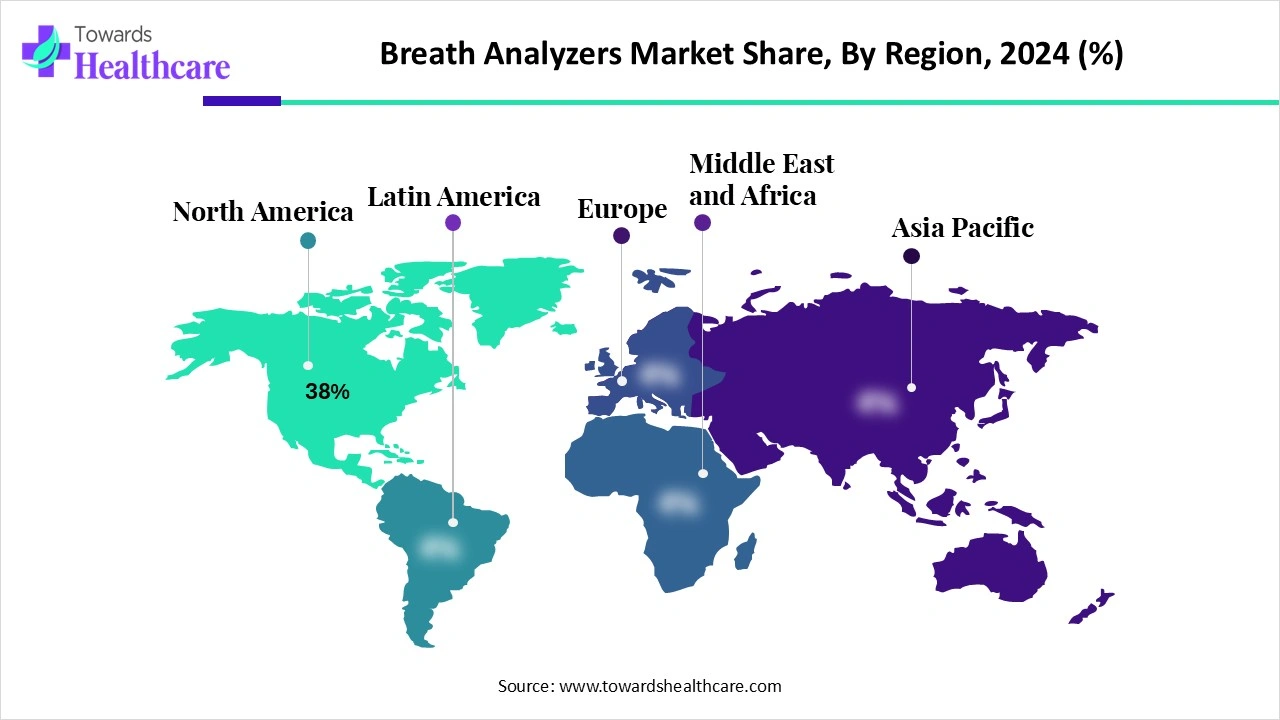
North America (dominant 38% share in 2024)
Large law-enforcement fleets & budgets
●Explanation: The U.S. and Canada maintain extensive roadside enforcement programs and established ignition interlock programs; this institutional buying underpins consistent procurement volumes.
Mature ignition-interlock market
●Explanation: Mandates and monitoring programs generate recurring service revenue (installation, monitoring, violations management), creating a stable and higher-ASP revenue stream.
R&D and clinical pilot leadership
●Explanation: U.S. academic centers and hospitals participate in clinical breath studies (e.g., multi-center mammography adjunct study) — accelerating clinical use cases.
Market dynamics
●Explanation: High public-sector procurement but also strong consumer market via e-commerce and safety campaigns; regulatory clarity improves evidential device adoption.
Asia Pacific (fastest growing region 2025–2034)
Vehicle fleet expansion & urbanization
●Explanation: Rapidly growing vehicle fleets and congestion lead governments to enact stricter road safety programs — increasing demand for roadside and fleet breath testing.
Regulatory catch-up & policy adoption
●Explanation: Countries introducing new DUI/road-safety mandates create greenfield markets for ignition interlocks and evidential devices.
Local OEM growth & cost competition
●Explanation: China-based OEMs and regional manufacturers supply low-cost MOx and portable devices, enabling faster penetration in price-sensitive markets.
Clinical & research investments
●Explanation: Growing healthcare investments (e.g., Suzhou Institute acetone work) point to fast adoption of clinical breath applications in Asia.
Europe
Regulatory stringency & adoption heterogeneity
●Explanation: Western Europe shows mature forensic standards and selective adoption of clinical breath diagnostics; some countries favor evidential, certified fuel-cell devices.
Public health programs
●Explanation: Workplace safety programs and fleet regulations sustain demand for certified monitoring equipment.
Latin America, MEA
Opportunistic growth via fleet/commercial programs
●Explanation: As regulations tighten and enforcement capacity grows, demand for affordable portable and fleet systems will likely rise.
Price sensitivity & need for low-cost sensors
●Explanation: MOx and hybrid sensor platforms can capture large addressable markets due to lower cost of ownership.
Market dynamics
Drivers
Rising alcohol consumption & impaired driving incidents
●Direct effect: Increased roadside testing, workplace policies, and ignition interlock mandates lead to higher device procurement.
●Evidence: The brief cites growing alcohol consumption as a primary driver of breath analyzer use.
Mandates and government enforcement programs
●Direct effect: Institutions buy certified devices at scale; ignition interlock programs drive recurring revenues (installation + monitoring).
Consumer safety awareness & e-commerce access
●Direct effect: Retail availability of portable devices (58% share) increases household penetration and repeated use.
Advances in sensors and AI
●Direct effect: Improved accuracy and new clinical capabilities expand addressable markets (disease detection, wellness monitoring).
Restraints
Regulatory barriers & approval timelines
●Explanation: Clinical breath diagnostics require trials/approvals; noncompliant devices may face recall, delaying launches and increasing cost.
Evidentiary standards and forensic acceptance
●Explanation: Law enforcement requires high accuracy and chain-of-custody features; devices that fail to meet standards cannot be used, limiting market entrants.
Sensor trade-offs
●Explanation: Low-cost sensors (MOx) sacrifice some specificity; fuel-cell devices are costlier — balancing cost vs. accuracy restrains some segments.
Opportunities
Clinical breath diagnostics & non-invasive health monitoring
●Example evidence: Breath tests for diabetes (acetone), lung cancer electronic nose (80–92% accuracy in study cited), and breath tests adjunct to mammography. These open high-value clinical market opportunities.
Ignition interlock expansion & fleet telematics
●Explanation: Integration with vehicle telematics and remote monitoring platforms creates recurring revenue and higher lifetime value.
AI-enabled platform services
●Explanation: Subscription data services, remote calibration, and analytics for fleets/labs can create SaaS revenue on top of device sales.
New analytes & drug detection (cannabis, drugs)
●Evidence: Cannabix collaborations and cannabis breath testing developments indicate drug detection is an expanding category beyond ethanol.
Value-chain levers
●R&D and sensor module specialization — suppliers and OEMs focusing on sensor modules can capture high margins supplying device manufacturers.
●Packaging & UDI traceability — packaging suppliers and compliance partners (DuPont, Amcor, etc.) add value for regulated sales.
●Patient support & services — user instructions, customer support, and calibration services are differentiators for clinical and consumer loyalty.
Top companies
Dräger / Drägerwerk
●Product: Evidential breath testing equipment, professional analyzers, clinical respiratory devices.
●Overview: Longstanding industrial/medical device maker with global law-enforcement footprint.
●Strengths: Regulatory credibility, durable professional equipment, enterprise sales channels.
Lifeloc Technologies
●Product: Handheld and evidential breath analyzers; calibration and service support.
●Overview: Specialist in professional breath testing with established service network.
●Strengths: Field-proven devices, strong aftermarket service and calibration capabilities.
Lion Laboratories / LION
●Product: Evidential instruments and fuel-cell based breathalyzers.
●Overview: History in forensic devices and interlock markets.
●Strengths: Certification track record, ignition-interlock integration expertise.
BACtrack
●Product: Consumer/portable breathalyzers and smartphone-linked devices.
●Overview: Consumer brand with strong retail/e-commerce presence.
●Strengths: Brand recognition in consumer market, app integration, low-cost devices for mass adoption.
Intoximeters, Inc.
●Product: Evidential and desktop breath testing systems.
●Overview: Focus on forensic accuracy and institutional sales.
●Strengths: Laboratory and law-enforcement acceptance, instrument robustness.
Intoxalock / Smart Start / LifeSafer (Ignition interlock ecosystem)
●Product: Ignition interlock devices, monitoring platforms, program management.
●Overview: Providers of installation, monitoring, and compliance software for interlock programs.
●Strengths: Recurring revenue model, large installed base, program management capabilities.
AlcoPro / AlcoHAWK / Alcohawk
●Product: Mix of consumer and professional handheld devices.
●Strengths: Price competitiveness, distribution breadth.
Bedfont Scientific / Owlstone Medical / Picarro / PTR-MS / Ionicon
●Product: Advanced clinical and laboratory breath analysis platforms, PTR-MS and GC-MS solutions.
●Overview: Focused on research/clinical VOC detection rather than consumer alcohol devices.
●Strengths: High sensitivity instrumentation, research partnerships, applications in medical diagnostics.
Sensit / Figaro Engineering / City Technology / Sensirion / Bosch
●Product: Sensor modules (MOx, electrochemical), components for OEMs.
●Overview: Component suppliers powering device makers.
●Strengths: Scale manufacturing, low-cost sensors, integration expertise.
Regional OEMs / China-based device makers / Contract manufacturers
●Product: Low-cost portable units and sensor modules.
●Strengths: Cost advantage, rapid manufacturing scale, local market penetration.

Get a Sample of this Report
Breath Analyzers Market
