

Cannabidiol Market Growth, Dynamics, Size and Latest Insights 2025

Market size
Historic and near-term values
◉2024 market size: USD 8.97 billion.
◉2025 market size (reported/grown): USD 10.38 billion.
Long-term projection
◉2034 projection: USD 38.97 billion.
◉Implied growth window 2025 → 2034: CAGR = 15.83%.
Scale implications
◉The market ~quadruples (≈3.75×) from 2025 to 2034, indicating rapid commercial scaling and capital flow into supply chains, formulation R&D, and retail.
Geographic concentration (2024 baseline)
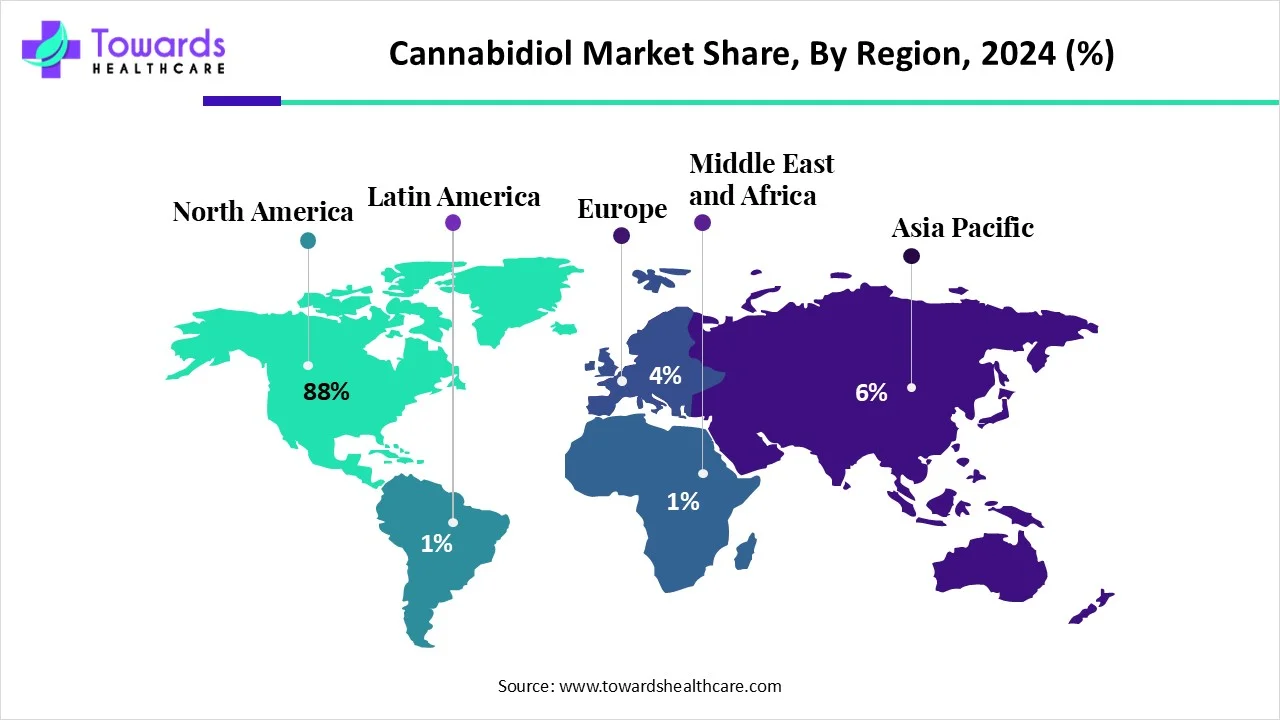
◉North America share: 88% (2024) — extreme concentration indicating regulatory and retail advantages in that region relative to the rest of the world.
Source mix (2024)
◉Hemp was the dominant source in 2024 and is expected to grow fastest — drives legal, large-scale extraction economics (low THC, easier regulatory path in many places).
Sales channel structure (2024)
◉B2B dominated overall sales in 2024 — reflects strong demand for CBD ingredients by pharmaceutical, nutraceutical, cosmetics and food & beverage manufacturers.
◉Within B2C, hospital pharmacies are noted as an attractive growth sub-segment for 2025–2034.
End-use dominance
◉Pharmaceuticals held the major share in 2024 and is expected to be fastest growing — movement toward regulated medical use and prescription formulations.
Market trends
Legalization and policy momentum
◉Examples: Himachal Pradesh cabinet (Jan 2025) recommended controlled cannabis cultivation for industrial/scientific/medicinal use, with universities engaged in controlled cultivation — a sign of state-level policy liberalization and institutional support for cultivation/R&D.
◉Global trend: progressive legalization and clarified hemp rules are unlocking both cultivation and downstream manufacturing.
Retail expansion and mainstream acceptance
◉Major pharmacy/retail chains planning rollout of topicals and other CBD products (examples mentioned: CVS Health, Walgreens Boots Alliance — in the original summary these retailers were referenced as planning store rollouts), showing shift to mainstream retail.
◉In-store availability + e-commerce dramatically expands reach and consumer trial.
E-commerce and subscription models
◉E-commerce is a growth multiplier for niche CBD brands and large incumbents — lowers customer acquisition costs, supports subscription revenue for consistent consumption categories like wellness and pet care.
Product diversification
◉Rapid innovation in edibles, topicals, beverages, nutraceuticals, personal care — enabling cross-category penetration (e.g., skincare + CBD).
Industrial supply chain strength (hemp)
◉Hemp’s dominance as source reduces regulatory friction in many jurisdictions (≤0.3% THC thresholds) and supports industrial-scale extraction economics.
Pharmaceuticalization
◉Increasing clinical interest: pharmaceuticals are taking larger share (2024) — clinical trials, prescription products, and hospital pharmacy uptake are moving CBD from lifestyle to medical channels.
Export and production shifts
◉Canada: large exporter (68 tonnes dried cannabis in H1 2024; 79.3 tonnes shipped in 2023 — figures included in the source text).
◉Spain and Portugal: big year-on-year increases in medical cannabis production and exports (Spain: 23,425 kg in 2023, ≈350% increase; Portugal: 32,558 kg sales reported).
Corporate balance-sheet and M&A readiness
◉Example: Aurora strengthened balance sheet in 2024 (net cash > USD 200M, fully repaid convertible notes) — suggests consolidation capacity and strategic repositioning in larger cannabis/cannabinoid companies.
Clinical & scientific developments
◉April 2025 meta-analysis reported at the European Congress of Psychiatry showing CBD reduced disruptive behaviors/anxiety and improved sleep in children/adolescents with ASD — indicates expanding evidence base for targeted therapeutic uses.
◉University of South Australia (March 2025) developed a phospholipid CBD complex improving solubility and absorption up to 6× — technological improvements that address bioavailability constraints.
Regulatory complexity as a headwind
◉Inconsistent laws, testing and labeling requirements across jurisdictions increase compliance costs and slow market expansion in some regions.
Institutional & hospital acceptance
◉Hospital pharmacies within B2C flagged as lucrative — institutional trust and regulated channels increase medical adoption.
AI impact / role in the CBD market
R&D acceleration and formulation optimization
◉AI models analyze multi-modal datasets (preclinical results, formulation parameters, excipient interactions, pharmacokinetics) to predict:
◉Optimal carrier systems (e.g., what formulation would pair best with a phospholipid complex).
◉Excipient choices to maximize stability and shelf life.
◉Candidate formulations that balance bioavailability, sensory profile (taste/texture), and manufacturability.
◉Outcome: fewer wet-lab cycles, lower R&D costs, faster time-to-market for novel delivery forms (e.g., high-bioavailability oral dosing).
Clinical signal detection and trial design
◉AI mines prior trial data and real-world evidence to:
◉Identify subpopulations (e.g., ASD subtypes, epilepsy phenotypes) most likely to respond to CBD interventions.
◉Optimize trial endpoints (sleep metrics, disruptive behavior scales) and power calculations to reduce sample size and cost.
◉Outcome: faster, more targeted clinical programs — enables pharmaceuticals segment expansion.
Quality control & manufacturing consistency
◉Machine learning applied to process sensor data (extraction temperatures, solvent ratios, chromatography fingerprints) for real-time anomaly detection and predictive maintenance.
◉Computer vision inspects packaging/labels and detects misprints or fill defects — crucial for regulated pharmaceutical and hospital pharmacy channels.
◉Outcome: consistent potency, compliance with testing standards, reduced batch failures.
Supply-chain optimization
◉AI forecasts hemp biomass supply and maps regional harvest cycles to demand signals (pharmaceutical bulk orders, seasonal retail spikes).
◉Optimizes logistics to reduce loss of active constituents (cold chain, extraction scheduling).
◉Outcome: lower cost of goods, reduced stockouts, better margins for B2B suppliers.
Regulatory & compliance automation
◉NLP systems parse changing regulatory texts across jurisdictions and flag product formulations/labels that require updates; automatically generate compliance documentation and audit trails.
◉Outcome: reduced legal overhead, faster market entry in multiple regions.
Consumer insights & targeted marketing
◉Deep learning customer segmentation identifies high-intent microsegments (e.g., middle-aged users seeking chronic pain relief vs. younger users for skin care).
◉Personalized product recommendations and subscription optimization increase retention and lifetime value.
◉Outcome: improved conversion, lower customer acquisition cost; supports retail partnerships and e-commerce scale.
Adverse event monitoring & pharmacovigilance
◉AI systems ingest EHRs, social channels, and pharmacy reports to detect safety signals earlier than traditional reporting.
◉Outcome: proactive risk mitigation and faster safety communications to regulators/hospitals.
Intellectual property and discovery
◉Generative models suggest novel CBD derivatives, prodrugs, or delivery conjugates and prioritize candidates for synthesis/testing.
◉Outcome: competitive differentiation for pharmaceutical companies moving from botanical extracts to proprietary therapeutics.
Operational automation for retail & hospital pharmacies
◉Chatbots and virtual pharmacists provide evidence-based product guidance and triage, increasing consumer confidence for OTC and hospital pharmacy sales.
◉Outcome: higher in-store conversion and better adherence in therapeutic regimens.
Ethical / governance considerations
◉AI must be audited for bias (e.g., underrepresenting certain populations in clinical predictions), and models used for medical claims must meet regulatory standards (explainability, reproducibility).
Regional insights
North America (including U.S. and Canada)
Market share & drivers
◉Accounted for 88% of global CBD market share in 2024 — extreme dominance.
◉Drivers: broad legalization of hemp-derived CBD, mature retail ecosystems, strong e-commerce penetration, and established B2B supply chains.
U.S. specifics
◉Large consumer base and gradual movement of CBD into mainstream retail (pharmacies, wellness stores).
◉Hospital pharmacy and pharmaceutical interest fuel demand for clinical-grade formulations.
Canada specifics
◉Canada is a major exporter of cannabis products (68 tonnes dried cannabis exported H1 2024; 79.3 tonnes in 2023) — strong production and export infrastructure supports global supply and R&D.
Implications
◉High concentration implies global regulatory attention on the U.S./Canada market; competitors elsewhere must navigate export/import rules to access these markets.
Europe (Germany, UK, Spain, Portugal)
Growth trajectory
◉Europe expected to be the fastest-growing region during the forecast; increasing consumer awareness and gradual regulatory relaxations.
Country highlights
◉Germany: favorable regulatory environment for hemp products; strong health-conscious consumer base.
◉UK: clearer guidelines in recent years improved market access for hemp-derived products.
◉Spain: explosive production growth — from 6,000 kg in 2022 to 23,425 kg in 2023 (≈+350%) with ~80% exported.
◉Portugal: reported 32,558 kg of cannabis sales; export activity tripled in 2024 across cultivation/manufacturing/wholesale.
Implication
◉Europe is transitioning from fragmented markets to coordinated industrial producers with export capability.
Asia-Pacific (China, India, Australia)
China
◉Key hemp producer: accounts for nearly half of world hemp supply and exports ~90% of its hemp products to major markets (U.S., Germany, U.K., Netherlands, Japan). China started targeted hemp cultivation for CBD extraction in three provinces.
◉Implication: China is a strategic raw material supplier for global CBD manufacturers, but domestic regulatory stance on finished CBD goods remains mixed — policy clarity will determine local market growth.
India
◉Growing awareness and cultural affinity for herbal remedies; regulatory evolution (state-level experiments like Himachal Pradesh) could promote domestic cultivation and downstream manufacturing.
◉Implication: India could become a low-cost cultivation source and a large domestic consumer market if national policies align.
Australia
◉Research institutions (e.g., University of South Australia) advancing formulation science — local R&D may boost clinical product development and exportable IP.
Latin America
Trends
◉Increasing production and gradually expanding medical frameworks.
◉Potential for export to Europe and North America given favorable climates and lower production costs.
Implication
◉Opportunity for vertically integrated companies to establish low-cost cultivation and serve global ingredient demand.
Middle East & Africa (MEA)
Drivers
◉Government support in some countries (South Africa, Lebanon, Morocco) for medicinal cannabis; legal reforms like South Africa’s Cannabis for Private Purposes Act clarify private use and open pathways for regulated commercial activity.
Implication
◉MEA represents nascent markets with export and local medical demand potential; regulatory change pace will govern investment.
Market dynamics
Drivers (expanded)
Rising consumer adoption for health/wellness
◉Consumers seek natural alternatives for pain, anxiety, sleep; CBD’s non-intoxicating profile supports adoption.
Regulatory wins for hemp
◉Hemp-derived CBD legal frameworks in many markets reduce barriers for large-scale manufacturing and retail.
Product innovation & diversification
◉Growth across edibles, topicals, beverages, personal care, and pet care expands addressable markets.
E-commerce & retail chains
◉Online channels and rollouts into mainstream pharmacy/retail stores increase accessibility.
Pharmaceutical uptake
◉Movement into regulated prescription/medical settings elevates average selling prices and institutional demand.
Restraints (expanded)
Regulatory complexity & fragmentation
◉Varying THC limits, labeling/testing standards, and classification (food vs drug vs supplement) across jurisdictions raise compliance costs.
Quality and standardization gaps
◉Lack of uniform potency and purity standards can erode consumer trust; creates barriers for B2B pharmaceutical adoption.
Clinical evidence & safety perception
◉Despite positive signals (e.g., WHO comment and meta-analysis for ASD), the need for more large-scale, high-quality RCTs continues to constrain medical prescribing.
Opportunities (expanded)
Retail expansion (major chains)
◉In-store launches by large pharmacy chains create mainstream legitimacy and broad exposure.
Hospital pharmacy adoption
◉Hospital pharmacies as a B2C sub-segment present an opportunity for regulated dispensing of clinical-grade CBD.
AI & formulation breakthroughs
◉Improved bioavailability technologies (phospholipid complexes) and AI-driven R&D shorten development timelines and open prescription pathways.
Export & production scale
◉Countries with large hemp supplies (China, Canada, Spain, Portugal) can service global ingredient demand, supporting B2B growth.
Top companies
Canopy Growth Corporation
◉Product/Offering: Licensed cannabis products spanning medical and consumer categories (including CBD-containing lines in certain markets).
◉Overview: Large, diversified cannabis firm with global operations and multi-channel distribution.
Strengths:
◉Scale and brand recognition.
◉Financial snapshot: Q3 FY2025 revenue = USD 74.76 million (Canada net revenue USD 41M; international USD 12M) — indicates stabilized revenue streams and diversified regional sales.
Cronos Group, Inc.
◉Product/Offering: Cultivation, production and distribution of cannabis/cannabinoid products in Canada, Israel and other markets.
◉Overview: Global cannabinoid company with manufacturing and R&D capabilities.
Strengths:
◉International footprint and manufacturing capacity.
◉Financial momentum: Net revenue 2024 = USD 111 million (up from USD 87 million in 2023) — positive revenue growth.
Aurora
◉Product/Offering: Broad cannabis product portfolio (medical and adult-use markets in certain jurisdictions).
◉Overview: Large incumbent in cannabis; used balance-sheet improvement to re-focus strategy.
Strengths:
◉Strengthened balance sheet (net cash > USD 200M; convertible notes repaid) — positions Aurora for strategic investments or M&A.
Xebra Brands / Elements CBD (partnered with BSK Holdings)
◉Product/Offering: Elements CBD (wellness/active lifestyle positioning).
◉Overview: Xebra Brands leading in Mexico; strategic U.S. expansion via partnership with digital marketing and subscription specialist BSK Holdings.
Strengths:
◉Market expansion strategy leveraging BSK’s digital marketing and subscription expertise; targeted rollout into the U.S. wellness & active lifestyle segment (March 2025 announcement).
Other notable companies (Endoca, Cannoid, Medical Marijuana, Inc., Folium Europe, Elixinol, NuLeaf Naturals, Isodiol, PharmaHemp, The Cronos Group again)
◉Product/Offering (general): Ranges across CBD oils, tinctures, topicals, nutraceuticals, clinical-grade extracts, and B2B extracts for pharmaceutical/cosmetic use.
◉Overview: Mix of vertically integrated cultivators, extractors, and branded consumer product firms.
Strengths:
◉Some are strong in brand/consumer trust (NuLeaf, Elixinol), some focus on B2B extracts and pharma supplies (Isodiol, PharmaHemp).
◉Diversified product portfolios and specialization across retail and B2B channels.

Get a Sample of this Report
Cannabidiol Market
