

Global Cardiovascular Devices Market Expands Rapidly with AI, Robotics, and Minimally Invasive Tech 2025

Market Size
Global Market Size
●2024: USD 78.13 billion
●2025: USD 83.79 billion
●2034: USD 156.33 billion
●CAGR: 7.24% (2025–2034)
Product Class Share (2024)
●Implantable devices: 62%
●Non-implantable devices: projected fastest growth
Technology Adoption (2024)
●Minimally invasive & transcatheter: 45%
●Robotic-assisted intervention: projected fastest growth
End User Share (2024)
●Hospitals: 55%
●Ambulatory surgical centers: projected fastest growth
Product Type Dominance
●Interventional cardiology devices: 32%
●Structural heart devices: fastest growth segment
Regional Market Share (2024)
●North America: 36%
●Asia Pacific: fastest-growing region (2025–2034)
Market Trends
Minimally Invasive & Transcatheter Technologies
●Preferred due to reduced complications, shorter recovery, and high efficacy in aging populations.
Robotic-Assisted Intervention Systems
●Increasing adoption for high-precision surgeries and complex procedures.
AI Integration
●AI-driven diagnostics, predictive analytics, and treatment planning becoming standard.
Wearable Monitoring Devices
●Rise of home monitoring and early detection solutions like MyoBioScan patch.
Biodegradable & Drug-Eluting Materials
●Enhancing safety and performance of stents and vascular grafts.
3D Printing & Patient-Specific Implants
●Used in structural heart interventions for complex anatomies.
Telehealth & Remote Monitoring
●Remote cardiac care platforms (e.g., KeeboHealth by OMRON & Tricog) supporting “Going for Zero” cardiovascular events.
Government Reimbursement Policies
●Encourage adoption of advanced cardiovascular devices in hospitals and clinics.
Rising Investment & Collaborations
●Series E funding for Cardiac Dimensions ($53M), ADIA investment in Meril ($200M).
Medical Tourism & Access Expansion
●High adoption in Asia Pacific driven by advanced healthcare facilities and cost-effective care.
Role of AI in Cardiovascular Devices Market
Early Diagnosis
●AI algorithms detect early signs of heart diseases via imaging and wearable devices.
Predictive Analytics
●Machine learning predicts device performance and potential complications.
Treatment Personalization
●AI provides tailored therapy plans based on patient-specific data.
Monitoring & Alerts
●Continuous monitoring platforms like MyoBioScan alert patients to cardiovascular stress.
Procedure Optimization
●AI-assisted platforms guide surgeons in real-time during complex interventions.
Clinical Decision Support
●Reduces errors and improves outcomes by suggesting optimal interventions.
Device Development
●AI enhances design of stents, pacemakers, and valve replacement systems.
Remote Care Management
●Telehealth platforms integrate AI to track patients’ vitals remotely.
Predicting Disease Progression
●AI predicts heart failure progression and arrhythmia risks.
Risk Assessment & Precision Prevention
●Systems like AnginaX AI enable precision-led risk assessment and prevention strategies.
Regional Insights
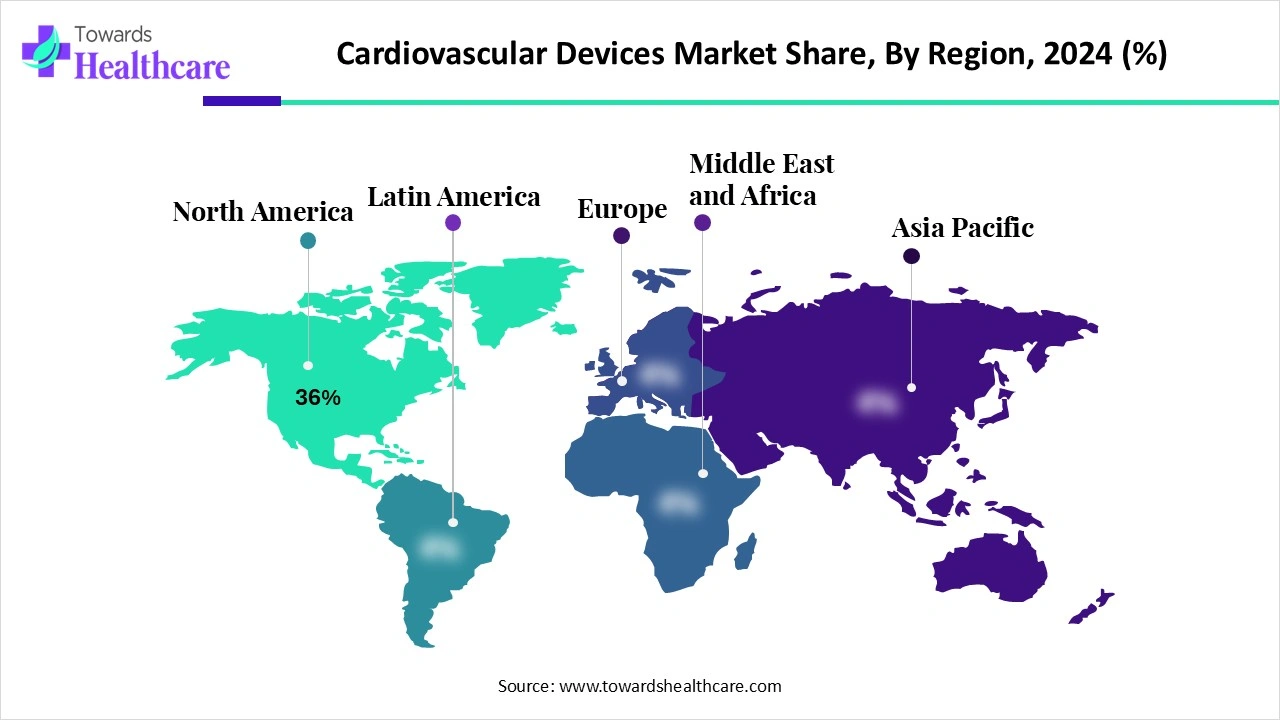
North America
Market Share (2024): 36%
Key Drivers:
●Robust healthcare infrastructure and presence of advanced medical technologies.
●High investments in R&D and clinical studies.
U.S.:
●Rising prevalence of cardiovascular diseases drives demand for monitoring and therapeutic devices.
●Reimbursement policies by government and insurance providers encourage adoption of high-cost cardiovascular devices.
●Rapid integration of innovations such as robotic-assisted systems, AI-based monitoring, and minimally invasive procedures.
Canada:
●Well-developed healthcare sector supports widespread device adoption.
●Collaborative R&D initiatives between medical institutions and device manufacturers accelerate innovation.
●Early adoption of advanced imaging, wearable monitors, and structural heart devices enhances patient outcomes.
Subpoint:
●The combination of strong regulatory frameworks, funding support, and patient awareness positions North America as the leading regional market.
Asia Pacific
Growth Outlook: Fastest-growing region (2025–2034)
Key Drivers:
●Increasing cardiovascular disease prevalence due to urbanization, lifestyle changes, and aging populations.
●Rapidly improving healthcare infrastructure and hospital capacity.
●Expansion of medical tourism, particularly in countries like India and Thailand.
China:
●Large population base leads to a significant cardiovascular disease burden.
●Government initiatives and hospital expansions encourage adoption of minimally invasive devices, stents, and pacemakers.
●Increasing awareness and affordability drive demand for diagnostic and therapeutic cardiovascular devices.
India:
●Healthcare advancements and government support for cardiovascular interventions boost adoption of advanced devices.
●Growing private healthcare sector and medical tourism facilitate access to modern treatments.
●Rising awareness among patients and healthcare providers promotes early diagnosis and device utilization.
Subpoint:
●Asia Pacific represents a high-potential growth market due to demographic trends, rising disposable income, and adoption of innovative cardiovascular solutions.
Europe
Market Drivers: Strong healthcare infrastructure and established regulatory frameworks.
Germany:
●Emphasis on minimally invasive interventions for structural heart and interventional cardiology devices.
●Integration of advanced technologies like robotic-assisted surgery and AI-driven imaging enhances procedural precision.
UK:
●Growing adoption of wearable diagnostic devices for early detection of cardiovascular conditions.
●Funding and support for clinical trials accelerate introduction of innovative devices.
Subpoint:
●Europe’s high clinical standards, supportive reimbursement systems, and innovative healthcare environment sustain steady market growth.
Latin America & Middle East & Africa (MEA)
Market Drivers:
●Emerging awareness of cardiovascular diseases among populations.
●Improving healthcare infrastructure in major countries like Brazil, Mexico, UAE, and South Africa.
Challenges:
●Limited access to advanced devices in rural or resource-constrained areas.
●Dependence on imports for high-end cardiovascular devices.
Opportunities:
●Growing private healthcare sector and medical tourism in urban centers can accelerate adoption.
●Increasing government initiatives for preventive healthcare support expansion of cardiovascular diagnostics and monitoring devices.
Subpoint:
●LATAM and MEA are still developing markets, but rising awareness, better infrastructure, and policy support are enabling gradual growth.
Market Dynamics
Drivers
Rising Cardiovascular Diseases
Global Impact: Cardiovascular diseases (CVDs) remain the leading cause of death worldwide, with prevalence rising due to aging populations, lifestyle factors, and increased chronic conditions.
Market Effect: This growing disease burden fuels demand for diagnostic, monitoring, and therapeutic cardiovascular devices such as stents, pacemakers, and structural heart devices.
Subpoint:
●Early diagnosis tools, like AI-enabled blood pressure monitors and wearable patches (e.g., MyoBioScan), are gaining traction.
●Hospitals and clinics increasingly adopt advanced devices to manage complex cardiac conditions, boosting market revenue.
Technological Innovation
Minimally Invasive Devices: Devices like TAVR systems and interventional catheters reduce surgical risk, shorten recovery times, and improve patient acceptance.
Robotic-Assisted Systems: Enhance procedural precision in complex cardiovascular surgeries, reduce complications, and optimize outcomes.
AI-Based Devices: Artificial intelligence improves diagnosis, predicts device performance, and supports personalized treatment strategies.
Subpoint:
●Innovations in imaging systems (3D echocardiography, intravascular imaging) and bioabsorbable stents are enhancing procedure safety.
●Telehealth and remote monitoring platforms allow continuous patient surveillance, increasing device utilization outside hospitals.
Increased Investment & Funding
Impact on Market: Funding supports new product development, clinical trials, and global commercialization.
Examples:
●Abu Dhabi Investment Authority’s $200M stake in Meril supports cardiovascular device innovations.
●Cardiac Dimensions’ $53M Series E funding enables development of the Carillon Mitral Contour System.
Subpoint:
●These investments accelerate R&D, promote collaborations between companies, and encourage entry of new players in emerging markets.
Restraints
High Device Costs
Market Challenge: Many cardiovascular devices are expensive due to advanced technology, high-quality materials, and rigorous clinical testing.
Effect:
●Low-resource hospitals and developing regions may find devices unaffordable, limiting adoption.
●Patients without adequate insurance or reimbursement options may opt for cheaper alternatives.
Limited Access in Developing Markets
Infrastructure Constraint: Lack of specialized healthcare facilities, trained personnel, and regulatory support reduces adoption.
Effect on Market:
●Slower market growth in regions where hospital infrastructure and device availability are limited.
●Hinders penetration of advanced devices such as robotic-assisted systems and TAVR platforms.
Opportunities
Innovation in Personalized & 3D-Printed Devices
Patient-Specific Solutions: Use of 3D printing for valves, stents, and surgical models enables highly customized treatments.
Market Benefit:
●Reduces procedural complications and recovery time.
●Enhances clinical outcomes, especially in complex structural heart diseases.
Subpoint:
●Hospitals and specialized cardiac centers adopt these technologies for high-risk patients, promoting device innovation.
AI-Driven Early Detection
Impact: AI-enabled wearables, telehealth platforms, and diagnostic devices improve early identification of cardiovascular stress or disease progression.
Benefits:
●Enables preventive strategies, reduces hospitalizations, and optimizes patient management.
●Increases demand for home-based monitoring devices and wearable cardiovascular solutions.
Examples:
●AI platforms like AnginaX and MyoBioScan help clinicians predict cardiovascular risks and personalize treatment plans.
Top Companies
1. Medtronic plc
Products: Pacemakers, Implantable Cardioverter-Defibrillators (ICDs), Cardiac Resynchronization Therapy (CRT) devices
Overview: Global leader in implantable cardiac devices; provides solutions for chronic heart disorders and arrhythmia management
Strength: Extensive R&D, broad product portfolio, strong global market presence
2. Abbott Laboratories
Products: Structural heart devices, vascular devices, minimally invasive platforms
Overview: Specializes in structural heart interventions and interventional cardiology solutions
Strength: Innovations in minimally invasive devices, strong global distribution network
3. Boston Scientific Corporation
Products: Coronary stents, catheters, rhythm management devices
Overview: Focused on interventional cardiology and cardiac rhythm management solutions
Strength: Robust interventional cardiology portfolio, wide clinical adoption
4. Edwards Lifesciences Corporation
Products: Heart valves, transcatheter devices, TAVR systems
Overview: Leader in structural heart interventions and minimally invasive valve replacement
Strength: Advanced structural heart technologies, global recognition in valve treatments
5. BIOTRONIK SE & Co. KG
Products: Cardiac rhythm management devices, stents
Overview: Provides innovative solutions for arrhythmia management and vascular interventions
Strength: Advanced device technology, strong global presence, focus on precision medicine
6. Terumo Corporation
Products: Vascular intervention devices, cardiac catheters
Overview: Develops interventional cardiology and minimally invasive cardiovascular solutions
Strength: Strong presence in Asia Pacific, broad device portfolio
7. B. Braun Melsungen AG
Products: Catheters, vascular products, interventional supplies
Overview: Supplies integrated cardiovascular solutions for hospitals and clinics
Strength: Comprehensive hospital solutions, high-quality vascular products
8. Johnson & Johnson (Cordis, Biosense Webster)
Products: Pacemakers, electrophysiology devices, cardiac mapping systems
Overview: Offers broad cardiac rhythm and interventional solutions globally
Strength: Extensive R&D, strong global distribution, high clinical adoption
9. Siemens Healthineers
Products: Cardiovascular imaging systems, diagnostic platforms
Overview: Specializes in high-quality imaging for diagnosis, preoperative planning, and monitoring
Strength: Advanced diagnostic imaging, high accuracy, integration with AI analytics
10. GE Healthcare
Products: Cardiovascular imaging & monitoring systems
Overview: Provides imaging, monitoring, and analytic solutions for cardiovascular care
Strength: Innovative imaging platforms, AI-driven diagnostics, strong global reach

Get a Sample of this Report
Global Cardiovascular Devices Market
