

Can Cell and Gene Therapy CDMOs Keep Up with the Future?

A New Race Begins in Biomanufacturing
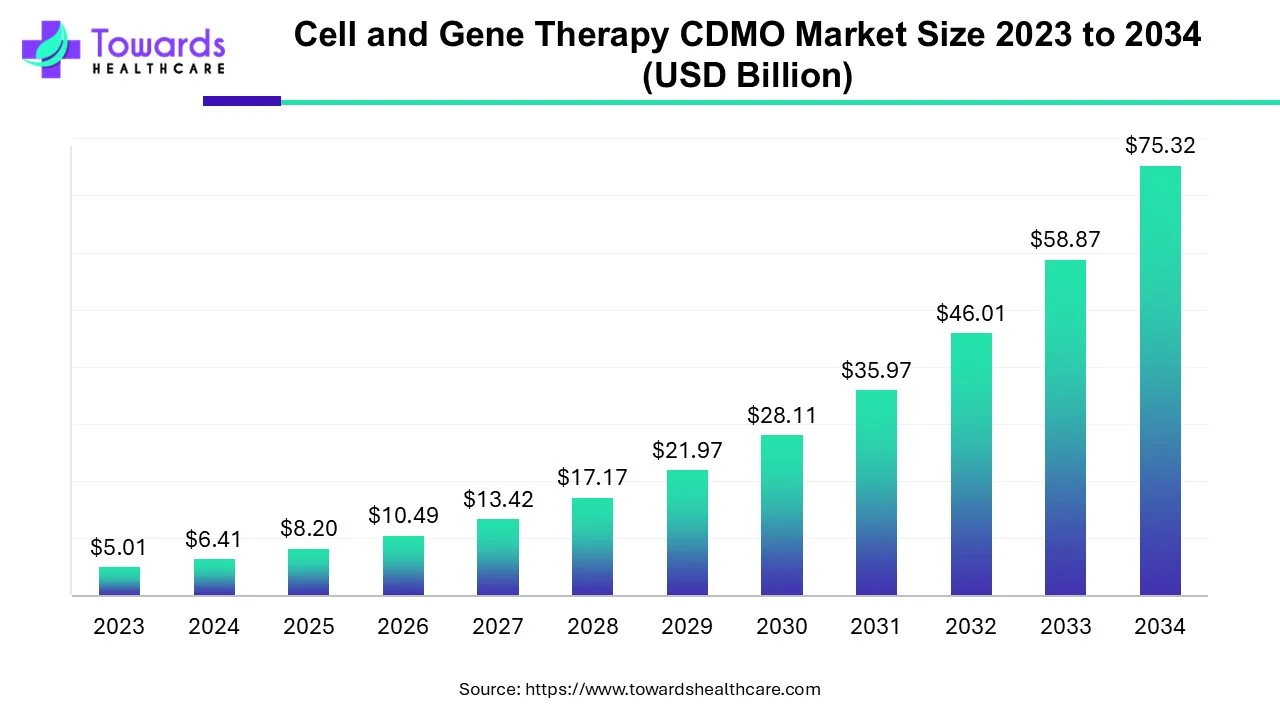
The global cell and gene therapy CDMO ecosystem is standing at a defining moment. The market, valued at just over USD 6.41 Billion in 2024, is moving at an unprecedented pace and is projected to cross USD 75.32 Billion by 2034. This is not a gradual shift but a profound acceleration driven by scientific breakthroughs, surging clinical activity, and the mounting pressure to transform research insights into real-world medical solutions. The world is now witnessing a rapid rise in diseases that demand personalized treatments, and this has pushed biotech innovators to depend more than ever on specialized outsourcing partners. CDMOs have evolved from supportive manufacturing units into strategic pillars of the therapeutic development ecosystem, reshaping how advanced therapies reach patients across the globe.
Download Sample:
https://www.towardshealthcare.com/download-sample/5452
Why the World Needs CDMOs More Than Ever
Cell and gene therapies have created new hope for patients suffering from rare diseases, genetic disorders, oncology indications, and life-threatening conditions that failed to respond to conventional treatments. These therapies rely on highly complex biological systems, often involving living cells or genetic material engineered to restore, replace, or correct patient biology. Such solutions require manufacturing environments that are as precise as they are innovative. This is where CDMOs enter the value chain, offering specialized infrastructure, deep expertise, and an operational architecture designed for therapies that are anything but standard.
The intense demand for these therapies has exposed the limitations of existing manufacturing capacity. Biotech startups often lack the internal capabilities to manage scale-up, regulatory compliance, viral vector production, and clinical batch manufacturing. Even larger pharmaceutical firms choose outsourcing to reduce capital burden and mitigate risk. As a result, the CDMO sector is no longer a complementary partner but an essential extension of the entire biopharmaceutical pipeline.
The CDMO Shift: From Support System to Strategic Engine
Across the last decade, CDMOs have transformed into highly adaptive organizations capable of operating at every step of therapy development. Their involvement now begins far before clinical trials and continues long after commercialization. From process development and viral vector engineering to GMP-grade manufacturing and regulatory documentation, CDMOs provide the backbone that holds the development journey together. Consolidation through mergers, acquisitions, and strategic alliances has strengthened this transformation. Each acquisition brings new technologies, expanded capacity, and specialized platforms that together accelerate the creation of therapies that once took years to develop.
The increasing reliance on CDMOs is also a result of a fundamental shift in biotech innovation. More than 90 percent of emerging biotech firms do not possess internal manufacturing capabilities. To stay competitive and meet the relentless demand for advanced therapies, they must operate with external partners who can deliver both speed and scalability. CDMOs, as a result, are becoming indispensable to the entire sector, especially in early research translation and late-stage commercial readiness.
The Era of Advanced Therapies Has Arrived
Cell and gene therapies have initiated a healthcare revolution, powered by living cells, genome editing tools, and engineered vectors. The potential of these treatments stretches far beyond symptom management. They offer curative possibilities for diseases previously deemed incurable. Yet, their promise also creates extraordinary pressure on the manufacturing ecosystem. Every therapy requires individualized processes, from customizing viral vectors to maintaining cell integrity throughout development.
These demands require an infrastructure built on precision, high automation, sterile environments, and specialized scientific expertise. CDMOs functioning in this space ensure that the complexity of living therapeutics does not become a barrier to accessibility. They modernize each step of the production pipeline, ensuring that both emerging innovators and global pharmaceutical leaders can deliver safe, effective treatments.
Innovation Takes the Lead as AI Reshapes Biomanufacturing
Artificial intelligence has become a driving force in reshaping bioprocessing, especially within the cell and gene therapy sector. Manufacturing unpredictability has long been one of the most significant challenges. Variations in cell viability, vector yields, contamination risks, and production bottlenecks can compromise entire batches. AI is addressing these challenges by analyzing millions of data points in real time to predict bottlenecks before they occur. AI-driven systems monitor biological processes continuously, identifying deviations and automating adjustments to maintain stability.
CDMOs integrating AI into their workflows are already experiencing enhanced throughput, more consistent yields, and reduced process failures. Predictive modeling is transforming decision-making, turning manufacturing into a more reliable and cost-efficient process. In an industry where every mistake is expensive and every delay impacts patient outcomes, AI has become a critical ally.
Demand Surges as Clinical Pipelines Expand
The growth of the cell and gene therapy CDMO market is tightly linked to the global rise in clinical trials. Today, dozens of therapy candidates are advancing across oncology, rare diseases, and infectious diseases. The FDA is reviewing a rising number of submissions, while regulatory bodies across Europe and Asia are encouraging the development of advanced therapy medicinal products. Biologics approvals have accelerated year over year, creating a pipeline that heavily depends on CDMO capacity.
The biotech sector’s increasing willingness to outsource is also driving market growth. Startups, academic spinouts, and early-stage innovators now recognize outsourcing as the fastest path to translate research into clinical programs. Reduced risk, lower cost, and access to state-of-the-art technologies make outsourcing a strategic imperative rather than an operational choice.

Get a Sample of this Report
Can Cell and Gene Therapy CDMOs Keep Up with the Future?
