

Cell-Based Vaccine Market Overview, Growth and Updates 2025

Market size
Overall market magnitude (qualitative / reported)
◉The market is described as “poised to generate substantial revenue — potentially climbing into the hundreds of millions” over 2025–2034. This framing signals a mid-hundreds-million USD market by late forecast years rather than single-digit billions in the baseline scenario provided.
Concentration & share indicators
◉North America (2024): 50% market share — implies a strongly concentrated market where a single region accounts for roughly half of global revenue.
◉Hospitals (care setting) dominated with 68% revenue share — indicating where the majority of spend/administration occurs today.
◉Direct sales to hospitals / GPOs accounted for 50% of distribution revenue in 2024 — shows concentrated, institutional purchasing.
Growth trajectory
◉The market is expanding (upward trajectory) with Asia-Pacific expected to have the highest CAGR over the forecast period (2025–2034), implying faster future value creation outside North America.
Investment & R&D intensity
◉Heavy R&D, government funding and clinical programs (cell lines, adjuvant libraries, dendritic-cell platforms) justify continued near-term investment before commercialization inflection points.
Manufacturing & cost profile
◉Production cost and scalability constraints (complex aseptic processes, bioreactors, cold-chain) compress margins and currently limit large-scale price declines — a near-term ceiling on absolute market expansion until manufacturing innovations scale.
Market segments that drive value capture (cross-cutting)
◉Sterile vaccines (dominant in 2024), hospital administration, and direct institutional channels are primary revenue drivers today; e-commerce and ambulatory settings are the fastest growth pockets.
Market trends
Platform shift: cell-culture vs egg-based production
◉Cell-based platforms (mammalian / insect cell lines) provide cleaner, scalable production, reduce egg-adaptation risks, and can shorten outbreak ramp-up times — a structural trend pushing vaccine makers to invest in cell culture capacity.
Personalised & therapeutic vaccines rising
◉Dendritic cell vaccines and personalized cancer vaccines are maturing in trials, moving cell-based vaccines beyond prophylactic influenza into oncology and individualized immunotherapies.
Government investment & strategic public funding
◉Governments are increasing investments and partnerships to secure rapid vaccine responses; examples cited include national initiatives to accelerate cell line and adjuvant resources (e.g., the MHRA adjuvant library initiative).
Adjuvant innovation & “off-the-shelf” libraries
◉Development of adjuvant libraries that can be combined with new vaccine candidates (as described) accelerates candidate optimization and shortens time-to-trial for novel pathogens.
AI & computational biology integration
◉AI is becoming core to antigen selection and immunogen design: machine-learning accelerates epitope prediction and candidate triage, reducing wet-lab cycles and focusing preclinical resources on higher-probability leads.
Expansion of care settings & distribution channels
◉While hospitals dominate today (68% share), ambulatory surgery centers/day clinics and e-commerce/B2B marketplaces are the fastest-growing channels, reflecting decentralization and digital procurement trends.
Regional manufacturing builds & domestic capacity
◉Asia-Pacific investment (China, India, South Korea, Japan) and firms (SII, Bharat Biotech, Sinovac, SK Bioscience) are scaling production and R&D, prompting a shift in where cell-based doses are made and distributed.
Regulatory & sterilisation focus
◉Sterile vaccine production dominates; regulators (FDA, WHO, CDSCO) emphasize sterilisation, serialization and GMP traceability — increasing compliance costs but improving safety and market acceptance.
AI’s impact / role in the cell-based vaccine market
Antigen discovery & epitope prediction
◉ML models (random forests, deep learning, sequence-based models) analyze pan-genomic and proteomic datasets to predict antigenic epitopes and prioritize immunogens for cell-based platforms, shrinking candidate pools and focusing experimental validation.
Vaccine design optimization (in silico immunogenicity scoring)
◉AI scores and ranks candidates for likely T-cell and B-cell responses, predicts antigen presentation efficacy on human HLA alleles, and helps design multi-epitope constructs tailored for personalized cancer vaccines.
Adjuvant pairing & combination screening
◉Computational models help predict synergistic adjuvant–antigen interactions, enabling rapid matching from adjuvant libraries (e.g., “off-the-shelf” adjuvants) to maximize immune activation in cell-based formulations.
Accelerating preclinical pipeline
◉AI reduces wet-lab experiments by simulating antigen-immune interactions and suggesting optimal cell lines or culture conditions, thereby cutting time from discovery to IND-enable studies.
Manufacturing process optimization
◉Predictive analytics optimize bioreactor parameters, media composition, and scale-up profiles to reduce variability, lower contamination risk, and improve yields in complex cell culture processes.
Quality control & contamination detection
◉Computer vision and anomaly detection models monitor aseptic filling, cell culture morphology, and sensor streams for early contamination detection — improving sterility and batch release confidence.
Clinical trial design & patient stratification
◉AI identifies patient subgroups most likely to respond (neoantigen profiles, immune status), enabling more efficient, smaller, and higher-yield personalised vaccine trials.
Post-market surveillance & pharmacovigilance
◉Natural language processing and signal detection from electronic health records / social data help detect adverse events faster, sharpening post-approval risk management.
Supply chain optimization & demand forecasting
◉Forecasting models predict regional demand for doses, optimize cold-chain logistics and distribution to hospitals and ASCs, and allocate fill-and-finish capacity (e.g., to manufacturers such as CSL Seqirus).
Regulatory submission support
◉AI-assisted report generation and data harmonization speed regulatory dossier preparation (standardizing large multi-omic or manufacturing datasets required by FDA/WHO/CDSCO).
◉Net effect: AI compresses timelines across discovery→manufacturing→trial design, increases candidate success probability, and reduces cost per successful vaccine candidate — thereby addressing key constraints (time, cost, scale) that currently restrain market expansion.
Regional insights
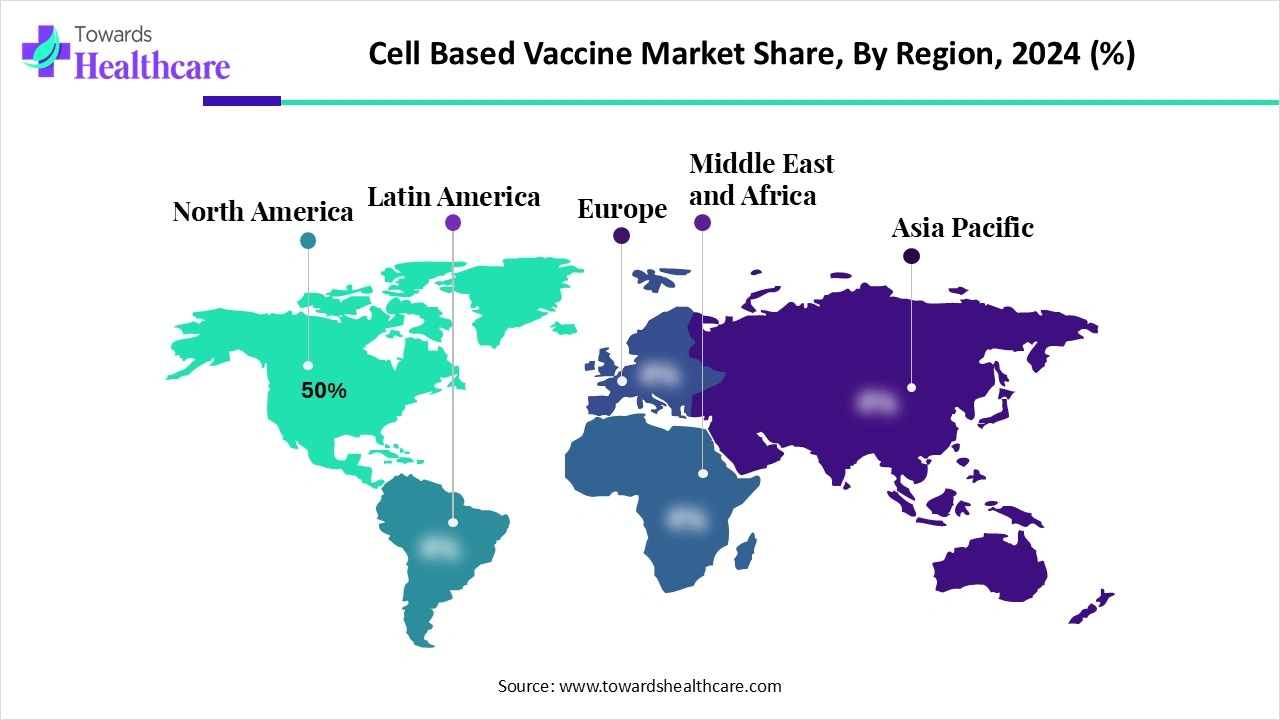
North America (dominant; 50% share in 2024)
Market concentration & buyer structure
◉High institutional adoption (hospital systems) and large direct procurement via GPOs → stable high-value sales and negotiated pricing, enabling premium pricing for specialized cell-based products.
R&D & clinical trial hub
◉Major biotech / academic centers and government funding (NIH, CDC collaborations) accelerate clinical translation (oncology vaccines, dendritic cell platforms).
Manufacturing & fill/finish capability
◉Presence of contract development and manufacturing organizations (CDMOs) and fill/finish capacity shortens time to market (e.g., CSL Seqirus role in pre-pandemic H5 fill/finish).
Regulatory sophistication
◉Stringent FDA oversight and advanced pharmacovigilance raise barriers to entry but increase market trust for licensed products.
Asia-Pacific (fastest CAGR expected)
Supply expansion & domestic champions
◉Large manufacturers (Serum Institute, Bharat Biotech, Sinovac, SK Bioscience) are expanding cell-culture capacity, lowering manufacturing costs and enabling scale.
Government programs & demand drivers
◉Population size, urbanization and public immunisation programs drive demand for routine and adult vaccines; governments prioritize domestic production capacity for pandemic preparedness.
Cost arbitrage & export potential
◉Lower manufacturing costs + scale = export opportunities to low/ middle-income countries and potential to capture global tender volumes.
Regulatory harmonization challenges
◉Varied regulatory frameworks across APAC can slow cross-border registration; however, regional cooperation (e.g., CEPI objectives) aims to reduce time to response.
Europe
Strong R&D clusters & biotech ecosystems
◉Europe hosts biotech firms and partnerships focused on immunotherapy and cell-culture innovations.
Regulatory emphasis on safety / serialization
◉EU regulatory pathways emphasize GMP, sterilization processes and traceability (serialization), which favors companies with compliant supply chains.
Latin America, MEA
Growing but nascent markets
◉Demand is increasing but is constrained by procurement budgets and cold-chain infrastructure; opportunities exist for lower-cost cell-based doses and regional fill-and-finish partnerships.
Adoption path
◉Likely to adopt through public health tenders, donation programs, and partnerships with global manufacturers.
Market dynamics
Drivers
Rising disease prevalence & unmet needs
◉Infectious disease threats and oncology unmet needs increase demand for innovative vaccine platforms (including therapeutic vaccines).
Personalised vaccine momentum (report cites personalized vaccines as “future of the market”)
◉Neoantigen targeting and patient-specific immunotherapies drive high-value product development and capture premium market segments.
Government funding & pandemic preparedness
◉Public investments (e.g., adjuvant libraries, expedited cell line development) lower R&D risk and accelerate platform readiness.
Technological advances in cell culture & adjuvants
◉Scalable cell lines, better adjuvant matching and improved sterile fill processes raise manufacturability and product potency.
Restraints / Challenges
Manufacturing complexity & cost
◉Cell-based production requires aseptic facility investments, specialized bioreactors and trained personnel — limiting rapid scale and increasing per-dose cost.
Contamination & sterility risks
◉Cell cultures are vulnerable to contamination — raising batch failure rates and regulatory scrutiny.
Scale-up limitations
◉Some viruses or recombinant constructs have restricted host ranges or unpredictable yield at scale, complicating large-volume production.
Viral mutation & antigenic drift
◉Pathogen evolution can lead to antigen mismatch, reducing vaccine effectiveness and requiring iterative updates.
Regulatory & reimbursement uncertainty for therapeutic vaccines
◉Therapeutic cancer vaccines face complex clinical endpoints and payer uncertainty over pricing and long-term value.
Opportunities
Cancer & therapeutic vaccines
◉Tumor-cell based vaccines that present multiple neoantigens mitigate the need to preidentify targets — a unique opportunity for personalised oncology.
Adjuvant libraries & plug-and-play formulations
◉Reusable adjuvant resources (e.g., MHRA library concept) reduce formulation risk and speed candidate advancement into trials.
Manufacturing innovations & CDMO partnerships
◉Investments in scalable cell lines and outsourced manufacturing enable capacity expansion and margin improvement.
Digital procurement & e-commerce channels
◉Growth in B2B marketplaces for hospital procurement offers new distribution channels and lower administrative friction.
AI & process automation
◉As covered earlier, AI reduces discovery and production inefficiencies — addressing major restraints.
Top companies
CSL Seqirus
◉Product / focus: Cell-based influenza vaccines; fill-and-finish for pre-pandemic H5 vaccines.
◉Overview: A major influenza vaccine manufacturer with cell-based production capabilities and global fill/finish infrastructure.
◉Strengths: Established influenza cell-culture platform, large manufacturing scale, and government supplier relationships (e.g., U.S. government orders for pre-pandemic doses).
Serum Institute of India (SII)
◉Product / focus: Large-scale manufacturing of vaccines using cell-based technologies (and other platforms).
◉Overview: One of the world’s largest vaccine manufacturers by volume.
◉Strengths: Cost-efficient scale, established global distribution, and strong position in supply to lower-cost markets.
GlaxoSmithKline (GSK)
◉Product / focus: Broad vaccine portfolio including cell-based and adjuvanted vaccine technologies.
◉Overview: Big-pharma with deep vaccines R&D, regulatory experience and commercialization reach.
◉Strengths: R&D funding, regulatory know-how, and global distribution networks.
Pfizer
◉Product / focus: Large vaccine and biologics pipeline; experience with mRNA and protein subunit vaccines that complement cell-based platforms.
◉Overview: Global leader in vaccine commercialization and scale.
◉Strengths: Global clinical development, commercialization strength, and manufacturing partnerships.
Sanofi
◉Product / focus: Broad vaccine R&D including cell-based influenza vaccines historically.
◉Overview: Established vaccine franchise with global reach.
◉Strengths: Global supply chain and vaccine experience.
Takeda, AstraZeneca, Bavarian Nordic, Vaxcyte, Valneva, Novavax, BioNTech, Moderna, Dynavax
◉Product / focus: Varied — from recombinant protein vaccines to adjuvanted formulations and emerging cell-based approaches; some focus on oncology vaccines or adjuvants.
◉Strengths: Innovative platforms (mRNA, recombinant), adjuvant expertise, and strong pipeline capabilities; some have niche strengths in oncology or pandemic preparedness.
Biological E. Limited, China National Biotec Group (CNBG), Sinovac Biotech, CanSino Biologics
◉Product / focus: Regional vaccine developers scaling cell culture and traditional vaccine platforms.
◉Strengths: Regional manufacturing capacity, government contractual relationships, and domestic market penetration.
BriaCell Therapeutics, NexImmune
◉Product / focus: Biotech specialists focused on cell-based or dendritic-cell oncology vaccines and personalized immunotherapies.
◉Strengths: Niche R&D focus, agility in clinical development for therapeutic vaccines.

Get a Sample of this Report
Cell-Based Vaccine Market
