

How Will Trends and AI Roles Shape the $6.42 Billion Dental Imaging Market by 2034?

Market size
Baseline (2024): Market value stood at US$ 3.12 billion (reported 2024 actual).
Near term (2025): Projected to reach US$ 3.35 billion in 2025 — an increase of US$ 0.23 billion (+7.37% vs 2024).
Long-term (2034): Projected at US$ 6.42 billion by 2034 under the supplied forecast.
CAGR (2025→2034): 7.46% annual growth rate is the basis for the 2034 projection.
Absolute growth (2025→2034): US$ 3.07 billion growth in total nominal value (from 3.35 → 6.42), a ~91.64% cumulative increase over those nine years.
Absolute growth (2024→2034): US$ 3.30 billion increase (3.12 → 6.42), a ~105.77% cumulative increase across the 10-year window.
Average nominal annual increase (2025→2034): about US$ 0.341 billion per year (3.07 / 9 years) in nominal dollars.
CAGR consistency check: applying 7.46% annually to US$3.35 across nine years yields approximately US$ 6.40–6.42 billion (rounding differences explain the tiny gap), confirming consistency between the CAGR and the stated 2034 projection.
Market scale context: the market roughly doubles (≈+100%) from 2024 to 2034; this implies persistent investment in imaging hardware, software and related services.
Implication for stakeholders: steady, mid-single-digit to low-double-digit returns over the decade — attractive for device makers, software/AI vendors and DSOs investing in standardized imaging workflows.
Market trends
Digital imaging supremacy (technology shift):
The digital (CMOS/PSP) segment accounted for ~88% of market revenue in 2024, showing near-ubiquitous migration from film/analog to digital sensors and plates.
Impact: faster captures, instant image transfer to software, simplified EHR integration and reduced running costs for clinics.
Intraoral imaging dominance (modality):
Intraoral imaging led with 34% revenue share in 2024 — it’s the everyday diagnostic backbone (bitewings, periapicals, sensors).
Impact: broad footprint across independent clinics and routine dentistry.
Rapid CBCT adoption (modalities shifting toward 3D):
CBCT is the fastest-growing modality, driven by implantology, surgery and orthodontics where 3D data materially improves planning and outcomes.
Software becoming revenue center (imaging acquisition & 3D planning):
Imaging acquisition & 3D planning software accounted for ~58% market share in 2024 — software is now as strategic as hardware.
Impact: recurring revenue models through licenses, cloud services, and integration fees.
AI/Automation accelerating (emerging but fastest CAGR among software):
AI/automation is expected to grow at the fastest CAGR among software segments — automating detection (caries, pathology), supporting treatment planning, and reducing clinician time per case.
Clinical application concentration in implantology & oral surgery:
Implantology & oral surgery were the largest single clinical application (~32% share) in 2024 — driving demand for CBCT and advanced planning software.
Orthodontics — fastest application growth:
Orthodontics (aligner planning, 3D dental arch analysis) is expected to post the fastest CAGR, benefiting from intraoral scanners and CBCT integration with aligner workflows.
End-user split — independent clinics dominate but DSOs grow fastest:
Independent dental clinics held ~54% share in 2024, reflecting the sector’s fragmented provider base — but DSOs/group practices are the fastest growing end-user segment (scale investments, centralized imaging strategies).
Geography: North America leader, APAC fastest growth:
North America led with ~39% revenue share in 2024. Asia-Pacific expected to register the fastest CAGR driven by infrastructure investments and rising cosmetic dentistry demand.
Product and detection tech cycles:
Frequent product launches (new scanners, detectors, lower-dose hardware) and detector portfolio updates (e.g., flat panels with better dynamic range) are shortening replacement cycles for clinics aiming to stay competitive.
Regulatory & radiation safety concerns persist:
Even as dose-reduction tech improves, radiation safety concerns are a restraining factor affecting frequency of scans (especially in pediatric and sensitive populations).
Integration & chairside workflows matter:
Buyers increasingly value systems that integrate imaging, 3D planning and practice management — the “one-stop” digital workflow can be a decisive purchasing factor.
AI roles and impacts
Automated pathology detection (caries, lesions, bone loss)
Role: AI models flag probable caries, periapical lesions, bone loss and other pathologies on 2D/3D images.
Impact: reduces missed findings, speeds triage, and supports second-opinion workflows.
Example link to supplied content: firms like Pearl AI, Overjet, and VideaHealth are named as market players specializing in AI detection.
3D treatment planning & implant placement assistance
Role: AI automates segmentation of bone and vital structures, suggests optimal implant positions and simulates outcomes.
Impact: reduces planning time for implantology & oral surgery (the leading application at ~32% share), improves surgical accuracy, and lowers complication risk.
Real-world tie: imaging acquisition & 3D planning software dominance (58% share) creates a natural platform for embedded AI tools.
Image quality enhancement & dose optimization
Role: AI denoising and reconstruction techniques enable clinically usable images at lower radiation doses.
Impact: addresses radiation safety concerns and increases clinician confidence to use 3D imaging when appropriate.
Automated measurement, landmarking and cephalometric analysis
Role: AI places cephalometric landmarks, measures angles/linear distances, and generates orthodontic reports.
Impact: speeds orthodontic workflows and supports the fast-growing aligner and orthodontics segment.
Workflow automation & case prioritization
Role: AI triages images arriving at a cloud/PACS server, prioritizes urgent cases and routes them to specialists.
Impact: improves throughput in DSOs and hospitals, reduces turnaround time for urgent findings.
Clinical decision support / predictive analytics
Role: AI aggregates image findings with patient records to predict treatment outcomes, risk of implant failure or progression of disease.
Impact: enables personalized treatment planning and better patient counseling (higher acceptance rates).
Quality assurance, compliance & audit trails
Role: AI flags inconsistent imaging protocols, incomplete captures or suboptimal exposures for operator feedback.
Impact: raises diagnostic quality and provides documentation for regulatory and reimbursement audits.
Augmented reality / visualization support for chairside communication
Role: AI converts image/3D planning data into patient-facing visualizations, overlays and treatment simulations.
Impact: improves patient understanding and consent, supporting case acceptance for cosmetic & implant procedures.
Scalability for DSOs & cloud platforms
Role: AI deployed in cloud/PACS environments scales analyses across networks of clinics.
Impact: DSOs can standardize diagnostics across multiple sites, improving quality control and enabling centralized review.
Commercial models & monetization (SaaS/AI licensing)
Role: AI creates recurring revenue streams (per-scan or subscription) layered on hardware sales.
Impact: shifts vendor economics from single-unit hardware sales to software/AI subscription, increasing customer lifetime value; aligns with the dominance of imaging acquisition & 3D planning software (58% share).
Regional insights
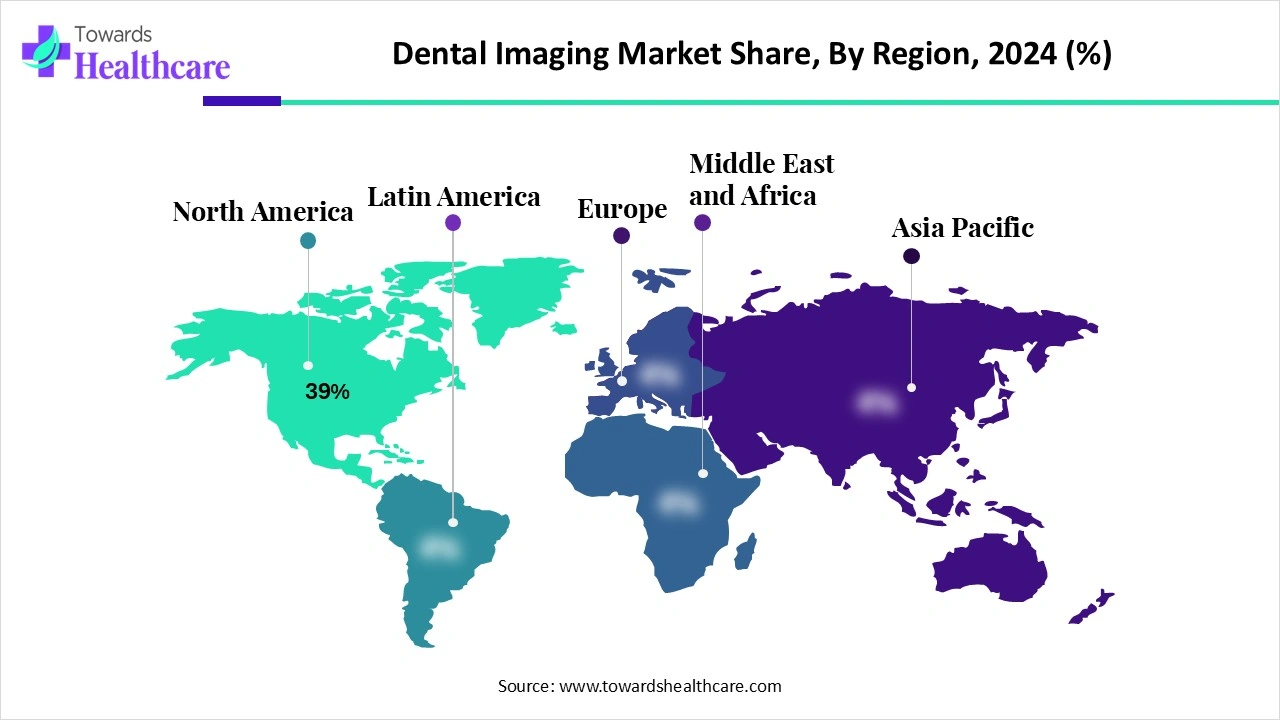
North America (leader — ~39% share in 2024)
Drivers: mature dental care market, high per-capita dental spending, strong private sector reimbursement in many cases, high adoption of cosmetic dentistry and implants.
Technology preferences: rapid adoption of CBCT, advanced digital sensors, and integrated chairside scanners — vendors focus on workflow integration and service contracts.
Buyer behavior: preference for complete solutions (hardware + software + service) and strong demand from DSOs for standardized imaging across networks.
Barriers: cost sensitivity in smaller practices remains; radiation safety awareness encourages dose optimization.
United States (detailed within North America)
Growth factors: large DSO presence, favorable reimbursement for diagnostic imaging in some contexts, high patient willingness to pay for cosmetic/implant treatments.
Innovation hub: many product launches and partnerships (examples given in content: Planmeca–Benevis, DEXIS new solutions, Align iTero launch).
Canada
Drivers: government-backed healthcare system for general medicine (but dentistry largely private/insured), increasing preventive/cosmetic dental attention, adoption of digital radiography and CBCT in urban centers.
Challenges: smaller market scale vs US, geographic dispersion increases installation/maintenance logistics costs.
Asia-Pacific (fastest CAGR forecast)
Drivers: rising middle-class disposable income, expanding dental infrastructure, increased awareness of oral health and cosmetic dentistry, and government investments in healthcare infrastructure.
Country highlights: China, Japan, India, South Korea and Thailand cited as key markets — each with different adoption curves (Japan/ROK: faster adoption and high-end tech; China/India: rapid volume growth and increasing mid-tier device adoption).
Opportunities: lower per-unit market penetration vs North America suggests long runway for device and software sales; local partnerships and price-sensitive product lines will be key.
Europe
Drivers: strong clinical standards, early adoption of digital dental tech in Western Europe, steady investment in CBCT for specialized centers.
Regulatory environment: EU medical device regulations and country-level reimbursement/regulatory idiosyncrasies guide adoption pace.
Latin America
Drivers: growing awareness and demand for cosmetic dentistry, urban clinics investing in digital workflows.
Barriers: price sensitivity and fragmented provider base; selective adoption of higher-end CBCT systems more likely in private specialist centers.
Middle East & Africa (MEA)
Drivers: pockets of high investment (e.g., UAE, Saudi Arabia) and growing private healthcare clusters.
Barriers: overall market smaller, heterogeneous regulations and variable access to financing for equipment.
Market dynamics
A. Key drivers (deep)
Rising prevalence of dental disorders & aging populations → higher diagnostic demand.
Digital transformation of dentistry → conversion to CMOS/PSP sensors, intraoral scanners and CBCT. (Digital = 88% share.)
Growth in implantology & cosmetic dentistry → drives CBCT and 3D planning software (implantology & oral surgery = 32% share).
DSO expansion and standardization → larger centralized purchases and software platform adoption.
AI & cloud software proliferation → software revenue growth and recurring license models (imaging acquisition & 3D planning software = 58% share).
B. Primary restraints (deep)
Radiation safety concerns → cautious use of repeated scans, especially in pediatric/young adult cohorts.
Capital cost & ROI concerns for high-end CBCT → slows adoption in small clinics despite clinical benefits.
Fragmented provider market → slows standardized procurement and complicates after-sales service networks.
Regulatory constraints → device approvals and data privacy rules can delay product launches in specific regions.
C. Opportunities (deep)
3D and CBCT market expansion → high-value devices with software add-ons; cross-sell opportunities.
AI integration for diagnostics & workflow → high CAGR for AI/automation software.
Subscription & cloud models → recurring revenue from imaging software, AI reads, and cloud PACS.
Emerging markets (APAC) → fastest growth potential with increasing private dental spend.
Detector & low-dose innovations → new hardware offerings that reduce radiation concerns.
D. Value-chain analysis (detailed steps & players)
R&D & product development — device sensors (CMOS, photon-counting), CBCT hardware, reconstruction algorithms, AI model training. (Key: Dentsply Sirona, Planmeca, detection tech examples.)
Manufacturing & component sourcing — detectors, X-ray tubes, mechanical assemblies; supply chain critical for uptime.
Packaging, sterilization & logistics — traceability for sensors/consumables and safe delivery to clinics.
Distribution & sales — direct sales to DSOs/large clinic chains and indirect to independent clinics via dealers.
Installation & training — clinical onboarding for CBCT and 3D planning systems.
Software licensing & cloud services — imaging acquisition, 3D planning, AI reads, PACS.
Patient support & services — maintenance contracts, remote diagnostics, upgrades. (Key players: Sirona, Carestream, Vatech cited.)
Top 10 companies
Dentsply Sirona
Products: comprehensive dental equipment portfolio including imaging hardware and software platforms.
Overview: one of the largest integrated dental manufacturers with solutions spanning imaging, restorative and CAD/CAM workflows.
Strengths: broad distribution network, integrated hardware+software ecosystem, large installed base enabling upsell of software and services.
Envista Holdings (DEXIS / KaVo Imaging / i-CAT)
Products: intraoral sensors/solutions (DEXIS), imaging systems (KaVo) and CBCT (i-CAT).
Overview: multi-brand strategy covering sensor to CBCT segments.
Strengths: brand portfolio that addresses both entry/intermediate and high-end markets; cross-brand channel coverage.
Planmeca
Products: CBCT units, 2D/3D imaging devices, and integrated software solutions.
Overview: established supplier of integrated imaging+planning systems.
Strengths: strong software integration, focus on R&D and practice workflow optimization (e.g., partnerships with US networks such as Benevis noted in supplied content).
Carestream Dental
Products: digital radiography, CBCT, 3D imaging and image management software.
Overview: long-standing imaging specialist serving clinics and hospitals.
Strengths: imaging-first reputation, service and maintenance footprint, and imaging workflow expertise.
Vatech
Products: CBCT, intraoral sensors and imaging software.
Overview: hardware and software vendor with growing AI partnerships.
Strengths: recent partnership with Pearl (March 2025) to integrate AI pathology detection, signaling strength in strategic collaborations and software enhancement.
ACTEON Group
Products: imaging equipment (panoramic, intraoral), surgical/implant devices.
Overview: specialist dental imaging and equipment supplier.
Strengths: product specialization and clinical focus that supports imaging use across multiple dental disciplines.
Align Technology
Products: intraoral scanners (iTero family), digital orthodontic/aligner workflow solutions.
Overview: known for strong position in orthodontic imaging and digital impression ecosystems.
Strengths: deep integration with aligner workflows, product innovation (e.g., iTero Lumina launch Jan 2024), and a captive downstream market (aligner users).
Medit
Products: intraoral scanners and associated software ecosystem.
Overview: scanner-centric vendor offering open workflow integrations.
Strengths: focus on scanner accuracy, developer-friendly ecosystem and competitive price/performance in intraoral scanning.
NewTom (Cefla Group)
Products: CBCT and advanced 3D imaging equipment.
Overview: CBCT specialist under a larger industrial group.
Strengths: niche CBCT expertise, targeted product lines for surgical/implant planning.
Pearl AI (representative AI vendor)
Products: AI pathology detection and diagnostic assistance tools for dental images.
Overview: AI software house focused on automating pathology detection and streamlining radiology reads in dentistry.
Strengths: algorithmic focus, partnerships with hardware vendors (e.g., VATECH partnership March 2025) and ability to integrate into imaging software/PACS.

Get a Sample of this Report
How Will Trends and AI Roles Shape the $6.42 Billion Dental Imaging Market
