The Catalysts of Digital Health Market Growth
Mobile Health Apps: A Game-Changing Trend
Central to the unprecedented growth of the digital health market is the escalating demand for mobile health apps. These applications serve as a bridge between patients and healthcare services, offering convenience, accessibility, and personalized health management. The surge in their popularity marks a paradigm shift in how individuals perceive and engage with their healthcare.
From Healthcare to Health Solutions: Ensuring Effectiveness, Efficiency, Equity and Sustainability for All
The digital health market refers to the use of digital technologies, such as mobile devices, wearable sensors, health information technology, and telehealth, to improve healthcare delivery and patient outcomes. The market encompasses a broad range of products and services, including mobile health apps, remote patient monitoring devices, electronic health records (EHRs), telemedicine, and health analytics.
The digital health market is experiencing significant growth due to several factors, including the increasing adoption of mobile devices and internet connectivity, the need to reduce healthcare costs and improve patient outcomes, and the growing demand for personalized and convenient healthcare services. The COVID-19 pandemic has also accelerated the adoption of digital health market technologies, as healthcare providers and patients seek ways to safely and remotely manage healthcare.
The market is expected to continue to grow as advancements in technology, such as artificial intelligence, machine learning, and big data analytics, enable the development of more sophisticated and effective digital health market solutions. However, there are challenges to overcome, such as data privacy concerns, interoperability issues, and regulatory oversight.
The Telehealth Takeover: Revolutionizing Healthcare Delivery
Telehealth is the delivery of healthcare services using digital technologies, such as video conferencing, remote monitoring, and mobile health applications. The rise of telehealth has been a game-changer for the healthcare industry, allowing patients to receive care from the comfort of their homes and improving access to care for those in remote or underserved areas.
The growth of telehealth is being propelled by several factors, including the rising demand for healthcare that is convenient, easily accessible, and affordable. Telehealth services allow patients to access care quickly and easily, reducing the need for expensive and time-consuming in-person appointments. This is especially important for those with chronic conditions or mobility issues that make it difficult to travel to a healthcare facility.
Telehealth also offers a more personalized and proactive approach to healthcare, with remote monitoring tools allowing healthcare providers to monitor patients' health status in real-time and intervene as needed. This can lead to earlier diagnosis and treatment of health conditions, improving patient outcomes and reducing the overall cost of care. Telehealth research is still in its early stages, but it is gaining traction. Studies have demonstrated that both telephone-based support and telemonitoring of vital signs in persons with heart failure lower the risk of death and hospitalization for heart failure while also improving quality of life.
In addition, telehealthcare is also being embraced by healthcare providers as a means of improving patient outcomes and reducing healthcare costs. Remote monitoring and teleconsultations can help to prevent hospital readmissions, decrease the length of hospital stays, and improve patient satisfaction. Furthermore, another driving force behind the trend toward telehealth care is the rapid advancements in technology. Mobile devices, wearable technology, and telemedicine software have all made it possible for patients to receive care virtually from anywhere in the world.
Moreover, telehealthcare technology is expected to continue to grow rapidly, driven by factors such as the increasing demand for convenient and cost-effective healthcare, advancements in digital technologies, and the shift towards more personalized and proactive healthcare models.
The healthcare industry is increasingly embracing digital transformation, and the synergy between service and software is a key driver of this shift. Healthcare organizations are recognizing the potential of digital technologies to streamline operations, enhance patient care, and improve outcomes. Digital services such as telehealth, remote patient monitoring, and virtual consultations have gained significant momentum in recent years, particularly with the onset of the COVID-19 pandemic. These services leverage digital technologies such as video conferencing, wearable devices, and mobile apps to provide patients with convenient and accessible care. They also enable healthcare providers to reach patients in remote or underserved areas, which is particularly important in rural communities.
As of 2022, services were the highest contributor to this market, with a 64.00% revenue share, and is anticipated to exhibit a 61.15% market share by 2032, registering a CAGR of 11.5% from 2023 to 2032. While the software segment is projected to witness the fastest growth with a CAGR of 12.5% (2023-2032).
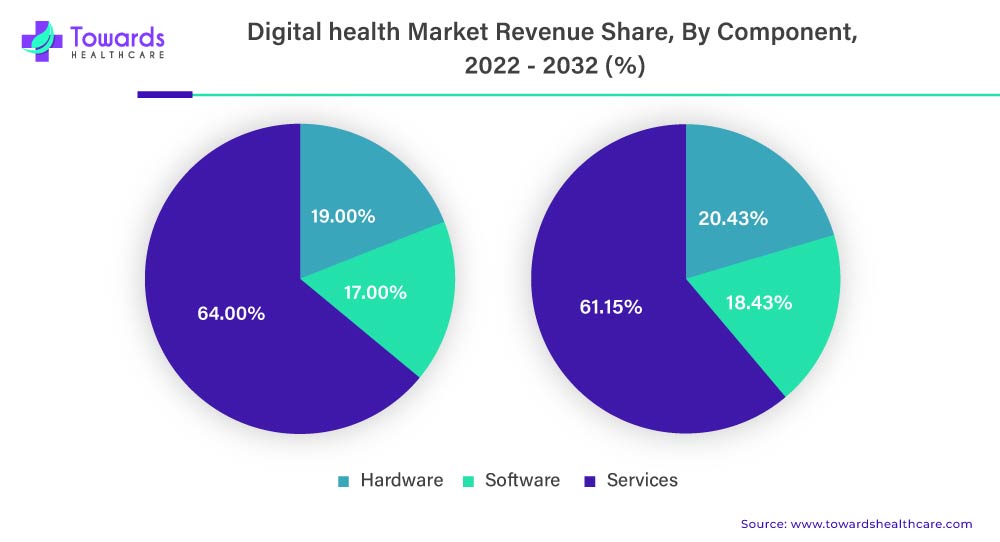
The service segment of the digital health market refers to the various services that are required for the implementation, integration, maintenance, and upgrading of digital health technologies such as electronic health records (EHR), digital imaging, e-prescription services, and enterprise resource planning (ERP) systems.
The growing demand for digital solutions such as electronic health records (EHR) and electronic medical records (EMR), e-prescription systems, and digital imaging technologies is a key factor driving the growth of the service segment. This is due to the need for healthcare organizations to manage and access patient data more efficiently, as well as to provide better patient care. The roll-out of new software and hardware, as well as upgrades of existing modules, is also expected to provide an impetus to digital health market services during the forecast period.
Another factor contributing to the growth of the service segment is the increasing number of investments in digital infrastructure, particularly in developing countries. This is leading to the adoption of digital health market services as a means of establishing successful digital platforms.
However, there are also some challenges to the growth of this segment. One of the main concerns is the cost associated with implementing and maintaining digital health market technologies. Healthcare organizations may be hesitant to invest in these technologies due to budget constraints or concerns about the return on investment. In addition, there may be resistance from healthcare professionals who are not familiar with the technology or who prefer traditional methods of record-keeping and patient care.
Thus, the service segment of the digital health market is expected to grow as the demand for digital health market technologies continues to increase. However, the success of this segment will depend on factors such as the cost of implementation and maintenance, the level of adoption by healthcare professionals and organizations, and the overall effectiveness of the technologies in improving patient care.
Bridging the Distance: Telehealth's Dominance in Europe and Emerging Growth in Asia Pacific
Europe is one of the most significant markets for digital health, with a growing number of startups and established players investing in digital solutions to transform healthcare delivery. The region's aging population, the increasing burden of chronic diseases, and the need for more efficient and cost-effective healthcare services are driving the demand for digital health market solutions.
Europe was the highest contributor to this market, with 35.51% revenue share in 2022, and is anticipated to account for 31.31% revenue share by 2032, registering a CAGR of 10.2% from 2023 to 2032. While Asia Pacific is projected to register the fastest growth with a CAFR of 14.1% (2023-2032).
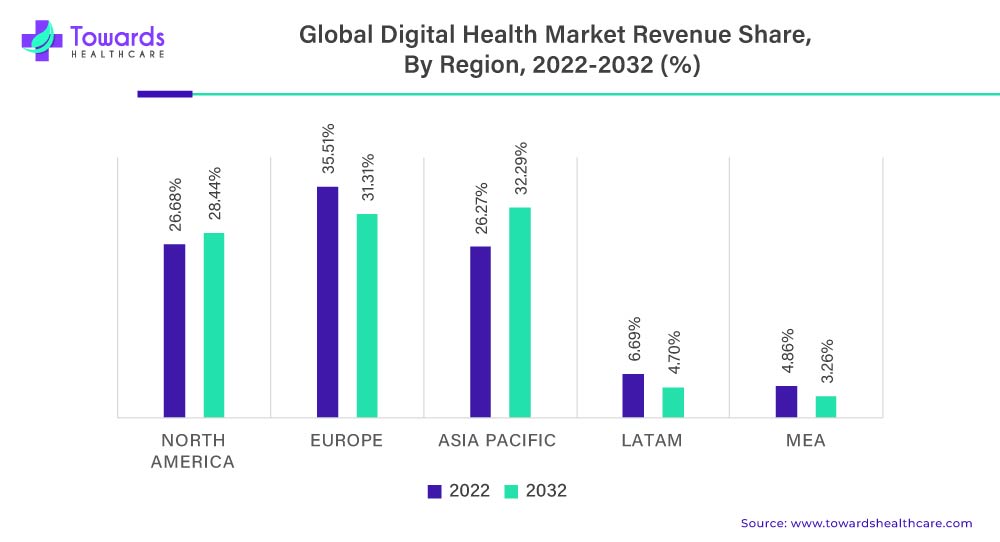
Some of the key digital health market solutions in Europe include electronic health records (EHRs), telemedicine, mobile health (mHealth), and health information exchanges (HIEs). The European Union (EU) has also launched initiatives to promote the development and adoption of digital health market technologies, such as the Digital Single Market strategy and the European Innovation Partnership on Active and Healthy Ageing.
| By Europe Region |
Revenue Share (%) 2022 |
Forecasted Revenue Share (%) 2032 |
| UK |
26.75% |
25.93% |
| Germany |
27.89% |
24.97% |
| France |
19.04% |
20.32% |
| Rest of Euorpe |
26.32% |
28.78% |
The COVID-19 pandemic has accelerated the adoption of digital health solutions in Europe, with telemedicine and remote monitoring playing a critical role in delivering care while reducing the risk of infection. The European Commission has also launched a COVID-19 Data Portal to facilitate data sharing and collaboration among researchers, healthcare professionals, and policymakers.
However, Europe's digital health market also faces challenges, including the lack of interoperability and standardization of digital health market solutions across different countries and regions. Data privacy and security concerns also need to be addressed to ensure patient trust and confidence in digital health market technologies. The regulatory environment for digital health solutions also varies across different countries, which can hinder innovation and investment in the sector.
Despite these challenges, the digital health market in Europe is poised for significant growth, driven by the increasing demand for more efficient and patient-centered healthcare services. The region's strong focus on research and development and the availability of funding and support for digital health market startups also make it an attractive market for investors and entrepreneurs.
| By Asia Pacific Region |
Revenue Share (%) 2022 |
Forecasted Revenue Share (%) 2032 |
| China |
32.06% |
31.32% |
| Japan |
12.41% |
11.31% |
| India |
10.34% |
12.84% |
| South Korea |
8.57% |
8.05% |
| Southeast Asia |
11.34% |
12.04% |
| Rest of Asia Pacific |
25.28% |
24.44% |
The Asia Pacific region is seeing the fastest growth in telehealth services, driven by a number of factors including increasing demand for healthcare services, expanding internet and smartphone usage, and rising healthcare costs. Countries like China, Japan, and South Korea are at the forefront of this trend, with large investments being made in digital health market infrastructure and initiatives to promote telehealth adoption.
In recent years, the Asia Pacific region has emerged as a significant player in the digital health market, with telehealth services being a major growth driver. The region's rapidly aging population, increasing prevalence of chronic diseases, and rising healthcare costs have created a demand for innovative healthcare solutions, leading to the adoption of digital health technologies.
Countries like China, Japan, and South Korea are investing heavily in digital health market infrastructure, including the development of telehealth platforms, to improve access to healthcare services and reduce the burden on their healthcare systems. In China, for example, the government has launched several initiatives to promote telemedicine, including a policy that allows doctors to practice across multiple provinces and a telemedicine network that connects medical institutions across the country.
In Japan, the government has been promoting the use of telehealth to improve access to healthcare services in rural areas, where there is a shortage of doctors. The country has also been investing in digital health market startups and providing funding for research and development in the field of telehealth.
Hence, the Asia Pacific region presents significant growth opportunities for the digital health market, particularly in the area of telehealth, driven by favorable demographics, increasing internet and smartphone usage, and government initiatives to promote healthcare innovation.
Mobile apps are transforming (READ MORE)
Smart healthcare by providing patients with convenient access to information, resources, and tools that can help them manage their health and well-being. These apps can be used for a wide range of purposes, including tracking fitness goals, monitoring chronic conditions, accessing medical records, and scheduling appointments.
Mobile health apps have seen significant growth in recent years, particularly in the area of chronic disease management. These apps offer patients the ability to track and manage their symptoms, monitor their medications, and communicate with their healthcare providers more easily. This can lead to improved health outcomes, better medication adherence, and reduced healthcare costs. In addition, the availability of wearable technology such as fitness trackers and smartwatches has further enhanced the potential for mobile health apps to support chronic disease management.
As the prevalence of chronic diseases such as diabetes and hypertension continue to rise, the demand for these apps is expected to grow. For example, diabetes management apps can track blood glucose levels, provide reminders to take medication, and even suggest healthy meal options.
Furthermore, another area of growth for mobile health apps is in mental health. Apps for stress management, meditation, and mindfulness have become increasingly popular, providing users with tools to manage their mental health and well-being. Mobile apps are also being used for telehealth services, allowing patients to have virtual consultations with healthcare providers from the comfort of their own homes. This can be especially beneficial for individuals who live in remote or rural areas and have limited access to healthcare services.
Moreover, mobile health apps are providing patients with more control over their health and well-being, while also improving the efficiency and accessibility of healthcare services. As technology continues to evolve, we can expect to see even more innovative mobile health solutions in the future.
Integration of Advanced Technologies
AI: Revolutionizing Healthcare
Artificial Intelligence (AI) stands at the forefront of transforming healthcare dynamics. From predictive analytics to personalized treatment plans, AI empowers healthcare providers with tools to enhance diagnostics and optimize patient outcomes. The seamless integration of AI into digital health solutions amplifies their effectiveness and sets the stage for a new era in healthcare innovation.
IoT and Big Data: A Symbiotic Relationship
The synergy between the Internet of Things (IoT) and big data plays a pivotal role in propelling the digital health market forward. Connected devices generate a wealth of real-time data, offering valuable insights into patient health and treatment efficacy. The utilization of big data analytics not only streamlines decision-making processes but also contributes to the precision and personalization of healthcare interventions.
Driving Forces Behind the Surge
Increasing Consumer Awareness
As individuals become more health-conscious, there is a burgeoning awareness of the benefits offered by digital health solutions. Mobile health apps, in particular, empower users to take an active role in managing their well-being, fostering a proactive approach to healthcare.
Pandemic-Driven Digital Transformation
The global shift towards digitalization in the wake of the COVID-19 pandemic has accelerated the adoption of digital health solutions. Telehealth services, remote monitoring, and virtual consultations have become integral components of modern healthcare delivery, contributing to the overall growth of the digital health market.