

Digital Microfluidics Systems on a Chip Market Growth, Size and Latest Insights 2025

Market size in Digital Microfluidics Systems on a Chip Market
Market headline
Market is described as “poised to generate substantial revenue growth, potentially climbing into the hundreds of millions over 2025–2034.” This is the core revenue frame to use for planning, investor decks, and sizing assumptions.
Structural composition that drives size (why revenue scales)
Consumables (chips) form the recurring-revenue backbone (chip segment ≈ 55% of 2024 market mix). High per-test consumable use multiplies instrument sales.
Instrumentation / devices are lower volume but higher ASP (average selling price) and enable recurring consumable purchases and service contracts.
Software & services are the fastest-growing product category — they increase lifetime value per instrument and represent a high-margin growth lever.
Channel & end-user concentration that supports scale
Hospitals & diagnostic laboratories (50% share in 2024) are major purchasers — single large procurements can jumpstart regional revenue. CROs are fastest growing, offering bulk purchasing and trials that scale consumable usage.
Material / manufacturing mix that determines unit economics
Polymer-based devices dominated (50% in 2024) because of low cost and disposability — this keeps per-test cost down and supports scale. Paper-based devices are the fastest-growing low-cost route for mass market/POCT.
Mode of operation and consumable frequency
Closed systems were dominant (60% in 2024), supporting multiplexed assays and higher test complexity (and hence higher per-use revenue). Open systems are the fastest-growing mode for research, where iterative experiments drive volumes.
Technology share that affects pricing & addressable market
Electrowetting-on-dielectric (EWOD) had 45% of the technology mix in 2024 — dominant because of precise droplet control and minimal pumps/valves, enabling higher value applications.
Regional market contributions to size
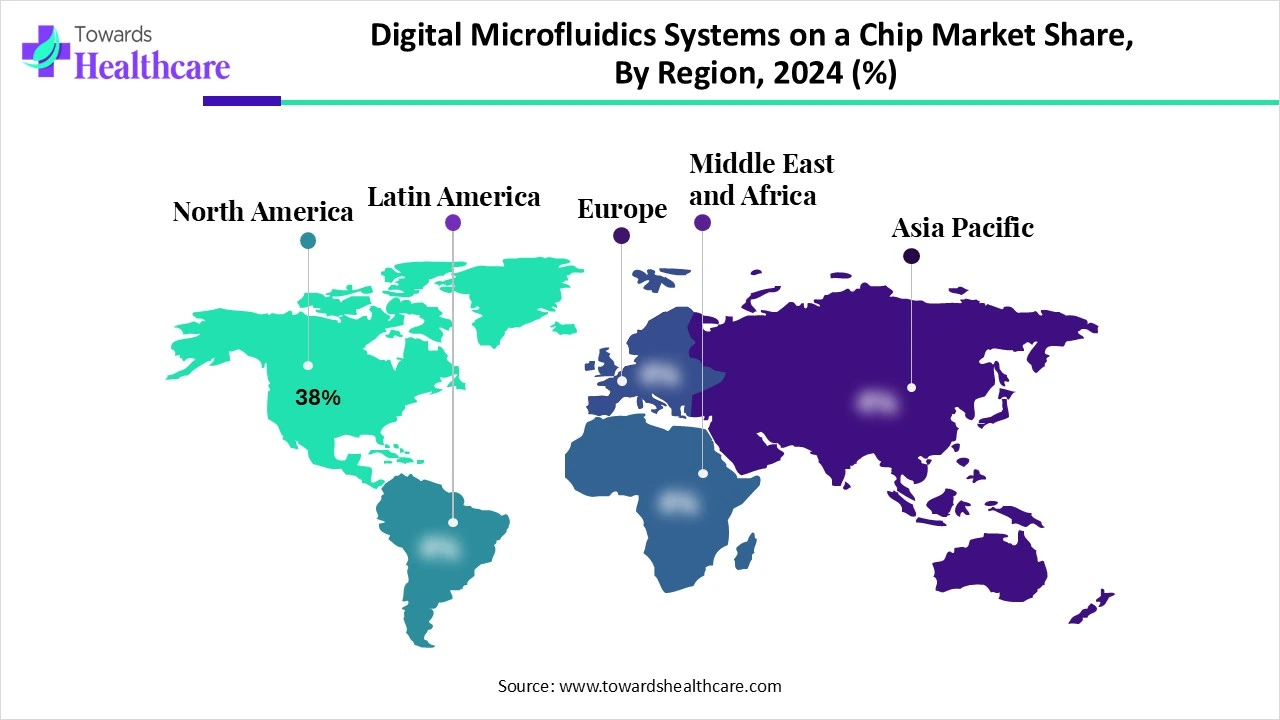
North America (38% in 2024) is the largest single regional market today due to R&D and funding intensity; Asia Pacific is the fastest-growing, adding volume and price-sensitive demand that drives adoption at scale.
Revenue model mix (implication for size)
Combination of one-time instrument sale + high recurring chip consumables + growing software & services means overall market value grows faster than instrument sales alone — important when projecting multi-year revenues.
Catalytic investments/announcements (size accelerants)
Recent multi-million investments, new commercial products (e.g., Parallel Fluidics’ MV-2), and national lab funding (Israel bio-convergence lab) materially increase capacity and commercial throughput, boosting near-term revenue potential.
Uncertainties that influence realized market size
Fabrication complexity, regulatory timelines, and material supply chain constraints can compress or delay revenue — these risks materially affect when “hundreds of millions” are realized.
Market Trends in Digital Microfluidics Systems on a Chip Market
Commercialization acceleration
Startups and device manufacturers (example: Parallel Fluidics — $7M seed, MV-2 product commercialization) are moving faster into market, shortening time from prototype to revenue.
Large strategic investments & national labs
Feb 2025 113 million shekels ($35.5M) invested into Israel’s first biochips & bio-devices lab to scale development and production — pushes regional manufacturing and lowers unit cost.
AI integration into microfluidics workflows
AI is being used for droplet control, automation, error detection and decision support (described in your brief), producing “smart” microfluidic devices and reducing operator dependency.
Paper-based diagnostics emergence
Paper-based devices (RCP-Chip at NYU Abu Dhabi, June 2025) enable ultra-low cost, rapid (~10-minute) POCT — an important trend for mass screening and low-resource markets.
Platform & scale partnerships
Collaborations (e.g., CellFE + Made Scientific) show a trend from single products to integrated system validations for clinical-scale performance, enabling step-change adoption.
Patent and IP activity focused on enabling biological applications
June 2025 AIBN patent for “smart microgel droplets” targeted at regenerative medicine/tissue engineering — trends toward therapeutic and upstream R&D markets.
Shift toward integrated software & services
Software & services flagged as fastest-growing product type — trend is bundling assays, analytics, and cloud connectivity with hardware to lock in recurring revenue.
Materials innovation for cost & sustainability
Movement toward polymer and paper materials to reduce cost and improve disposability/biocompatibility.
Regulatory & reimbursement maturation
As clinical diagnostics usage grows (~40% application share), expect regulatory pathways and reimbursement models to evolve — increasing clinical adoption.
Geographic rebalancing — APAC rising fast
Asia Pacific is the fastest-growing region driven by demand, government support, and domestic manufacturing — shifting global demand patterns.
AI impacts / roles in the Digital Microfluidics Systems on a Chip Market
Real-time droplet control & adaptive actuation
AI models (control/ML) learn electrowetting dynamics and adjust voltage waveforms in real time to correct for evaporation, surface defects, or fluid variability — improves yield and assay repeatability.
Predictive fault detection & maintenance
Anomaly detection algorithms monitor actuation traces, sensor telemetry and image streams to predict electrode failures or coating degradation, scheduling preventative maintenance and reducing downtime.
Assay optimization & reagent minimization
ML optimizes reagent volumes, mixing sequences and incubation times to minimize reagent use while preserving sensitivity—reduces per-test cost and accelerates assay development.
Computer vision for droplet & assay readout
Image-based AI interprets droplet shape, colorimetric changes, fluorescence signals and microgel formation for automated result calling and QC (reducing human interpretation variability).
Automated design of electrode patterns & chip layouts
Generative algorithms create electrode geometries and routing for specific assays (mixing, splitting, incubation) optimized for throughput and power consumption, shortening design cycles.
End-to-end process orchestration (software as a lab manager)
AI coordinates instrument scheduling, sample routing, multiplexing decisions and data flows — enabling sample-to-answer automation at scale (critical for CROs and clinical labs).
Virtual assay testing & in-silico validation
Simulation combined with ML predicts assay outcomes for given electrode sequences, reducing physical trial costs and accelerating regulatory documentation.
Quality assurance, compliance & provenance
AI logs and verifies assay metadata, flags outliers and generates audit trails to support regulatory submissions and traceability for clinical diagnostics.
Supply and inventory optimization
Forecasting models predict consumable demand per site, optimizing manufacturing runs and distribution to reduce stockouts — crucial when chips are single-use.
Decision support & diagnostic triage
Built-in AI interprets multiplexed assay results and outputs clinical triage suggestions (decision support) to clinicians, increasing the value proposition of on-chip diagnostics.
Implication: AI is not just “nice to have” — it moves microfluidic systems from gadgets to scalable clinical/industrial platforms by increasing robustness, lowering operational cost, and enabling regulatory compliance.
Regional insights
North America (overall) — driver of technology and early adoption
R&D density & funding
Strong university & industry R&D, NIH and private funding create fast prototyping cycles and early clinical validations.
Clinical adoption & reimbursement pathways
Large hospital systems and diagnostic labs (50% end-user share) accelerate clinical validation and create reference use cases.
Commercialization ecosystem
M&A activity and large distributors help scale device rollouts; established companies (e.g., Thermo Fisher, Illumina) can bundle solutions.
Challenges
High regulatory bar and reimbursement uncertainty can slow market entry for novel assays.
United States (specific)
National funding & translational labs
NIH and private grants backing translational studies; strong CRO presence for clinical validation.
Market concentration
Early adopters = academic medical centers and national reference labs.
Canada
Government support & research collaborations
Government funding and collaborative centres bolster small-scale adoption and local manufacturing pilots.
Opportunity
Canadian labs can act as testbeds for CE/US regulatory readiness.
Asia Pacific — fastest growing (region)
Volume demand & cost sensitivity
High unmet testing needs in high-population countries drive paper-based and low-cost polymer adoption.
Local manufacturing push
Domestic manufacturers in China and India lower cost and accelerate unit production.
Government initiatives
National programs to accelerate diagnostics and biotech manufacturing amplify uptake.
Challenges
Fragmented regulatory frameworks and variable reimbursement across APAC countries.
China
Scale & industrial capability
Large domestic market and manufacturing ecosystem for scaling low-cost devices and consumables.
Focus areas
Clinical testing platforms and drug discovery tooling.
India
Affordable innovation
Emphasis on low-cost, point-of-care, and environmental testing solutions; government funding often supports scaling.
Europe — innovation & sustainability focus
R&D clusters & startups (Germany, UK)
Strong microfluidics start-up activity; focus on eco-friendly materials and precision medicine diagnostics.
Regulatory sophistication
CE/IVDR frameworks require solid clinical evidence; encourages quality platforms.
Germany
Start-up collaborations & materials innovation
Push toward biodegradable/eco-friendly microfluidic materials; strong manufacturing partnerships.
United Kingdom
Precision medicine & clinical applications
Focused on integrating microfluidics into precision therapeutics and genomic workflows.
Latin America & MEA
Emerging adoption
Potential for rapid uptake of affordable paper-based and polymer assays for infectious disease surveillance.
Barriers
Funding and procurement constraints; need for simplified regulatory routes and field validations.
Market dynamics
Driver — Increasing demand for point-of-care diagnostics
What: Rising disease burden and demand for rapid testing.
Why it matters: Microfluidics enables fast, portable, low-sample assays ideal for POCT.
Implication: Hospitals and POCT providers increase purchase of devices and consumables, expanding market revenue and recurring sales.
Restraint — Complex fabrication process
What: Small changes in fabrication can cause device failure; materials must be biocompatible and robust.
Consequence: Higher production QA cost, slower scale-up, and possible supply chain fragility.
Mitigation: Investments in standardized fabrication labs (e.g., Israel biochip lab) and design for manufacturability become priorities.
Opportunity — Growing advancements & ecosystem improvements
Sensors & smartphone integration: Enables remote monitoring and continuous health tracking.
Paper-based & polymer innovation: Lowers per-test cost and opens consumer/home testing.
AI & software services: Boosts assay reliability and offers high-margin revenue streams.
Implication: Companies that combine robust hardware, validated assays, and strong software will capture disproportionate market share.
Competitive dynamics
Large incumbents vs startups: Incumbents offer scale, distribution and regulatory experience; startups offer disruptive pricing, speed and novel materials. Collaboration and M&A are likely.
Regulatory & reimbursement pathways
Effect: Clinical diagnostics dominance (≈40% application share) means regulatory clarity is critical. Early clinical validations and reimbursement case studies accelerate uptake.
Top 10 companies
Illumina, Inc. (Advanced Liquid Logic assets now part of Illumina)
Product/Focus: Microfluidics platforms integrated with genomic workflows (Advanced Liquid Logic capabilities).
Overview: Acquisition/integration strategy builds platform synergy between sequencing and on-chip sample prep.
Strengths: Large genomics installed base, strong distribution, capacity to bundle assays with sequencing services.
Thermo Fisher Scientific Inc.
Product/Focus: Broad lab instrumentation and life-science platforms that can integrate microfluidic modules.
Overview: Established global reach across clinical, pharma, and research markets.
Strengths: Global sales/service network, strong regulatory and customer support capabilities.
Agilent Technologies, Inc.
Product/Focus: Analytical instrumentation and microfluidic-compatible instrumentation.
Overview: Focus on precision lab instrumentation with emphasis on analytics and assay robustness.
Strengths: Analytical credibility, enterprise lab relationships, strong engineering.
Danaher Corporation (Beckman Coulter)
Product/Focus: Clinical diagnostics instruments and supporting consumables.
Overview: Platform-centric approach in clinical labs, where microfluidic modules can augment automated workflows.
Strengths: Scale in clinical sales, strong service contracts, distribution penetration.
Fluidigm Corporation
Product/Focus: Microfluidics-enabled genomics and biological assay systems.
Overview: Niche leader in microfluidic automation for genomics and single-cell workflows.
Strengths: Deep assay integration and customer adoption in research markets.
Bio-Rad Laboratories, Inc.
Product/Focus: Life-science reagents and instruments used alongside microfluidic assays.
Overview: Complementary reagent and detection products that synergize with microfluidic platforms.
Strengths: Reagent portfolio and lab relationships; cross-sell potential.
Tecan Group Ltd.
Product/Focus: Liquid-handling automation and instrument integration for labs.
Overview: Automates workflows — valuable for integrating microfluidic chips into high-throughput labs.
Strengths: Automation expertise, customization for CROs and large labs.
Merck KGaA (MilliporeSigma)
Product/Focus: Materials, reagents and consumables supporting microfluidic assays.
Overview: Supplies biocompatible materials and chemistries used in device manufacture and assays.
Strengths: Materials science capability; global supply chains for reagents and consumables.
PerkinElmer, Inc.
Product/Focus: Analytical and diagnostic instruments; consumable ecosystems.
Overview: Clinical/genomics/product lines that pair well with microfluidic sample processing.
Strengths: Instrumentation portfolio, service contracts, regulatory experience.
Micronit Microtechnologies B.V.
Product/Focus: Microfluidic chip manufacturing and custom microfluidic components.
Overview: Specialist manufacturer enabling design-to-fabrication for customers and OEMs.
Strengths: Manufacturing expertise, prototyping-to-production capabilities for polymers and glass.

Get a Sample of this Report
Digital Microfluidics Systems on a Chip Market
