

Digital Pathology Market Growth, Companies and Latest Insights 2025

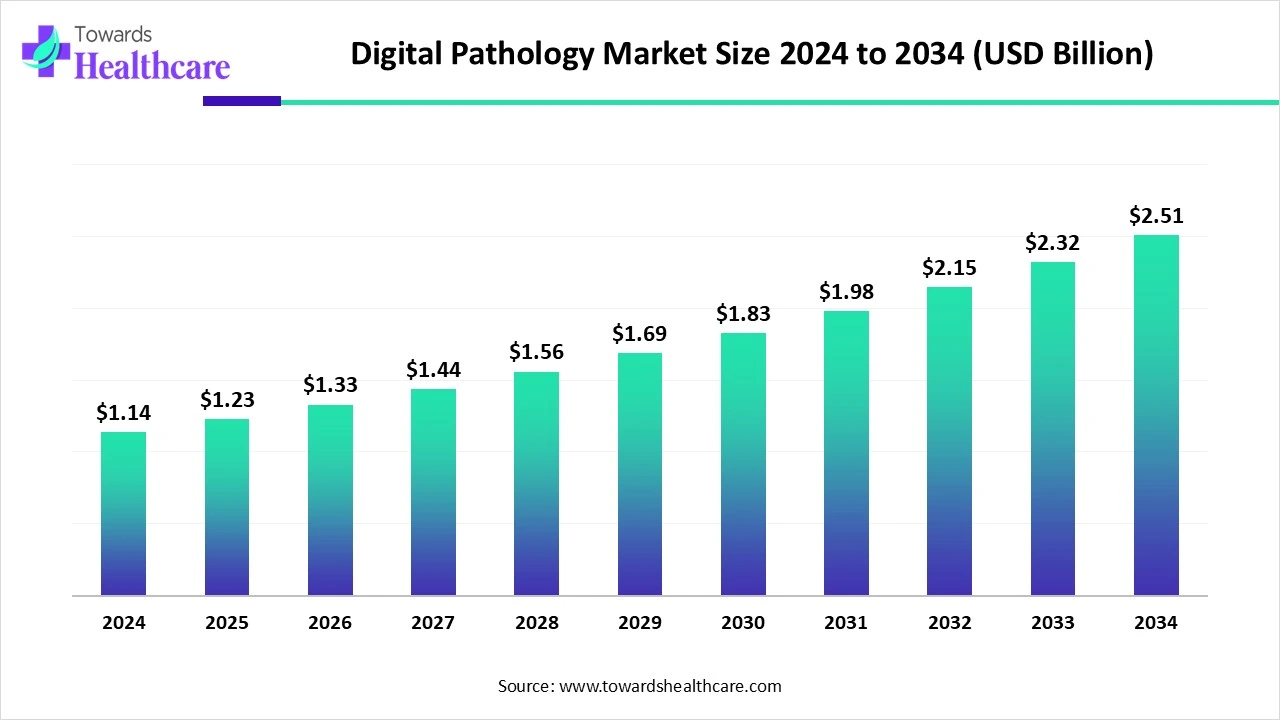
Market Size
◈2024 → USD 1.14 billion
◈2025 → USD 1.23 billion
◈2034 → USD 2.51 billion
◈CAGR (2025–2034) → 8.24%
Leading Region (2024) → North America, 41% share
◈Strongest Growth Region (Forecast) → Asia Pacific
Key Dominating Segments (2024):
◈By Product → Devices (scanners, slide systems)
◈By Type → Human pathology
◈By Application → Academic research
◈By End Use → Hospitals
Market Trends in Digital Pathology
1. AI & ML Adoption
◈Precision Gains: AI models are improving diagnostic accuracy in tumor grading, metastasis detection, and rare disease identification, with error reduction rates of 15–25% compared to manual review (varies by cancer type).
◈Workflow Automation: AI-enabled scanners and slide management systems cut manual review times by up to 40%, boosting throughput in high-volume diagnostic labs.
◈Telepathology Enablement: AI triage systems pre-screen slides, flagging abnormal cases for pathologists in remote or resource-limited regions, helping bridge the global shortage of specialists.
2. Collaborations & Alliances
◈NVIDIA (Jan 2025): Partnering with healthcare leaders to embed agentic & generative AI in pathology imaging workflows → expected to enhance diagnostic precision and decision support in multi-center hospitals.
◈Leica Biosystems + Indica Labs (Jan 2025): Alliance to develop AI-powered companion diagnostics, particularly in oncology drug trials, integrating imaging biomarkers into FDA-approved workflows.
◈Other Notables: Paige AI, PathAI, and Ibex Medical Analytics forming partnerships with pharma companies for clinical trial support and biomarker validation.
3. Growing Demand for Digital Workflow
◈Whole-Slide Imaging (WSI): Adoption in academic institutions is projected to grow at a CAGR of 18% (2025–2030), driven by training needs and algorithm development.
◈Cost Savings: Digital workflows reduce physical slide storage and shipping costs by up to 30–40% annually for research organizations.
◈Education Impact: Leading universities are replacing glass-slide archives with digital libraries, enabling global collaboration.
4. Rising Cancer Burden
◈Global Context: WHO projects 28.4M new cancer cases by 2040, up 47% from 2020.
◈Pathology Role: Digital pathology + AI critical for early-stage detection, particularly in breast, prostate, lung, and colorectal cancers, which together account for 45% of all cancer diagnoses.
◈Adoption Driver: Oncologists and pathologists increasingly rely on AI tools to quantify tumor biomarkers (e.g., PD-L1, HER2) for personalized therapy decisions.
5. Capital Investment Surge
◈Mindpeak Funding (2024): Secured $15.3M for expanding its AI-powered pathology tools into U.S. and European markets.
◈Overall Investment: Venture capital funding into digital pathology startups exceeded $650M globally in 2023–24, reflecting strong investor confidence.
◈M&A Trend: Larger players acquiring niche AI startups to consolidate their tech portfolios (e.g., Philips and Paige AI collaborations).
6. Telepathology Expansion
◈Canada: Digital pathology used in rural provinces where access to subspecialist pathologists is limited; adoption supported by government telehealth programs.
◈Asia Pacific: Telepathology networks in India, China, and Japan enabling urban hospitals to consult with specialists in real time.
◈Growth Rate: Telepathology projected to grow at 15% CAGR (2025–2034), boosted by cloud infrastructure and 5G networks.
Role of AI in Digital Pathology
1. Accuracy & Efficiency
◈Improved Precision: AI models (e.g., convolutional neural networks) can distinguish between benign and malignant cells with 90–96% accuracy in validated studies.
◈Error Reduction: Automating tumor grading reduces intra-observer variability — a common issue in traditional pathology.
◈Real-world Use: Ibex’s AI solutions for prostate and breast cancer detection already show error reduction of up to 25% in clinical labs.
2. Telepathology
◈Remote Consultations: AI triage flags high-risk slides for rapid expert review, vital in regions with low pathologist density (e.g., Africa, rural India, Canada).
◈Home-based Review: Pathologists can access digital slides securely from any location; AI pre-annotates areas of concern to save time.
◈Impact: Reduces turnaround times for cross-border or subspecialty consultations from days to hours.
3. Automation of Routine Tasks
◈AI-driven Slide Handling: Automates scanning, image stitching, and quality control checks, reducing manual errors in slide preparation.
◈Image Classification: AI systems pre-classify tissues (e.g., inflamed vs. normal) so pathologists focus on complex diagnostic cases.
◈Efficiency Gains: Labs using automated slide sorters report up to 35% faster case throughput.
4. Companion Diagnostics (CDx)
◈AI in Oncology: Algorithms quantify biomarkers (e.g., HER2, PD-L1, Ki-67), providing reproducible results critical for targeted therapies.
◈Integration with Pharma: Companies like Roche and Novartis are embedding AI pathology tools in clinical trials for FDA-approved companion diagnostics.
◈Precision Medicine Push: Supports personalized drug selection and response monitoring, especially in immunotherapy.
5. Predictive Analytics
◈Pattern Recognition: Machine learning detects subtle histological changes before they are visible to human eyes.
◈Risk Stratification: Predicts recurrence or metastasis risk, guiding treatment intensity.
◈Example: AI models predicting colorectal cancer recurrence achieved 80% predictive accuracy in pilot studies.
6. Drug Discovery & Development
◈Biomarker Validation: AI accelerates analysis of tissue samples in preclinical and clinical studies, cutting variability by 20%.
◈Trial Efficiency: Reduces patient recruitment and study timelines by simulating outcomes using digital biomarkers.
◈Adoption: CROs now offer AI-enabled pathology services, making this a standard in pharma R&D pipelines.
7. Workflow Optimization
◈Turnaround Time: AI shortens pathology reporting cycles from 3–5 days to less than 48 hours in some hospitals.
◈Case Prioritization: Urgent oncology cases are auto-flagged for immediate review.
◈Hospital Efficiency: Leads to better bed management and faster clinical decisions.
8. Cost Reduction
◈Slide Digitization: Saves on glass slide storage/shipping, which can cost large hospitals $250k+ annually.
◈Operational Savings: Automation lowers reliance on repeat tests and manual labor.
◈Broader Impact: Over time, AI lowers per-diagnosis costs, making advanced pathology more accessible in low-resource settings.
9. Integration with Imaging Systems
◈Seamless Ecosystem: AI linked with whole-slide scanners, LIS (Laboratory Information Systems), and cloud storage for better accessibility.
◈Data Retrieval: AI-powered indexing makes archives searchable by cell type, biomarker, or morphology, saving researchers weeks of work.
◈Trend: Vendors moving toward plug-and-play interoperability (e.g., Philips IntelliSite, Leica’s Aperio).
10. Generative AI Potential
◈Beyond Analysis: Generative AI can simulate disease progression on digital slides, predicting how tissues evolve over time.
◈Synthetic Data Creation: Useful for training AI models when real pathology datasets are scarce.
◈Partnerships: NVIDIA’s agentic & generative AI platforms aim to help simulate virtual clinical trials, reshaping drug development and diagnostics.
Regional Insights
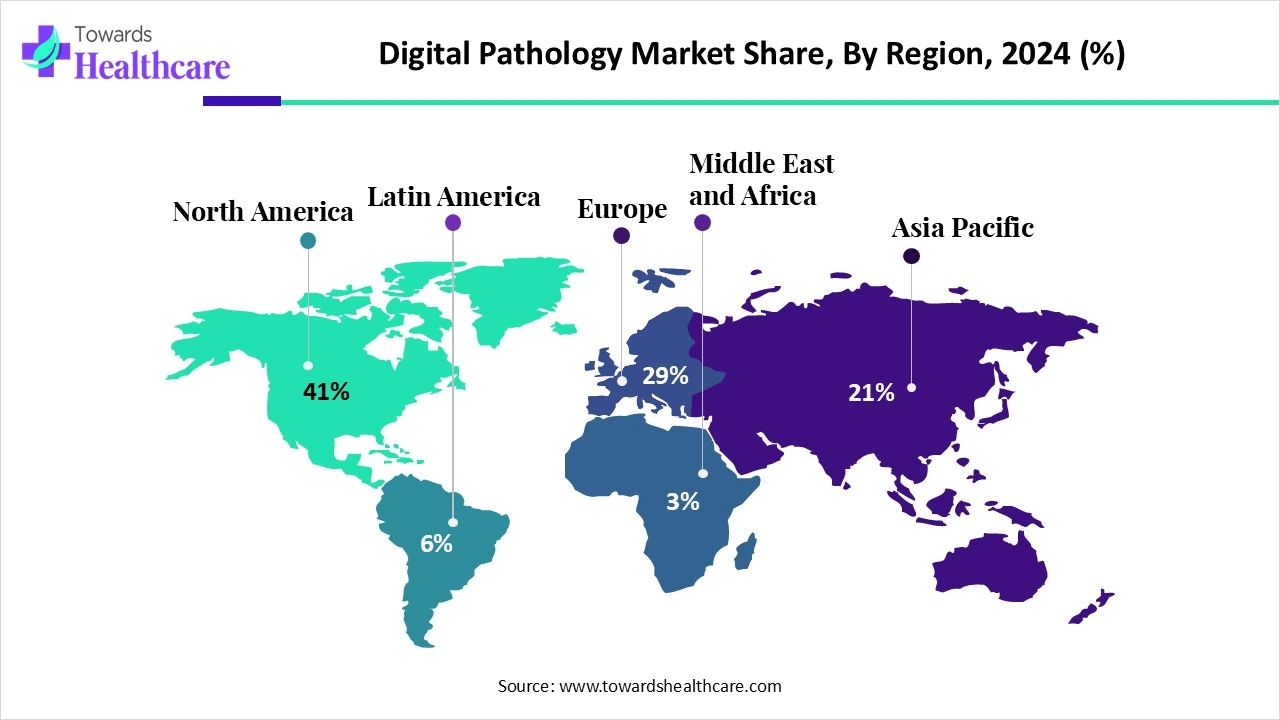
1 North America (41% Market Share, 2024)
High Disease Burden
◈Elevated prevalence of cancer and chronic illnesses, driving need for faster, accurate diagnostics.
◈U.S. cancer incidence: ~2 million new cases annually → heavy pathology workload.
Healthcare Infrastructure & Investments
◈Strong presence of advanced labs, academic medical centers, and R&D programs.
◈Government initiatives promoting digital transformation of healthcare.
U.S. Specific Trends
◈<10% of hospitals currently using digital pathology clinically → significant growth headroom.
◈AI-based cancer detection platforms gaining FDA approvals (Paige, PathAI).
◈High VC and private equity funding for digital health start-ups.
Canada Specific Trends
◈Telepathology crucial due to wide geographic spread and rural healthcare gaps.
◈Provincial programs (Ontario, British Columbia) promoting AI-based teleconsultations.
2 Asia Pacific (Fastest CAGR Globally)
Rising Adoption of Digital Technology
◈Increasing awareness of AI, telepathology, and workflow digitization.
◈Growing burden of cancer (China and India combined: >5M new cancer cases/year).
China
◈Strong government support for AI in healthcare (Healthy China 2030).
◈Large patient base fueling demand for AI-powered diagnostics.
◈Investments in domestic slide-scanner manufacturing and AI pathology start-ups.
Japan
◈Aging population and severe shortage of pathologists → telepathology adoption accelerating.
◈AI integration in hospitals (e.g., RIKEN collaborations on computational pathology).
◈Policy focus on remote diagnostics for elderly care.
India & Southeast Asia
◈Cost-sensitive markets pushing adoption of affordable, AI-enabled diagnostic solutions.
◈Growth in medical colleges and academic research driving pathology digitization.
◈Government initiatives for healthcare IT expansion (e.g., India’s Ayushman Bharat Digital Mission).
3 Europe
High Chronic Disease Burden
◈Leading driver: cancer, diabetes, and cardiovascular diseases requiring pathology services.
◈EU healthcare digitization frameworks accelerating adoption.
UK
◈NHS expanding remote pathology networks with AI predictive analytics.
◈Partnerships between AI start-ups and hospital networks for cancer diagnostics.
Germany
◈Heavy focus on cost efficiency and telepathology services.
◈Academic–industry collaborations (Fraunhofer, Helmholtz) on digital slide analysis.
4 Latin America
Medical Tourism & Digital Transformation
◈Rising investment in AI-enabled healthcare technologies.
Brazil
◈PathAI–Rede D’OR partnership deploying AISight AI pathology system across hospitals.
◈Government interest in expanding oncology diagnostics.
Mexico
◈Growing adoption supported by medical associations and pathology congresses.
◈2025 Pathology Congress expected to accelerate awareness of AI pathology tools.
5 Middle East & Africa
Government-Led Digitization Programs
◈Rapid adoption of AI under Vision 2030 (Saudi Arabia, UAE).
UAE
◈Hosting AI pathology congresses (2025).
◈Strong focus on government-backed digitization.
South Africa
◈Leader in Africa’s digital economy.
◈380 accredited labs forming backbone for telepathology adoption.
Market Dynamics
Drivers
◈Rising prevalence of chronic diseases and cancer → higher diagnostic demand.
◈Growing investments in healthcare digitalization & telepathology.
◈Increasing adoption of AI-enabled diagnostic workflows.
Restraints
◈Integration issues with existing EHR and LIS systems.
◈High cost of adoption for smaller hospitals and labs.
◈Data privacy and cybersecurity risks in patient record handling.
Opportunities
◈AI-powered drug discovery and biomarker analysis.
◈Expansion into veterinary pathology markets.
◈Affordable AI-enabled solutions for emerging economies.
◈Adoption in academic research, medical training, and virtual pathology labs.

Get a Sample of this Report
Digital Pathology Market
