

Direct-To-Consumer Genetic Testing Market Trends, Size and Growth 2025

Market Size and Forecast
| Year | Market Size (USD Billion) | CAGR 2025–2034 |
|---|---|---|
| 2024 | 2.45 | - |
| 2025 | 3.05 | 24.44% |
| 2034 | 21.85 | 24.44% |
Insights:
The massive CAGR of 24.44% indicates the market is highly dynamic, driven by technological innovations, AI integration, and increasing consumer awareness.
Online platforms and OTC access are expanding adoption globally.
Growth is concentrated in North America but emerging strongly in Europe, Asia Pacific, and Latin America due to advancing healthcare infrastructure and government support.
Market Trends
Collaborations and Partnerships:
◉ May 2025: Targeted Genomics LLC partnered with OraSure Technologies to launch at-home celiac disease testing using FDA-cleared saliva collection devices. This shows innovation in OTC testing and regulatory-compliant home solutions.
◉ April 2025: Ginkgo Bioworks collaborated with Aura Genetics to deploy Reconfigurable Automation Cart (RAC) systems for high-throughput genetic analysis, highlighting automation and scalability in genetic testing.
Rise of Personalized Wellness:
◉ Genetic-based wellness, such as nutrigenomics for mental health and diet, is now integrated into holistic health assessments (e.g., Earth's Edge Wellness).
◉ Personalized treatment planning is becoming mainstream, leveraging DNA to tailor therapy and nutrition.
Technological Advancements:
◉ Whole Genome Sequencing (WGS) dominates the market due to affordability, accuracy, and integration with AI/ML.
◉ Targeted Analysis is growing because it is rapid, cost-effective, and easier to interpret, making it suitable for preventive testing.
Digital Distribution Platforms:
◉ Online platforms dominate due to convenience, ease of access, and wider test availability.
◉ OTC platforms are rapidly expanding, making genetic testing more accessible to consumers who prefer home testing.
Role of AI in DTC Genetic Testing
◉ Data Analysis and Interpretation:
AI processes complex genetic datasets, identifying patterns and variants that are difficult for humans to analyze.
Predictive modeling using AI improves risk assessment for genetic diseases.
◉ Personalized Treatment:
AI assists in creating tailored treatment plans, improving outcomes and reducing side effects for conditions like cancer, cardiovascular diseases, and neurological disorders.
◉ Drug Development and Pharmacogenomics:
AI identifies drug-gene interactions, allowing companies to develop personalized drugs based on genetic profiles.
◉ Automation and Workflow Efficiency:
AI, combined with robotic systems like Ginkgo Bioworks’ RAC, accelerates high-throughput genetic testing, reducing time and human error.
◉ Integration with Predictive Healthcare:
AI helps predict potential diseases based on genome analysis, enabling preventive healthcare and personalized interventions.
Market Dynamics (Ultra In-Depth)
Drivers
Rising Awareness Among Consumers
◉ Awareness campaigns and healthcare programs educate populations on genetic disorders and early diagnosis.
◉ Increased understanding of personalized medicine and predictive health insights drives adoption of DTC testing.
◉ Growth in conditions like cancer and hereditary disorders pushes consumers toward self-initiated genetic testing.
Technological Advancements in Genetic Testing
◉ Whole Genome Sequencing (WGS) and Targeted Analysis make testing faster, affordable, and accurate.
◉ Integration with AI/ML enhances data interpretation, predictive modeling, and treatment recommendations.
Early Diagnosis and Preventive Healthcare
◉ Rising cancer rates in the U.S. and globally increase the need for genetic-based early detection.
◉ Early identification of disease risk enables consumers to adopt preventive lifestyle measures or targeted treatment plans.
Increasing Personalized Treatment Approaches
◉ Use of genetic insights to customize treatments, diets, and wellness plans.
◉ Reduces side effects, improves effectiveness, and promotes patient satisfaction.
Restraints
Privacy and Data Security Concerns
◉ Massive collection of sensitive genetic data increases risk of hacking and breaches.
◉ Regulatory compliance and ethical concerns affect consumer confidence in DTC-GT companies.
Regulatory Challenges
◉ Variations in national and international regulations on DTC testing limit cross-border expansion.
◉ Some regions require healthcare professional involvement, restricting fully OTC models.
Opportunities
Rising Demand for Nutrigenomics and Wellness Testing
◉ Growing interest in personalized diets and lifestyle plans based on genetic profiles.
◉ Integration with mental health, fitness, and holistic wellness programs.
Expansion of Online and OTC Platforms
◉ Increased e-commerce and telehealth adoption allow companies to reach wider demographics.
◉ Simplifies sample collection, reporting, and follow-up consultations for consumers.
Government and Institutional Support
◉ Funding for genomics research, awareness campaigns, and early disease screening improves accessibility and affordability.
Top Key Players 2025
1. Ancestry.com LLC
Headquarters: United States
Revenue (2024): >$1.3 billion
Global Reach: 27 million connected users; over 65 billion genealogical and historical records; available in 89 markets worldwide.
Core Services:
◉ Genetic ancestry testing
◉ Health insights and risk assessment (via genetic genealogy)
◉ Family tree building and heritage tracing
Technologies Used:
◉ DNA microarray analysis for ancestry
◉ Integration of whole genome sequencing for deeper insights
Market Position:
◉ Largest consumer DNA network globally
◉ Strong brand recognition in ancestry and heritage-based genetic testing
Recent Developments:
◉ Continuously expanding genealogical database to enhance ancestry and genetic insights
2. 23andMe
Headquarters: United States
Revenue & Acquisition: Purchased by Regeneron Pharmaceuticals in May 2025 for $256 million
Core Services:
◉ Health risk reports for genetic conditions (cancer, cardiovascular disease, etc.)
◉ Carrier status testing for inherited disorders
◉ Pharmacogenomics insights for drug responses
◉ Ancestry and wellness reports
Technologies Used:
◉ SNP microarrays
◉ Integration with AI/ML for predictive health analytics
Market Position:
◉ Leading DTC health and ancestry testing company
◉ Strong focus on ethical use of genetic data and patient privacy
Recent Developments:
◉ Acquisition ensures secure handling of customer data
◉ Expansion plans for AI-driven personalized treatment recommendations
3. Labcorp Holdings, Inc.
Headquarters: United States
Revenue (2024): $13.01 billion (Full-year), $3.33 billion (Q4 2024)
Core Services:
◉ Comprehensive genetic testing for diagnostics and research
◉Drug development laboratory services
◉ High-throughput genomics services
Technologies Used:
◉ Whole genome sequencing
◉ Targeted genetic panels
◉ High-throughput automation platforms
Market Position:
◉ Major laboratory service provider; extensive expertise in clinical diagnostics and genomic research
◉ Serves hospitals, healthcare providers, and DTC customers indirectly
Recent Developments:
◉ Scaling up services to integrate AI and robotics for faster testing
◉ Focus on expanding preventive and predictive genetic testing services
4. Genesis HealthCare
Headquarters: United States
Core Services:
◉ Consumer-focused genetic testing for wellness and disease risk
◉ Screening for inherited disorders
◉ Nutrigenomics and personalized health recommendations
Technologies Used:
◉ DNA microarrays
◉ Targeted analysis for specific conditions
Market Position:
◉ Known for wellness-oriented DTC genetic testing
◉ Competes with larger companies by offering specialized, niche services
5. Family Tree DNA
Headquarters: United States
Core Services:
◉ Ancestry and genealogical testing
◉ Carrier status and health risk reports
◉ Family lineage tracing
Technologies Used:
◉ SNP-based testing
◉ Mitochondrial DNA and Y-DNA testing for paternal/maternal lineage
Market Position:
◉ Strong reputation in genealogy-focused genetic services
◉ Caters to consumers interested in ancestry more than health diagnostics
6. Myriad Genetics Inc.
Headquarters: United States
Core Services:
◉ Cancer risk assessment (BRCA1/BRCA2, other hereditary cancers)
◉ Screening for rare genetic disorders
◉ Pharmacogenomics and predictive testing
Technologies Used:
◉ Whole genome sequencing
◉ SNP analysis and targeted gene panels
Market Position:
◉ Leader in clinical-grade genetic testing for hereditary cancer and rare diseases
◉ Focused on healthcare provider partnerships alongside DTC offerings
7. EasyDNA
Headquarters: Global (operates in multiple countries)
Core Services:
◉ Rapid at-home DNA testing for ancestry, health, and paternity
◉ Carrier testing for inherited disorders
Technologies Used:
◉ Saliva and cheek swab collection
◉ Online reporting systems for easy consumer access
Market Position:
◉ Specialized in convenient, fast, home-based testing
◉ Expanding in OTC market
8. Living DNA Ltd.
Headquarters: United Kingdom
Core Services:
◉ Ancestry testing with global sub-regional breakdowns
◉ Health insights and wellness recommendations
Technologies Used:
◉ Whole genome sequencing
◉ Targeted analysis for ancestry and health
Market Position:
◉ Premium ancestry-focused DTC provider with emerging health testing services
Regional Segments
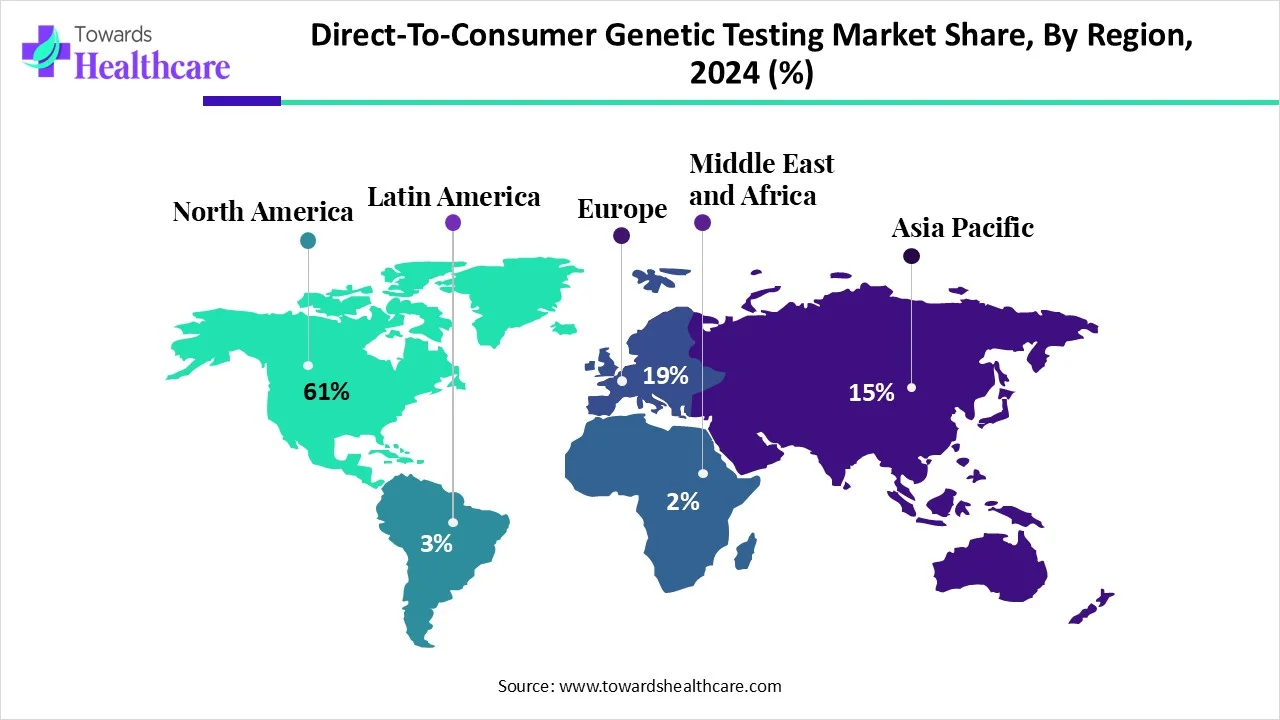
1. North America (Largest Share 61%, 2024)
Key Countries: U.S., Canada
Drivers:
◉ Advanced healthcare infrastructure
◉ Skilled workforce and high-tech laboratories
◉ Government and insurance support for preventive healthcare
U.S. Trends:
◉Expansion of DTC companies
◉ Integration of AI and advanced sequencing for predictive testing
Canada Trends:
◉Rising awareness and adoption
◉Increase in both private and public genetic testing services
2. Europe (Fastest-Growing Region)
Key Countries: Germany, UK, France, Italy, Spain, Sweden, Denmark, Norway
Drivers:
◉Awareness campaigns for early disease diagnosis
◉Growth of genomic research and personalized medicine
◉Technologically advanced healthcare sector
Germany Trends:
◉Increased testing due to rising genetic disorders and preventive healthcare adoption
UK Trends:
◉Growing consumer interest in health management
◉Use of advanced sequencing technologies in DTC testing
3. Asia Pacific (Emerging Growth)
Key Countries: China, India, Japan, South Korea, Thailand
Drivers:
◉Rapidly developing healthcare infrastructure
◉Increasing adoption of advanced diagnostics and sequencing technologies
China Trends:
◉High-throughput genetic screening and precision medicine adoption
India Trends:
◉Government support to make tests affordable
◉Rising prevalence of genetic disorders and growing awareness
4. Latin America (Significant Growth)
Key Countries: Brazil, Mexico, Argentina
Drivers:
◉Rising prevalence of genetic disorders
◉Development of personalized medicine
◉Government initiatives for early screening and awareness
Mexico Trends:
◉Rare Disease Patient Registry shows 71.53% of patients recognized potential genetic origin; 27.77% underwent testing
Argentina Trends:
◉Congenital anomalies affect 1.7% of newborns
◉Around 6,500 clinical laboratories (1,000 public, 5,500 private)
5. Middle East & Africa (MEA – Lucrative Growth)
Key Countries: South Africa, UAE, Saudi Arabia
Drivers:
◉Increasing awareness of genetic disorders
◉Rising research and technological adoption
◉Collaborations between industry and academic institutions
Growth Drivers:
◉Development of advanced DTC platforms
◉Government investments supporting genomic medicine

Get a Sample of this Report
Direct-To-Consumer Genetic Testing Market
