

Endocrine Testing Market Size, Growth, Shares and Key Trends 2025

Market size
Base and near-term values
●2024 market size (reported): USD 2.99 billion.
●2025 market size (reported): USD 3.24 billion.
Long-term projection
●Projected 2034 market size (reported): USD 6.75 billion.
Growth metrics
●Reported CAGR for 2025–2034: 8.54%.
●Absolute projected increase from 2025 to 2034: USD 6.75B − USD 3.24B = USD 3.51 billion additional market value over that period.
Regional weighting (scale & concentration)
●North America: 38% of global revenue in 2024 (dominant single region).
●Asia-Pacific: fastest growing region (no single % provided, but called out as highest CAGR region).
Major revenue drivers inside headline numbers
●Instruments & reagents accounted for 65% of market revenue in 2024 (largest revenue stream).
●Clinical & hospital laboratories accounted for 58% of end-user revenue in 2024 (largest end-user channel).
●Automated immunoassays comprised 52% of assay/platform revenues in 2024 (largest technology share).
●Diagnostic & monitoring of thyroid & diabetes comprised 60% of indications revenue in 2024 (largest indication group).
●Thyroid function tests alone were 38% of test-type share in 2024 (single most dominant test family).
Concentration / structure
●The market shows high instrument + reagent dependency (65% revenue share) — implying recurring consumable sales dominate monetization.
●Large labs/hospitals are primary buyers (38% regional + direct OEM sales dominance), indicating centralized procurement and long OEM relationships.
Market trends
Rising disease prevalence and screening expansion
●Diabetes and thyroid disease continue to drive baseline testing volumes (cited IDF 2025: 11.1% of adults 20–79 have diabetes; many undiagnosed), which supports routine testing demand and chronic monitoring volumes.
Shift to automation and high-throughput platforms
●Automated immunoassays held 52% share in 2024 — labs are consolidating around automated analyzers to handle large volumes, reduce TAT, and standardize results.
LC-MS/MS adoption for specialty assays
●Laboratory mass spectrometry (LC-MS/MS) marked as the fastest-growing assay platform, driven by demand for high specificity in steroid and low-level hormone panels.
Commercial models moving toward services
●Growth in contract testing/reference lab services and lab-as-a-service/send-outs—these service models are the fastest-growing revenue streams and distribution channels, allowing smaller clinics to access advanced assays without capital spend.
POC and at-home testing emergence
●Point-of-care glucose and at-home hormone tests (examples in the content) are expanding the testing universe beyond the lab and creating new consumer revenue channels.
Inorganic growth and partnerships
●M&A and partnerships (e.g., the Norman Parathyroid Center partnership) are being used to expand test access and referral flows quickly.
Funding into consumer/remote hormone testing
●Startups raising seed and pre-seed rounds (Hormona, Level Zero Health, Eli Health) show investor interest in remote monitoring, DNA/sensor technologies, and consumer-facing hormone tools.
Regulatory activity enabling new tests
●FDA 510(k) clearances (example: chemiluminescence free testosterone assay) enable faster clinical uptake of newer, faster assays.
Reimbursement and policy remain pivotal
●Favorable reimbursement in developed markets (cited for North America) continues to sustain higher per-test revenue and tech adoption.
AI impact / role
AI-assisted result interpretation and decision support
●Subpoint: Algorithms can analyze multi-analyte patterns (e.g., combinations of TSH, free T4, antibodies) to flag likely disease states or borderline results.
●Explanation: This reduces clinician diagnostic uncertainty, creates standardized interpretative comments, and minimizes follow-up testing due to ambiguous reports.
Automated QC and anomaly detection
●Subpoint: AI monitors instrument telemetry and assay performance to detect drift, lot issues, or pipetting anomalies in real time.
●Explanation: Proactive QC reduces false results, lowers repeat testing rates (cost saving), and supports laboratory accreditation efforts.
High-throughput data processing for LC-MS/MS
●Subpoint: Machine learning accelerates deconvolution of complex spectral data and improves peak integration for low-abundance hormones.
●Explanation: Improves sensitivity/specificity of steroid panels and reduces manual review time for mass spec results.
Predictive analytics for population screening
●Subpoint: AI models can combine historical lab data, demographic risk, and clinical notes to prioritize patients for targeted endocrine screening (e.g., undiagnosed diabetes or hypothyroidism).
●Explanation: In public health programs, this increases yield per screening dollar and helps allocate resources more efficiently.
Workflow orchestration & lab automation
●Subpoint: AI optimizes sample routing between automated analyzers, LC-MS/MS instruments, and send-out labs to minimize TAT and reagent wastage.
●Explanation: Especially valuable for labs operating hybrid automated + specialty workflows.
Personalized reference ranges & longitudinal trend detection
●Subpoint: AI builds individualized baselines from longitudinal hormone data (e.g., cyclical reproductive hormones) and flags meaningful deviations.
●Explanation: Reduces false alarms from single point testing and improves infertility or endocrine disorder management.
Integration with wearables and remote monitoring
●Subpoint: AI fuses periodic lab tests with continuous physiologic streams (sleep, HR variability, activity) to infer endocrine stressors (e.g., cortisol dynamics).
●Explanation: Enables novel remote monitoring services and chronic disease management products.
Clinical trial support & biomarker discovery
●Subpoint: Unsupervised learning to discover new endocrine biomarkers or composite indices predictive of disease progression or therapy response.
●Explanation: Creates upstream R&D value, boosting assay development pipelines.
Revenue & business model transformation
●Subpoint: AI enables value-based testing (predictive algorithms that reduce downstream costs) and subscription/monitoring services tied to automated interpretative reporting.
●Explanation: Shifts some spend from one-time tests to ongoing analytics services—aligns with instruments & reagents dominance (consumables) plus software/licensing revenue.
Regulatory, validation, and explainability challenges
●Subpoint: AI models used clinically need documented performance, transparency, and post-market monitoring—regulatory pathways are evolving.
●Explanation: Labs and vendors must invest in clinical validation, explainability tools, and data governance to deploy AI at scale.
Data privacy & interoperability concerns
●Subpoint: Combining lab results with EHR and wearables requires secure data exchange, consent models, and standardized APIs.
●Explanation: Failure to address privacy impedes adoption and may limit payer reimbursement for AI-enabled services.
Operational risk reduction
●Subpoint: AI can predict supply chain shortages (e.g., critical reagents) and recommend substitutions or schedule changes.
●Explanation: Helps labs avoid downtime and ensures continuity for high-volume endocrine tests.
Regional insights
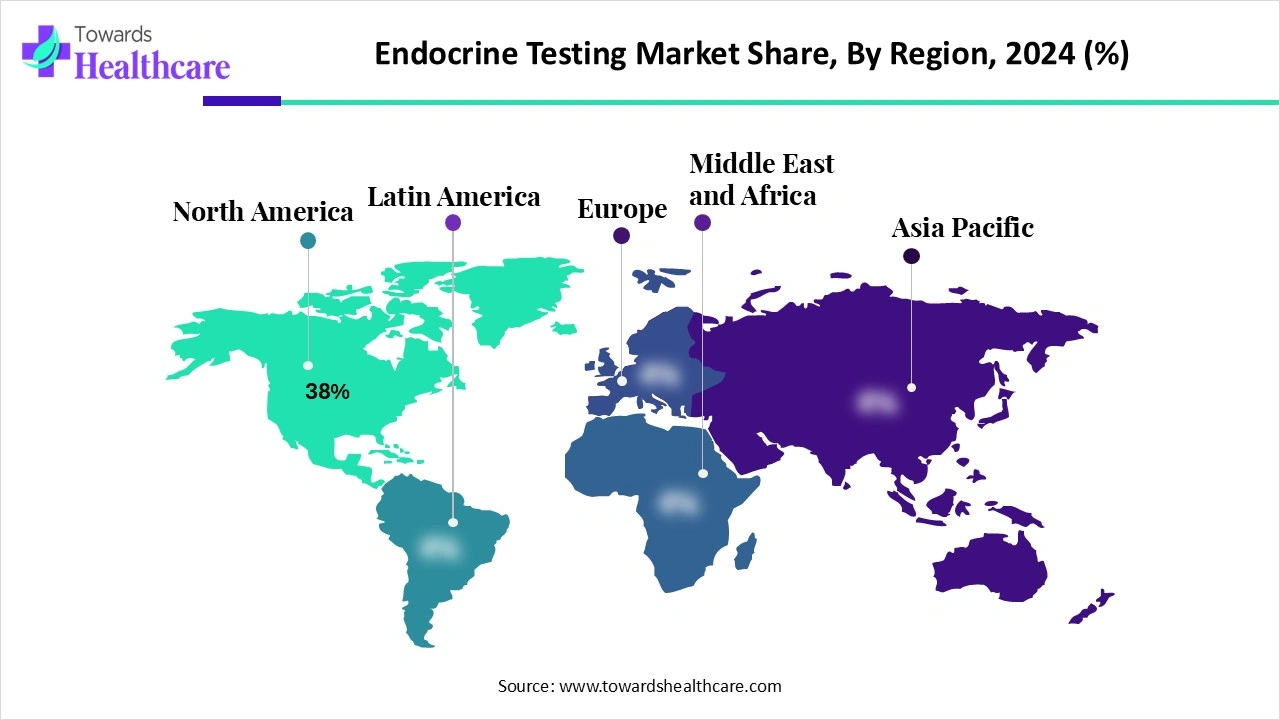
North America (dominant; 38% share in 2024)
Market structure & drivers
●Large hospital systems and clinical labs with centralized procurement favor OEM direct sales and long-term service contracts.
●Reimbursement frameworks and public health programs (e.g., diabetes screening programs) sustain high per-capita test volumes.
Technology adoption
●High penetration of automated immunoassay platforms (52% share) and rapid adoption of LC-MS/MS for specialty assays.
Commercial implications
●Vendors prioritize instrument availability, on-site service, and reagent contracts; reference labs (LabCorp, Quest, ARUP) absorb complex send-outs.
Regulatory/innovation environment
●FDA clearances (example: free testosterone chemiluminescence assay) speed clinical adoption.
Asia-Pacific (fastest growth region)
Demand drivers
●Rising diabetes and thyroid disease prevalence, expanding healthcare infrastructure, and greater disposable income.
Market dynamics
●Significant upside for OEMs through distributorships and localized service networks; labs move from manual to automated platforms.
Country subpoints
●India and China: large addressable populations and increasing screening programs; early adopter hospitals in metros drive premium test uptake.
Challenges
●Variable reimbursement, fragmented lab networks, need for training & workforce development.
Europe
Health system diversity
●Mix of public and private provision; centralized procurements in some countries (e.g., NHS in UK).
Technology & R&D
●Strong clinical research networks and adoption of high-specificity assays; emphasis on quality and interoperability.
Latin America and MEA
Access & growth
●Lower baseline per-capita testing but high growth potential where screening programs are scaled.
Barriers
●Infrastructure, reimbursement limits, and workforce shortages slow adoption of advanced assay platforms.
Country specifics highlighted in content
United States
●High disease burden (CDC figures cited in content) and supportive programs such as NDPP; major purchasing power and high lab automation.
Canada
●Rapid expansion of POC and digital health tools; provincial health programs support preventive screening.
Market dynamics
Drivers
High prevalence of endocrine disorders
●Diabetes prevalence (IDF 2025: 11.1% of adults 20–79) and large numbers with thyroid disease support sustained testing demand.
Government screening & preventive programs
●Screening programs push routine testing volumes (noted as a key driver).
Technology advancements
●Automated immunoassays and LC-MS/MS increase throughput and diagnostic accuracy.
Recurring consumable revenue
●Instruments & reagents account for 65% of revenue, creating stable vendor cash flow.
Restraints
Shortage of skilled laboratory operators
●Limits capacity to adopt complex assays and to scale LC-MS/MS despite technical need.
Regulatory hurdles
●Lengthy approvals delay commercialization of new assays and AI tools.
Reimbursement limitations in some countries
●Limits patient access and dampens demand growth in markets without favorable coverage.
Opportunities
Reference/Contract testing growth
●Outsourcing provides access to advanced assays without heavy capital outlay; fastest growing end-user segment.
Infertility & reproductive endocrinology
●Reproductive hormone tests are fastest-growing test type due to infertility trends and ART uptake.
AI-enabled services and remote monitoring
●Creates new service layers (analytics/subscriptions) and improved disease monitoring.
Point-of-care and consumer testing expansion
●At-home cortisol/progesterone and POC HbA1c/glucose broaden market reach.
Top companies
Roche Diagnostics
●Product: Automated immunoassay analyzers, reagent kits, integrated lab automation.
●Overview: Market leader in high-throughput immunoassays; large installed base in hospitals and reference labs.
●Strengths: Strong reagent lifecycle (recurring revenue), global service network, broad assay menu (thyroid, diabetes, reproductive panels).
Abbott Diagnostics
●Product: Lab and point-of-care platforms (immunoassays, POC glucose/HbA1c), reagents.
●Overview: Dual strength in lab systems and POC solutions; strong presence in decentralized testing.
●Strengths: POC leadership, established reagent supply chain, diversified diagnostics portfolio.
Siemens Healthineers
●Product: Clinical chemistry and immunoassay analyzers, connectivity solutions.
●Overview: Major supplier to hospital labs; strong systems integration and service offerings.
●Strengths: Enterprise contracts, integration with hospital IT and LIS.
Beckman Coulter
●Product: Immunoassay analyzers and diagnostics reagents.
●Overview: Focus on clinical lab instrumentation and assay chemistry.
●Strengths: Robust analyzer platforms, built for high throughput labs.
Ortho Clinical Diagnostics
●Product: Immunoassay systems and reagents.
●Overview: Known for chemiluminescence and immunoassay test menus.
●Strengths: High throughput workflows and trusted assays for endocrine analytes.
Thermo Fisher Scientific
●Product: LC-MS/MS instrumentation, sample prep solutions, lab supplies.
●Overview: Strong in mass spectrometry and specialty testing instrumentation.
●Strengths: Technical leadership in LC-MS/MS (key for steroid and low-abundance hormone assays).
Agilent Technologies
●Product: Mass spectrometers, chromatography systems, lab consumables.
●Overview: Supplier to labs requiring high-sensitivity mass spec and separation technologies.
●Strengths: Analytical performance and support for research/clinical labs.
Waters Corporation
●Product: LC and mass spec systems optimized for clinical and research mass spec assays.
●Overview: Specialist in separations and MS workflows for endocrinology assays.
●Strengths: High-quality LC-MS workflows for steroid panels and specialty assays.
Bio-Rad Laboratories
●Product: Controls, calibration materials, some immunoassay reagents and QC products.
●Overview: Supplies many labs with QA/QC and reagent products that support endocrine testing reliability.
●Strengths: Strong reputation for controls and quality materials.
Other important players
●Tosoh Bioscience, Snibe/Mindray, Fujirebio, QuidelOrtho (assay suites), LabCorp, Quest Diagnostics, ARUP — collectively create the testing & reference lab backbone.

Get a Sample of this Report
Endocrine Testing Market
